
© Bill Alexander 2011
On September 10, 1939, Canada declared war on Germany. As a nation at war, the roles and functions of the Royal Canadian Mounted Police were critical for national security and the safety of the state. Despite the need for a trained and competent police force within Canada, many members of the R.C.M.P. wished to serve with the forces and sought leave to resign and enlist in one of the armed services. The government emphasized the need for the trained members of the R.C.M.P. for the defence and security of Canada, but allowed the national police force to field a “representative unit to be recruited from the R.C.M.P.” This unit was mobilized as No 1 Provost Company (Royal Canadian Mounted Police). It was assigned to 1 Canadian Infantry Division (1 CID), to carry out the roles and duties of the Canadian Provost Corps in that formation for the duration of the war.
No 1 Provost Company (RCMP) embarked for the United Kingdom in December of 1939. For the next 3 ½ years the Company performed duties typical of the provost. Discipline within the division and learning and applying the skills of war occupied the unit during those years in Britain.

In 1943, 1 Canadian Infantry Division landed in Sicily and No 1 Provost Company (RCMP) deployed on war service. For the next year and a half, No 1 Provost Company fought with the regiments of 1 CID through Sicily, the invasion of Italy and in the campaign up the Italian peninsula. In early 1945, with the rest of 1 Canadian Corps[1], No 1 Provost Company was transferred from Italy and re-united with the First Canadian Army in Northwest Europe. Here, No 1 Provost Company participated in the campaign to liberate Holland and in the final drive into Germany.
The Cloth Insignia.
No 1 Provost Company was recruited from the R.C.M.P. and wore badges and insignia indicating their R.C.M.P. affiliation throughout the war. The officers and men of No 1 Company were provided with the standard metal cap badge of the R.C.M.P. for their headdress. However, a variety of unique shoulder titles and brassards were obtained and worn on the battledress and summer issue uniforms and armlets. Some of titles were officially approved and issued for wear, while others have no official authorization. A catalogue of the major patterns of cloth shoulder insignia worn by No 1 Provost Company (RCMP) follows:
- RCMP tablet pattern title. In the fall of 1939 No 1 Canadian Provost Company was authorized to wear RCMP insignia. Under this authority, No 1 Coy C Pro C obtained small red on black embroidered titles reading RCMP and brassards reading RCMP. Photographic evidence indicates that the tablet pattern of RCMP title was obtained in Canada and worn before the Company embarked for overseas. Subsequent issues were acquired in the United Kingdom. The titles are rectangular in shape, approximately 2 ½ inches long by 1 inch high, red on black. These titles were replaced by the fully spelled out title. Photo evidence from the time period indicates that the title was worn in combination with the brassard reading R.C.M.P.

- Royal Canadian Mounted Police, red embroidered on black, fully spelled out title. Various patterns exist. Archive documentation indicates that these were authorized July 13, 1942. It is not certain when the titles were actually obtained for issue and the varieties of these titles extant, suggest that there were several makers and / or several issues purchased. The members of No 1 Provost Company may also have privately purchased their examples. A DND Memorandum dated August 14, 1944 notes that long style titles for the Royal Canadian Mounted Police had never been provided in Canada.

- Royal Canadian Mounted Police red flocked (painted) on black felt. Flocked pattern titles are scarce and evidence suggests that flocked pattern titles were made in Canada. Though similar to the approved pattern of shoulder title the flocked issue had a red border incorporated in the design which was not found in the approved embroidered and printed patterns. These titles are unofficial and no approval has been found. The Canadian government considered adopting flocked pattern titles but found them to be unsuitable for use.

- Royal Canadian Mounted Police, printed pattern canvas title, first issued early in 1943. Subsequent printings were made through the end of the war. Printed titles were authorized by the Canadian army in late 1942, but it would be over two years before all units of the Canadian Army overseas would get their issues. Some units of 1 Canadian Infantry Division were issued printed titles before embarking for Sicily.

- RCMP armband. The armbands are made with red cloth letters sewn on a heavy black cotton armband. The first issue was acquired in Canada, and subsequent issues were likely purchased in the U.K.

- Not illustrated. Armlets can be found with the Royal Canadian Mounted Police (spelled out title) over the 1 CID patch on khaki drill material. Various rank badges can be found on these as well. These were worn with the summer issue uniforms in Italy.
- There has been some confusion with the R.C.M.P. titles, black embroidery on red. That pattern of title was worn by the Royal Corps of Military Police and was never authorized for, issued to, or worn by No 1 Provost Company (R.C.M.P.).


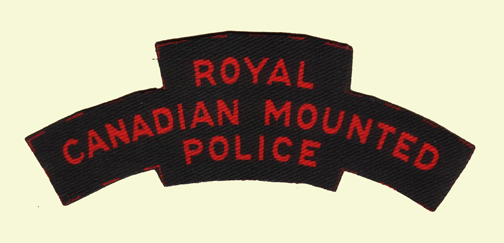

This provides an overview of the main patterns of cloth unit insignia worn by No 1 Provost Company (R.C.M.P.) during the Second World War. Corrections or additions are welcome.
References
- Canadian Military Police Virtual Museum, http://mpmuseum.org/index3.html.
- Nicholson L.H. Battle-dress Patrol No.1 Provost Company (R.C.M.P.) 1939-1945. Access to History Publications, Ottawa, 1992.
- Hill C.H. Lt.-Col., D.P.M. CMHQ, Letter: Shoulder Patches, to B.G.S. (Cdn). VII Corps, September 19, 1940. RG 24 Vol 10040 to Vol 10056.
- Memorandum Department of National Defence HQS 8700-1, DOS. (GS). July 13, 1942. Library and Archives Canada RG 24.
- Memorandum, Department of National Defence HQS 8700-1 Vol. 2. DOS GS. 14th August, 1944. Library and Archives Canada RG 2
- Bill Alexander. Copyright 2009.
[1] 5 Canadian Armoured Division had landed in Italy in late 1943, and with 1 CID had formed 1 Canadian Corps. The transfer of 1 Canadian Corps from Italy to NW Europe was code named Operation Goldflake.
by Clive M. Law
Although many Canadians of a certain age may remember the fierce flag debate of the early 1960’s few are aware that the Canadian search for a national flag that pre-dates the selection of the modern version.
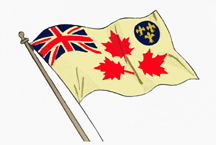
Coloured interpretation of the Canadian Army ‘Battle Flag’.
In 1926, Colonel A. F. Duguid, DSO, Director of the Historical Section and author of the official history of the Canadian Expeditionary Force, submitted a design to the Deputy Minister of National Defence for a national flag. No action was taken at that time by the Deputy Minister and the first attempt at a national flag was quietly set aside by the government of the day.
At the outbreak of the Second World War, and following Canada’s decision to embark troops for overseas, it was decided by the Army that a flag was required which would suitably identify the Canadian Active Service Force (CASF). However, it was decided by the Prime Minister that the Union Jack, then the official Canadian national flag for Canada, would continue in use although the Red Ensign would be flown at Canadian establishments in the UK in order to identify the Canadian contribution to the war.
Nonetheless, Duguid’s design was resurrected and its use was recommended by then Major-General Andrew McNaughton as the identifying flag of the senior formation of the CASF in his 27 November 1939, letter to the Minister of National Defence. In describing the flag McNaughton referred to a memo by Duguid which outlines the design as including “three maple leaves proper, conjoined on a white field, the correct device for Canada. Great Britain is represented by the union, in a canton next to the staff. Old France is represented by three gold fleur-de-lis on a blue background, within a circle. The latter device indicating ‘an ancient and honourable connection’ ”. All of the elements of the flag were adapted directly from the Armorial Bearings of Canada as assigned by Royal Proclamation of 21 November 1921, and were in keeping with the rules of heraldry. The design was approved by the Cabinet and Militia Councils on 7 December, 1939.
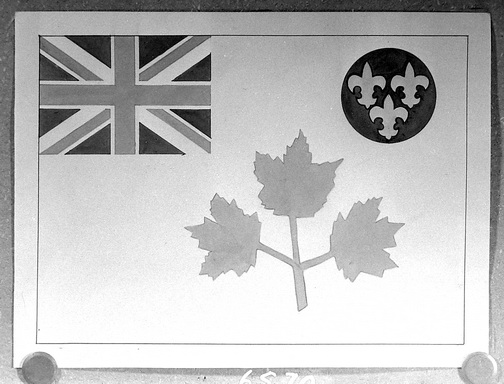
Colonel Duguid’s original drawing, submitted in the 1920’s as the Canadian national flag to replace the Union
When the 1st Canadian Division sailed for England in December, 1939, the flag was flown from the ship carrying the Divisional Commander with the approval of the Admiral in charge of the movement. During this voyage it was consecrated in mid-Atlantic. On 24 January 1940, the flag, which had unofficially become known as the Canadian Battle Flag, was flown at the Royal review of the 1st Canadian Division where the King expressed approval of the design and accepted a miniature replica presented to him by the Divisional Commander.
As the flag was always intended to be flown by the Commander of the senior CASF formation – often known as the Senior Combatant – it had been predicted that, should a Canadian Corps be formed, the flag would pass to that Commander. Ultimately, the Canadian forces overseas grew to an Army and it was the Army Commander who held the flag. In fact, when McNaughton handed over command of the First Canadian Army to Lieutenant-General Harry Crerar, in January 1944, he sent the flag with a short memo which stated “On relinquishing Command of the First Canadian Army I hand over to you the Canadian Army Flag with my very best wishes to you and all who serve under your Command.”
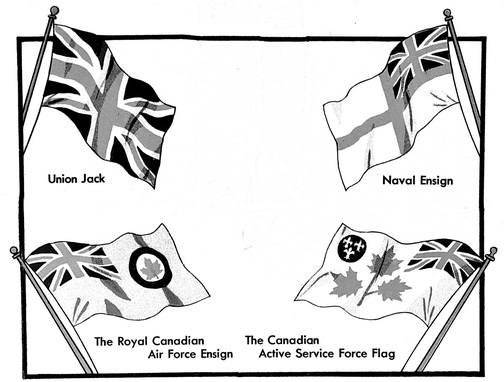
This war-time drawing demonstrates that the flag was considered as the ‘Army’ flag and is shown here alongside the Union and the RCN and RCAF flags.
Little is known of the whereabouts of the original flag although many examples were produced, in a variety of sizes. The design was often used in Canadian Army publications and the author holds examples of the flag on a Christmas card as well as on a match-book cover. Photos of the flag in use, as well as photos of the flag itself would be welcomed.
Library and Archives Canada, Record Group 24, Volume 1882, File HQ-9-8-3 and HQ-54-27-91 (various folios)
By Roger V Lucy
From 1957 to 1960 a Canadian squadron of Ferret scout cars served as part of the United Nations Emergency Force (UNEF) which separated the Israelis from the Egyptians in the Sinai and Gaza Strip after the 1956 Suez Crisis. UNEF was the brain-child of the Secretary of State for External Affairs, Lester B. Pearson, and was commanded by Canadian Major-General E.L.M. (“Tommy”) Burns. The Canadian contribution comprised a Royal Canadian Corps of Signals (RCCS) signals squadron, a Royal Canadian Electrical and Mechanical Engineers (RCEME) Workshop, two Royal Canadian Army Service Corps (RCASC) transport platoons, and 56 Canadian Reconnaissance Squadron, a composite unit drawn from the Royal Canadian Dragoons and Lord Strathcona’s Horse, which served with UNEF from March 1957 to January 1958. The Squadron had an establishment of 105 men and 29 Ferrets.

Fort Garry Horse Ferret ca.1960. Note the AoS number ’53’.
Subsequent rotations were drawn from 8 Canadian Hussars ((CH) January 1958 to January 1959); the Royal Canadian Dragoons ((RCD) from January 1959 January 1960); and the Fort Garry Horse ((FGH from January 1960 to January 1961). The Ferrets were withdrawn in August 1960 and replaced by jeeps. The Canadian contingent was withdrawn in 1966.

An M1 helmet liner used by a Royal Canadian Dragoons corporal serving with UNEF’s Canadian Reconnaissance Squadron, that served in the Sinai and Gaza in 1959. Author’s collection.
The Ferrets were painted white and bore, on their left front and right rear fenders, an Arm of Service (AoS) flash in the red and yellow colours of the Royal Canadian Armoured Corps (RCAC). Each rotation bore a different number superimposed on the flash: 56 for 56 Recce Squadron, 52 for the 8 CH squadron; 50 for the RCD Squadron and 53 for the FGH squadron.
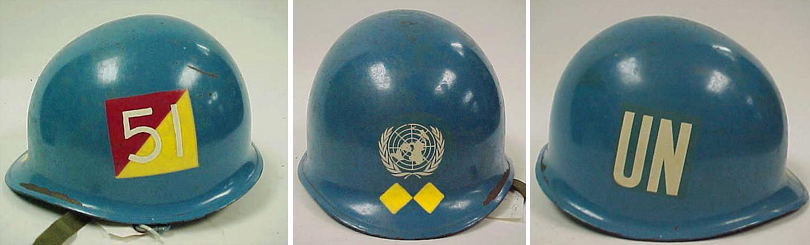
An M1 steel helmet worn by a Lieutenant of an unidentified Canadian RCAC unit forming the UNEF Recce Squadron. Canadian War Museum
Approved UN headdress consisted of either blue berets, blue Canadian field caps or blue US M1 helmets. The helmets were obtained from a US depot in Livorno, Italy, and were issued to the Canadian contingent as they passed through Naples airport. The helmets were painted blue with a white decal bearing the UN’s emblem (a globe in a laurel wreath) in the front and the letters UN at the sides. However, some at of the Recce squadrons’ helmets owners also painted their units’ AoS flash on the left and their rank badge at the front. Illustrated here are two examples of M1 helmet liners worn by the RCD Squadron in 1959, one by a corporal, the other by a Captain. There is also an example in the Canadian War Museum, worn by a 1st Lieutenant complete with its steel outer body. Its AoS flash bears the number 51. Both of the RCD liners are of a pattern produced between 1950 and 1954, and may well be part of the batch issued in Naples, as this type of M1 was not procured by the Canadian Army.[1]
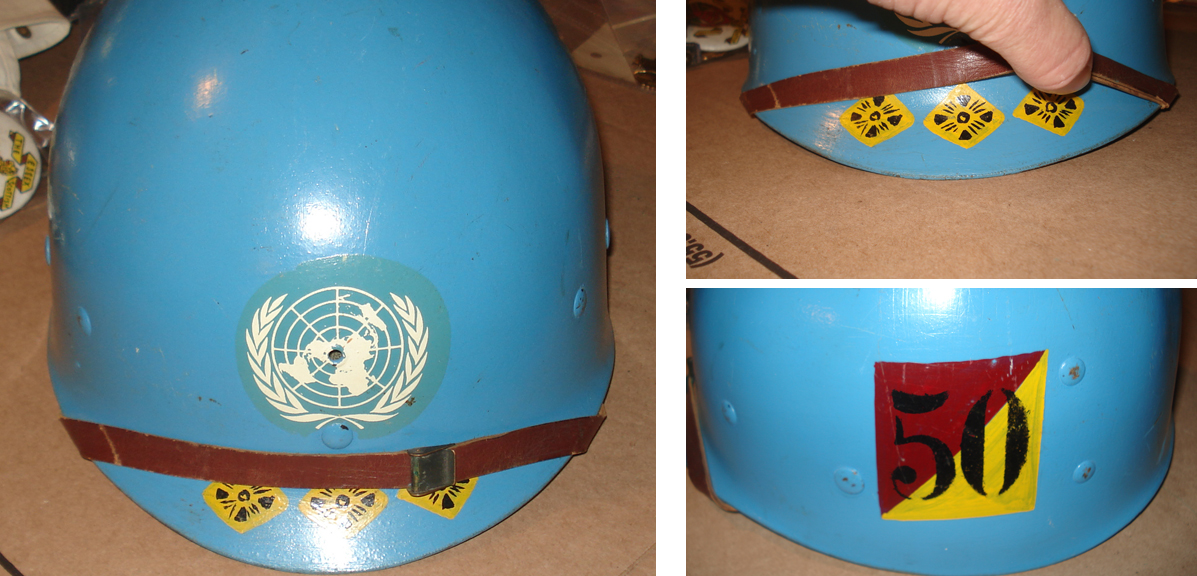
This liner was worn by an RCD Captain with the same contingent. Dean Owen collection.
[1] DND Department of History and Heritage (DHH) AHQ Report No..94, page 28
by Roger V Lucy
The Rota-trailer was a British design, intended to provide armoured units with additional supplies of ammunition and fuel by towing them in a two-wheeled trailer behind their tanks. Successful trials of the initial version, the Rota-tank, were undertaken at the British Directorate of Tank Design’s (DTD) Wheeled Vehicles Experimental Establishment (WVEE) at Farnborough, in January 1942. By May a contract had been placed with a British firm, Tecalemite, to produce Rota-trailers for the British War Office.
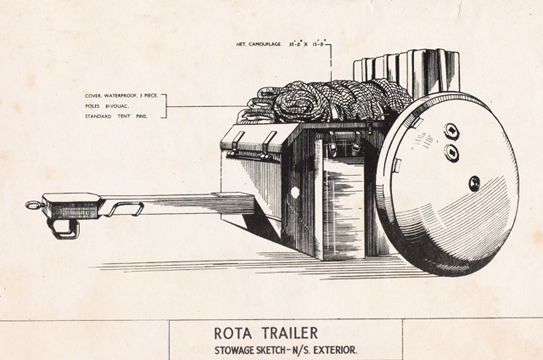
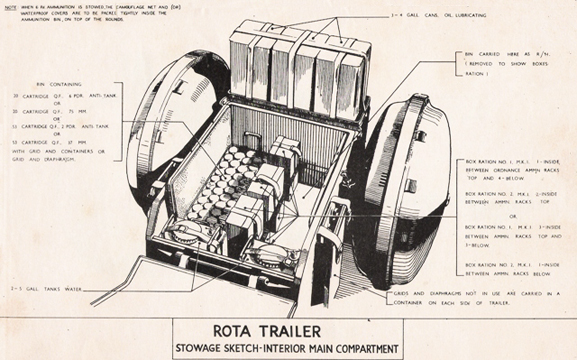
The Rota-trailer comprised two cylindrical drums, with tires, which formed the wheels; held together by a central framework comprising the axle, platform box and towing bar. Ammunition (or other supplies) was carried in the platform box and fuel in the hollow wheels, each of which held 60 imperial gallons (300 litres). The platform box could carry 900 rounds of small arms ammunition (.303 or Besa) and either 106 2-pounder or 37mm rounds; or 40 6-pounder or 75mm rounds. Additionally it carried lubricating oil (30 litres), water (50 litres) and seven ration boxes. Overall it was 3.1 metres long, 1.9 metres wide and 0.96 metres high. Its unladen weight was 1.6 metric tonnes, its gross weight 2.6 tonnes. Each unit cost about £200 (about $1,000 at the exchange rate of that time).
Based on the British War Office’s policy, First Canadian Army directed on 2 September 1942 that all its tanks should be fitted with a towing attachment with a quick-release hook that could pull a Rota-trailer. Trials using Canadian Ram tanks to tow the Rota-trailer were undertaken by 5th Canadian Armoured Division. In normal training the trailer itself stood-up well. Except in extreme conditions (such as steep muddy slopes) towing a Rota-trailer did not affect the Ram’s performance nor did it appreciably increase fuel consumption. Initially it was proposed that one trailer be issued to each troop (three tanks) or six per squadron, bringing the estimated Canadian requirements to 300-400 trailers. As the British could provide the Canadian Army Overseas (CAOS) with 20 Rota-trailers a week, from their own production, Canadian Military HQ’s (CMHQ) preference was to procure its Rota-trailers locally.
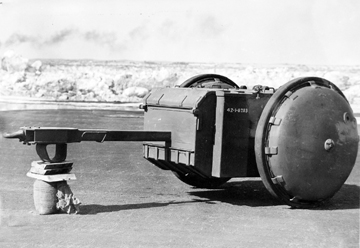
Canadian-made Rota-trailer. Note the DND number 42-1-8283
However, in the event that Canadian production might be required, CMHQ sent a set of plans and drawings to Ottawa, in July 1942, followed by a complete Rota-trailer shipped at the end of August. The Canadian Department of Munitions and Supplies (DM&S) used these to build a pilot version which was ready in November. By then, the proposed scale of issue for Rota-trailers had increased to one for each tank, bringing the requirement to 1,140. The War Office offered to provide the CAOS with 30 to 40 a week from British production. In Canada DM&S estimated that within three months of its receiving the go-ahead it could have the Rota-trailer in production in Canada.
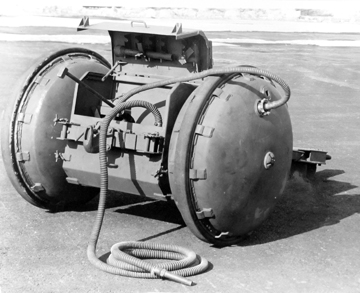
By January 1943 CMHQ had decided to bid for 600 British-made Rota-trailers for use with the Ram, while DM&S would contract for 1,350 for use with its planned production run of the Grizzly (M4A1). An initial order for 500 Rota-trailers was placed under Contract Demand LV1704. According to DM&S Design Record, a single pilot was built, incorporating a number of modifications to make it sturdier. [i]
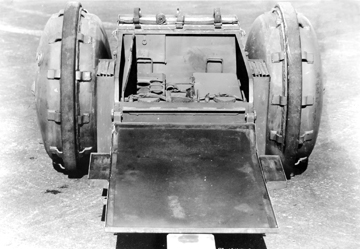
In actual operations the Rota-trailer proved less robust than advertised. Towing the trailer placed considerable stress on the tow-bar, which needed to be strengthened, and on the tank’s towing hook and its attachment to the hull. Cases were known of trailers being turned upside-down as they bounced along – completely bending the hook out of shape. A specially designed towing hook was required.[ii]
By April 1943, the Rota-trailer was about to enter production in Canada, based largely on the original British No.1 Contract design. By then, the British had made a number of design changes to rectify the various weaknesses revealed by actual service conditions. Various parts were reinforced, the trailer lid was raised by 10cm to accommodate 6-pounder and 75mm APCBC ammunition, and the standard British 2-gallon oil and water canisters were replaced by jerricans. These modifications were not incorporated in the first batch of British Rota-trailers received by the CAOS, which had racks only for 2-pounder or 37mm ammunition. Production in Canada was put on hold until the design changes could be passed back to DM&S. In April CMHQ asked the DTD for a copy of the plans and drawings of the changes, and for an example of one of the 50 pilot No.2 Contract Rota-trailers that, it understood, were being built by Tecalemite. The War Office, however, refused to finalize the design, pending the results of large-scale trials planned for September. It did not expect the redesigned trailers would be in service before 1944. These delays made DM&S uneasy, as its contractor’s production facilities were tied-up pending release of the final design. Some parts had already been fabricated for the Canadian trailers and major design changes could render them obsolescent. CMHQ tried to reassure DM&S that the design of the wheels, bearings, axles and main components would not be affected, but no revised pilot was likely to be available before mid-October 1943. By then the trials had shown the Rota-trailer’s problems could not be fixed and that it was tactically and mechanically unsatisfactory. On 29 October, CMHQ advised DND that Rota-trailers were no longer a CAOS requirement and on 3 November 1943, DND’s Director of Mechanization asked the Secretary of DM&S, to cancel the order.[iii]
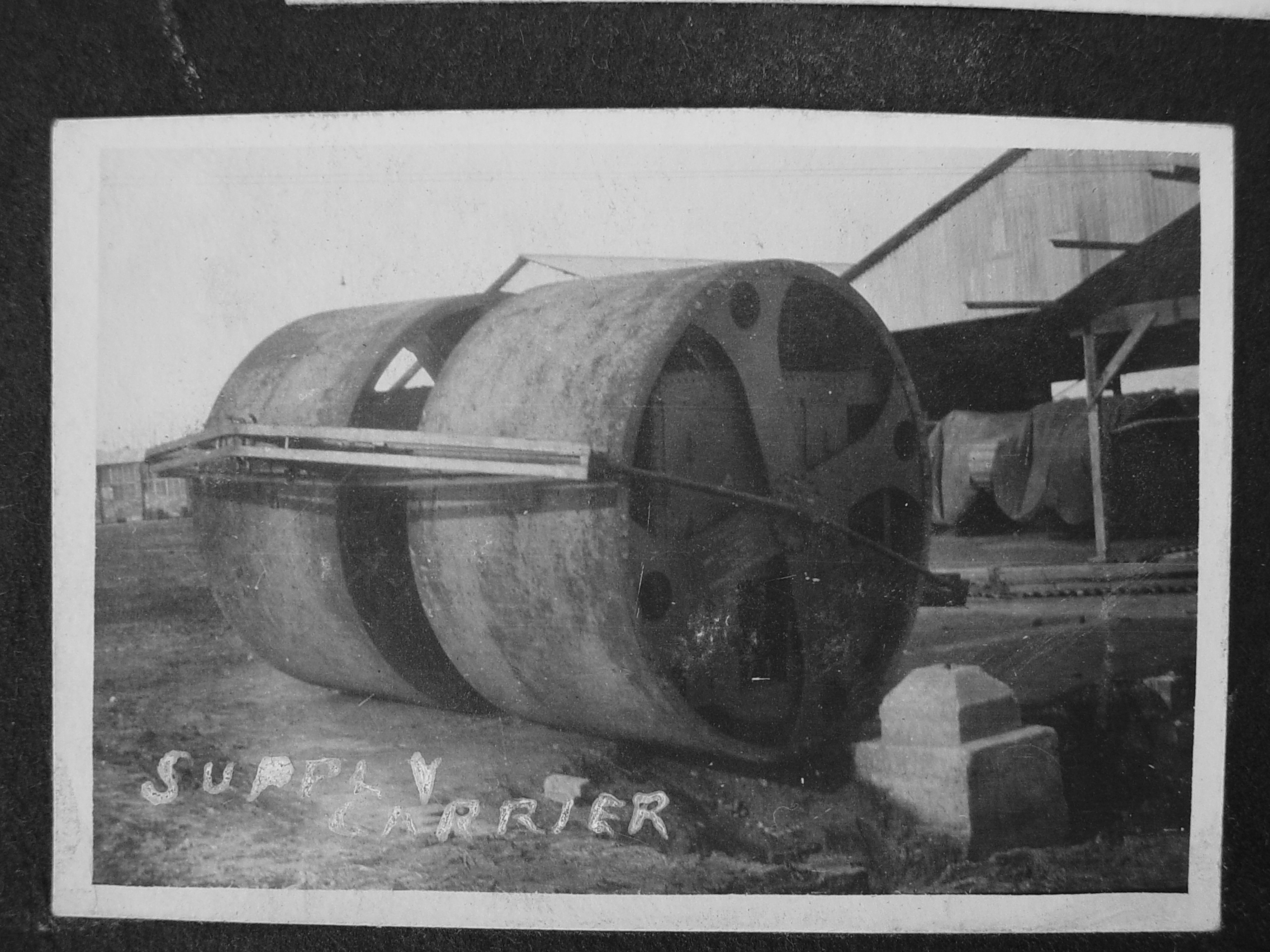
Editor’s note – The following photograph was recently discovered and shows a similar item dating from the First World War. This dates from October-November, 1918. The photo was taken at Bovington, in the UK.
[i]. LAC RG24, volume 9364, file 38/ARM VEH/26, DM&S, Design Record, Volume III, History of Tanks in Canada page 2.
[ii].idem, LAC, RG24, reel C-5778, file 55/621 /T24; CWM, Box 21, DMS report E301.
[iii]. LAC RG24, volume 9364, file 38/ARM VEH/26
You can rate this article by clicking on the stars below.
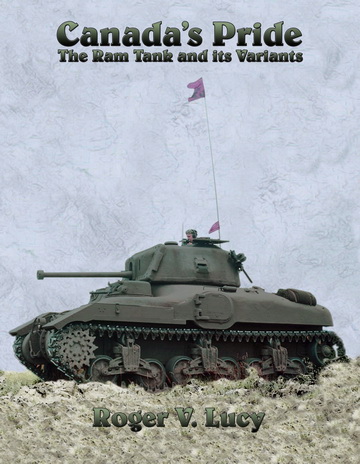
You can read more about the Ram tank by ordering the author’s book “Canada’s Pride” available from Service Publications
by Mike Kennelly
The journey to document the various Second World War examples of shoulder titles to this storied French Canadian Régiment is my homage to the service my Grandfather rendered with them from 1940-1945. He was among a considerable cadre of Acadians from New Brunswick who served with great distinction in the Canadian Active Service Force (CASF) for them.
A brief historical overview will provide some contextto the shoulder title discussion. During the Second World War it was one of a few that fielded 3 Battalions. The CASF Régiment was known as Le 1er Battalion (Sept. 39-June 45), The Canadian Army Occupation Force(CAOF) Régiment was known as Le 3e Battalion (June 1945-April 1946), and stationed back in Canada as a Reserve was Le 2e Battalion(1940-1946)1a. Both the CASF and CAOF Battalions had a full complement of Other Ranks and Officers. The Reserve Battalion was made up mostly of overage and underage volunteers who committed generally one night a week for service, it comprised only 11 Officers and 174 Enlisted Ranks at its zenith in October 19451b.
The first iteration of Shoulder Titles for the CASF Régiment came in the form of the trapezoid shaped Worsted Titles and Khaki Drill slip-ons. I have noted at least 2 distinct examples of Worsted Titles, with the difference namely in the thickness of the black thread. Both of these Titles were worn by the CASF from early 1940 until approximately July 1941 when they departed for the United Kingdom (U.K.). The CAOF force did not have occasion to wear either of the Titles, however The Reserve Battalion did wear them from 1942-45 as this was the only authorized pattern worn by the Reserve Army 2.
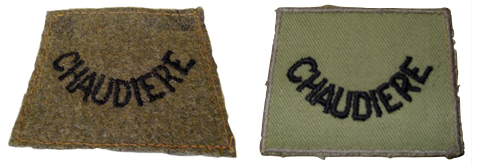
Left, Worsted Title – Author’s Collection.
Right, Khaki Drill – Bill Alexander Collection
The colours of the shoulder titles have a unique genesis. The shoulder title colours in addition to the colours of the helmet decal and the Coloured Field Service Cap (CFSC) were Maroon, Silver (White) and Scarlet. These were chosen out of tradition and respect for the colours of the outer vestments worn by high ranking Catholic Canadian Clergy when they attended Papal Conclave’s (meetings). In the writings of Captain (Padre) Turmel, it indicates that the colours were specifically out of respect to His Eminence, Cardinal and Archbishop of Quebec City Jean-Marie Rodrigue-Villeneuve. He actively helped recruit men in the spring/summer of 1940 from the rural areas of Quebec. The choice was well received as many were practicing Catholics, 3, 4, 5, 6.
April 1941 saw thempurchase 500 pairs of their first coloured embroidered melton wool titles at .24 cents per Title 7. This low purchase number is striking in that at the time there were 908 Officers and Other Ranks as detailed by a medical examination board document that was prepared for their journey to the U.K. in July, 19418.The other 2 Regiments in the 3rd Infantry Division (8th Brigade) also purchased titles at the same time; their purchases comprised a much larger order. The North Shores from New Brunswick ordered 1794 pairs, and the Queen’s Own Rifles from Toronto ordered 2000 pairs. One possible explanation for the low order is that the Chaudière may not have been in a financial position to purchase a pair for each member due to the requirement at the time to pay for them out of Regimental funds9.Known examples of Canadian, British and private purchase embroidered titlesfor the CASF from 1941- 1945 are showcased and highlighted. The author welcomes submissions of embroidered titles not presented that are believed to be Second World War (SWW) vintage.
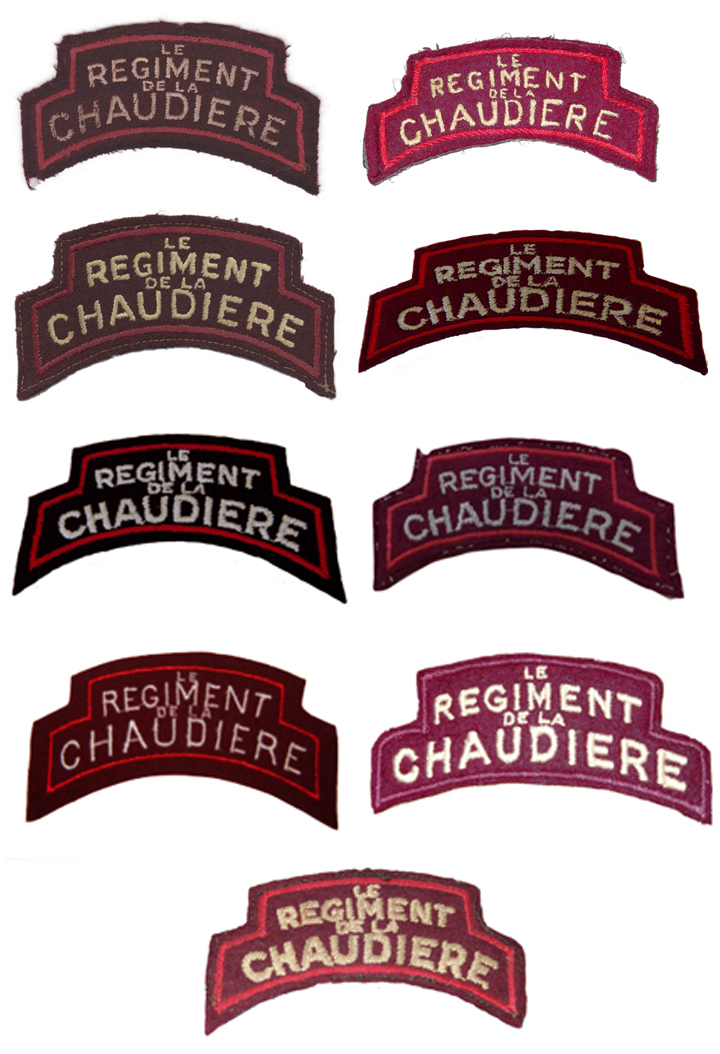
Top row, left, author’s collection – Type 1 Canadian. Right, author’s collection – Type 2, British Made.
2nd row, right, J-F Le Cuziat collection – Type3 British-made. Right, author’s collection – Type 4 British-made.
3rd row, left, author’s collection – Type 5 British-made. Right, Raymond Gilbert collection – Type 6 ‘Starch-back’.
4th row, left, author’s collection – Type 7 Canadian-made. Right, Bill Alexander collection – Type 8 private purchase.
Bottom, author’s collection – Type 9 British-made
Amendment to the original article that appeared in the Summer 2013 CSMMI Journal: The estimated time issued for the various types can be summarized as follows: Type 1 issued April 1941, Type 2 issued 1941-43, Type 3 issued 1941-43, Type 4 issued 1943-44, Type 5 issued 1945, Type 6 issued 1945 and Type 8 unknown issue time frame. Type 9 was discovered post publication of the CSMMI article and is estimated to have been issued 1942-43. Dates for the Type 7 are unknown and after consultation with a number of fellow collectors it has been determined it is most likely a post war variant and therefore an error on the author’s part. The author is looking to discover photographic evidence of the Title in use.
In 1943, a U.K. company called Calico Printers produced printed or ‘canvas’ titles 10. There have been 2 identified patterns for the Chaudière. The first type was produced in 1943-44 and is constructed ofCotton Drill number 2. This type is made of a slightly thicker, duller and coarser canvas material. The second type was made of Satin Drill and was produced in late 1943-45. It is thinner,has a slightly darker almost reflective black cherry colour to them11. This pattern is most often associated with the D-Day Landings. Both the CASF and CAOF wore examples of these. Samples of each are provided.

Author’s collection – Left, canvas 1st Type, 1943-44.
Author’s collection – canvas 2nd Type 1943-45.
The following images of my Grandfather depict him with various Shoulder Titles to the Régiment. The first photo was taken in 1941 shortly after arrival in the UK. This would identify this Title as being one of the original 500 purchased in April 1941. Photograph 2 is dated 1943 and as best as can be determined is an example of the Type 4 British Made Title. The final photograph was taken sometime in 1944 and appears to be the Canvas 2nd Type Title.

From the left, Type 1 Canadian. Type 4 British -made. Canvas 2nd Type.
Caution needs to be exercised by the collector with regards to the titles. There are a number of reproduction titles currently circulating including a number produced for re-enactors perpetuating the unit’s history. There are also a number of post war titles being marketed and or misidentified as SWW. Finally, the author has recently witnessed a number of made up Battle Dress (BD) to the Régiment that have had post war titles added. Some of these BD have been made with a clear intention to deceive and unfortunately fetched significant sums to unsuspecting Buyers.

Left, Bill Alexander collection – Canvas ‘Repro’.
Author’s collection – Embroidered ‘Repro’ of Type 4.
Acknowledgements
The author would like to posthumously thank his Grandfather who continues to provide the inspiration and dedication to collect and research Le Régiment de la Chaudière. The author would like to thank Sally Roberts for her patience in editing and formatting the pictures. The author would also like to thank Bill Alexander (who also openly shared his knowledge and research), Raymond Gilbert and J-F Le Cuziat for the use of their titles. The author can be reached by e-mail should members wish to submit unidentified examples or if they have items from the Régiment for sale at chaudiere1944@gmail.com.
Finally, any errors or omissions are the author’s entirely.
Publisher’s note – please note that the shoulder titles are not necessarily to the same scale so collectors should not rely on the relative sizes between titles.
References
1: “Le Régiment de la Chaudière” Jacques Castonguay and Armand Ross, 1983, 1a pp. 365-432, 1b pg. 399.
2. “Canadian Army Cloth Shoulder Titles of the Second World War A Primer”, CSMMI Journal Spring 2011 – Raymond Gilbert and Bill Alexander.
3. “The Canadian Soldier” Jean Bouchery, pg. 50.
4. “Le Régiment de la Chaudière” Jacques Castonguay, Armand Ross and Michel Litalien, 2005, pgs.558-560.
5. Museeet Archives du Régiment de la Chaudière, Notes from Emile Turmel. Not published.
6. “Les Origines de noscouleursregimentaires” Richard Martin. Manuscript. Not published.
7. Library of Archives Canada (LAC). Reference provided by Bill Alexander.
8. “Le Régiment de la Chaudière” Jacques Castonguay and Armand Ross, 1983, pg. 149.
9. Library of Archives Canada (LAC). Reference provided by Bill Alexander.
10. “Canadian Army Cloth Shoulder Titles of the Second World War A Primer”, CSMMI Journal Spring 2011- Raymond Gilbert and Bill Alexander.
11.Alexander, Bill. (2012) Retrieved from website October 8, 2012, http://www.britishbadgeforum.com/forums/showthread.php?t=27587
by Roger V. Lucy
In January 1943. First Canadian Army ordered 100 sets of imitation Germans tunics, side caps, belts, leather equipment and helmets – for its Intelligence Section – from the British War Office. The Directorate of Clothing and Equipment of the British Ministry of Supply sent back samples and a price list. These were deemed acceptable by First Canadian Army and in early February the Ministry of Supply confirmed that all the requested items were due to arrive shortly, except the helmets which would take another month to produce. The helmets seem to have been made by Grimson & Slater Ltd of Long Eaton Nottinghamshire.
According to the firm’s letterhead it normally manufactured springs and steel furnishings, but it is also known to have made helmet linings. Grimson & Slater Ltd wrote to First Canadian Army, on 4 March to advise that 100 “special assemblies” were en route by train and should be arriving within 24 hours.[i]
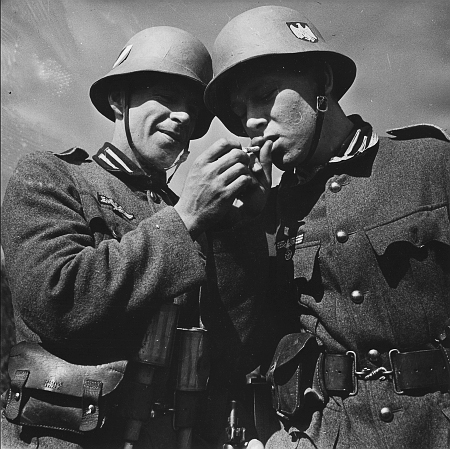
Two members of the Ist Canadian Division German Demonstration team.
These helmets (priced at 15/ each) were an imitation of the German M35 Stahlhelm . Made of magnetic steel and painted dark green, they were externally similar to German helmet, except they lack bushed vents and had liners based on the British Mk.II. The rivets and chin-straps closely resembled the German originals.

British copy of German M35 Stahlhelm

Interior view of the British copy of German M35 Stalhlelm
The leather equipment provided by the Ministry of Supply, was actually old Pattern 1914 leather equipment, presumably the Ministry of Supply deemed it an acceptable substitute for what the Germans actually used.

Note the use of British weapons. Here they are shown using a BREN gun.
Some at least of these helmets and uniforms were issued to the 1st Canadian Division German Demonstration Team. In its War Diary the 7th Reconnaissance Regiment t recorded a visit by the Team, on 21 April, 1943. This group of proto‑reenactors replicated a German infantry platoon, giving demonstrations of German drill, commands, and infantry tactics. They also acted as subjects for training 7th Recce personnel in controlling POWs. The War Diarist was impressed by their “rigid discipline” and the speed with which they brought their weapons into action. Pictures of the team taken in late March 1943 show they were using standard British weapons and some wear cloth covers with German insignia over their helmets.

The demonstration team used Patt ’14 equipment.

1st Canadian Infantry Division German Army Demonstration Team
[i]. RG 24 microfilm reel C‑8412, file 9012‑16‑6
by Roger V. Lucy
In 1948 the Department of National Defence issued a requirement for a tank helmet that would: offer protection from rifle and machine gun bullets and mortar fragments; come in three sizes; was as compact as possible; allowed use of head-sets, and; had a detachable liner made of non-conducting material. The USA was working a one-type-fits all helmet for ground troops, parachutists and AFV crews. Their efforts were monitored with great interest, but no satisfactory design emerged.
The old cork Helmet, Crash, Tank Battalion soldiered on, and quantities of the British Helmet Steel RAC, Mk.II was procured and issued in the 1950s under the designation Helmet, Soldier’s Steel, RCAC. This was essentially the same as the war time RAC steel helmet but had the same type of removable lining as used on the British Mk.IV infantry helmet. In 1959, the RCAC identified a need for a more modern tank helmet.
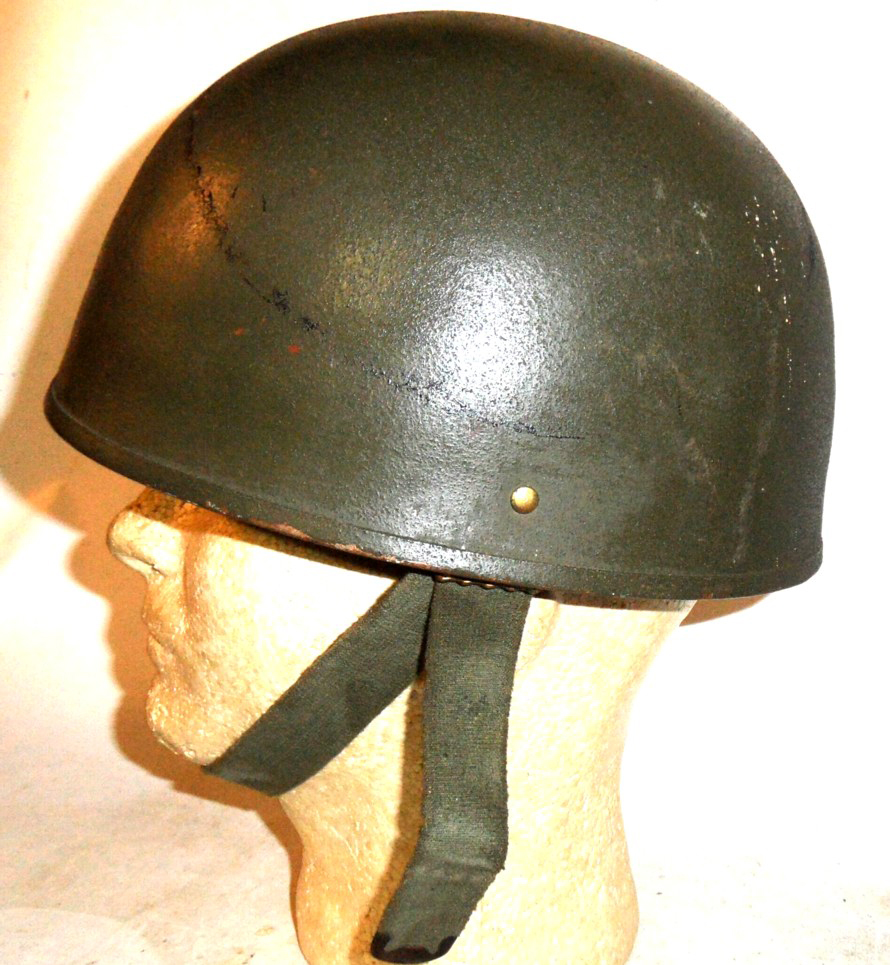
Helmet Steel RAC MkII
In 1961 the USA having abandoned its multi-purpose helmet dreams adopted the fibre-glass foot-ball helmet shaped T56-6 as its Combat Vehicle Helmet (CVC). It was was evaluated by the Canadian Army, but found to be unsatisfactory for use in the Centurion tank or the proposed Bobcat APC, both in its form and due to its incompatible communications equipment (the T-56 used a carbon microphone, the Centurion headsets a dynamic microphone). At the instigation of the Surgeon General, tests were also carried out using modified aircrew helmets: the Gentex DH 411, and DH 51-4. A helmet made by the British communications company Racal, was also considered. All these likewise not only proved unsatisfactory but the trials caused a certain amount of inter-office discord and concern at Army HQ that development of an AFV helmet was going off on “separate uncoordinated paths.”
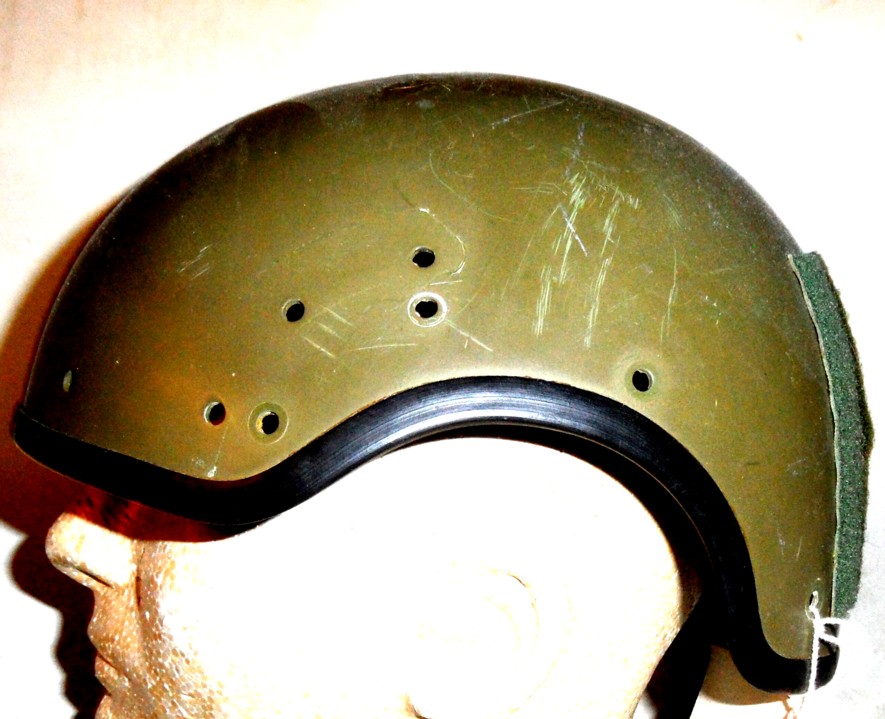
Gentex DH411 helicopter helmet shell

Racal Amphlivox STH trials during the Fox winter trials. W.E. Storey collection
In 1966, following unification, Canadian Forces HQ tasked Mobile Command to draw up a list of requirements for a CVC helmet. The Directorate of Armour came up with the usual list of seemingly irreconcilable elements including: shock and bump protection, ballistic protection, lightness, comfortable fit, quick-release ability, compatibility with existing communications equipment, not water absorbent, no reflective surface and – this being Canada – a cold weather liner suitable down to -30F (-65 when worn with a parka). In the end it was decided to defer any decision until a replacement for the Centurion tank was found. That said, the later 1960s saw limited procurement of the US CVC helmet, for use with the M113 APC, which had supplanted the abandoned Bobcat.
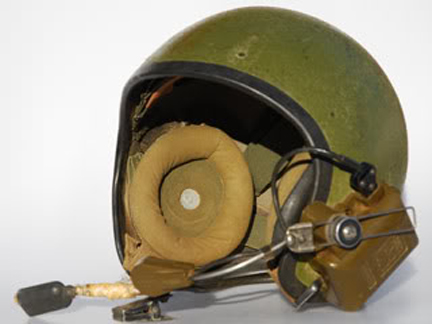
US CVC helmet
In the 1970s, the US firm Gentex introduced a much improved AFV helmet, the DH-132, made of with a fibreglass hard shell (replaced in the 1980s by the DH 132A with a kevlar shell which provided ballistic protection). This was attached by Velcro to a thick neoprene rubber liner which held communications and sound attenuation equipment. This helmet replaced the CVC helmet for M-113 and LAV crews.

Gentex DH132 trial during the Fox Winter Trials. W.E. Storey collection
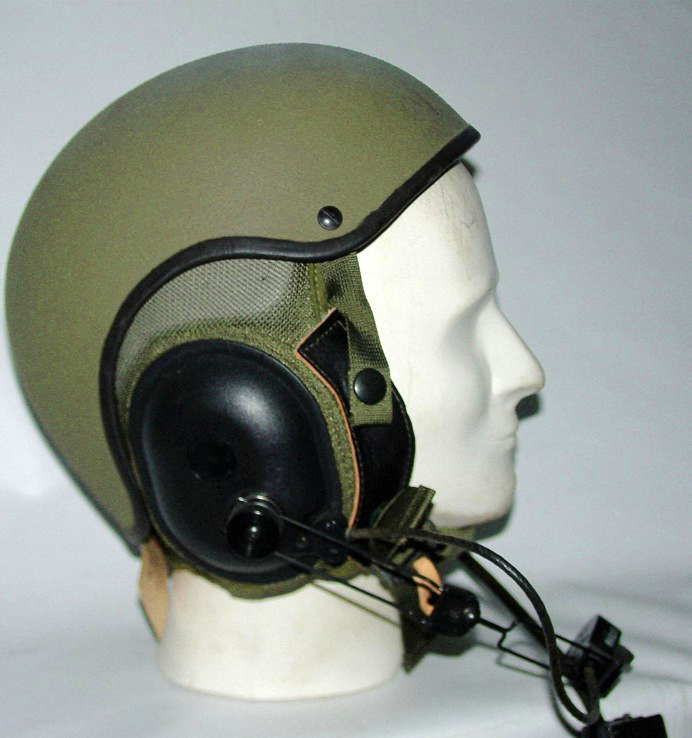
Gentex DH 132A
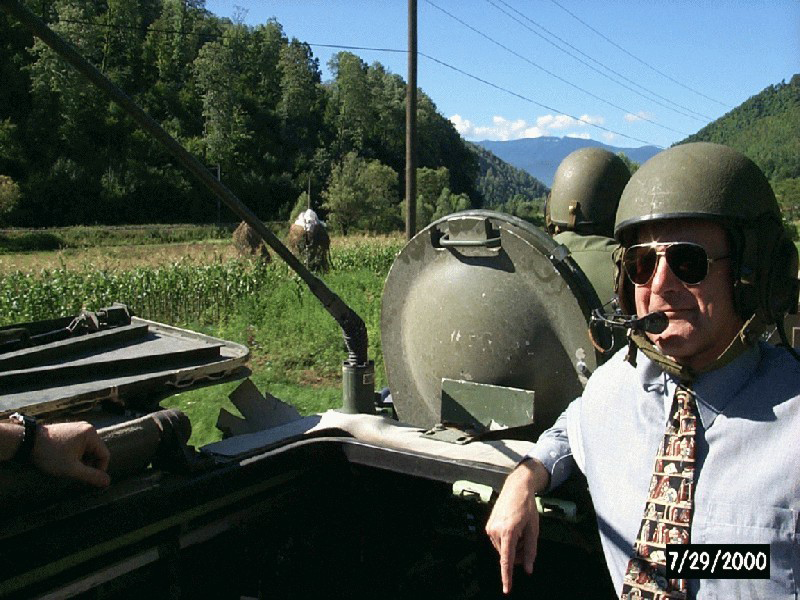
Canadian Ambassador to Bosnia wearing a Gentex DH132A
With the adoption of the Leopard tank in the early 1970s, Canada adopted a variant, the Gentex DH-169 helmet, which differs from the standard DH-132 pattern by having a two piece skull and brow guard, to allow better access to the Leopard’s weapons sights. It came equipped with an ambient noise pick-up which allows conversation, while it is being worn, but protects the user from sudden noise by cutting out at 85 db. In the 1980s a Kevlar shelled version, the DH-169A which offered more ballistic protection was introduced.
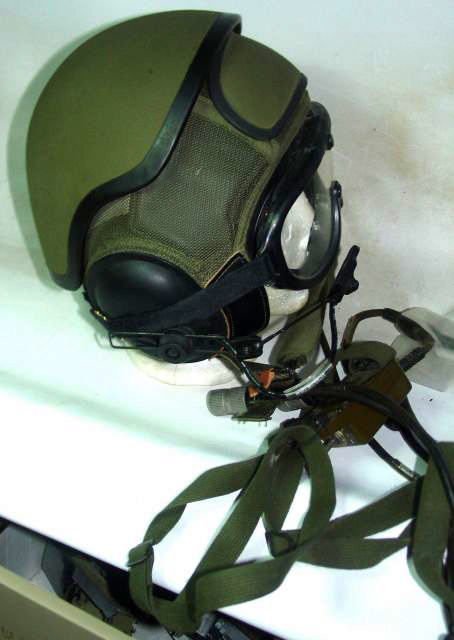
DH169A
With the introduction of CG634, (see Canada’s Search for a Composite Helmet) tests were undertaken between 18 November-17 December 1996 with 21 soldiers from F Company, 1 RCR, who were on an AVGP driver training course, comparing the DH-169 with a prototype CG634 worn over the Racal Slimgard II headset. The helmet/Slimgard combination, while heavier, offered greater protection and proved more comfortable, compact and convenient (as the helmet and head-set could be worn separately) and was less subject to ambient noise than the DH-169. The combination of helmet and headset also proved more durable and was rated by the soldiers as looking more professional, soldierly and “high-tech”. Since then, this combination, while viewed as an interim solution, has seen frequent use in the field, including combat conditions.
Concurrent with plans to adopt a new suite of communications equipment using the Tactical Command Control and Communication System (TCCCS) communications headset, the Canadian Forces began work to develop a AFV helmet, the Combat Vehicle Crew Modular Helmet. According the to the DND website, its critical requirements are to achieve compatibility with the TCCCS and to improve ballistic protection. Increased “head and facial impact protection, enhanced comfort, vehicle gun-sighting access, and reduced weight are all improvements sought in the design concept.” Other aims of the project included: improved impact protection to the head; reduction of helmet weight during training and tactical hatches down conditions, without loss of impact protection; integrated maxilla‑facial protection; modularity to address diverse vehicular positions; and interchangeability with multiple communications headsets. Ballistic protection was to be equivalent to the CG634 helmet.
Off-the-shelf British modular combat vehicle helmets produced by Racal and Courtaulds Aerospace were tested as part of this project, and the VTH shell of a Racal Ventilated Combat Vehicle Crewman’s Helmet was used as the basis for the prototype, which does indeed include a prominent, but detachable, jaw guard. A contract worth $3.9 million was awarded on 27 January, 2010 to a Quebec company Louis Garneau Sports Inc., for the production of the Combat Vehicle Crew Modular Helmet. Its introduction into service began in 2011.
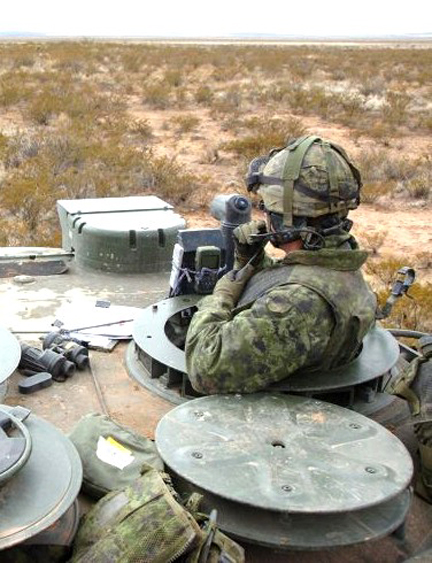
CG634 with Slimgard
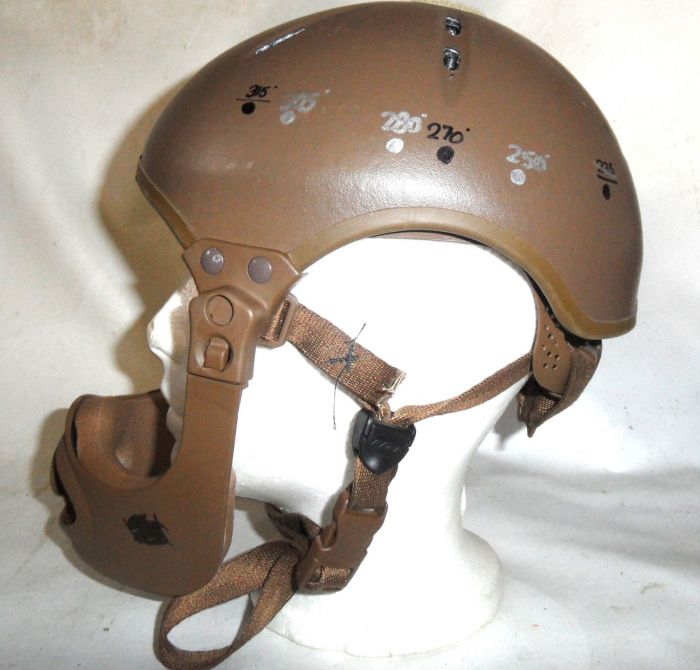
A prototype of the impact liner for the new Canadian Combat Vehicle Modular Helmet
by Roger V. Lucy
Traditionally Canadian armored vehicle crews often preferred to wear only their black berets, but hard realities dictated that more protective head-gear was required.
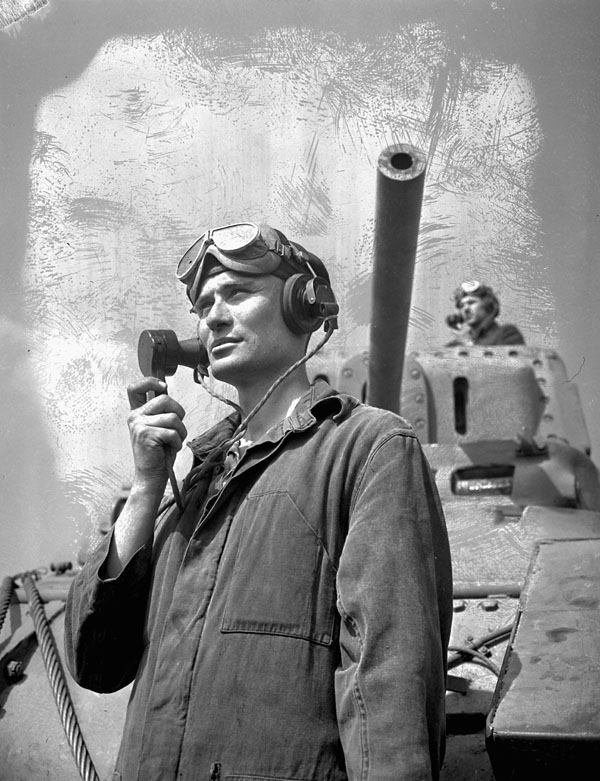
In the summer of 1940, DND opted to adopt a Canadian-made version of the British Helmet, Crash Royal Armoured Regiment. The helmet was made of cloth covered cork, with rubber vents in the sides.and a web suspension. A leather “scrum”, attached by laces and buttons, held the head phones. Some 12,000 were made. Known in Canadian service as the Helmet, Crash, Tank Battalion, they were not issued overseas, but remained in service in Canada until 1966.

Helmet ,Crash, Tank Battalion
As Canadian procurement was taking longer than anticipated (and because the London office of the DM&S had apparently mislaid its original requisition) the War Office was asked in late December, 1940 for 2,500 Helmets, Tank. The helmets provided were the British Helmet Crash, Royal Armoured Corps, a war-time expedient, introduced in 1940, made from three pieces of fibre riveted together.
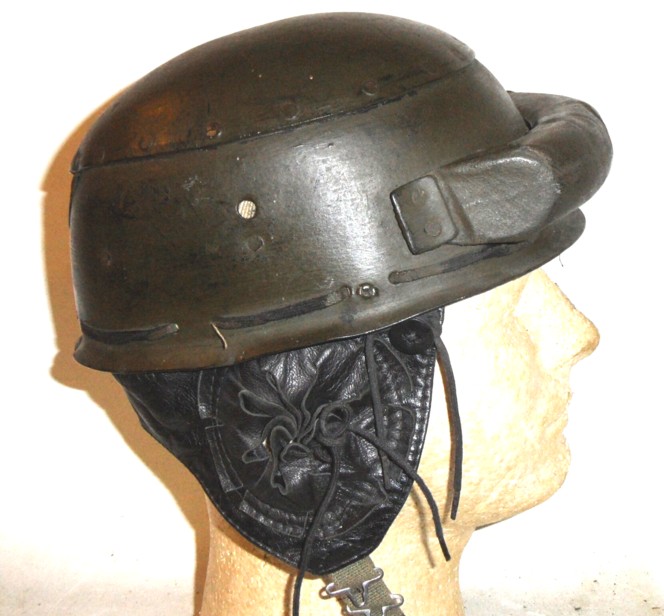
Helmet, Crash, RAC
These helmets protected the wearer only from impacts, they provided no ballistic protection. In 1942, the British developed a steel helmet with the same body as its DR and airborne helmets but with the lining and chin-strap of the Mk.II helmet. This Helmet, Steel RAC Mk I was adopted by the the Canadian Army overseas in June, 1943. Canadian production was not undertaken and helmets were issued from British stocks from early 1944. Canadian tankers were not wholly satisfied with it. Its compatibility with the AFV headsets was somewhat limited. Trials showed that for the helmet rim to clear the head-set, the lining had to be adjusted so the helmet rode as high as possible and the steel band of the head-set worn as low as possible on the back of the neck. Even these adjustments would not work with certain head shapes. In addition the helmet’s passing resemblance to the German Paratrooper helmet made them unpopular in areas where Fallschirmjäger operated.
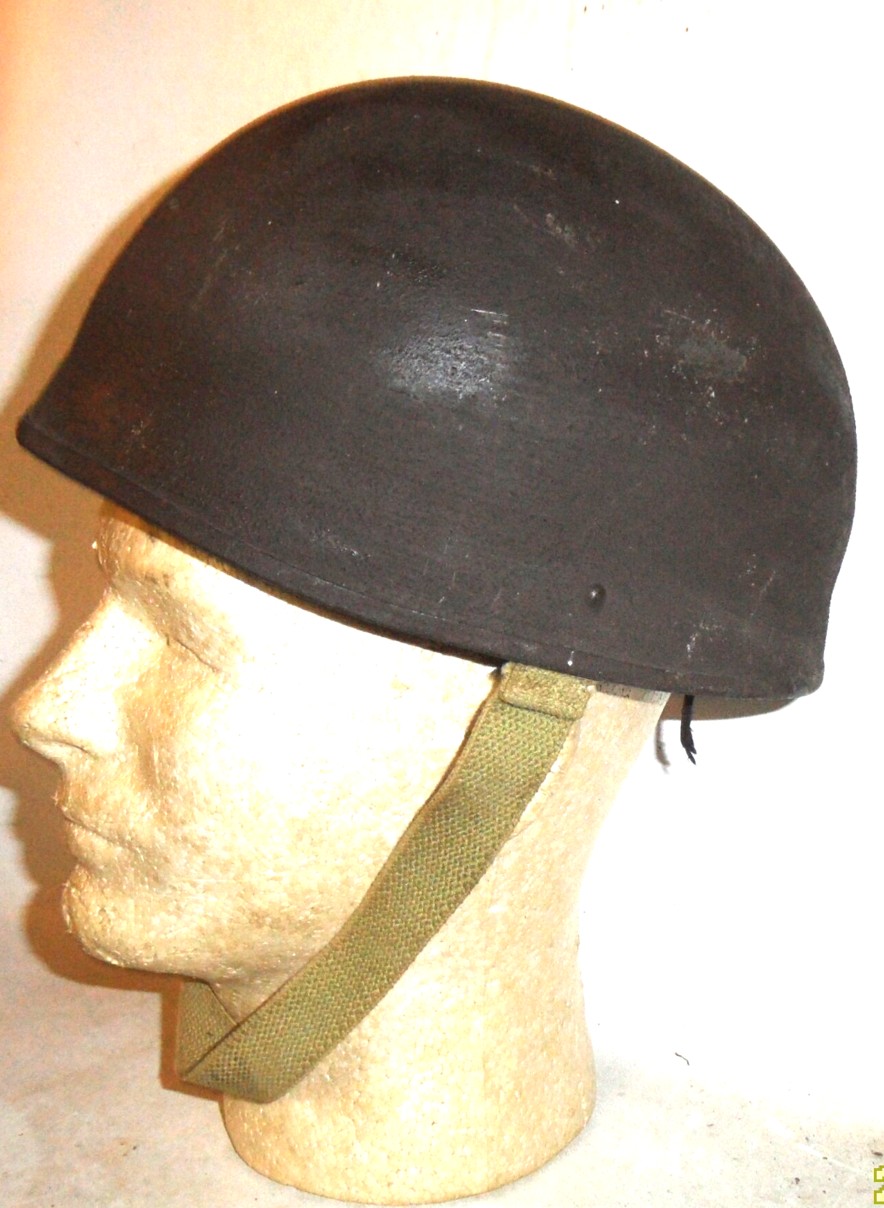
Helmet, Steel, RAC
The Canadian Armoured Corps also used large numbers of American tanks, which came with a set of fibre US Helmets Tank. Its Canadian designation was: Helmet, Crash, Tank, USA Pattern. Examples were tested in February, 1943 by the Experimental Wing of the Canadian Armoured Corps Training Centre in Borden Ontario. It was found to be light and comfortable and could be worn for long periods without strain, if properly fitted. It withstood shock well (hitting the occupant with 4cm metal pipe at a force of 15kg, caused little discomfort. For extra protection, a Mk.II helmet with the lining removed could be worn over it, and it could be worn comfortably with a respirator. The helmet did not interfere either with the use of goggles or the tank’s telescope. The fibre did not soften after 45 minutes exposure to artificial rain-fall. The only criticisms were ear-flaps did not accommodate the standard wireless head-phones, and the large perforations in the crown made it unsuitable for use in cold or wet weather.
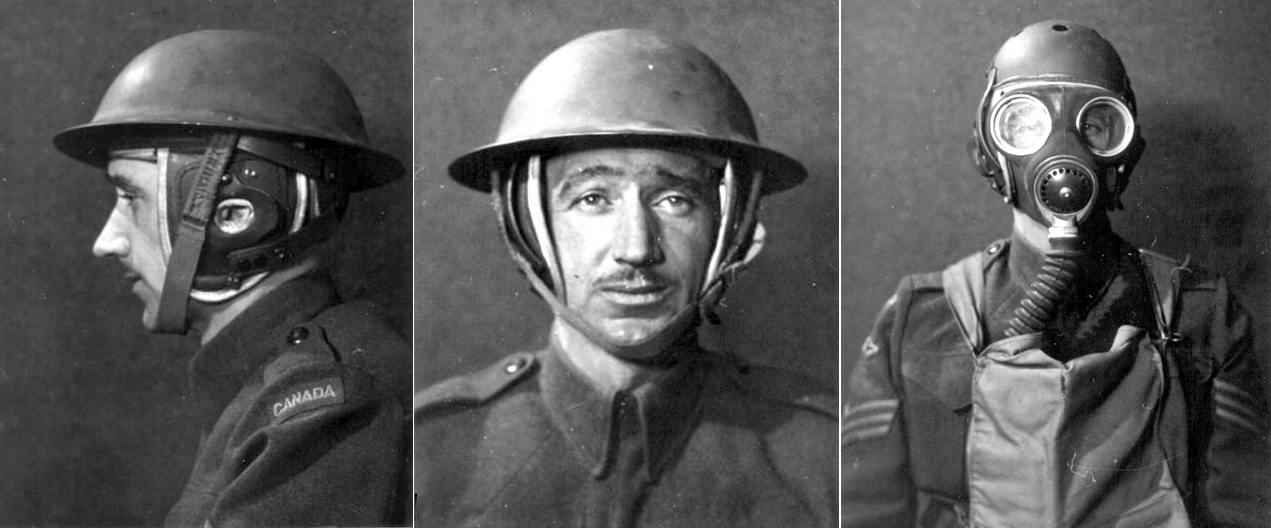
Helmet, CAC
These helmets proved quite poplar with Canadian troops in both Italy and NW Europe. Wearing his Helmet, Tank, US, in a more heroic pose than the CAC Experimental Wing’s model, is Major General Bert Hoffmeister.
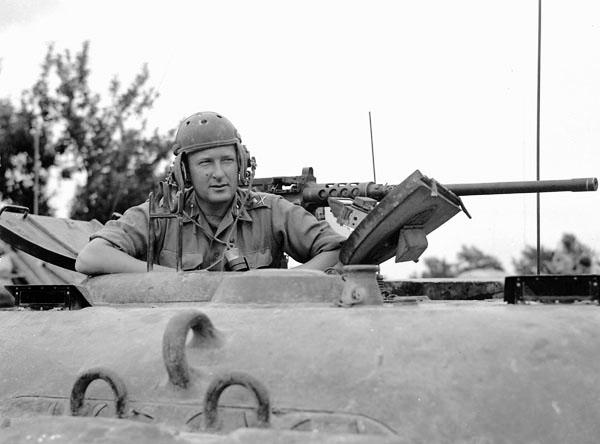
Brigadier Hoffmeister
Other helmets were also tried out. Here is an interesting photograph of an officer of 21 Canadian Armoured Regiment (Governor General’s Foot Guards) who has liberated a French Mle‑35 and rigged it up with his head set and (normally hand‑held) microphone
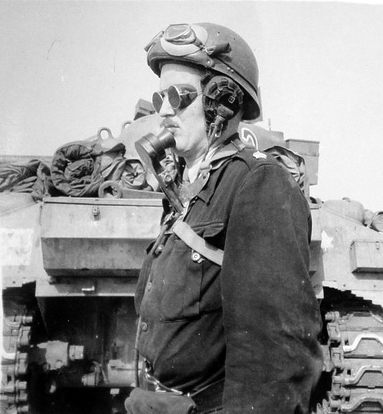
French helmet in wear by an officer of the GGFG
The Army Technical Development Board also initiated a project to develop a winter tank helmet. The experimental Helmet, Tank Crew, Leather was tested in Exercises Eskimo and Polar Bear in the winter of 1944/45. The exercises revealed the need for additional padding at the forehead and temples and along the top and back of the head, as well as a redesign to allow bitter fit for head-phones. While it received General Staff approval in September 1945, no procurement action seems to have been taken..
This poor but intriguing photo seems to be the only one known of this helmet.
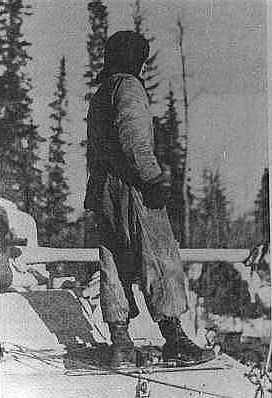
Leather tank helmet worn during Exercise Eskimo. W.E. Storey collection
However a number examples exist of a leather-covered Sorbo rubber confection with a C broad arrow stamp inside. Failing any other logical explanation of its purpose it may be the interior padding to the helmet tank leather.

outside and inside views of the leather helmet
Bill Alexander © 2012
In November of 1939, four national volunteer service organizations, the Canadian Legion, Knights of Columbus, the Salvation Army and the Young Men’s Christian Association (YMCA) were asked to provide “auxiliary services” for the Canadian armed services. These services included, but were not limited to, “organizing sports and dances, providing movies and concerts, reading and writing and recreation rooms, libraries, mobile canteens, and tea vans … and establishing leave hostels and information bureaus for troops on leave”. Members of these organizations both served overseas and at home throughout the war.[1]

Supervisors of the YMCA (left) and Knights of Columbus Catholic Army Huts (right)
The Auxiliary Services were staffed by civilians, but due to their unique duties, were paid by the government. Two classes of Auxiliary Services personnel were employed. One group were granted the status of officers, assigned the rank of captain, and were addressed as Supervisor. The other group of Auxiliary Services personnel were classified as Civilian Helpers, with no military rank. Commensurate with their role, the Auxiliary Services officers wore modified service dress and later, all Auxiliary Services personnel were granted permission to wear battledress uniforms.[2]
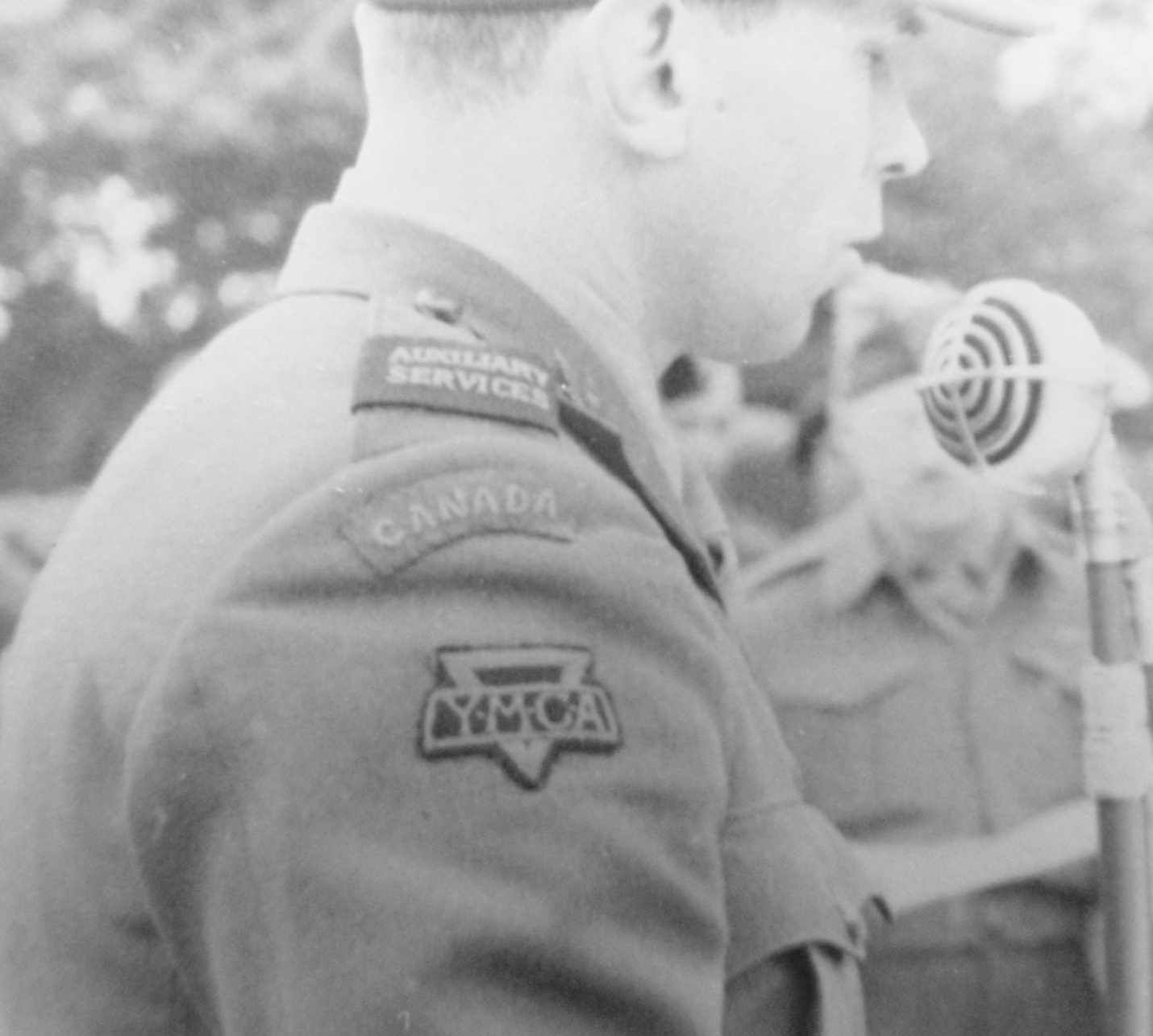
An officer of the YMCA Auxiliary Services wearing Service Dress, May 1943. Photo Library and Archives Canada.
Initially, officers in the Auxiliary Services wore service dress uniforms with no epaulettes, without rank, and no Sam Browne belts. They were to be identified in two ways. First a black armlet, 3 ½ inches wide with CDN AUX SER in ¾ red inch lettering, was to be worn on the left arm. In addition to the armlet:
“A cloth distinguishing patch will be worn on each sleeve of the khaki jacket placed 1 in below the shoulder seam. The patch will be 2 ¼ ins by 3 ins and will have embroidered thereon the authorized insignia of the organization concerned.”[3]



BESL Royal Canadian Legion
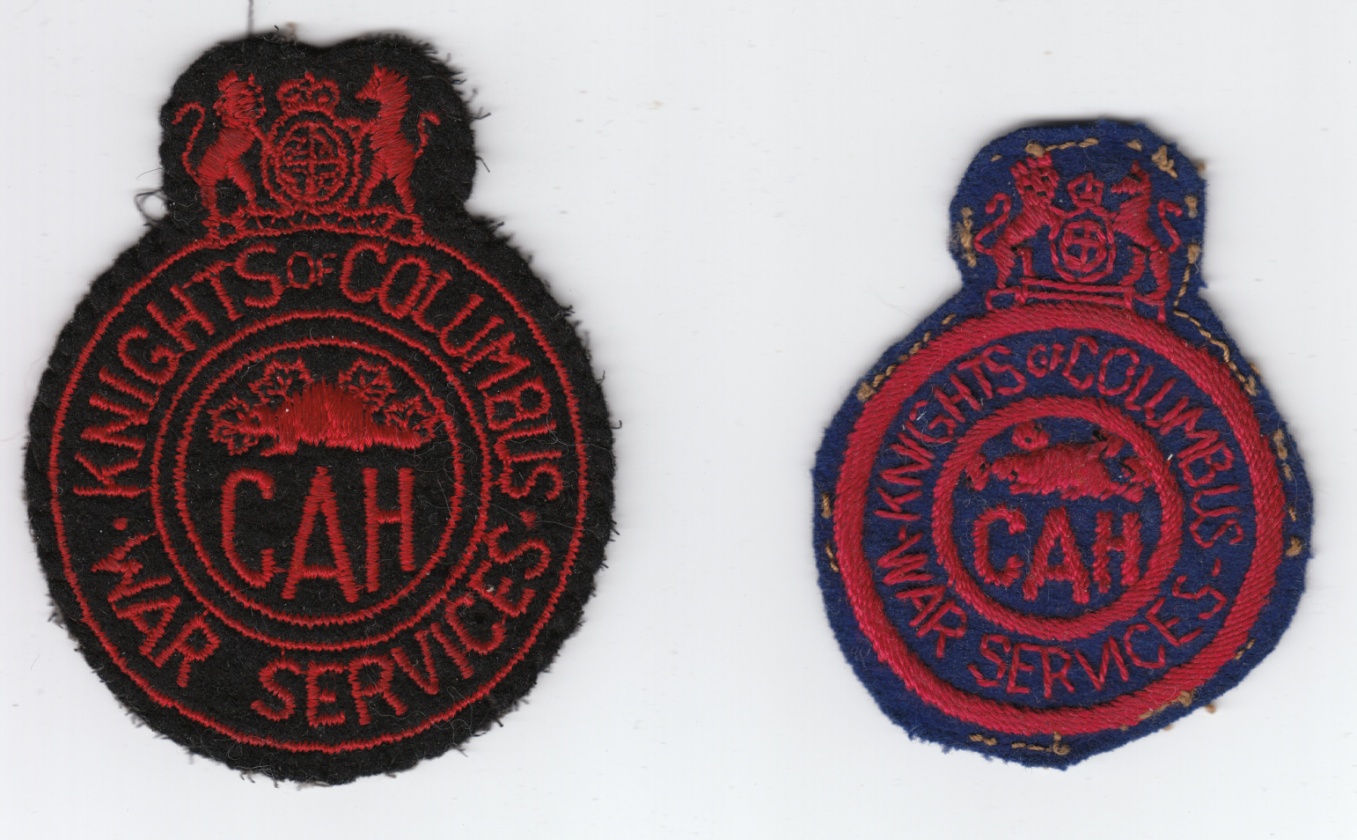
In mid-1940, the four service organizations, the Canadian Legion, Knights of Columbus, Salvation Army and YMCA, adopted patches representative of their organizations. Unlike military cloth titles, the design of the patches was created solely by the service organization, subject to review and acceptance by military authorities. The coloured embroidered patches were to be worn on the mid upper arm sleeve of the service dress or battledress. The basic designs of the respective organizations patches remained the same for the remainder of the war, with minor variations resulting from subsequent orders from various makers.
Supervisors soon found themselves in an odd situation:
Whereas the said supervisors have been granted the status of officers for messing purpose and other amenities of service…and:
Whereas a good proportion of such voluntary personnel have held commissions either in the last War or subsequently in the Canadian Militia, it is considered by them to be a mark of certain inferiority not to be entitled to wear shoulder straps on the type of uniform as laid down for their wear…:
May approval be granted whereby these said supervisors be permitted to wear a shoulder strap, with a band of navy blue cloth encircling the outer edge of the shoulder strap with the wording “AUXILIARY SERVICES” embroidered in gold thread thereon…[4]
The request was approved and, effective with Routine Order 370, 14 October 1940, the Auxiliary Services were granted permission to wear uniforms with shoulder straps. In February of 1941, permission to wear battledress was granted, extending the issue of shoulder straps to that uniform.
The Auxiliary Services shoulder strap was to be 1 ¼ inches wide dark blue cloth, embroidered in ¼ inch gold thread. A memo noting the shoulder strap approval also outlined the sequence of insignia to be worn by the Auxiliary Services. The blue band would be worn on the shoulder strap, with the regulation worsted “CANADA” one inch below the shoulder seam, and the patch of the service organization, below the nationality title. Finally, the Auxiliary Services armlet was withdrawn. Both Supervisors and Helpers were to follow these practices.[5]
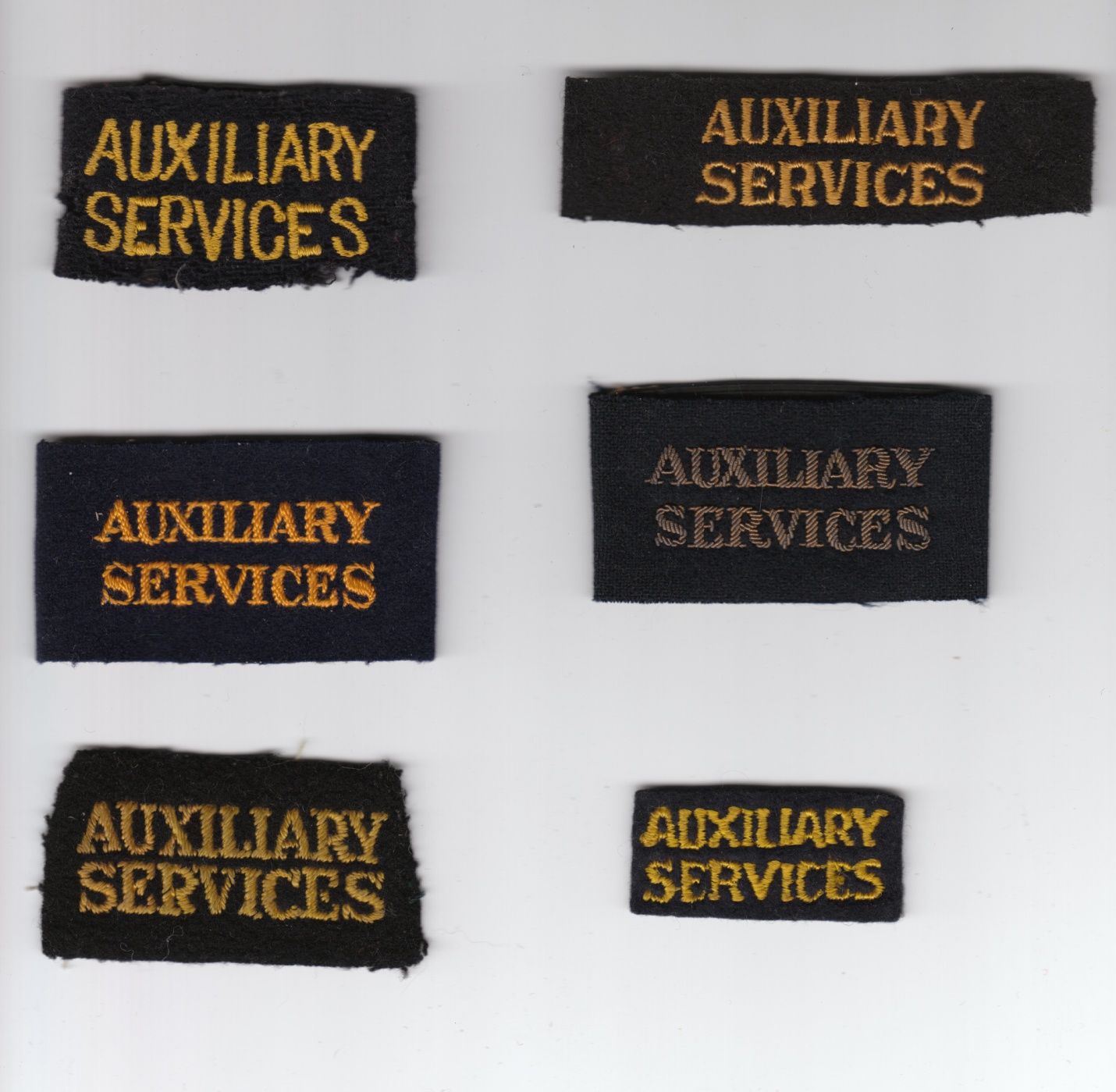
A variety of AUXIIARY SERVICES shoulder strap titles as worn by the Canadian Legion, the Catholic Army Huts (Knights of Columbus), Salvation Army and YMCA.
The Auxiliary Services contributed in many ways to the comfort and entertainment of the soldiers of the Canadian Army. Over 300 auxiliary services supervisors and a similar number of civilian helpers served the forces during the war. Their insignia was an important element of their identity, which assisted the Auxiliary Services in the delivery of their important contribution to the comfort of the fighting services and ultimately the war effort.

Knights of Columbus armband

Wire embroidered cap badge for the Knights of Columbus. Courtesy Marway Militaria
[1] (C.P.Stacey, 1955, pp. 421-422)
[2] (Routine Order 115, 1940)
[3] (Routine Order 115, 1940)
[4] (J.M. Humphrey, 1940)
[5] (C.R.S. Stein, 1941) and (Routine Order 115, 1940, p. Ammendment 7 Oct 40)
Bibliography:
C.P.Stacey. (1955). Six Years of War. Ottawa: Minister of National Defence.
C.R.S. Stein, L.-C. A. (1941, February 10). Memo-Dress National Voluntary Organizations. Dress – National Voluntary Organizations . Library and Archives Canada Volume 24 Volume 10164.
J.M. Humphrey, S. O. (1940, September 9). Letter Dress Regulations National Canadian Volunteer Organizations Supervisors. Library and Archives Canada Record Group 24 Volume 10164 .
Routine Order 115, C. A. (1940, May 28). RO 115. Routine Order 115 Status and Dress Representatives Voluntary Organizations . Canadian Army Routine Orders.
by Dwayne Hordij
On Apr 1st 1945, The Perth Regiment was authorized to become a Scottish Unit. Hostilities had not yet ended in NW Europe yet plans were being made for the postwar organization of the unit. The Perth Regiment had been affiliated with the with the Scottish Cameronians since 1930, so it was logical for LCol Whyte to request and receive permission to adopt many of the dress regulations and traditions from the unit. The one major exception was that the Cameronians wore trews and the Perths would become a kilted unit.
With this adoption of Scottish traditions, it was decided that some changes to the regimental cap badge would be in order. In July 1945, Capt Dent had designed the new badge which it appeared in the 2nd edition of “The Perthonian”. The idea was to take the existing regimental badge in its current design and simply superimpose it onto a St Andrew’s cross.

- Capt Dent’s design from The Perthonian and the official Maple Leaf design
During the course of the war, it had come to the attention of CMHQ that there should standardization in the design of the maple leaf being used on badges and vehicles. Up to this point, the use of the maple leaf in badges and vehicle markings had lead to some unique leaf designs some of which looked nothing like a maple leaf. Any new badges would have to adhere to the newly approved leaf design. In the opinion of the regiment the proposed badge was an alteration of the existing badge, not an entirely new one. For that reason, the desire was to continue with leaf design of the old badge.
That sentiment was not shared by NDHQ and the initial design was declined. This did not sit well with LCol Whyte Perth OIC who continued to press the case, often soliciting support from local politicians and former Perth commanding officers. This continued for over two years but finally the Regiment realized they weren’t going to win and adopted the new leaf design as part of the badge.
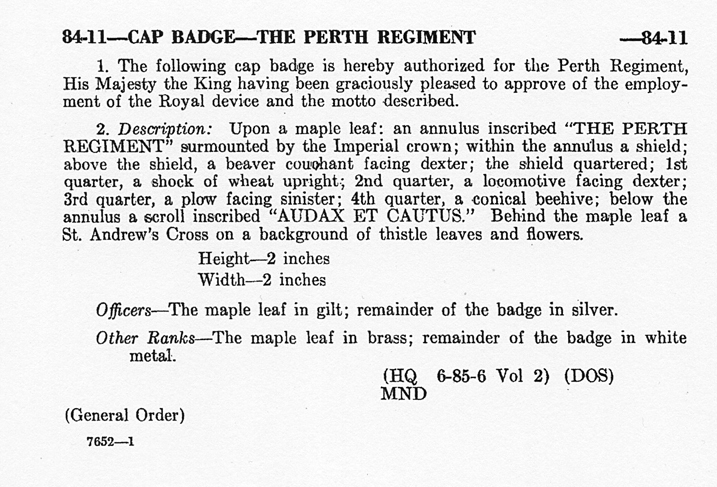
General Order dated 22 March 1948
1948 pattern cap badge
While we have seen many variants of the previous 1920 pattern cap badge, the post war period saw a single variant for the 1948 pattern other ranks badge. These were made exclusively by Scully Ltd and are maker-marked on the reverse.

1948 pattern badge
The 1948 pattern officers pattern badge mirrored the overall design or the other ranks pattern, but came in a couple of different finishes. The manufacture and detail of the officers pattern was far superior. The Maple leaf portion was also gold plated. It was common for officer’s to wear the other rank pattern for day to day use. The Officers private purchase cap badge tended to be reserved for special/full dress occasions. It came in a frosted and non frosted version. They too were manufactured exclusively by Scully Ltd.
The overlay on the officers pattern is a separate piece pinned through the St-Andrews cross.
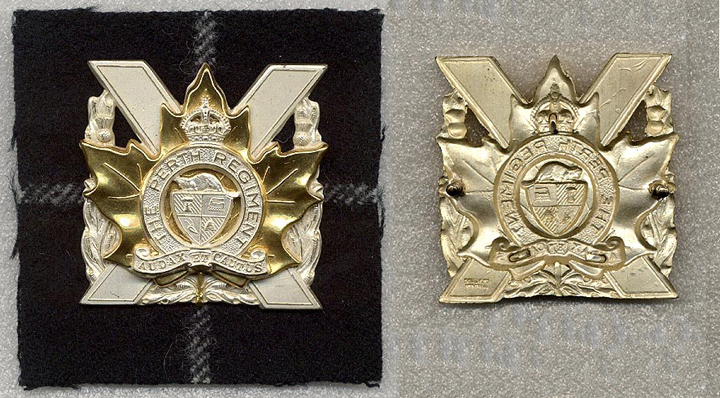
Top, Frosted finish 3 piece Scully made collars
Collar badges:
To date no examples of other rank collar badges have been found for the 1948 pattern badge. Following the war, there was no immediate return to a universal service dress that required the use of collars. At the time that the 1948 pattern badges were being designed, wartime pattern battledress was still in use. The adoption of the postwar pattern battledress with open collar did not require collar badges.
Officers continued to wear service dress and officer pattern collar badges were designed. Unlike the 1920 pattern collar badges, these were designed with a left and right facing collar. As with the cap badge, they came in at least two finishes. The 1948 kings crown collar badges are fairly scarce.
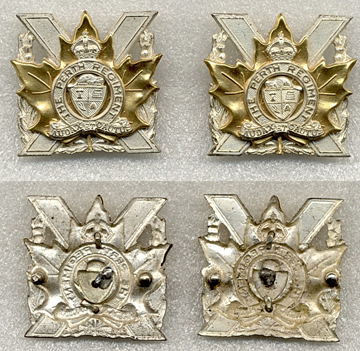
Frosted finish 3 piece Scully made collars
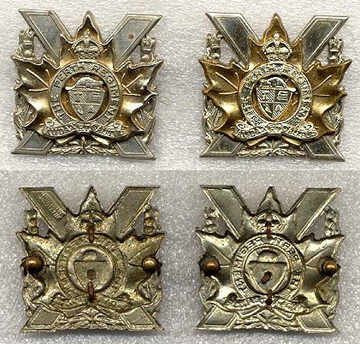
White metal finish 3 piece Scully made collars
1959 Pattern Cap badge
The last cap badge worn by the Perth Regiment came several years after Queen Elizabeth II ascended the throne. As is the tradition, the crown on cap badges changes depending on the gender of the reigning monarch. The Perths as a county militia unit were not a priority in terms of adopting the new crown on their badges and subsequently continued to wear the King’s Crown version of the cap badge.
The first version of the Queen’s Crown cap badge was issued with a slider instead of lugs. The Perth Regiment along with some other highland units had some difficulties with the slider as it tended allow the cap badge to move while being worn. A request was made to have the cap badges recalled and have the sliders replaced by lugs. This was approved on 18 Mar 1963. The badges would be sent to Breadner Co Ltd in Hull Quebec for the modification. The was estimated cost 10 cents a badge. The 1948 pattern cap badge was reintroduced while this work was being done.

- 1959 Pattern cap badge
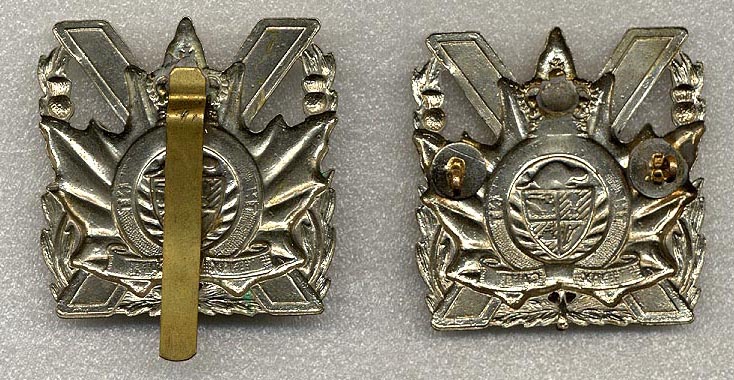
1959 Pattern Cap badge with original slider and later example with lugs added
Collar badges:
In the post war period, Service Dress was often left to the individual units to decide upon. The cost of service dress was usually a personal expense . By the late 1950’s, early 1960’s service dress was making a limited return in some militia units.
Similar to the 1948 pattern collar badges, a left and a right badge did exist with facing beavers.

1959 Pattern Collar badges. Not maker marked but Scully made
Officer’s Badges :
To date there are no known examples of Queen’s Crown officer badges. The 1948 pattern officer badges continued to be worn.
Brass titles:
A new brass title was adopted during this period to be worn on the service dress. It was much smaller than the Second World War pattern. As with the badges and collars , it was made exclusively by Scully.

Brass shoulder title
Cloth Insignia 1945-1965
The 20 year period from the end of the war until being struck off strength in 1965 was a period of transitions for the regiment. Those transitions are well illustrated when one examines the insignia of the period.
Following the return to Canada after the war, the insignia worn by the regiment consisted of what was worn during the war, including the 5th Armoured Division distinguishing patch. This practice ceased on Jan 1, 1947 when all distinguishing patches were removed from wear. Shoulder flashes continued to be worn.

Capt McGowan circa 1950 note the absence of a formation patch. Douglas Tartan tie and diced Glengarry being worn
The first pattern of post-war title mirrored the wartime design and colours. Existing stocks of wartime titles would have continued to have been worn and it isn’t likely that new titles were ordered much before 1950.
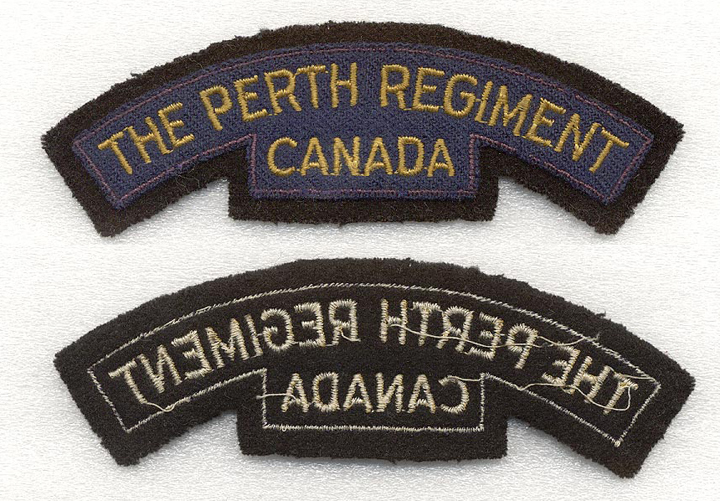
1st post war pattern title circa 1950
Based on remaining examples of this title, it was probably limited to a single run of titles. It is a scarce variant without a backing material.
The second pattern of post war title had brighter thicker yellow lettering and can be seen in use in the picture of Capt McGowan above.
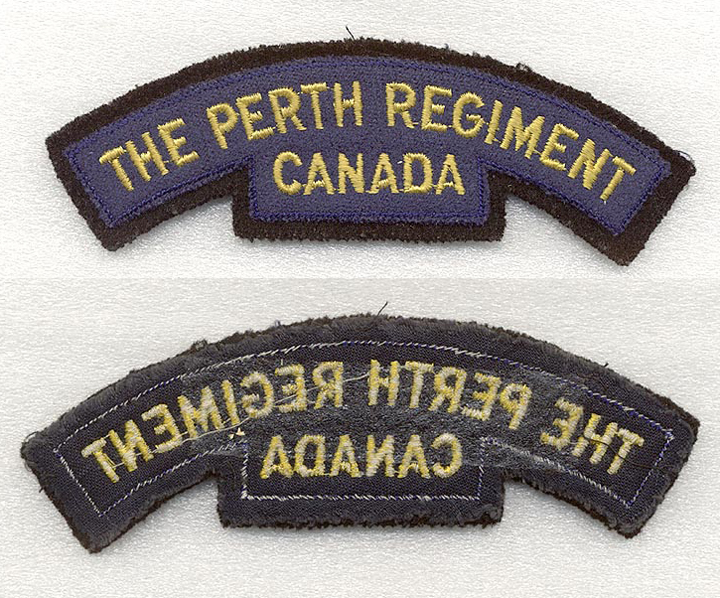
2ndt post war pattern title circa early 50’s
In 1954 a general reorganization of the Canadian Militia saw The Perth Regiment lose it’s individual identity for a thirty month period when the decision was made to merge the Perth Regiment with the neighbouring Highland Light Infantry in Galt.
The subject of insignia came up in the discussions for this forced marriage. The decision was made that the Perths would adopt the bulk of the traditions and insignia associated with the HLI and lose all of its distinct insignia. Some recognition of the Perths would be acknowledged with the new unit being named the Perth and Waterloo Regiment (HLI of C)
The cap badge for the new unit was to be the HLI cap badge but with the name Perth and Waterloo replacing the motto “Defense and Defiance”.
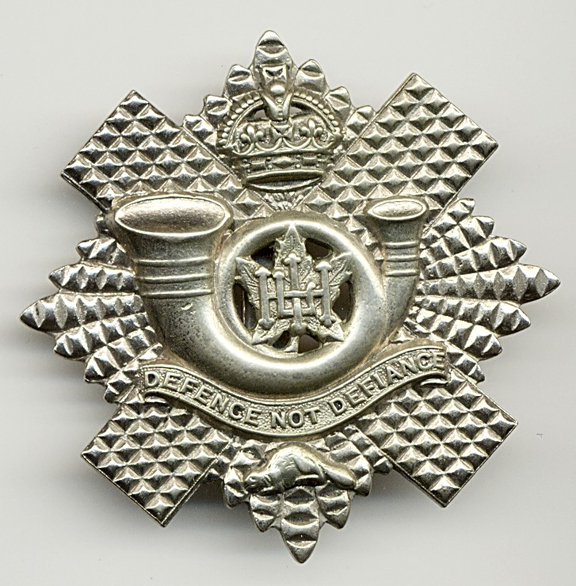
Highland Light Infantry cap badge
The new cap badge never got past the design stage and was subsequently never worn. Both units continued to wear their respective cap badges during this period.
The subject of cloth insignia however was developed beyond the planning stage and resulted in the creation of a shoulder flash that was worn for less than 1 year.
During the initial discussions, it was decided that the HLI colours of Green and Gold would used in the basic design of the new shoulder flash. Several designs were created and declined as the officers of the HLI did not like how the cipher appeared on the flash.

Unaccepted designs for new flash
Finally a design was accepted and on 15 Feb 1956 it was approved.

Top, Authorization of final 1957 pattern title
Bottom, Short lived Perth and Waterloo Regiment flash
This forced merger was not popular with either unit and it was decided that it should be dissolved. The Perth Regiment regained it’s separate identity on April 1st 1957.
Less than a month after reverting back to being “the Perth Regiment” a design was submitted and approved. This resulted in the 1957 pattern flash, a design that would be the last cloth insignia made for the regiment. Less than eight years later, the unit would struck off strength to the Supplementary Order of Battle.
by Dwayne Hordij
The post WW1 period saw another reorganization of the Canadian military. The practice of generically numbered battalions reverted back to the prewar unit names. On April 1, 1920 the regiment was redesginated “The Perth Regiment” (perpetuating the 110th battalion C.E.F). This change also led to the creation of a whole new design of insignia. It was decided that the Perth County coat of arms should play in integral part of that new insignia, a decision that would play a part in future badge designs.
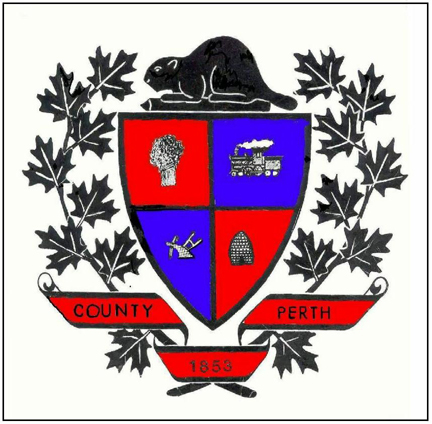
The county coat of arms consisted of a shield divided into 4 sections, each depicting a part of Perth county life.
(Upper left) a sheaf of wheat representing agriculture and the main crop of the County at the time it was formed
(Upper right) a train representing the progress of industry. The Grand Trunk Railway had their shops located in Stratford since 1870.
(Lower left) two plows representing agriculture
(Lower right) a beehive representing the industriousness of the citizens.
Cap Badges
While the wearing of the new cap badges may have begun as early as 1920, the official general order authorizing the badges did not come out until G.O 91 in 1923. The description in the general order was for officers’ badges. G.O. 136 in 1938 added that Other Ranks’ badges would be “of the same design as for officers but in bronze.”

Original badge line drawings and a souvenir post card, both by W Scully ltd.
Other Ranks’ Cap badges.
There are at least two distinctly different dies used for cap badges during the period. It is quite possible that the die used on the first cap badges was either lost or destroyed as the bulk of badges found are stamped from the second die. Below is a list of all the known variants of cap badges.
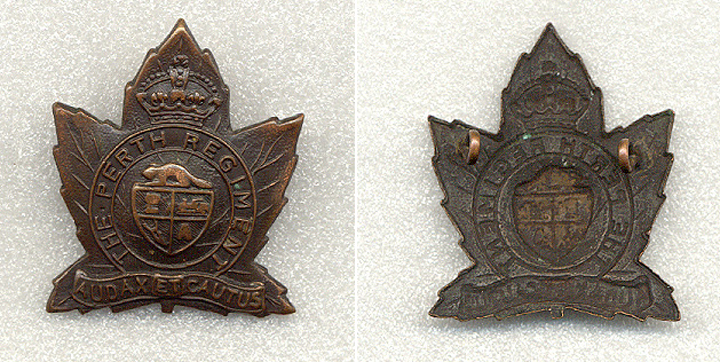
1st Pattern Cap badge circa mid 1920’s.
Lettering is larger in the scroll than in later issues. Not as much detail in the veins of the maple leaf. No periods or dots prior to the “T” in The or after the “T” in regiment. No maker marks. This particular badge has had the center “domed” outwards which was commonly done by the soldiers.
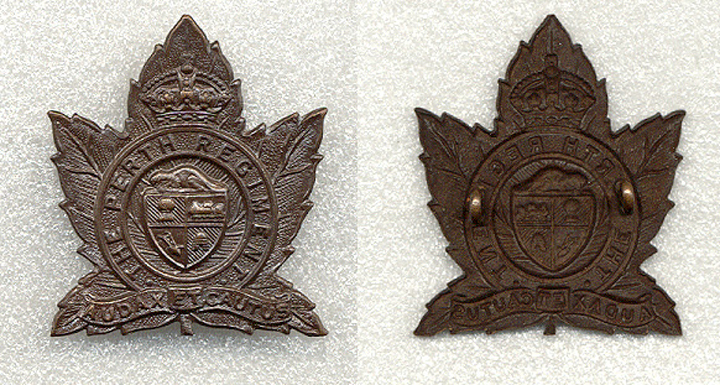
2nd Pattern Cap badge 1930’s -1940’s
The second pattern of cap badge is the more commonly found variant. The distinguishing features of this badge include more detail in the veins of the maple leaf. Periods or dots are found before the “T” in the and after the “T” in regiment. Unissued cap badges came in a dull chocolate brown coating. Soldiers were instructed to shine their badges by removing this coating to reveal a copper bronze badge. No maker marks but believed to be manufactured by Scully Ltd of Montreal.
While these are the 2 primary examples of other rank cap badges, a number of other variants exist, some of which were unofficially altered or added to by men in the field.
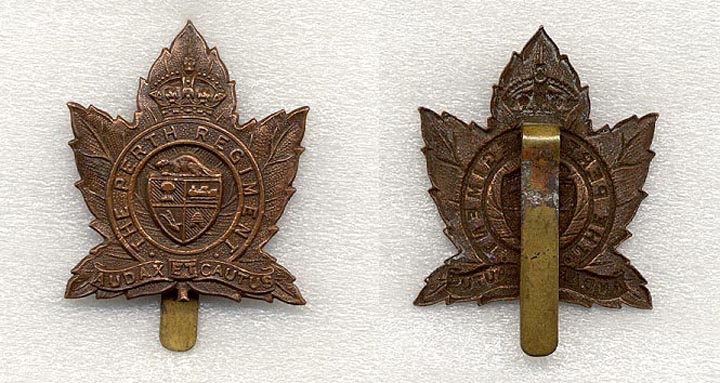
An example of a pre-war cap badge with a slider attachment. This example was never fitted with lugs. During the 1930’s there was a period of time when badge manufacturers adopted the use of sliders. It did not last long with them reverting back to the use of lugs as the preferred method of attaching a badge to headgear. Examples of Perth badges with sliders are quite scarce.
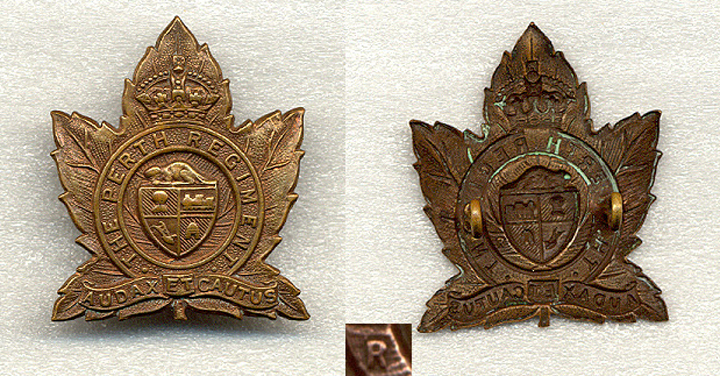
Cap badge made by Roden Bros. The vast majority of cap badges do not have a maker mark on them. In addition to Scully Ltd, it is known that Roden Bros also manufactured badges for the unit. Badges made by Roden Bros can be distinguished by a small “R” found on the back of the badges.

While brass was the preferred metal to be used for other ranks cap badges, the Perth’s were one of the few units to have their badges primarily made in bronze. Brass examples do exist of the badges, and were likely manufactured during the war. There are no known examples of brass collar badges which suggest that these were made during the later part of the war when collar badges were not worn.
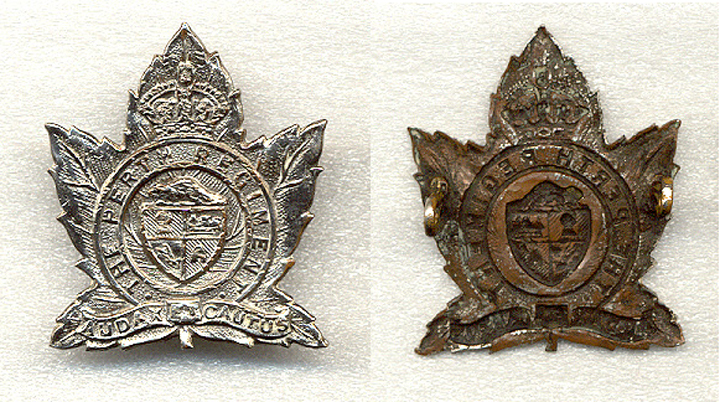
While not a true variant, a number of badges were plated when the unit was in Italy to give them a high shine finish. Unlike some units that plated badges for the use of their regimental band, these badges were altered against regimental regulations. An entry in the regimental diary dated Jun 27 1944 noted that “the silvering of cap badges will cease and personnel presently with white badges will polish them clean immediately”

One other alteration that was commonly done towards the end of the war was to wear a coloured cloth backing behind the badge. There is some debate as to which colour was to be worn. The above example made from a canvas 1st div distinguishing patch clearly shows that red was one of the colours worn. Red was the colour authorized for wear by infantry units. Several veterans of the unit also suggested that they wore maroon backings behind their badges to represent the 5th Armoured Division.
These badges have been reproduced for the re-enacted unit. There are ways to tell the difference between the repro badges and the originals.
Officers’ Cap badges
Officers’ cap badges mirrored the pattern worn by other ranks. The primary difference was that they were bi-metal with the crown and scroll being in silver on a brass/gilt maple leaf. Despite the fact that a single company ( Scully Ltd )made most of the badges, there are an interesting number of variations. Unlike the other ranks, officers were not issued badges but were expected to purchase their own.

The earliest known version circa late 1920’s early 1930 came off a pre war pattern officers’ service dress cap. Unlike subsequent examples, this pattern is a one piece crude casting and plated in gilt and silver. The silver plating has worn over the years in several areas. The lugs are cast as part of the badge. This was likely done as a cheaper alternative to purchasing a professionally made one.
The next 3 badges were all made by Scully limited of Montreal.

The example pictured here is a two piece cast badge. The silver overlay is a separate piece “pinned” to the front of the badge. It is a solid backed badge with the manufacture stamping W Scully Ltd Montreal in the centre of the badge. The badge has lugs as a means of attaching the badge to headdress.

A three piece Scully made badge. Also using lugs, this version has the coat of arms as a separate 3rd piece. The depression in the centre of the badge is a result of the manufacturing process. It is stamped W Scully Montreal at the bottom of the badge.

The Scully made officers’ badge is significantly different from the preceding patterns. Instead of using lugs, this badge has screw posts as a means of attaching the badge to headdress. It is a two piece badge with a frosted silver overlay attached to an antiqued brass/gilt leaf. It is stamped Scully Ltd Montreal at the bottom of the badge.
Many units’ officers had embroidered badges made privately. This was a practice seen in the later years of the war 1943-1945. The exact place of manufacture is unknown. On the left is a mint example while the one on the right has been removed from a beret and was worn by the regimental commander LCol William S. Rutherford. Examples of these badges are rare.
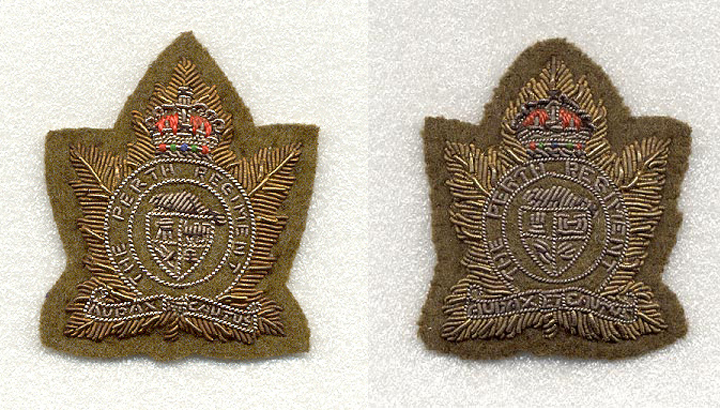
These embroidered badges were primarily for wear on berets.
Collar badges
Collar badges were an integral part of the militia uniform from 1920 until the adoption of battledress. Prior to battledress, the principal uniform worn was that of service dress. Similar in appearance to the WW1 uniform, other ranks service dress had a stand up collar. Both other ranks and officers were expected to wear collar badges on their service dress.

An officer and NCO showing the location of collar badges circa 1930
The collar badges worn during this period are essentially a smaller version of the cap badge. Unlike many units that have a different left and right collar, the beaver on the Perth Regiment collars faces the same way (left) when viewing them. The explanation for this is unknown but the additional cost of having different dies made could have been the reason.
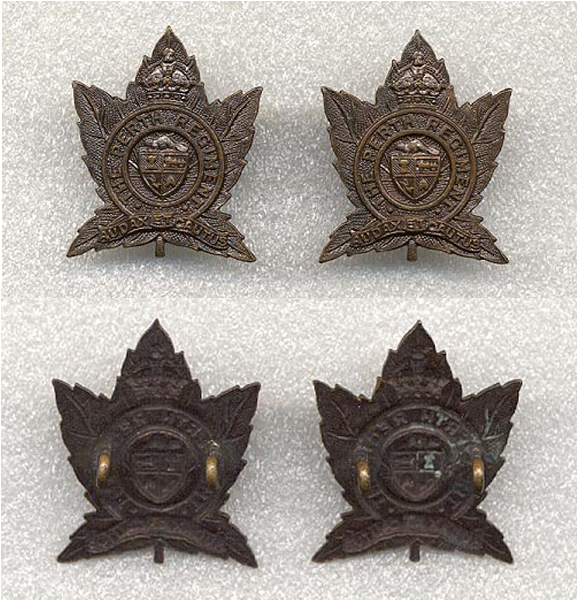
Other Ranks’ Collar badges. No maker’s mark but believed to be Scully. Note both beavers face left. Lug backed.

Officers’ Collar badges. Solid back 2 piece silver and gilt similar in manufacture to the officers’ cap badge. Lug backed
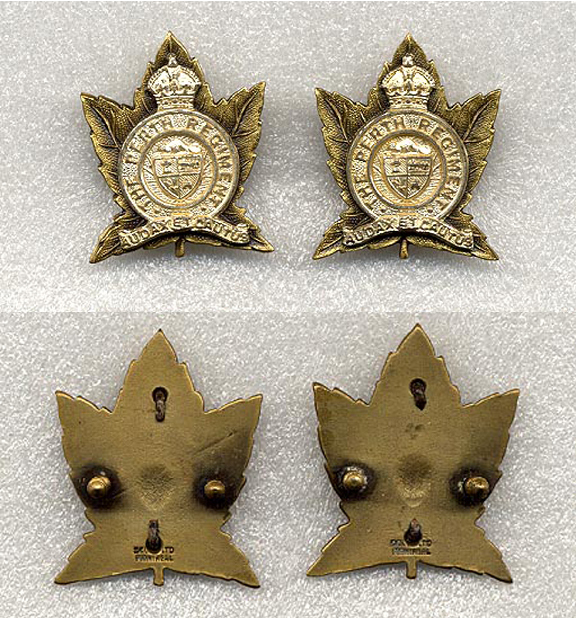
Officers’ Collar badges. Scully manufactured frosted silver and gilt collar badges. Screw post backed.
Collar badges were worn by other ranks until the issuance of battledress. For the Perth Regiment, that was on March 13th 1940. Collar badges were not to be worn on the new battledress. On March 28th 1940, all other ranks were ordered to return their collar badges to QM stores immediately.
Officers continued to wear collar badges on service dress throughout the war.
Shoulder titles/ Cloth Insignia
The first titles worn by the regiment during the period 1920-1948 were bronze and brass PERTH titles. The exact period for each and the reason for the two different materials are unknown.
These were worn on the service dress epaulettes until battledress was issued. They continued to be worn by officers on service dress until they were replaced with plain brass CANADA titles in 1942.
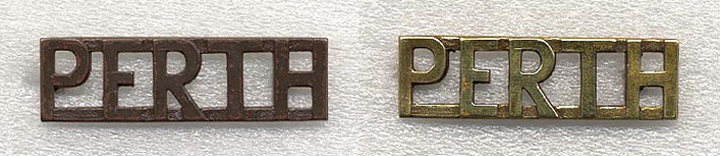
Left, Bronze shoulder title
Right, Brass shoulder titles

Position of the brass title and collars badges on an officers’ service dress
The first cloth insignia worn by the regiment were slip on titles that came in two variants. They were first issued to the regiment on June 19th 1940 and came with the following instructions;
“The cloth Perth badges which have just been issued will be worn on the shoulder straps. These badges will not be sewn on or defaced.”
This provided a challenge for officers as the proper method of wearing these badges would hide their rank insignia. It was common for officers to trim the top of the titles and sew them near the shoulder seams of the sleeves.
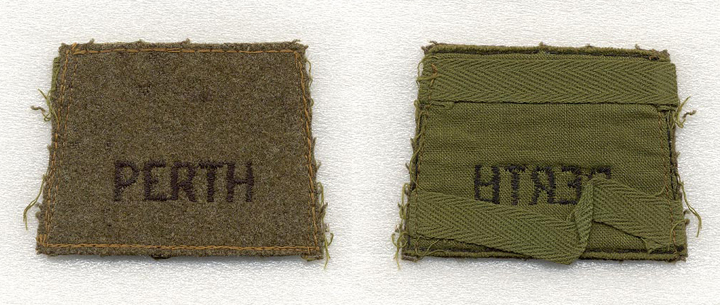
Details of the winter battledress slip- on titles

Details of the summer khaki drill slip-on titles

Positioning and method of attaching Slip-On titles onto battledress
These slip on titles were not worn with any other insignia other than rank. When the unit went overseas in late 1941 they would have been wearing slip on titles.
In April 1942, the Perths as part of the 5th Canadian Armoured division adopted a new method of unit and regimental insignia. Distinguishing patches would replace the slip on titles. Rather than adopt the methods chosen by the 1st and 2nd divisions, the 5th Armoured Division would use unit abbreviations on the maroon divisional patch. Since the word CANADA was not part of the patch, a separate CANADA patch would be worn above the distinguishing patch. Regimental regulations stipulated that the top of the patch would be 3 inches from the shoulder seam.
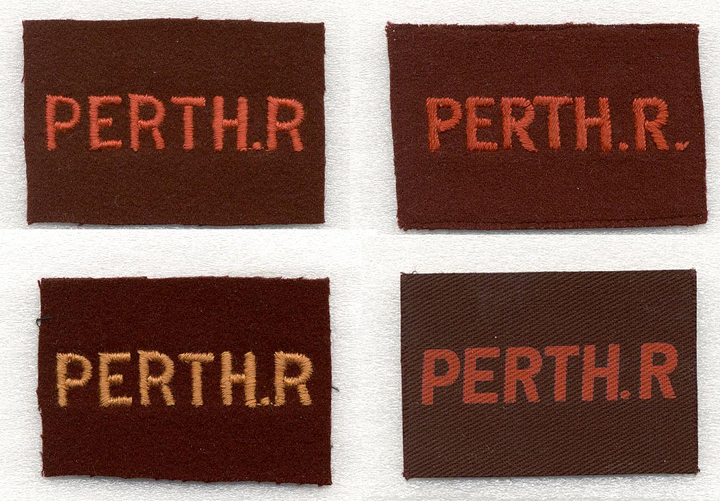
Top row, left, Embroidered single period.
Right, Embroidered double period.
Bottom row, Right, Embroidered single period (orange).
Left, Printed single period.
There are four known variants of the Perth R distinguishing patch, all with unique characteristics. The upper two in the picture are embroidered red lettering on a maroon divisional patch. The primary difference between the two is the additional period after the “R” for the patch on the right. The third variant was originally thought to be a faded example. In fact it is not faded but rather a different dye lot used in the lettering. The fourth example is a printed canvas example.

Details of the reverse of the distinguishing patches
In Italy, distinguishing patches were worn either sewn directly onto the battledress, khaki drill shirts also known as bush shirts or were worn on brassards. Removing the insignia on a brassard made cleaning the garments that much easier.
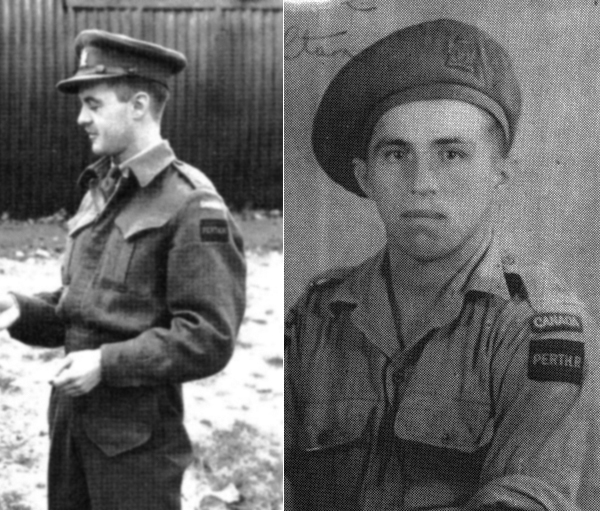
Left, Perth R dist patch worn on battledress.
Right, Printed PERTH R worn sewn directly onto a khaki drill shirt

Left, PERTH R brassard worn on bushjacket, Right, Details of original brassard
It was expected that all members of the unit wear the PERTHR distinguishing patches on all their uniforms. Due to supply problems it was noted on Mar 24 1944 that regular divisional patches could be worn on greatcoats for “personnel who have not got three sets of Perth patches.”
In anticipation of the regiment’s move from the Italian theatre to join 1st Canadian Army in NW Europe, the regiment ordered on Feb 10 1945 that “all unit titles, div and brigade patches and the CVSM ribbon will be removed. “
The move away from distinguishing patches in favour of unit titles over plain divisional patches had begun much earlier for the units already serving in NW Europe. In the name of consistency, it had been decided units from the 1st Canadian Corps would adopt this method of insignia.
The design of the Perth Regiment’s shoulder flashes had begun almost a year earlier. On April 28th 1944 while the unit was still in Italy, a design was approved which would be the blueprint for the printed canvas title.

Printed canvas titles had first been issued to units in England as early as late 1943. The Perth Regiment would not receive theirs until the spring of 1945

Top, Canvas shoulder title.
Bottom, Pte Ken Earl wearing the printed canvas title Holland 1945 (note the absence of the divisional patch)
The government had done some earlier testing with the printed titles to ascertain their longevity. It was found that the printed variety tended to fade over time and was more likely to curl at the edges with wear. Cloth embroidered titles tended to be more popular with the men and these would often be seen on their best or walking out uniforms.
One of the first of these titles to make its way overseas was courtesy of the Stratford chapter of the IODE (Imperial Order Daughters of the Empire). As a sign of supporting their regiment overseas, they raised money to have shoulder flashes made and sent to the unit.

Left, Article from the Stratford Beacon Herald
Right, Capt Smith wearing IODE title

There are a couple of other variants of shoulder flashes that were introduced and worn by the unit before its return to Canada in Jan 1946.
The title below tried to mimic the design of the printed canvas 2 coloured titles. It is Canadian made and would have only been worn after the cessation of hostilities when the unit was stationed in Sneek Holland.
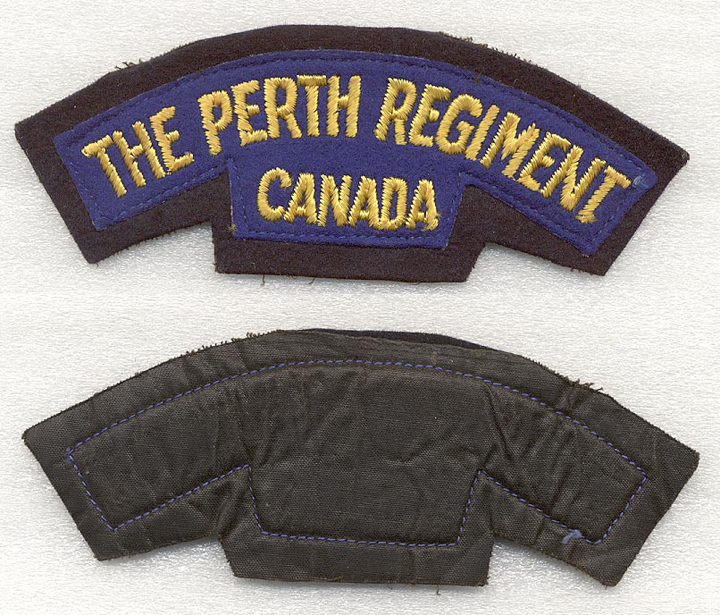

The final wartime title is one that was not worn by the 1st battalion during the war. It is Canadian made and may have been worn by the reserve battalion in Stratford. Examples of this title are always found in mint condition.

They appear to have some stitch marks on the back suggesting that they were being sewn onto a uniform. The stitch marks are incomplete with every example having the same marks.
Miscellaneous Insignia
In addition to the standard insignia worn by the regiment during the war, there are a number of additional pieces of insignia that were worn by members of the unit.

Left, Original jacket with 8th Army patch
Right, Details of 8th Army patch
While the regiment was in Italy, it was part of the famous British 8th Army. This was something many of the men identified with. Being a member of this formation was something to be proud of. Some started to wear the 8th Army crusader patch on their left epaulette. While not something seen on a uniform while the unit was in theatre in NW Europe, it could be found on men convalescing in London. It was done against regulations. As Perth veteran Stan Scislowki recalls it was only when some &%$#@ provost came by that he was forced to take it down.

Left, Battledress of a Major attached to CMHQ
Right, Embroidered CMHQ patch
Personnel attached to other formations continued to wear their unit shoulder flashes, but wore the patch of the formation they were with instead of the maroon rectangle of the 5th Armoured Division.

The CAPF patch worn on a greatcoat. A total of 73 Perths joined the CAPF
The end of the war in Europe allowed Canada to turn its focus on the Pacific War. Members who volunteered to join the Canadian Army Pacific Force (CAPF) wore a 6 colour octagon patch sewn onto their existing formation patch. The six coloured patch (each colour represented one of the divisions plus black for the armoured brigades) was worn with black and red at the top of the patch.
Regimental Buttons
The Perth Regiment did not have a regimental button during the war. The book “Buttons of the Canadian Militia” by Eric Smylie incorrectly attributes a black rifle regiment button to the regiment for the period 1920-1952.
Unlike many militia and regular force units that had regimental and corps buttons prior to the war, the Perth Regiment wore GS (general service) brass buttons on their service dress and great coats.

Examples of Regimental buttons.
Left to right, Lord Strathcona’s Horse, Hastings and Prince Edward Regiment, Regiment de Maisonneuve and the General Service button
On Oct 22nd 1943, a formal request was made to CMHQ for a regimental button. Enclosed was a proposed design for the button that would include the Perth county coat of arms. CMHQ referred to a Canadian Army Routine Order dated Oct 1942 that stated that regimental buttons would no longer be manufactured. The Perths were a year too late. The request was denied.

By Clive M. Law
When, in 1911, the Department of Militia & Defence (M&D) ordered the transition from the white Universal helmet to the white Wolseley pattern helmet they permitted existing pugarees to continue to be worn. This satisfied the need for regimental identities for most orders of dress. However, the 1904 introduction of drab Service Dress called for either a khaki cover to the helmet or a khaki helmet left the Militia with little opportunity for regimental expression.

Plain Wolesley helmet, dated 1913 and marked with the Canadian C/Arrow property mark.
Although most khaki helmets are unadorned photographic evidence shows that some regiments adopted a regimental flash for the khaki helmet prior to the First World War. This practice only received official sanction in 1935 following British practice where, in 1934, Dress Regulations permitted the use of flashes or other embellishments on the Wolseley. The adornment could be worn either directly on the helmet or on the khaki cover to the white helmet.

Unit flashes sewn to the khaki cover.
Left, 2nd Divisonal Canadian Engineers, ca. 1930.
Right, Queens’ York Rangers, ca.1940

Pugaree and badge as worn b y the 38th Dufferin Rifles. Courtesy emedals.com

A khaki Wolesley helmet with an extravagant pugaree and the badge of the 38th Battalion, later the Cameron Highlanders of Ottawa.
– Pugaree – a cloth wrapping around the base of the helmet’s crown. The pugaree can be plain, consist of a set number of folds, include colour folds or consist of a simple coloured ribbon
– Badge – a regimental badge, placed either on the side or on the front.
– Flash – a rectangular piece of material featuring the regimental tartan, or colours, often in silk but could be made of any material
– Embellishment – typically a plume or hackle.

Three examples of helmets displaying flashes only.
Left, Hastings and Prince Edward Regtiment, ca. 1940.
Centre, Royal Canadian Engineers, ca. 1938.
Right, Duke of York’s Royal Canadian Hussars, ca. 1940

Two Second World War examples of helmets with ’embellishments’. Both of these were approved in the 1943 War Dress Regulations.
Left, Royal Highlanders of Canada (Black Watch).
Right, Governor General’s Foot Guards.
Khaki helmets, when adorned, will often use one or two of the above although examples exist where three elements are incorporated. The author has yet to find an example where all four elements have been used on a single helmet.

Four styles of helmets displaying multiple adornments.
Top row, left, Royal Winnipeg Rifles.
Right, Royal Canadian Army Medical Corps.
Bottom row, left, Victoria Rifles of Canada.
Right, 12th Manitoba Dragoons.
The challenge to collectors is the identification of many flashes. Although headquarters’ approval was required no central files were kept and details can only sometimes be found in individual unit records.
In lieu of the approved Wolseley pattern helmet, officers also purchased a Cawnpore-style helmet. Examples show that this pattern helmet often included a badge placed at the front whie others include a flash.

In addition to the Wolseley pattern helmets, many officers procured Cawnpore-style sun helmets.
Top row, left, Fort Garry Horse.
Right, unidentified.
Bottom row, left, Royal Canadian Army Service Corps.
Right, Royal Canadian Artillery.
By the mid-1940s the khaki helmet was no longer in wear.
by Clive M. Law
Shortly after the adoption of the Home Service Helmet in 1878 by the British War Office, the Canadian Department of Militia and Defence (M&D) followed suit. However, within a few years this pattern, which included blue helmets for Infantry and the various Corps, Green for Light Infantry and a short-lived dark Green for Rifle regiments, M&D did a volte face and ordered the white ‘Foreign Service’ pattern helmet for general use.

A Royal Canadian Artillery Universal Pattern Helmet Circa 1905
It has been stated that the change followed comments by British officers on exchange to Canada who believed that, as they were attached to M&D on Foreign Service, then certainly all Canadians were also on ‘foreign service’ as they were not serving in Great Britain.
Whatever the actual reason, in 1886 the white helmet was adopted for use throughout the Canadian Militia but was termed, in Canada, as the ‘Universal’ pattern helmet. Notwithstanding the date of adoption, the Canadian Engineers wore the universal pattern as early as 1880.

The Canadian “Blue Cloth” helmet featuring the Queen’s Crown
Early examples were obtained from British suppliers but Canadian firms, such as William Scully of Toronto (and later, Montreal) began production. However, some regiments chose to purchase US-made helmets for both cost and speed of delivery. M&D swiftly put a stop to this arguing that the US helmets did not conform to War Office specifications.

A period photo of three officers of the 5th British Columbia Artillery circa 1895
The Universal Pattern helmet in Canadian wear followed regulations set down in Britain insofar as description and furniture but, as is to be expected, Canadian pattern helmet plates were used.
By the mid-1890 a number of regiments sought, and obtained, permission to wear coloured pugarees. These range from a simple silk scarlet pugaree wrapped around the crown to detailed, multi-coloured pugarees. As was typical of the Canadian Militia of the day, adherence to regulation was in inverse proportion to the distance to the local headquarters resulting in a number of regiments adopting colourful pugarees with no prior approval. Most regiments however, either retained the integral single-fold band or elected to use a white, multi-fold pugaree.

The 32nd Battalion Band (circa 1886) wearing four-panel American sun helmets
It was this white Universal pattern helmet that was worn by Canadians in the Boer War. In keeping with local orders, the helmet was covered with a khaki cover and later, the white helmet itself was field-coloured khaki.
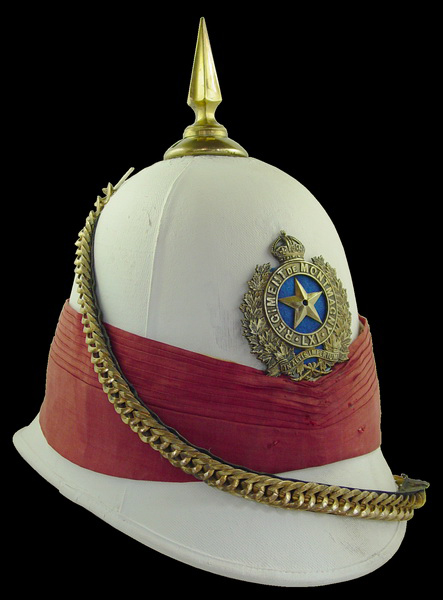
A helmet to the 61t Battalion Regiment de Montmagny circa 1907
By 1910 the use of large helmet plates was discontinued and Regiments were permitted to use the badge normally worn on the forage cap. That same year M&D advised officers that the Wolseley helmet would soon be introduced into wear. By mid-1911, Routine Orders advised the change to Dress Regulations and the Wolseley helmet formally replaced the Universal pattern helmet.
by Roger V. Lucy
While it became more common after the Armistice than during the War, many CEF units had their regimental or arm of service badge or their unit battle flash painted on the front of their steel helmets.
While there is photographic evidence but virtually no documentation of the practice before 11 November 1918, the end of hostilities brought on a flurry of helmet painting. For example, the GOC 1st Canadian issued a circular on 23 November 1918 which instructed Battalion COs to have their unit’s helmets painted as soon as possible “…with the old Red Patch and the Regimental crest in any combination preferred by battalions, as it is the most uniform and striking head-dress we have.” The response seems to have been to apply the battalion’s formation patch.
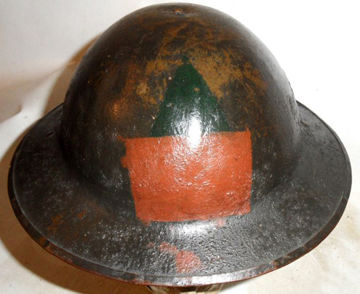
1 Div 3rd Bn CEF
3rd Canadian Division Orders of 27 November 1918 were more prescriptive. Helmets were to be sent to the central depot and painted grey. The unit badges were to be stencilled at the front. Painted cap badges were in red for most arms and services..

3 Div RCAMC
The badges of 7th Brigade were to be painted in green
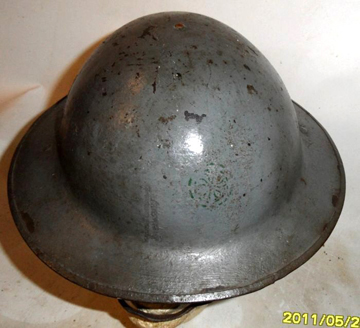
3 Div PPCLI
The badges of the battalions in the 8th Brigade were to be painted in red.

3 Division 5th CMR
The badges of 9th Brigade were to be painted in blue.
The badges of 3rd MG Battalion and the divisional veterinary company were to be maroon, and the Division’s Signals, Motor Transport and Train in white. The Division’s staff was to apply light blue badges.
There were some exceptions to this. At least one battalion, the 58th applied not only its cap badge, but on the back of the helmet its formation patch.

3 Div 58 Battalion formation patch verso

3 Div 58 Bn badge, recto.
More lavishly, at least some members the 4th CMR mounted their actual brass cap badge on their helmets.

3 Div 5th CMR private collection
© Bill Alexander 2010
In the late summer of 2001, Canada was asked to participate in a NATO operation in the Former Yugoslav Republic of Macedonia (FYROM). Ethnic Albanians had taken refuge in the Macedonian territory and were threatening to overthrow the Macedonian government. At the request of that small nation’s president, NATO moved to disarm the Albanians and destroy their weapons. Operation Essential Harvest was to last 30 days, commencing on August 27, 2001.
Task Force Harvest, the field component of Operation Essential Harvest, was a 4,400-strong multinational force comprising personnel from 14 nations, including Belgium, Canada, the Czech Republic, France, Germany, Greece, Hungary, Italy, the Netherlands, Norway, Portugal, Spain, Turkey and the United Kingdom.
The Canadian contingent consisted of about 200 Canadian Forces members, as follows:
Three staff officers working at Task Force Harvest Headquarters in Skopje, Macedonia
- A Squadron, The Royal Canadian Dragoons, a 145-strong armoured reconnaissance squadron based at Petawawa, Ontario and re-assigned from Operation Palladium in Bosnia-Herzegovina
- A National Command Element of about 45 personnel from the Canadian Forces Joint Operations Group in Kingston, Ontario
- A National Support Element of about 10 personnel from units in Canada and Bosnia.
The RCD’s deployed to a camp west of Skopje Macedonia. The Dragoons, using Coyote reconnaissance vehicles, carried out observation, scouted routes and escorted convoys. They set up camp on August 31, and were ready to carry out their first mission, a convoy escort, on September 2. At the end of September, when the NATO monitoring operation began, the Dragoons returned to Bosnia and their duties as part of Operation Palladium. The Canadian contribution to the mission finally closed with the return of the last staff officer from Skopje at the end of September, 2002. Members of the Canadian contingent to FYROM wore combat uniforms with the appropriate combat insignia, depending on their regimental affiliation. These included the Canadian flag (some images show it in red and white colour rather than subdued) an RCD and NCE combat titles.
In addition to combat insignia, a brassard sporting a white triangle with the abbreviation TFH in white letters was worn on the arm of the combat uniform. The short duration of the operation and relatively small size of the contingent required a limited number of brassards, and these are seldom seen. The example pictured is screen printed on a Canadian issue armlet. Other national elements produced patches or armlets for their contingents.

 CSMMI MILART