
by Mark W. Tonner
The Matilda tank in Canadian Service
As stated earlier in Part 1, the main Canadian users of the Matilda tank were the 12th Canadian Army Tank Battalion (The Three Rivers Regiment (Tank)), and 14th Canadian Army Tank Battalion (The Calgary Regiment (Tank)) (hereafter referred to as the Calgary Regiment, and the Three Rivers Regiment, respectively), of the 1st Canadian Army Tank Brigade, and No. 1 Canadian Ordnance Reinforcement Unit.

An example of the Infantry Tank, Mark III, Valentine, that the 1st Canadian Army Tank Brigade was to have been equipped with. Source: MilArt photo archive.
The 1st Canadian Army Tank Brigade, commanded at that time by Brigadier F.F. Worthington, was the first formation of the Canadian Armoured Corps (CAC) to arrive in the Untied Kingdom, landing on 30 June 1941. The General Officer Commanding, Canadian Corps (VII Corps), Lieutenant-General A.G.L. McNaughton had been anxious to add an armoured formation to his force in the Untied Kingdom at the earliest possible moment, and had encouraged the authorities in Canada to hasten the departure of Brigadier Worthington’s, 1st Canadian Army Tank Brigade as much as possible. The brigade came under command of the Canadian Corps immediately upon its arrival in the United Kingdom. At this time, the brigade consisted of the following units:

An example of the new Infantry Tank Mark IV, Churchill (A22), that came straight from the Vauxhall Motors production line, that was issued to the Ontario Regiment on 10 July 1941, being inspected by Lieutenant-General A.G.L. McNaughton (hatless) and Brigadier F.F. Worthington (standing on the upper track run, with his back to the camera). Source: authors’ collection.
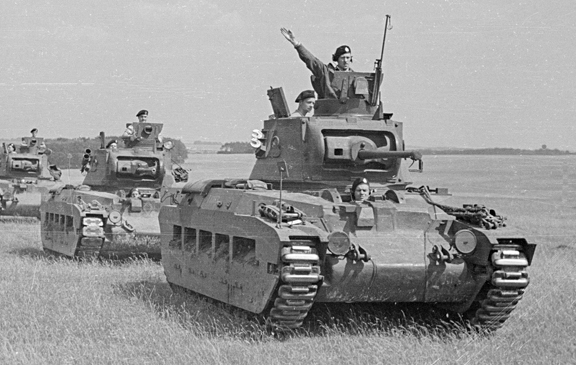
A column of Matilda tanks of the 12th Canadian Army Tank Battalion (The Three Rivers Regiment (Tank)), led by T10163, a Mark IIA* Matilda III, which was taken-on charge of the Canadian Army Overseas, and issued to the Three Rivers Regiment, on 16 July 1941. Source: MilArt photo archive.
Headquarters, 1st Canadian Army Tank Brigade, CAC
- 1st Canadian Army Tank Brigade Headquarters Squadron (The New Brunswick Regiment (Tank)), CAC
- 11th Canadian Army Tank Battalion (The Ontario Regiment (Tank)), CAC
- 12th Canadian Army Tank Battalion (The Three Rivers Regiment (Tank)), CAC
- 14th Canadian Army Tank Battalion (The Calgary Regiment (Tank)), CAC

In the background is T10163, a Mark IIA* Matilda III, taken-on charge of the Canadian Army Overseas on 16 July 1941, and in the foreground is T17700, a Mark IIA* Matilda III, taken-on charge of the Canadian Army Overseas on 14 July 1941. Both of these tanks served with the Three Rivers Regiment, while in Canadian service. Source: MilArt photo archive.
Army tank brigades were independent formations under army control, as opposed to armoured brigades that were part of the armoured divisions. The sole role of the army tank brigades was infantry co-operation, and they were usually attached to an infantry division as the operational situation demanded. The tank battalions in the brigade were intended to provide intimate support to the infantry and were equipped with heavy ‘infantry’ tanks, in contrast to the lighter cruiser tanks used by the armoured brigades in the armoured divisions. At the time that 1st Canadian Army Tank Brigade arrived in the United Kingdom, the war establishment of a Canadian army tank battalion, at this time, called for an authorized fighting strength of 58 infantry tanks to be held by each battalion, inclusive of six infantry tanks close support. The organization of an army tank battalion at this time was:

In the foreground is a Mark IIA* Matilda III Close Support, armed with the 3-inch howitzer (with the co-axial 7.92-millimetre Besa machine gun mounted on it’s right). Although this particular tank (T29795) did not serve with the Canadian Army Overseas, the Mark IIA* Matilda III Close Support tanks that were issued to the Calgary, and Three Rivers Regiments, respectively, would have appeared as such. Source: IWM (H 11654).
a Battalion Headquarters
- with either four cruiser or four infantry tanks close support with a total strength of 17 all ranks
a Headquarters Squadron, consisting of:
- a squadron headquarters
- an intercommunication troop, with nine scout cars
- an administrative troop with a total squadron strength of 133 all ranks
three Squadrons, each consisting of:
- a squadron headquarters, with one cruiser or infantry tank, and two cruiser or infantry tanks close support
- five troops, with three infantry tanks each with a total strength of 154 all ranks per squadron for a total authorized tank battalion strength of 612 all ranks.

A Mark IIA* Matilda III of the Calgary Regiment, barring the War Department number T10159, which was taken-on charge of the Canadian Army Overseas, and issued to the Calgary Regiment, on 14 July 1941. Although not visible, this tank was named RINGER, and served with Battalion Headquarters of the Calgary Regiment, until being withdrawn from Canadian service and returned to the British on 1 December 1941. Source: MilArt photo archive.
The 1st Canadian Army Tank Brigade was to have been equipped with the Canadian-built Infantry Tank, Mark III, Valentine, before leaving Canada. However, because of delays in Canadian tank production, Lieutenant-General McNaughton set out to persuade the British War Office to lend tanks to the incoming 1st Canadian Army Tank Brigade. These would be replaced with Canadian-built tanks when Canadian production problems were overcome. With the added support of the British Army’s Commander of the Royal Armoured Corps, Major-General G. Le Q. Martel, he was successful in this endeavour.
Immediately upon arrival in the United Kingdom, 1st Canadian Army Tank Brigade was able to draw equipment on a respectable training scale. The Ontario Regiment was equipped with the new Infantry Tank Mark IV, Churchill (A22), straight from the Vauxhall Motors production line, while the brigade’s other two battalions, the Three Rivers Regiment and the Calgary Regiment were issued with the Infantry Tank Mark IIA*, Matilda III (with twin Leyland diesel engines, a 2-pounder Ordnance Quick Firing gun Mark IX or Mark X, and a co-axial 7.92-millimetre Besa machine gun mounted in the turret, and fitted with the No. 19 Wireless Telegraph Receiving and Transmitting set (a radio set)). The British Directorate of Armoured Fighting Vehicles, also made arrangements, for officers and men of these two regiments, to attend courses on the Matilda, that they ran at three of the firms producing this tank. Each of these courses was five days in length, and were ran at the Vulcan Foundry Ltd., site at Newton-le-Willows, Lancashire, at the Grantham, Lincolnshire, site of Ruston & Hornsby Ltd, and at the John Fowler & Co., site at Leeds, West Yorkshire.

Right-hand side view of T10159, RINGER, a Mark IIA* Matilda III, of Battalion Headquarters, the Calgary Regiment, during a demonstration of ‘Tank Hunting’ with a platoon of the 3rd Canadian Divisional Infantry Reinforcement Unit, in the vicinity of Headley, Hampshire, on 9 October 1941. Source: authors’ collection.
As with the Churchill tanks that the Ontario Regiment began to receive, the Matilda tanks that began being issued to the Three Rivers Regiment and the Calgary Regiment, were received from the British through No. 1 Canadian Base Ordnance Depot, Royal Canadian Ordnance Corps, located at Bordon Camp, Hampshire. No. 1 Canadian Base Ordnance Depot, as with the Churchill tanks, took the Matilda tanks onto Canadian charge, and after inspecting them for any mechanical faults, and insuring that all the appropriate tank tools and equipment for each individual tank were in place, and if not, noting what deficiencies (shortages) there were, passed them onto the charge of the receiving unit.
By the end of July 1941, both the Three Rivers Regiment, and Calgary Regiment, held between them, 29 Mark IIA* Matilda III tanks, while Headquarters 1st Canadian Army Tank Brigade, held one Mark IIA* Matilda III Close Support tank, with a 3-inch howitzer in the turret. The war diary of the Three Rivers Regiment states that as of 31 July, they held on strength 11 Mark IIA* Matilda III tanks, thus leaving ten, as being held on strength of the Calgary Regiment.
During the month of August 1941, a total of 18 Mark IIA* Matilda III tanks were issued between the Three Rivers Regiment, and Calgary Regiment, with the Three Rivers Regiment receiving two, while the remainder were issued to the Calgary Regiment. September saw the issue of an additional 31 Mark IIA* Matilda III tanks, to the Three Rivers Regiment, and Calgary Regiment, with the Three Rivers Regiment receiving 21, while the Calgary Regiment received the remaining ten. Additionally, the Calgary Regiment was issued with one Mark IIA* Matilda III Close Support tank during the month of September. Of note, as of 30 September 1941, of the 71 Mark IIA* Matilda III tanks issued to date, to the Three Rivers Regiment, and Calgary Regiment, 61 of these are shown on the 1st Canadian Army Tank Brigade Readiness Return as ‘in action,’ (battle ready) with the remaining ten shown as being ‘out of action,’ due to various forms of mechanical failure, etc. Both of the Mark IIA* Matilda III Close Support tanks that had been issued to units of 1st Canadian Army Tank Brigade, to date, were also shown as ‘in action.’
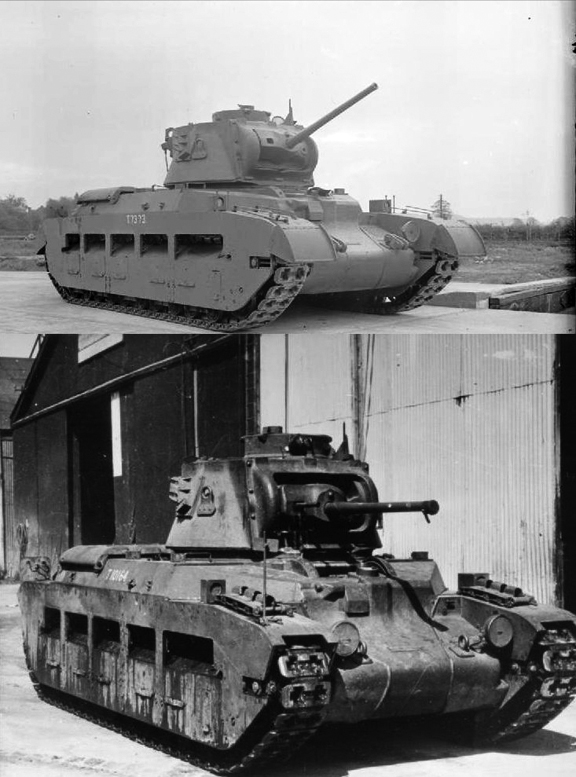
As mentioned at the end of Part 1, the Mark IIA Matilda II (powered by twin AEC diesel engines), and the Mark IIA* Matilda III (powered by twin Leyland diesel engines), could only be identified as such from the rear, by the simple fact, that the Mark IIA Matilda II had only had one exhaust pipe running down the left side of the engine deck, while the Mark IIA* Matilda III had an exhaust pipe running down each side of the engine deck. As can be seen in this photo, other then the exhaust pipe(s), both the Mark IIA Matilda II, and the Mark IIA* Matilda III were identical in appearance when viewed from the front. The top image is of a Mark IIA Matilda II (Source: IWM (KID 782)), while the bottom image, is of a Mark IIA* Matilda III (Source: IWM (MH 9264)).
The month of October 1941, was the last month in which the Mark IIA* Matilda III tank, was issued to units of the 1st Canadian Army Tank Brigade, with a total of 18 having been received by months end. The war diary for the Three Rivers Regiment states that as of 31 October 1941, out of an entitlement of 45 infantry tanks, they held on strength a total of 42 Mark IIA* Matilda III tanks, while the war diary of the Calgary Regiment, reflects that out of an entitlement of 45 infantry tanks, they held on strength a total of 4 Mark IIA* Matilda III and two Mark IIA* Matilda III Close Support tanks. Of the 89 Mark IIA* Matilda III tanks held by the Three Rivers Regiment, and Calgary Regiment, as of 31 October, the 1st Canadian Army Tank Brigade Readiness Return reflects that 84 of these were ‘in action,’ with the remaining five as being ‘out of action.’ Both the Mark IIA* Matilda III Close Support tanks, held by the Calgary Regiment (one with “A” Squadron headquarters, and one with “C” Squadron headquarters), were shown as being ‘in action,’ on the Readiness Return of 31 October 1941.
Continued in Part 3 – The Infantry Tank Mark II, Matilda II (A12) in service with the Canadian Army Overseas
You can rate this article by clicking on the stars, below.
by Mark W. Tonner
Introduction
The Matilda II (A12) was an ‘Infantry’ (or ‘I’) tank which was specifically designed to fight in close support of infantry operations, or as the British General Staff defined it, “the role of the infantry tank is the assault in the deliberate battle in conjunction with other supporting arms.” For this role, the requirements for an infantry tank, as the British General Staff saw it, were that the tanks have heavy armour, powerful armament, good obstacle-crossing performance, with reasonable range and speed. It was the second in the British series of infantry tanks, with its predecessor being, the Infantry Tank Mark I, Matilda I (A11).

A 3/4 front view of the pilot model of the Infantry Tank Mark I, Matilda I (A11), designated A11E1 (and baring the War Department number T1724, and the Road Registration number CMM 880), which was delivered for trials in September 1936, to the British Mechanization Experimental Establishment, Farnborough, Hampshire. Source: IWM (KID 68).
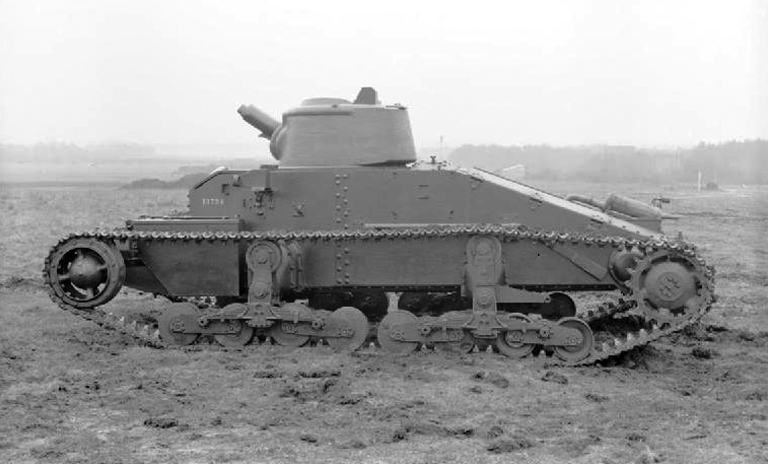
Mechanization Experimental Establishment. By November 1939, the limitations of the solitaire machine gun armament (either one .303-inch Vickers machine gun, or one .50-inch Vickers machine gun) of the A11, and the need for better armoured protection of the crew, and for greater firepower, lead, to the design of the Infantry Tank Mark II, Matilda II (A12), since to incorporate the needed improvements, was not feasible with the basic A11 design. Source: IWM (KID 158).
A brief note on the nomenclature (names) used by the British for the various variants of the Infantry Tank Mark II, Matilda II (A12). The suffix letter ‘A’ denoted a change in the armament of the co-axial machine gun, from that of the .303-inch Vickers machine gun, to that of the 7.92-millimetre Besa machine gun. The asterisk denoted that the power units, had been changed over to Leyland twin diesel engines, from that of AEC twin diesel engines.
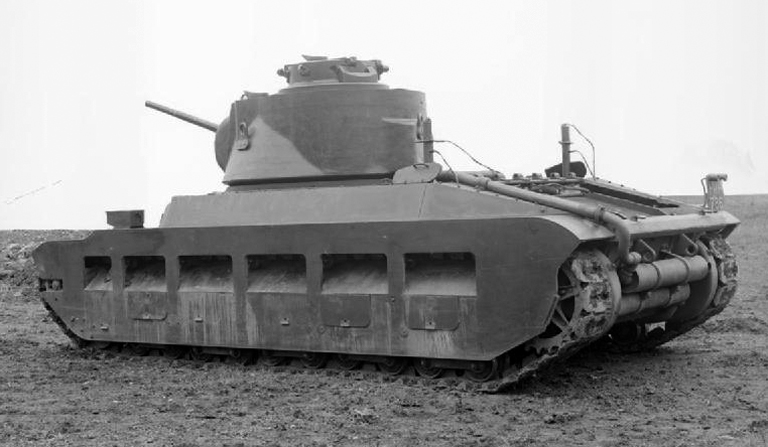
A 3/4 rear view of the pilot model Infantry Tank Mark II, Matilda II (A12), designated A12EA1 (barring the Road Registration number HMH 786). This pilot model was delivered for trials in April 1938, to the British Mechanization Experimental Establishment, Farnborough, Hampshire. Source: IWM (KID 465).

A right-side view of the pilot model Infantry Tank Mark II, Matilda II (A12), A12EA1, while undergoing trails at the British Mechanization Experimental Establishment. A12EA1, was powered by twin commercial AEC straight six-cylinder water-cooled diesel engines, making the Infantry Tank Mark II, Matilda II (A12), the first British tank in service to use diesel engines. Source: IWM (KID 1542).
Prior to June 1940, the Infantry Tank Mark II, the Infantry Tank Mark IIA, and the Infantry Tank Mark IIA*, had been simply known as the A12. As of 11 June 1940, to differentiate the various changes in armament or power units, the nomenclature was further broken down by designating the Matilda, whose co-axial machine gun was that of the .303-inch Vickers machine gun, and whose power units were AEC twin diesel engines, the Infantry Tank Mark II. Those with the 7.92-millimetre Besa co-axial machine gun, and whose power units were AEC twin diesel engines, were designated the Infantry Tank Mark IIA, while those with the 7.92-millimetre Besa co-axial machine gun, and whose power units were Leyland twin diesel engines, was designated the Infantry Tank Mark IIA*. As of July 1941, the nomenclature of the Matilda was changed yet again. The Infantry Tank Mark II, was designated the Matilda I, while the Infantry Tank Mark IIA, was designated the Matilda II, and the Infantry Tank Mark IIA*, was designated the Matilda III.
The main Canadian Army Overseas users of the Matilda tank were the 12th Canadian Army Tank Battalion (The Three Rivers Regiment (Tank)), and 14th Canadian Army Tank Battalion (The Calgary Regiment (Tank)), of the 1st Canadian Army Tank Brigade, and No. 1 Canadian Ordnance Reinforcement Unit.
British Development and Production of the Infantry Tank Mark II, Matilda II (A12)
The need for better armoured protection of the crew, and for greater firepower, lead to the design of the Infantry Tank Mark II, Matilda II (A12), since to incorporate the needed improvements was not feasible with the basic Infantry Tank Mark I, Matilda I (A11) design. The new design for the A12, drawn up by the British Mechanization Broad, called for increased armour thickness, a commercial AEC straight six-cylinder water,-cooled diesel engine, and heavy armoured side skirts to protect the suspension. It also called for a crew of four, as opposed to the A11 crew of three, and initially, the design called for a turret mounting two co-axial machine guns as the main armament. This was quickly changed to a three-man turret mounting a 2-pounder anti-tank gun and a co-axial Vickers machine gun. At the time, in view of the A12’s proposed role as that of an infantry tank in close support of infantry operations, there were some who advocated that a main armament capable of firing high explosive rounds should be mounted. The British General Staff however, declared that the Matilda II (A12) was to protect the infantry from enemy tanks, and thus the 2-pounder anti-tank gun, which at the time was the best anti-tank gun in the world, was to be used as the main armament. However, an agreement was reached whereby the turret should be made capable of mounting a 3-inch howitzer1 as an alternative to the 2-pounder anti-tank gun, which was only envisioned at the time, and that the howitzer was only required to fire smoke rounds as cover for gun tanks.

Work is finished off on a Matilda tank, at a factory somewhere in the United Kingdom. Note the grinding down of rough surfaces, which is being done by a worker on the rear deck. Source: IWM (D 9191).
In November 1936, Vulcan Foundry Ltd., of Warrington, Lancashire, was directed to produce a wooden mock-up of the A12 design. The mock-up was inspected in April 1937, by which time the British Mechanization Broad had decided to use twin AEC diesel engines coupled together instead of just one AEC diesel engine. Each engine was capable of delivering a maximum 87-brake horsepower2 at 2,000-rotations-per-minute. The Matilda II (A12) was the first British tank in service to use diesel engines. Having accepted the mock-up, Vulcan Foundry was directed to produce two pilot models of mild steel construction (with the assigned designations of A12EA1 and A12E2, bearing the War Department numbers T-3431 and T-3432, respectively – Contract No. T.3951, dated 25 May 1937). Construction of the pilot models was however held up by the delay in the delivery of component parts and it wasn’t until April 1938, that the A12EA1 (War Department number T-3431) pilot was delivered for trials to the British Mechanization Experimental Establishment, at Farnborough, Hampshire. Trials were generally satisfactory, but some small modifications were needed to the gearbox, suspension and cooling system. In June 1938, an initial order for 140 Matilda II (A12) tanks was placed with the Vulcan Foundry Ltd., followed in August by an order for 40 more which were manufactured at the Grantham, Lincolnshire, site of Ruston & Hornsby Ltd., under Vulcan, who were responsible for overall production. As the threat of war became a reality other firms, all operating under the leadership of the Vulcan Foundry Ltd., began the manufacture of the Matilda II (A12). These firms were, the John Fowler & Co., of Leeds, West Yorkshire, the North British Locomotive Company of Glasgow, Scotland, Harland & Wolff of Belfast, Northern Ireland, and the London, Midland & Scottish Railway Company at their Horwich Locomotive Works site. Vulcan Foundry Ltd.’s own production line for Matilda II (A12) was located at their Locomotive Works, Newton-le-Willows, Lancashire. Generic fittings and electrical equipment that each Matilda tank was to have, was supplied to the firms working under Vulcan’s direction from a vast number of suppliers within the United Kingdom.
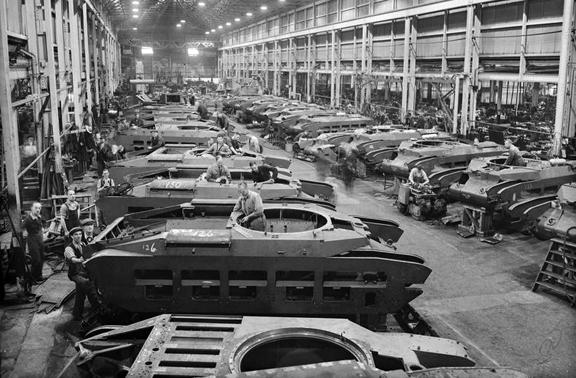
The view of a busy Matilda tank assembly line, at a factory somewhere in the United Kingdom. Source: IWM (P 58).
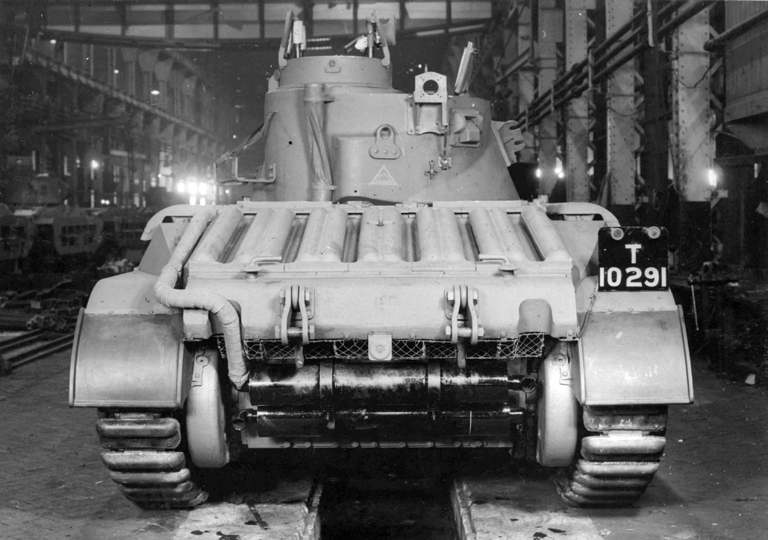
As noted in the text, the Mark II Matilda II, and the Mark IIA Matilda II, that were powered by twin AEC diesel engines, could be identified from the rear, by the simple fact, that only one exhaust pipe ran down the left side of the engine deck, as can be seen here on the rear of T10291, a Mark II, Matilda II. Source: authors’ collection.
The most significant factor in the A12 design, was its armour protection, which at the time could withstand any known anti-tank gun and most other known forms of artillery. The Matilda II (A12) tank was not easily massed-produced. The hull of the Matilda II (A12) was constructed differently than those of most other tanks in that it was built up of specially shaped armour and mild steel castings, and from armour steel plates secured together by rivets and screws, which were so constructed as to form a rigid structure, whereas other tanks used a frame on to which plates were built. The size and shape of its mixture of armoured rolled plates and castings, gave the Matilda II (A12) great strength but demanded a vast amount of specialist skills during the manufacturing process. In areas where these armoured castings were too thick they had to be ground away from the inside, a very time consuming task which required skilled craftsman to carry out. In addition to the hull proper, armoured side protection (skirting) plates carried from the hull on cast steel brackets were provided to give additional protection from gun fire. The interior of the hull was divided into three compartments, the driver’s compartment, the fighting compartment, and the rear compartment (or engine housing) which housed the power units (engines) and transmission gear. Side panniers were provided along the hull sides above the track tunnels. Mud chute plates, designed to protect the suspension gear from mud and stones carried over by the tracks, were provided between the hull sides and the armoured side protection (skirting) plates.
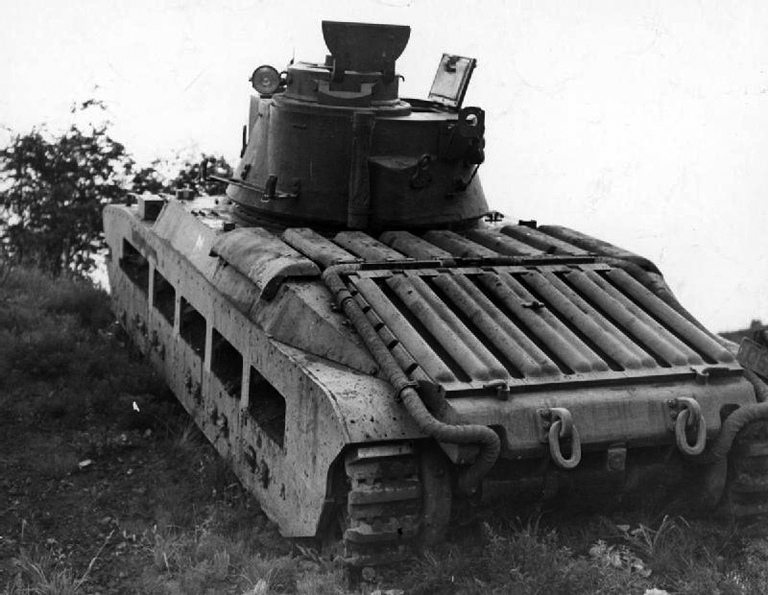
As noted in the text, those Matilda tanks that were powered by twin Leyland diesel engines (the Mark IIA* Matilda III onwards), could be identified by an exhaust pipe running down both sides of the engine deck, as seen in this photo. Source: authors’ collection.
Just as the Matilda II (A12) had entered production, the British War Office came to the decision that the water-cooled .303-inch Vickers machine gun, carried by all British armoured vehicles at that time, would be replaced by the British built version of the Czech ZB air-cooled 7.92-millimetre Besa machine gun, which became the principal co-axial machine gun used in British tanks. This caused a modification in design of the Matilda turret, not only in the mantlet, but also in the elimination of the outlet for the discharge of vapour from the water-cooled Vickers. With the removal of the Vickers the electrically driven pump that maintained its water supply went with it, with this pump’s circuit being modified to provide for an extractor fan in the turret roof. With these modifications the tank became known as the Infantry Tank Mark IIA or the Matilda II. Also, shortly after the beginning of production of the Matilda II (A12), a search for an alternate power unit had begun. Vulcan Foundry Ltd., modified the second pilot model, A12E2 (War Department number T-3432), to fit twin Leyland 6-cylinder diesel engines, each of which was capable of delivering a maximum of 95-brake horsepower. Once the Leyland 6-cylinder diesel engine was accepted, the various contractors involved in the production of the Matilda, under the parentage of Vulcan Foundry Ltd., were ordered to fit them into future models of the Matilda. This was designated the Infantry Tank Mark IIA* or the Matilda III (these were also known as the Matilda Star tank). The twin Leyland diesel engine Matilda III was the first to mount the alternate main armament of a 3-inch howitzer in the turret. These were designated the Infantry Tank Mark IIA*, Matilda III Close Support

Contract No. T.9958 (dated 12 June 1940), to the North British Locomotive Company, under which the highest number (18) of Mark IIA* Matilda III tanks issued to the Canadian Army Overseas was built. Source: authors’ collection.
As a point of interest, the Mark II Matilda II and the Mark IIA Matilda II, powered by twin AEC diesel engines, could be identified from the rear by the one exhaust pipe which ran down the left side of the engine deck, with the other emerging from underneath the hull. Those powered by twin Leyland diesel engines (the Mark IIA* Matilda III onwards) had an exhaust pipe running down both sides of the engine deck. On all Matildas these exhaust pipes ended in a pair of silencers (a device for reducing noise) mounted across the back of the hull, beneath the overhanging rear deck.
Over all, by August 1943, when production of the Infantry Tank Mark II, Matilda II (A12) ended, the British had built approximately 2900 (inclusive of the two pilots) Matilda II (A12) tanks.
Contracts under which Matilda tanks issued to the Canadian Army Overseas, were built:
Contract No. T.5115 (dated 11 June 1938) (the initial contract) – built by Vulcan Foundry Ltd.
Contract No. T.5693 (dated 24 October 1938) – built by John Fowler & Company Ltd.
Contract No. T.5741 (dated 19 April 1939) – built by London, Midland & Scottish Railway Company
Contract No. T.6904 (dated 1 July 1939) – built by North British Locomotive Company
Contract No. T.6905 (dated 19 April 1939) – built by Harland & Wolff Ltd.
Contract No. T.6906 (dated 19 April 1939) – built by John Fowler & Company Ltd.
Contract No. T.6907 (dated 19 April 1939) – built by Ruston & Hornsby Ltd.
Contract No. T.6929 (dated 19 April 1939) – built by Vulcan Foundry Ltd.
Contract No. T.7717 (dated 26 August 1939) – built by North British Locomotive Company
Contract No. T.9862 (dated 12 June 1940) – built by London, Midland & Scottish Railway Company
Contract No. T.9958 (dated 12 June 1940) – built by North British Locomotive Company
Contract No. T.9959 (dated 12 June 1940) – built by Ruston & Hornsby Ltd.
Contract No. T.311 (dated 26 July 1940) – built by Vulcan Foundry Ltd.
Notes:
1. A relatively short barreled gun for firing shells at a high angle.
2. Brake horsepower is the measure of an engine’s horsepower before the loss in power caused by the gearbox and drive train.
Continued in Part 2 – The Infantry Tank Mark II, Matilda II (A12) in service with the Canadian Army Overseas
You can rate this article by clicking on the stars below.
by Major (Ret’d) Paul Harrison, CD
G4 Supply SSF/2 CMBG 1995
Following the 1995 demise of the Canadian Airborne Regiment, it was decided that the Special Service Force (SSF) was to be re-aligned to closely match 1 and 5 Canadian Mechanized Brigade Groups. This resulted, on 24 April 1995, in the creation of 2 Canadian Mechanized Brigade Group (2CMBG), based on the former SSF.
The author had been posted to the Force G4 Supply position in December 1994 and one of his secondary duties included supply requirements that fell outside either the unit level or the national (NDHQ) level of responsibility.
In the spring of 1995 the author was advised that the Brigade Commander wanted a new Brigade patch in wear for a parade to be held in the fall of 1995. In addition to the procurement of the badges, the Base tailor shop would have well over 3000 tunics to re- badge with the associated time requirements.
Although National Defence Headquarters understood the need for quick action they advised that the procurement of new brigade patches would not be possible for at least eighteen months due to other priorities. In light of this it was agreed that NDHQ would provide the funding while the author would raise a contract with support from Base Supply.
Calls were made to known Canadian Forces badge suppliers including Grant Emblem in Toronto, Ontario. In a June of 1995 meeting they reviewed the drawings supplied by the Directorate of Heritage and History and agreed to produce five samples for each of the Distinctive Environmental Uniform (DEU) Land and the Army Garrison Dress Uniform. The cost of the samples was approximately $500. The samples, once received, exhibited excellent work and the initial concern was the degree of detail.
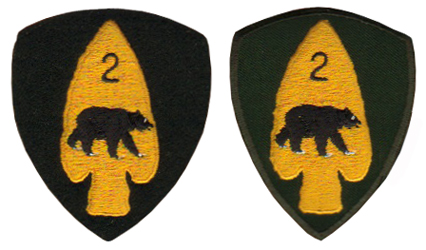
First set of samples included white detail for the bear’s eyes and claws as well as the bear facing to the right. Courtesy Bill Alexander
Both the DEU and Garrison versions had a black bear superimposed onto a gold arrowhead and, in keeping with the artwork provided by DHH, included details such as white claws and an eye. The blessing of the Force RSM, CWO Douglas, was obtained although he subsequently directed that it was critical the bear, moving left to right, be reversed. From a heraldic point of view this was not acceptable, so among the changes transmitted to Grant Emblem was a corrected direction, the removal of the white stitching and amplification of the correct colours. The 2CMBG Commander argued against the change of direction of the bear but was over-ruled by heraldic rules governing badge design within the CF.
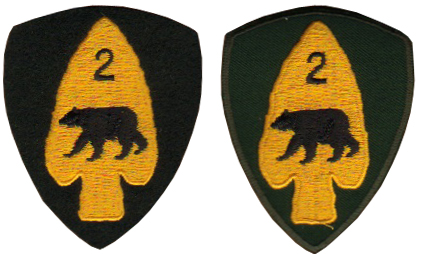
Second set of samples corrected the initial concerns but the colours were incorrect, especially the Garrison Dress badge which did not display the ‘subdued’ colour expected. Courtesy Bill Alexander
It was agreed that the supplier would produce another set of samples and, in July a second set of samples, for both DEU and Garrison dress, was received. The DEU versions were basically correct, although the gold arrowhead colour was a shade off, but the Garrison Dress patches were incorrect, as the arrowhead was still in bright gold and not the subdued colour required. The manufacturer was contacted and a third set was produced. These arrived in August and met all the requirements. At that point sealed samples were produced and sent to the DHH and an order for 7000 examples of each badge was placed. This initial order was based on roughly two patches of each type for all army personnel in 2CMBG.
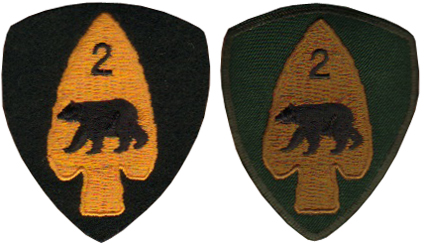
Production examples showing the DEU patch on the left and the Garrison Dress patch on the right. Courtesy Bill Alexander
CF regulations covering the wear of brigade patches stipulated that these were to be worn on the right sleeve. Once the bear was moving in the heraldically correct direction it could be interpreted as ‘running away’ from battle – in fact 5 Brigade was the butt of good-natured ribbing within the army that the lion depicted on their patch was running away, or facing the rear. This resulted in the brigade commander ordering the formation patch to be worn on the left sleeve only and it remained this way for at least the first year.

Officers of the Royal Canadian Dragoons, circa 1997, shown wearing the 2CMBG formation badge on the left sleeve in order to ensure that the bear was facing forward. This practice was tolerated for only a couple of years by NDHQ. DND photo SUC97-87, courtesy Bruce Graham
One framed set, consisting of the first and second sets of samples, along with SSF patches, was presented to the Base Museum at CFB Petawawa. This included all of the original paperwork that had been created and was donated with the understanding that they would remain on display, with the documentation ensuring a recorded history of the procurement. The remaining patches were released among a few collectors and the G4 at that time.
You can rate this article by clicking on the stars below
by Andrew B. Godefroy
© 2014
The wars of the 1990s proved that nations capable of leveraging space-based platforms in operations enjoyed a decided advantage over their adversaries. Allied success in the 1990-91 Gulf War, for example, involved the successful military application of the Global Positioning System (GPS), space-based imagery, theatre missile warning and defence, satellite communications, and space situational awareness. These space systems continued to evolve throughout the 1990s, and towards the end of the decade the Canadian Forces (CF) undertook a series of its own initiatives designed to operationalize various strategic level space-based assets within its field forces. These efforts included the creation of an experimental CF Joint Space Support Team (JSST) within the CF Joint Operations Group (CFJOG) at Kingston, Ontario in 2001.
Formed in early 2001, the JSST initially consisted of only two members (1 officer, 1 NCO), with a third junior NCO joining the team later in the summer of 2001. Throughout its brief existence (2001-2004), the original JSST never included more than four members at any time, typically 2 officers and 2 senior NCOs. Each member was responsible for specific area of expertise. The author served as the only officer commanding throughout this period.
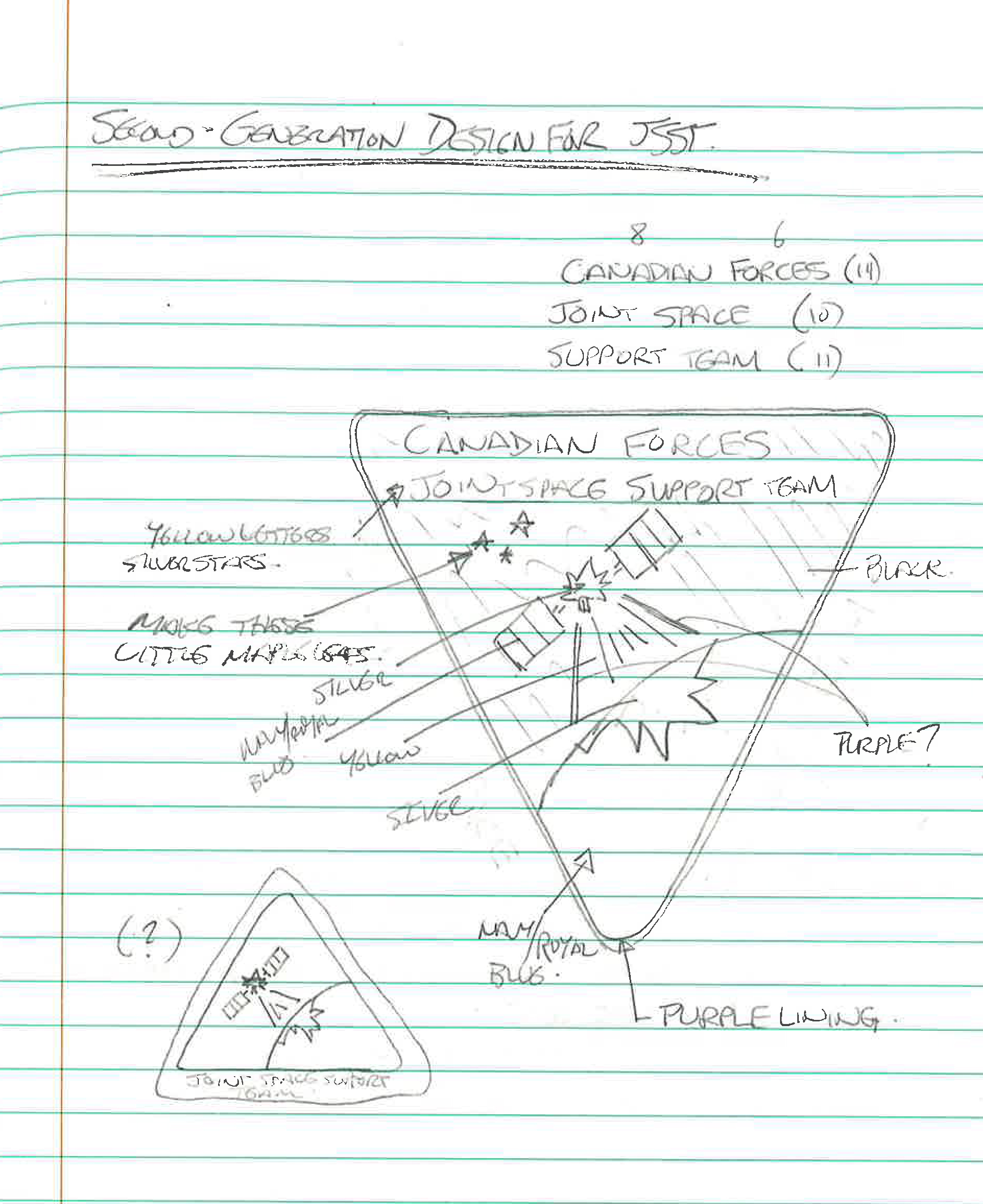
Author’s notebook doodles that led to the final design. Author’s collection
As an experimental team focused on integration, testing, and evaluation, in addition to technology demonstrations and real world operational support, the JSST was also tasked to trial a variety of new combat uniform patterns and badges. The first members arrived in their posts still wearing the Cold War era olive drab combat uniforms, but this soon changed when the CF introduced the new CADPAT combat clothing the following year. Still, even though the team operated in a defined area within the CFJOG headquarters, unlike the CF Disaster Assistance Response Team (DART) officers and NCOs it remained difficult to visually discern at a glance exactly who the JSST members were.
The idea of creating a specific insignia identifier to be worn by JSST members was first raised by the CFJOG Chief of Staff at a weekly coordination meeting in April 2001. The CFJOG itself had just recently formalized its own new crest and other specialized units then under command, such as the CF DART, were already wearing special insignia in the headquarters on olive drab brassards. It was therefore suggested that while the JSST was attached to the CFJOG, it should adopt a similar practice for ease of identification. The author forwarded the request back to the Directorate of Space Development (D Space D) in Ottawa, which after a short period of consideration replied favourably to the idea.
Insignia Concepts
The author was subsequently tasked to propose a small number of designs for consideration. There were caveats applied of course. D Space D had expressed a desire that in order to best promote both the team and the project that it was a part of the final insignia design should easily stand out from other traditional military styles. D Space D therefore directed early on to come up with something unique and therefore to avoid using the typically popular 4-inch diameter circular patch as the basis for the team’s insignia. The author consulted various sources for other ideas, including the variety of insignia then in use by Canada’s civilian space program. This proved helpful as space programs employed a wide variety of shapes depending on the program, project, or mission.
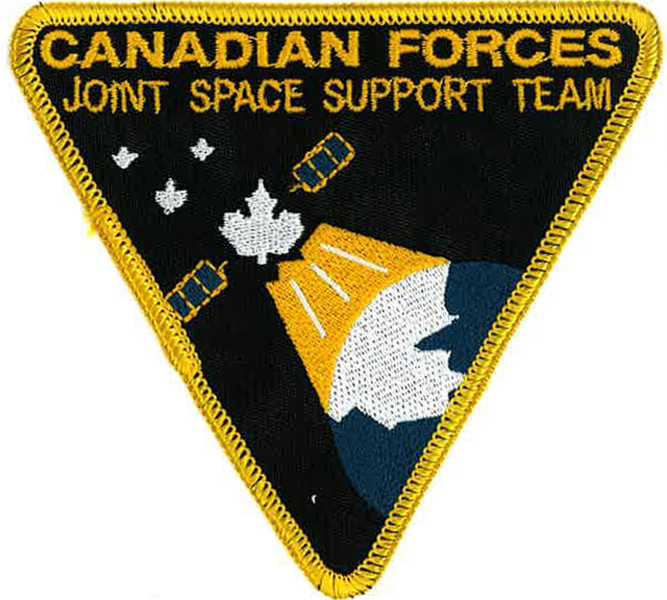
The JSST insignia with D Space D’s own directorate logo was also designed by author, in 1999, while serving at NDHQ. Author’s collection
D Space D also directed that any and all design proposals should align the JSST insignia with D Space D’s own directorate logo in order to strengthen the Canadian defence space community’s overall ‘brand’. Several scribblings and conversations later the author arrived at a final proposal for the JSST insignia. Like all Canadian military patches it seemed necessary to include a maple leaf. With this in mind the remainder of the design was inspired by a report the author had recently written for D Space D simply titled ‘Maple Leaf in Orbit’.
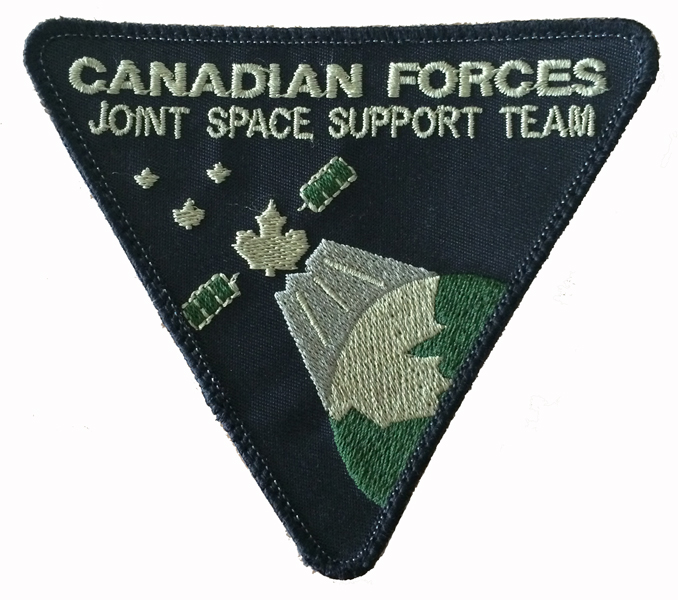
Subdued version of the team patch. This was worn on the left sleeve. Author’s collection
Production and Use
The final design was approved during the summer of 2001, and local companies were consulted soon after to produce the patch for the team. Due to the fact that the JSST was an experimental unit and would only ever consist of a very small cadre of perhaps less than a half dozen personnel, the JSST insignia were produced in very limited numbers. A single proof of design patch was made for the author’s approval – this unique patch has a black backing and special tag – with all remainder production full colour and olive drab patches having a off-white cloth cover backing (Figure 5). A private contractor made a total of 100 patches in each variety. Initially worn on a brassard in similar fashion to the DART staff members, each team member received two full colour and two subdued pattern brassards to wear on the new CADPAT uniform.
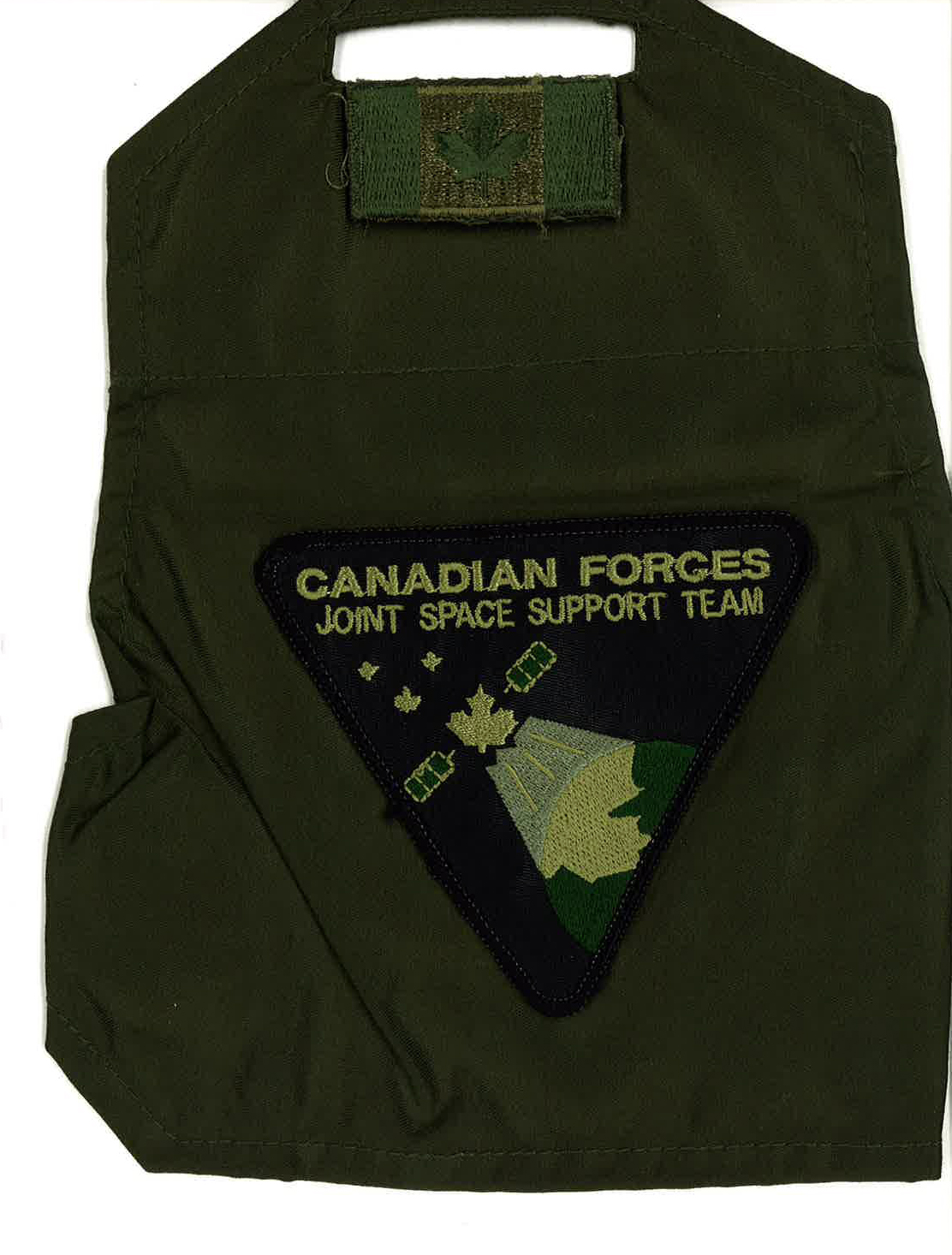
The brassard worn with the subdued badge by team members when on Ops and in CadPat. When the team switched to flight suits the badge was changed to a pattern with Velcro backing. Author’s collection
As part of the larger CF joint experiment, in early 2002 the JSST was directed to begin trialing an air force flight suit uniform in lieu of army CADPAT for the remainder of the year. This resulted in the brassard being replaced by Velcro backed insignia that could be applied to the suits. Typically full colour insignia was worn on these uniforms while in garrison, switching to subdued pattern patches when on exercise or in support of operations. These outfits proved popular with the team as well as the joint community, and they remained in use until the end of the initial trial in 2004.
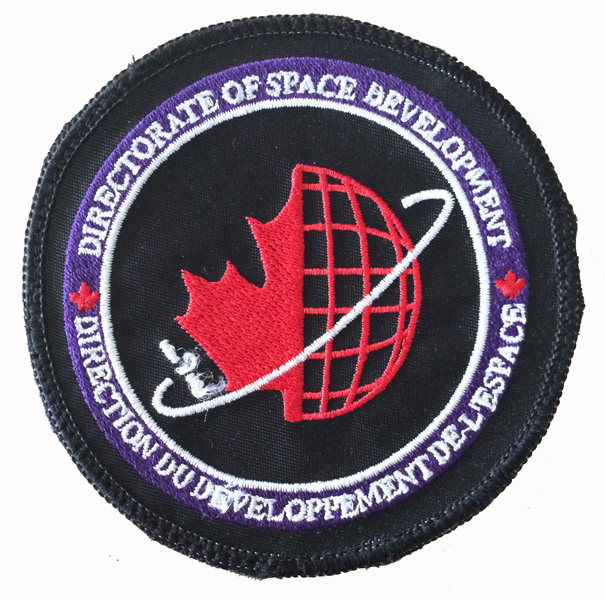
Directorate of Space Development (aka D Space D) full colour patch. Author’s collection
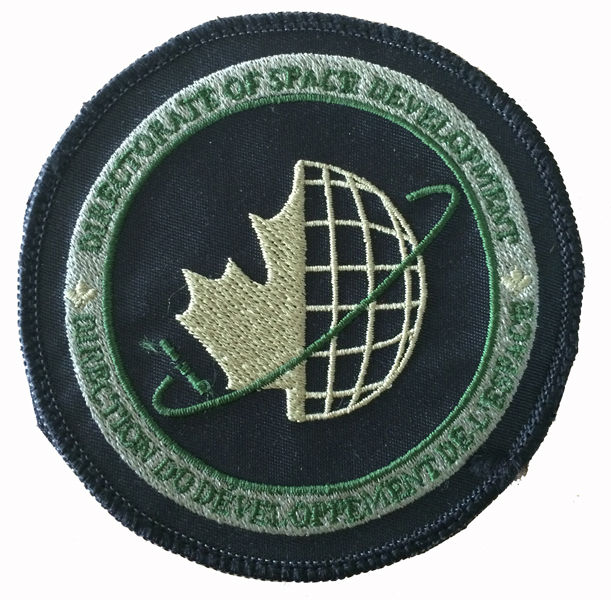
Subdued pattern of the D Space D patch as worn on the right sleeve. Author’s collection
Final disposal and reproductions
Each member of the JSST received approximately a dozen each of the colour and subdued pattern insignia for the various uniforms tested throughout the project; this accounted for about half of the total number produced. The remaining patches were dispersed amongst various CF personnel, the two USAF exchange officers attached to the project between 2001-2004, as well as a handful of DND civilian project managers and defence scientists also involved with the project. A very small number were handed out as tokens of appreciation during various official visits to the team, thus a few have made their way into the United States and elsewhere. When the initial team was stood down in 2004, none of the patches remained in stocks and no more were produced. Interestingly, the original JSST design is still in use by DND today, except that it has been subsequently altered to reflect the acronym of a new joint organization with a different name assigned within DND’s Director General Space (DG Space).
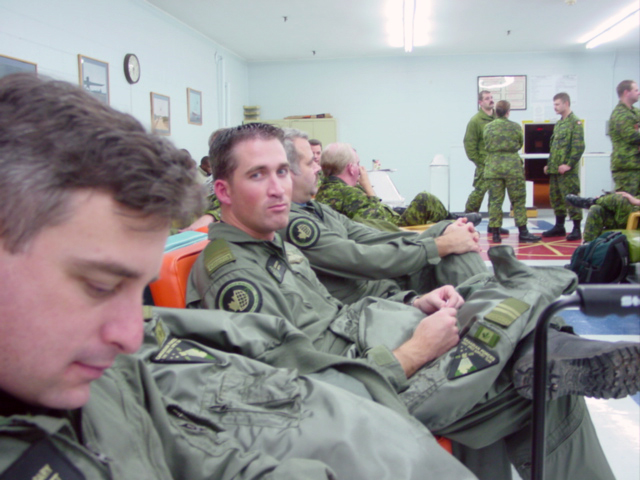
Team members attend a briefing. The subdued pattern is shown in wear. Author’s collection
Perhaps what is more interesting even is the fact that in recent years the author has seen various reproductions of both the colour D Space D patch and the colour JSST patch appear for sale, with a few appearing from time to time on E-bay and other auction or militaria websites. These generally tend to be of much poorer quality than the originals, and since there was ever only a single batch of originals made, any other known design variants of the patches illustrated in this article may be considered to be reproduction patches.
During the brief existence of the CFJOG from 2000 to 2005, both the DART and the JSST stood out from the remainder of the headquarters group in terms of distinct insignia designed for a specific purpose. Because it still exists today as a special organization much has been written concerning the insignia of the DART, while the original JSST has since fallen entirely into total obscurity. This short article has sought to rectify that imbalance just a little, by shedding new light on the worn insignia of one of the modern CAF’s little known units.
by Clive M. Law
The British Commonwealth Air Training Plan was formed in December 1939 to address the need for aircrew training to meet the needs of the Commonwealth. Although not limited to Canada the great majority of schools and graduates were trained in Canada. At the plan’s high point in late 1943, an organisation of over 100,000 administrative personnel operated 107 schools and 184 other supporting units at 231 locations all across Canada.
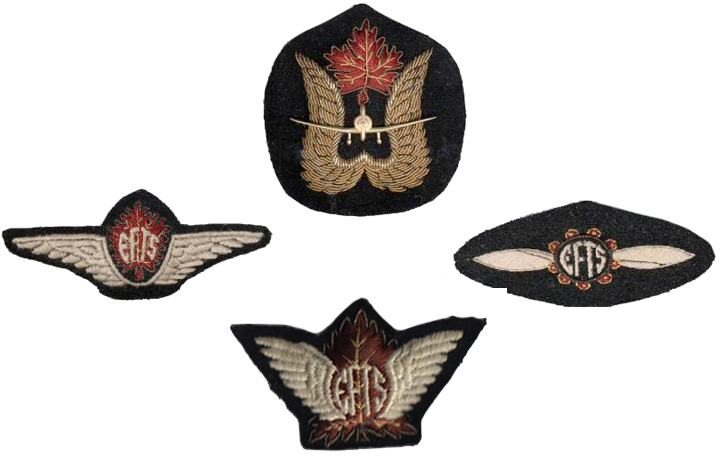
Examples of EFTS insignia. Note the the badges are not to scale in this image.
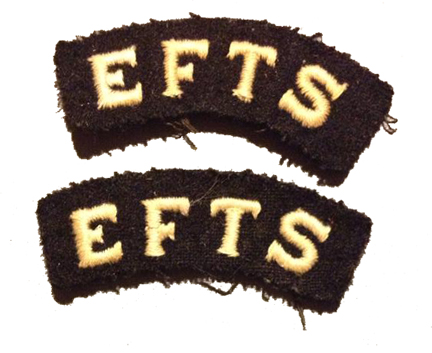
EFTS shoulder insignia. Cam Harrod collection
With the outbreak of the Second World War many flying clubs, including the SCFC saw their resources being stretched to the limit. This was due to new members hoping to gain qualifications in an attempt to automatically qualify for the Royal Canadian Air Force.
The staff of the schools were not members of the Royal Canadian Air Force but were civilians hired under contract by the individual school. Nonetheless, as they were in ‘command’ of the students during training the wear of a uniform was supported by National Defence Headquarters. Most schools standardized on a dark blue pattern although some chose a charcoal grey. The cut was similar to the RCAF Service Dress. In the case of 9 EFTS, the initial uniform was of khaki material and only changed when the BCATP standardized on blue.
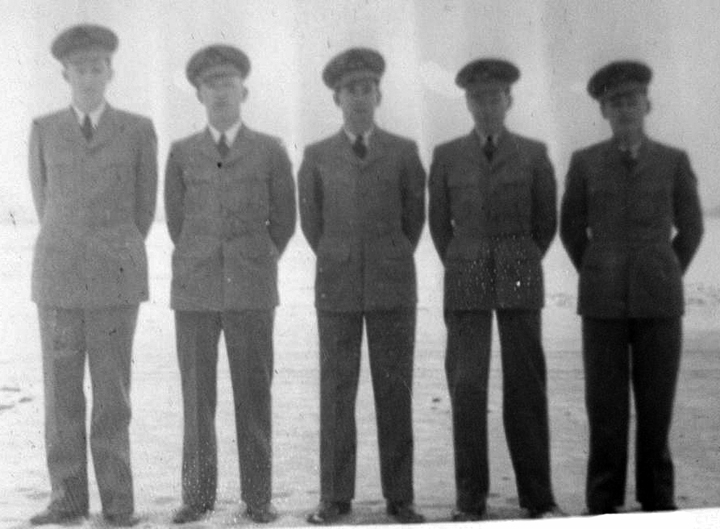
Opening day at #9 EFTS with Instructor Charlie Harrod in the middle. Note that the uniforms lack any insignia as they were not designed yet. Cam Harrod collection
The use of insignia proved to be challenging as NDHQ regulations (supported by an Act of Parliament in 1943) made the wear of military uniforms and insignia by civilians illegal. This resulted in the schools designing and producing their own insignia which, by definition, did not require NDHQ approval. For this reason identifying the badges worn by these schools is difficult for modern collectors.

Staff of No.9 EFTS at St. Catharines. Note that there are no Engineering staff included in this photo. MilArt photo archives
Thanks to the Canadian Flying Clubs Association there was some standardization of insignia. These included separate cap badges for flight instructors and engineering staff, as well as different breast insignia (calling them “wings” would be a stretch).

Badges available from the Canadian Flying Clubs Association to EFTS schools. MilArt photo archives
Nonetheless, some schools developed their own badges. One of these was No. 9 EFTS at St. Catharine, Ontario.
This school was established after Murton A. Seymour, president of the St. Catharines Flying Club (SCFC) travelled to Ottawa in 1939, in an attempt to have the government support air training through existing flying clubs. This goal was realized on August 12, 1940 and an order was received from Ottawa announcing that the opening date of October 15, 1940 and that the school was expected to accept 28 students.

EFTS Cap badge. On the right is Instructor Charlie Harrod, circa 1943. Cam Harrod collection
The insignia for No. 9 EFTS borrowed heavily from the RCAF in that it used a cap badge similar to the officer’s pattern, full wings for flying instructors and a single wing for ground instructors. This latter badge has the appearance of the First World War Observer’s badge.
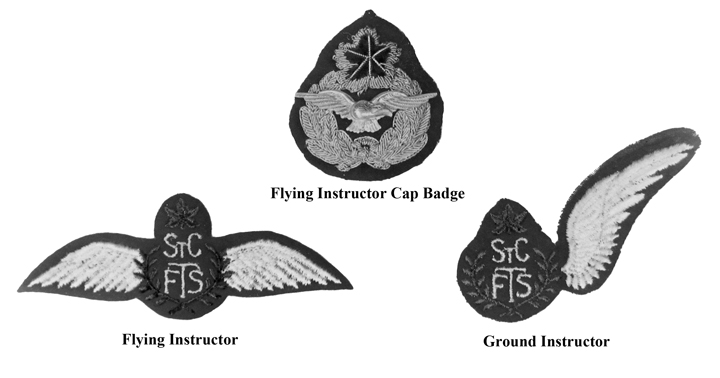
Flight staff insignia specific to the St Catharine’s Flight Training School. MilArt photo archives
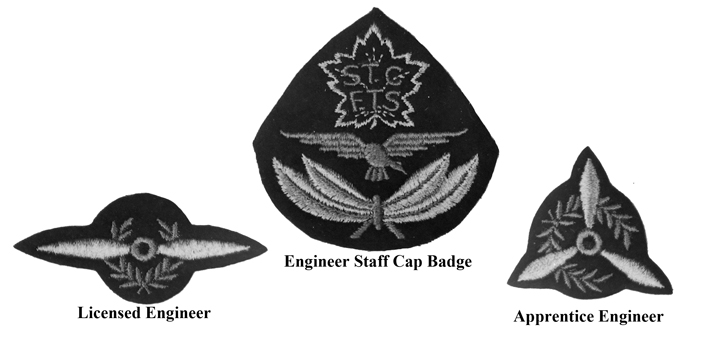
Insignia worn by the Engineering staff of No. 9 EFTS at St. Catharine. MilArt photo archive
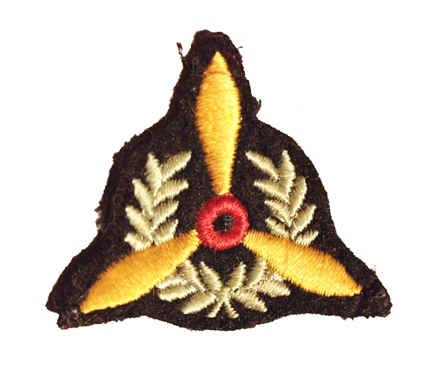
Engineering apprentice badge worn by #9 EFTS, St Catharines. Cam Harrod collection
Continuing the separation between skills, the engineering staff wore a different cap badge and wore breast insignia that could be mistaken for trade badges.
Not wishing to be left out, administrative personnel also wore a badge consisting of stylized wings with the letter ‘A’ in the centre. The manager of the school wore a similar badge but with the letter ‘M’ to denote his higher status.

F. Pattison, Manager of the school and A. Parsons, Secretary-Treasurer. Note the unique wings worn by these two individuals. MilArt photo archives
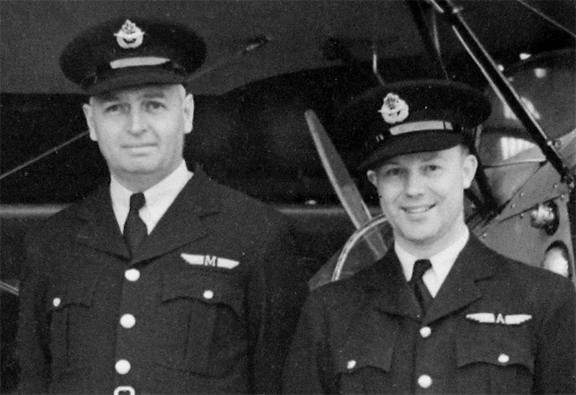
Close-up of the wings worn by non-training staff. MilArt photo archives
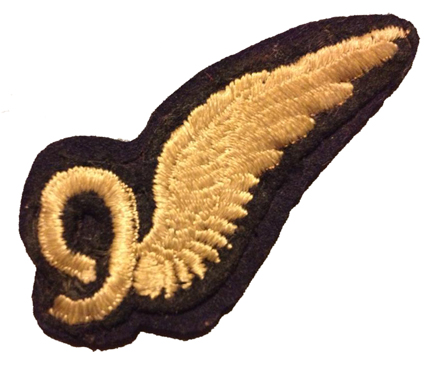
A stylized “9” emulating the First World War Observers badge. This was worn by non-flying personnel. Cam Harrod collection
No. 9 EFTS was formally disbanded on January 14, 1944. When the school closed it had accepted 2,468 student pilots. Of these, 1,848 graduated from the program. The total air time for the school was 134,011 hours.
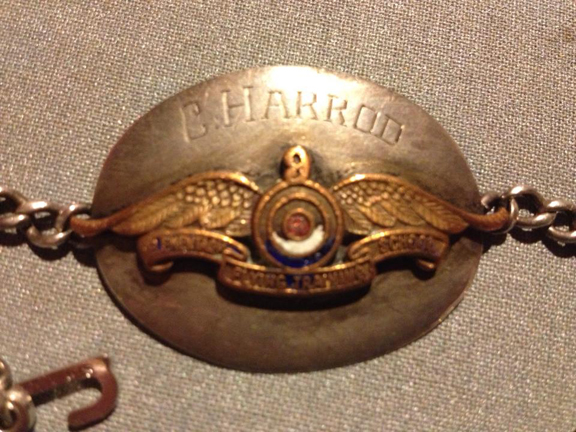
ID Bracelet. Note the incorporation of the ‘9’ at the top of the wings. Cam Harrod collection
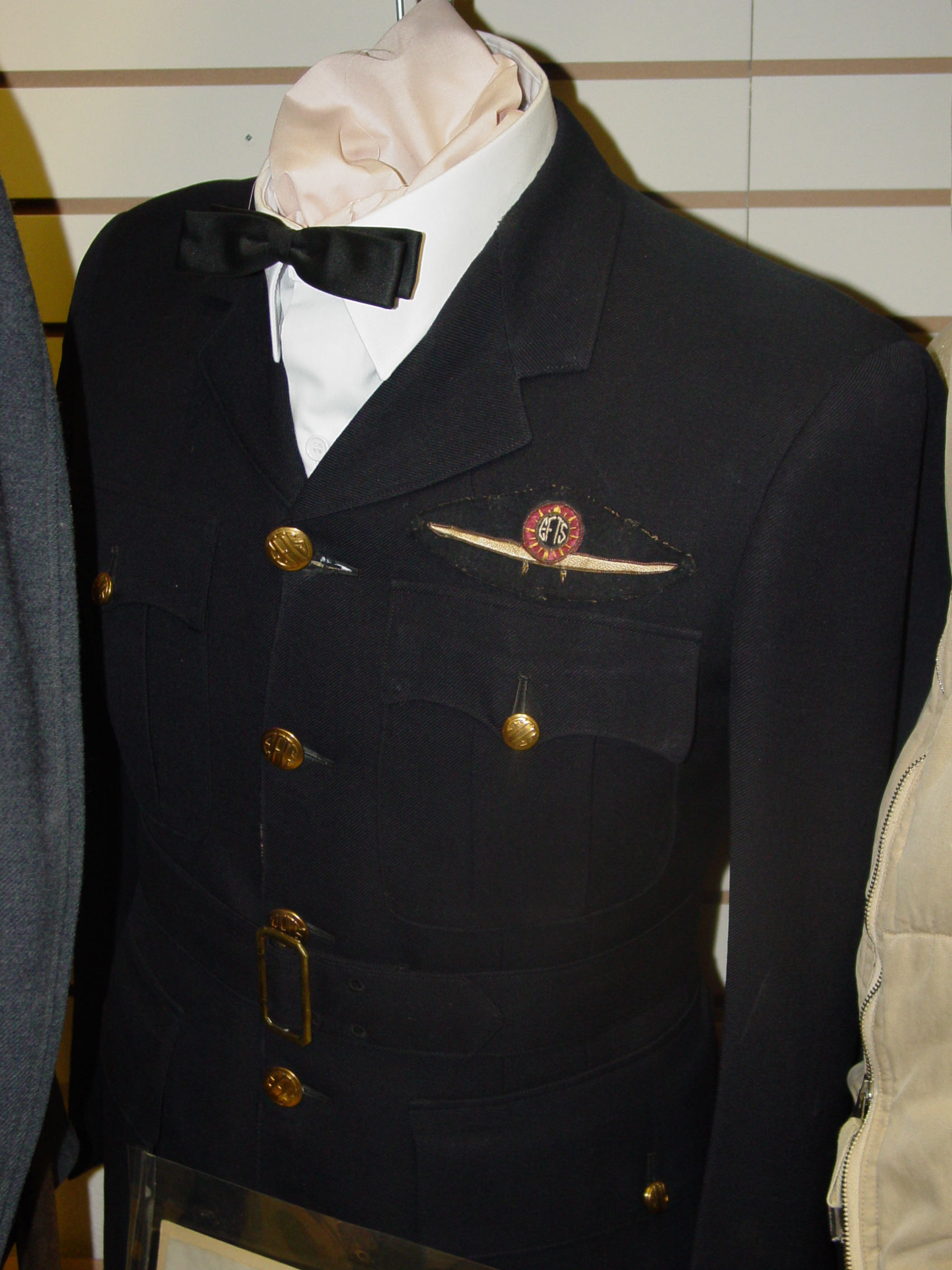
Uniform worn by an EFTS Ground School Instructor. Courtesy Saskatchewan Military Museum
The study of the uniforms and insignia of the BCATP is a fertile ground and has not been adequately addressed although there are a few dedicated collectors who are actively researching this insignia. The author wishes to acknowledge the assistance and photos provided by Cam Harrod, whose father Charlie Harrod was an instructor at #9 EFTS, St Catharines.
You can rate this article by clicking on the stars below. You can also leave comments by using the link at the bottom of the page.
by Edward Storey
The use of British designed body armour by the Canadian Army in World War Two is not well known and few examples have survived in museums and private collections. Brian L. Davis gives an excellent overview of the British Medical research Council (MRC) Body Armour in his book “British Army Uniforms & Insignia of World War Two”. Tracing the use of MRC Body Armour can be very difficult as photographs of MRC Body Armour in use during World War II are scarce since the prescribed method of wear was underneath the Battledress (BD) uniform.
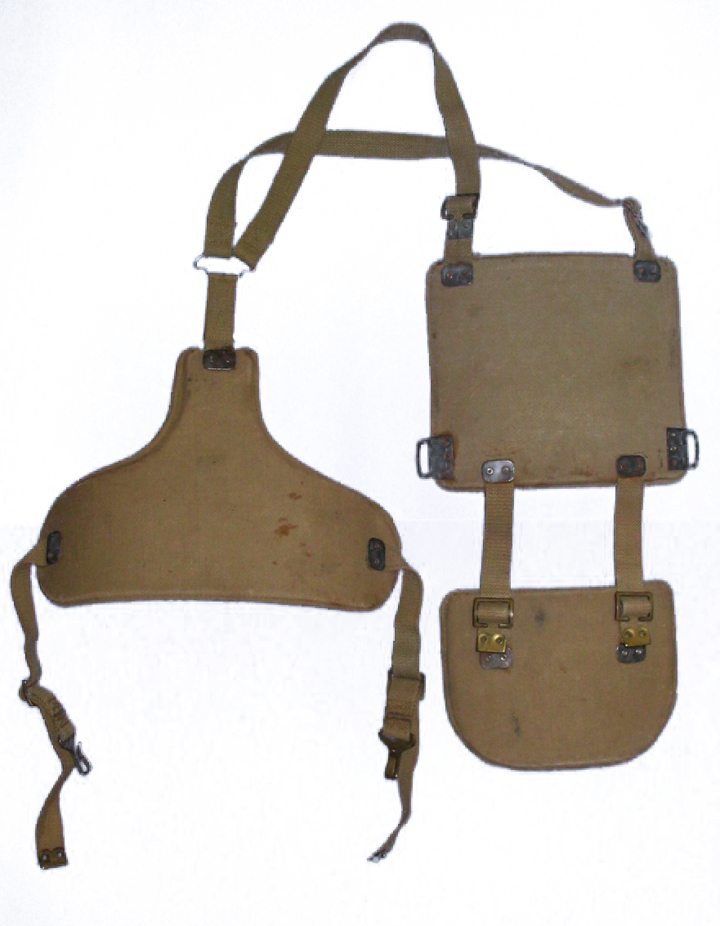
MRC Body Armour – exterior. Author’s collection

MRC Body Armour – interior. Author’s collection
From 1940 until 1942 the British Army and the Medical Research Council (MRC) worked hard at developing a set of body armour that could fill the needs of all three services had to be considered as well as designing a piece of equipment that could be worn comfortably.
The material used in this body armour was the same 1mm manganese steel found in British helmets. The body armour, weighing 3½ pounds, was designed so that its three pieces covered the vital parts of the body.
“After field trials on 5000 sets of armour, official use was given in April 1942 to introduce the body armour into the British Army. Originally 500,000 sets were to be produced although eventually only 200,000 were actually produced with 79,000 being issued. The Royal Air Force took the bulk at 64,000 and the 21st Army Group the remaining 15,000.”[i]

Front and rear photos of the MRC body armour in wear. MilArt photo archives
Simon Dunstan also gives a rather detailed description of the testing that the MRC Body Armour was subjected to in his book “Flak Jackets 20th Century Military Body Armour“.
“The body armour, when tested, proved favourable and withstood a .38 bullet at five yards, a .303 bullet at 700 yards and a ‘Tommy Gun’ single shot (.45 cal) at 100 yards. After further field exercises it was found that the armour, although well padded, tended to cut into the soft-skin areas of the body causing chafing, with the result that violent and rapid movements were significantly impaired. Moreover, it causes a man to perspire so profusely that his powers of endurance were affected.”[ii]
Production was reduced from 500,000 sets to just 200,000 sets because the steel required was the same as that of Steel Helmets which had priority. Of this production,
“Some 12,000 sets were sent to 21 Army Group, where the major portion was allocated to the Airborne Divisions, with smaller quantities to the Canadian Army, SAS Troops and the Polish Parachute Brigade… The MRC Body Armour was rarely used in action; the only confirmed occasion was by the Airborne Forces during Operation ‘Market Garden’.”[iii]
Canadian Army use of the MRC Body Armour is not well documented and little known. By studying World War II photographs and by talking to veterans, a pattern starts to emerge.

Reconstruction photographs showing a rifleman with The Royal Rifles of Canada modelling the MRC Body Armour. Author’s collection
A 3rd Canadian Infantry Division veteran, Sapper Jack Fleger from 6 Field Company, Royal Canadian Engineers, fought in North-west Europe from the Normandy Invasion in June 1944; until the fighting around the Breskins Pocket, Belgium, in October 1944 when he was wounded in the face. For the Invasion of Normandy, Mr. Fleger waded ashore with the following equipment: 1937 Pattern Web Fighting Order, Mine Detector, Life Belt, Number 4 Mark I* .303 Lee-Enfield and MRC Body Armour. The Body Armour was to protect him from mine blasts, he dumped the Body Armour shortly after coming ashore.
Lieutenant John J. H. Connors was a Stretcher Bearer Officer in the 4th Canadian Infantry Brigade (CIB) of the 2nd Canadian Infantry Division who fought in North-west Europe from the Capture of Caen in July of 1944, until the end of hostilities in May of 1945. The 4th CIB consisted of the following Infantry Regiments: The Royal Hamilton Light Infantry, The Royal Regiment of Canada and The Essex Scottish. Lieutenant Connors was one of two Stretcher Bearer Officers in the 11 Canadian Field Ambulance, Royal Canadian Army Medical Corps, and they usually worked in conjunction with the lead Infantry Battalions.

Infantrymen of Le Régiment de la Chaudière using a rubber raft to cross the Ijssel River, Zutphen, Netherlands, 7 April 1945.
The nature of Mr. Connors work was very hazardous and in the Caen area he and his men managed to get some sets of MRC Body Armour from casualties who no longer needed them. He wore the armour throughout the North-west Europe Campaign and it is still in his possession. Mr. Connors even wore the Body Armour while sleeping in trenches to help cover the exposed portions of his body. He noted that some of those he saw wearing the MRC Body Armour were primarily more concerned with covering their reproductive organs than any other part of the body.
Another veteran of the 2nd Canadian Infantry Division I have spoke to also stated that he wore the MRC Body Armour. I did not record his name, but in conversation he mentioned that he served with the Fusiliers Mont-Royal, 6th CIB in North-west Europe. He mentioned that MRC Body Armour was used on specific occasions; usually by the lead sections in the assault; and that the body armour gave those that wore it an added sense of security.
Detail Photograph of MRC Body Armour from page 62 of “The Brigade” – Le Reg de Maisonneuve, Major Jaques Ostiguy and his headquarters section. Author’s collection
Photographic and anecdotal evidence tends to point to the 2nd Canadian Infantry Division as the primary user of MRC Body Armour from the time they arrived in theatre in July, 1944 until the end of the war in May, 1945. Canada fielded five divisions in World War II, why the 2nd Canadian Infantry Division had what appears to be almost exclusive use of the British MRC Body Armour is open for more investigation.
ACKNOWLEDGEMENTS
I would like to thank the following individuals for their assistance with this article:
Major John. J. H. Connors (Ret.)
Jack Fleger, who passed away in November 1989 as a result of wounds received while on active serve in Europe
Guy Lafontaine
My wife Loretta.
SOURCES
Copp, Terry, “The Brigade – The Fifth Canadian Infantry Brigade, 1939-1945”, Stoney Creek, 1992.
Davis, Brian L., “British Army Uniforms & Insignia of World War Two”, London, 1983.
Dunstan, Simon and Ron Volstad, “Flak Jackets 20th Century Military Body Armour”, London, 1984.
Whitaker, W. Denis and Shelagh, “Tug of War – The Canadian Victory That Opened Antwerp”, Toronto, 1984.
NOTES
[i] Brian L. Davis, “British Army Uniforms & Insignia of World War Two” (London, Arms and Armour Press, 1983), p 246-247.
[ii] Simon Dunstan and Ron Volstad, “Flak Jackets 20th Century Military Body Armour”, (Osprey Men-at-Arms Series, 1984, Number 157), p 8-9.
[iii] Op. Cit.
You can rate this article by clicking on the stars below. You are also encouraged to leave a comment.
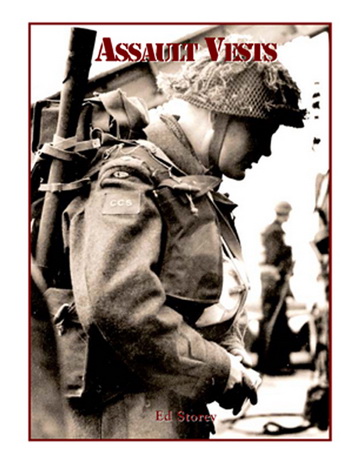
“Assault Vests” by Ed Storey is now available from Service Publications
by Clive M. Law
The Regiment of Canadian Guards joined the ranks of the Canadian Army on 16 October 1953, amid a fair measure of reluctant acceptance by existing regiments. The Canadian Guards (Cdn Gds) also faced opposition from the press, lead by the Ottawa Journal which published a number of controversial articles attacking Lt-General Guy Simonds, Chief of the General Staff. It was Simonds who conceived the idea of a Guards regiment and who was its major champion.
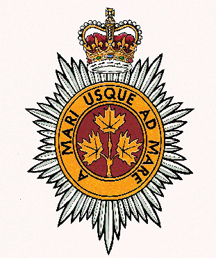
Cap badge of the Regiment of Canadian Guards. The Queen was instrumental in the design of this badge.
The regiment consisted of four battalions and a depot. The battalions were previously the 3rd Bn, The Royal Canadian Regiment (1st Bn Cdn Gds), 3rd Bn, Princess Patricia’s Canadian Light Infantry (2nd Bn Cdn Gds), 1st Canadian Infantry Battalion (3rd Bn Cdn Gds), and 2nd Canadian Infantry Battalion (4th Bn Cdn Gds). These latter battalions were created for the 27th Canadian Infantry Brigade and were themselves created from a number of Militia regiments for service in Germany. The composition of the Cdn Gds was truly national and, unlike other Infantry regiments which were limited to specific territories, were allowed to recruit across Canada.
In keeping with the regimental establishments of the day, five ‘bands’ were authorized; a military band for the Regiment, fife and drum bands for the 1st and 3rd battalions, and pipe bands for the 2nd and 4th battalions. Following the stated desire of Her Majesty, Queen Elizabeth II, the Cdn Gds were to follow closely the uniform worn by the (UK) Brigade of Guards. In keeping with this principle the Minister of National Defence requested, through the Governor-General, permission from the Palace for the pipers to adopt the Highland uniform as worn by the Scots Guards, including the Sovereign’s Royal Stuart tartan.
If Her Majesty grants permission for the adoption of this distinctive Highland dress, which includes the Sovereign’s personal tartan, by the pipers of the Canadian Guards, this high honour will be a source of pride to the Regiment and will greatly enhance its prestige.
Permission to adopt the uniform, including the Royal Stuart tartan, was given in December 1954. At the same time, the Queen approved a drawing of the bonnet badge to be worn by pipers on the feather bonnet, at the base of the red and white feather plume. This badge, drawn in April 1954, featured the Cdn Gds cap badge in a white metal buckled belt (annulus) upon which was the regiment’s name. The dimensions were two inches high (to the tip of the buckle) and 2 3/16 inches wide.
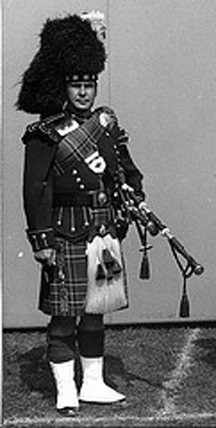
An undated photo of a piper. His sporran cantle displays a badge as does his buckle while the remainder of his accoutrements are plain.
In addition to the uniform and bonnet badge, a number of other ancillary items were required in order to complete the uniform for pipers. These included kilt pins, plaid brooch, belt buckle, sporran badges, and cross-belt fittings. Wasting little time, by December 1955 Army Headquarters (AHQ) had drawings prepared for all of these items and submitted them to the Cdn Gds so that the regiment could obtain samples. These were to be provided at no expense to the public or from the grant provided for bands.

Proposed belt buckle. The size was fond too mall to properly cover the gap between the doublet and the kilt and was made larger in 1959.
What action was actually taken by the regiment and if the items they obtained were even close to the suggested pattern is unknown although, in 1959 the regiment proposed changes to some designs, specifically; that the bonnet badge be re-sized to 2 1/2 inches in diameter (exclusive of the buckle tip), the pipers buckle be made four inches wide and three inches high, and the buckle tip for the cross-belt be semi-circular instead of circular.
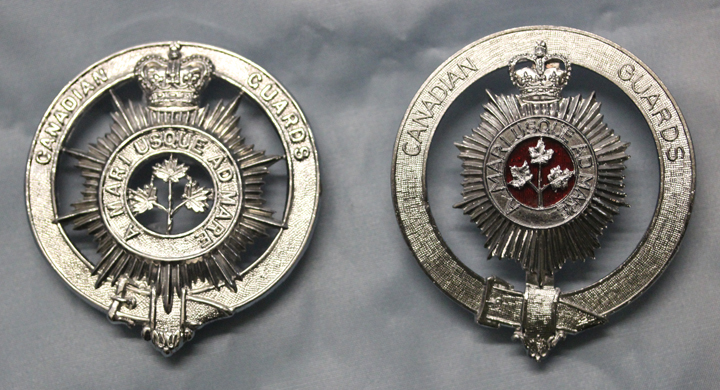
Although the first pattern badge (left) was that approved by the Queen, the second pattern (right) was more in keeping with the actual regimental badge. Courtesy Bruce Graham
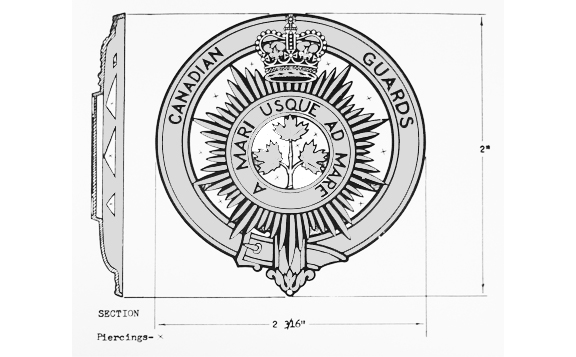
Drawing of the proposed badge to be worn on the feather bonnet by pipers, as approved by the Queen.
While the AHQ supplied drawings show a very plain plaid brooch at least one firm proposed a regimental pattern. In late 1959 the London firm of Henry Potter, supplier of drums to the regiment, provided a drawing of a four-inch piper’s plaid brooch with the regimental badge centered. However, there is no evidence that these were ever purchased.

Brooch pin design proposed by Henry Potter Ltd., of London, the firm that supplied instruments to the bands, including the emblazoned regimental drums. The design does not appear to have been adopted.
Some of the changes were straight forward and approval from AHQ was routine provided some basic design criteria were met and procurement policy respected. However, changing the bonnet badge was problematic as the design was specifically approved by Her Majesty. The regiment was advised that the size could be altered but only if the entire badge were re-sized proportionally. In other words, the buckle could not be made larger while retaining the same size badge. The regiment agreed to this condition.
In spite of the drawings supplied to the regiment photographic evidence suggests that they obtained buckles and cross-belt fittings that were of more elaborate design and, for junior ranks, plain (no badge) belt buckles although photographs dating from the mid-1960s show the larger belt buckle embellished with the regimental badge.
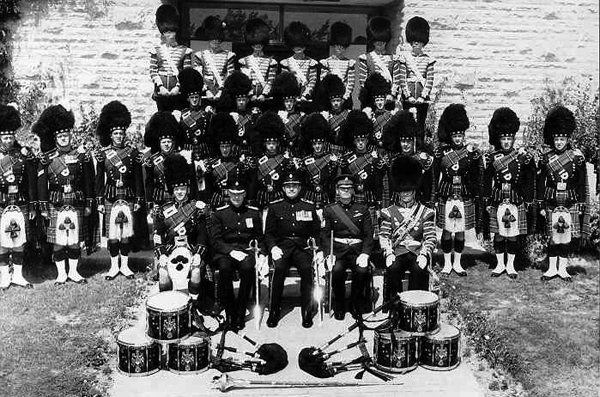
Pipes and Drums of the 2nd Battalion, The Regiment of Canadian Guards, May 1965, at Camp Petawawa. Here, the large buckles exhibit the regimental badge.
As is customary in Highland dress, the regiment obtained both hair sporrans for full dress and leather sporrans for wear with battle dress. Most photographs of the former lack the badge on the cantle although it is shown worn on the leather sporran along with four leather tassels – emulating the four black ‘tails’ worn over the white hair sporran.

Army Headquarters drawing of the suggested cantle. The whole item, as with other badges and distinctions, were to be of polished white metal.
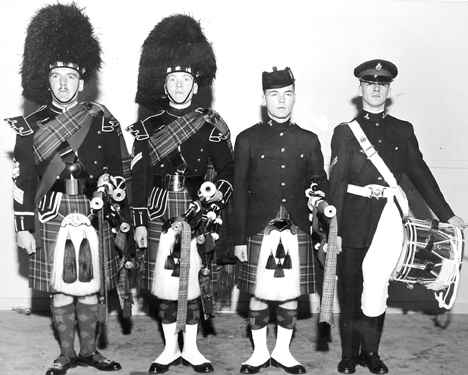
The cantles do not appear to have badges and the brooch buckles are plain.
Note the badged leather sporrans which also include four leather tassels. The waist belt buckles are unadorned.
Another key item of dress for the bands was the Baldric (var. Baldrick) – the highly decorated sash worn by Drum-Majors. A standard design used by all Line Infantry regiments, with insignia specific to the Cdn Gds, was adopted. Each of the four battalions’ Baldric was identical with the sole exception of the battalion numeral. For the Cdn Gds depot, a lyre was substituted for this numeral.

Left, Baldric of the 1st Battalion (DND photo)
Right, Baldric of the Regimental Depot (author’s collection)
The author wishes to acknowledge valuable documents provided by Ken Joyce and Dr. James Boulton. Regrettably, requests for information to the Canadian Guards Museum at Garrison Petawawa remain unanswered.
You can rate this article by clicking on the stars, below. You may also leave comments.
by Dan Mowat
Military pioneers were defined by Major Charles James of the Royal Artillery Drivers, in a book entitled ‘An Universal Military Dictionary[1]‘, published in 1821, as:
“PIONEERS, (pioniers, Fr.) in war-time, are such as are commanded in from the country, to march with an army, for mending the ways, for working on entrenchments and fortifications, and for making mines and approaches: the soldiers are likewise employed in all these things. Most of the foreign regiments of artillery have half a company of pioneers, well instructed in that important branch of duty. Our regiments of infantry and cavalry have 3 or 4 pioneers each, provided with aprons, hatchets, saws, spades, and pick-axes …”
and of their position in a military force, he writes:
“A detachment of pioneers, with tools, must always march at the head of the artillery, and of each column of equipage or baggage.[2]“
Records show that the role of military pioneers was established in the early 17th century, and perhaps earlier. They were originally attached to the artillery branch, but under the direction of the engineers, and they were responsible for creating the means to move and place field cannons in active warfare. Their role was to create roads, probably better described as tracks, and to open up areas near to the fighting so that the teams of horse drawn cannon could quickly get into position to support the infantry. Infantry could move quickly, at the whim of officers far behind the action, and the artillery had to keep pace or risk catastrophic results for the foot soldiers. In addition to road building, they were also responsible for the establishment and repair of offensive and defensive battlements and fortifications, entrenchments for men and munitions to have cover and shelter, secure areas for teams of service animals such as horses and mules, and perhaps most importantly, they provided carrying parties to get food and equipment to the forward area and to get the wounded back to the rear. Much of this work was done in front of or alongside the advancing infantry and artillery. These men were invariably in harm’s way.

Canadian Pioneers laying trench mats over mud. Battle of Passchendaele.
Initially men assigned as pioneers were of the lowest class of the military force, and were not considered to be effective fighting forces. Major James refers to the degradation of officers and non-commissioned officers as punishment, being reduced in rank to that of private soldiers, and for private soldiers who misbehave, as follows:
“… So late as the reign of Charles I. private soldiers, for misbehaviour in action, were degraded to pioneers.[3]“
In his definition of Effective Forces, James makes the following distinction:
“Effective Forces. All the efficient parts of an army that may be brought into action are called effective, and generally consist of artillery, cavalry, and infantry, with their necessary appendages, such as hospital staff, wagon-train, artificers and pioneers: the latter, though they cannot be considered as effective fighting men, constitute so far a part of effective forces, that no army could maintain the field without them.[4]“
The make-up of the pioneers evolved over the following decades such that they became hard-working and intelligent men, coming under the military structure of the Engineers branch of service, and in addition to the traditional activities of pioneers, they undertook more engineering functions such as bridge building, setting of foundations upon which they erected buildings, and undertook civil construction works such as diversion of watercourses to get water nearer the fighting troops, and the drainage or mitigation of boggy areas.

Canadian pioneers splitting logs for use in trenches. August, 1917.
When the Great War started in August 1914 Canada’s permanent military force was small, made up of a small number of infantry, cavalry, artillery and engineers. Canada had no navy at the time war broke out, and relied on the British Navy for protection on the high seas.Canada did, however, have a relatively large militia, having many seasoned soldiers who had fought as British forces in prior conflicts. However, many militia regiments in Canada were more social than military in nature, and although they had training in marching and other drill exercises, and musketry, they were not trained in military tactics. Each infantry battalion had a small number (usually 3 or 4) of trained pioneers, but there were insufficient numbers of pioneers to do any substantial work.
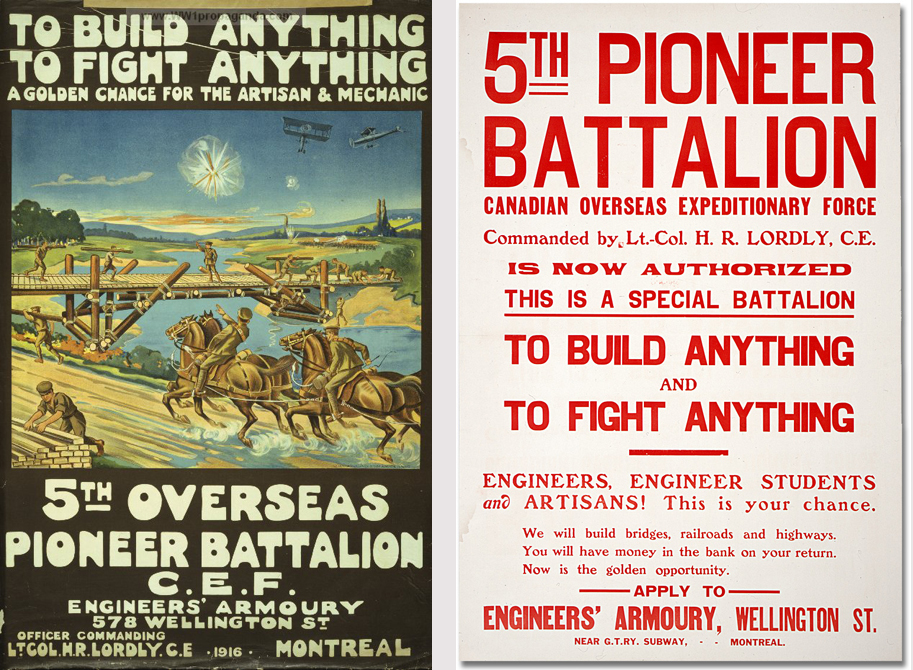
Recruiting posters produced by the 5th Pioneer Battalion, CEF.
When the Canadians first arrived in France, there were no battalions of pioneers, and the work that would normally be done by them fell to the infantry. Not only were the fighting men required to attack and defend, they were also required to dig trenches, shore up battlements, carry food, munitions and equipment, dig latrines, build shelters and improve lodgings for themselves, and to assist the artillery in their movements. The infantry loathed this work, and they often cursed the engineers and pioneers for not being there when they were needed, and too often in insufficient numbers to relieve the infantry of this labour. In truth, this situation plagued the infantry right up to the summer of 1918, when General Currie reorganized the engineering branch and created several new battalions of engineers to undertake this work. After the war, Currie wrote in a letter to newspaper reporter Owen McGillicuddy:
“I am of the opinion that much of the success of the Canadian Corps in the final 100 days was due to the fact that they had sufficient engineers to do the engineering work and that in those closing battles we did not employ the infantry in that kind of work. We trained the infantry for fighting and used them only for fighting.”
The Canadian Pioneer Battalions were not raised until 1915, and even then, three infantry battalions that had been raised and trained in Canada, arrived in England and completed their training as infantry battalions, were converted to Pioneer Battalions shortly before mobilizing to France: the 48th Infantry Battalion became the 3rd Pioneer Battalion; and the 124th Infantry Battalion became the 124th Pioneer Battalion. The 123rd Infantry Battalion, Royal Grenadiers, was also re-purposed as the 123rd Pioneer Battalion, Royal Grenadiers. The 123rd had the special distinction of having the name of its home Regiment officially included in the name of the Battalion, with the blessing of the King. A book is currently being written about the history of the 123rd.
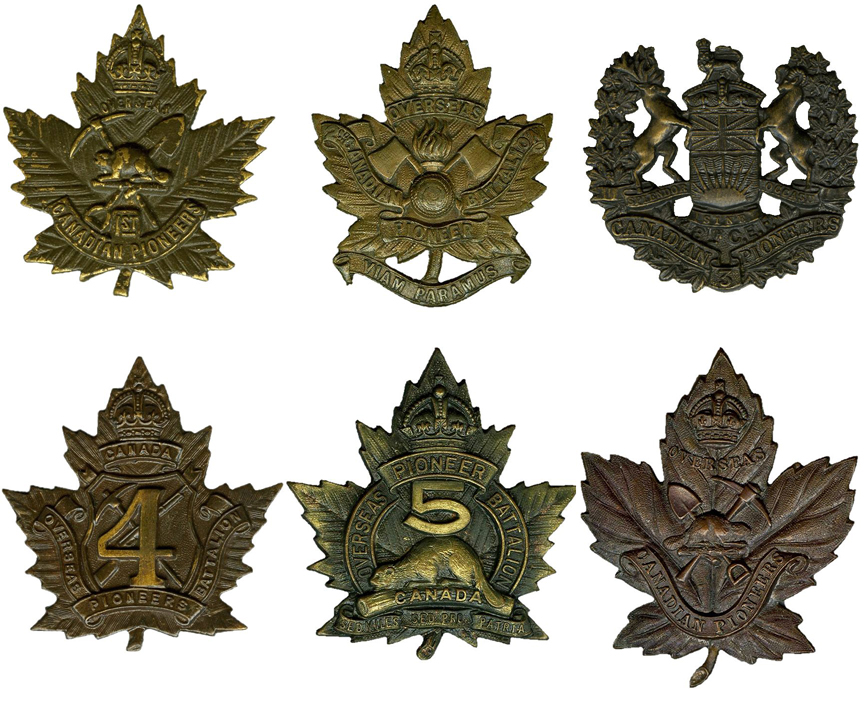
Badges of the 1st to 6th Pioneer Battalions, CEF. Courtesy http://www.britishbadgeforum.com/
The men of the 3rd, 123rd and 124th were uniquely skilled, in that they were first fully trained as infantry soldiers, and then added the skills of pioneers and engineers to their strong foundation as fighting men. Understanding infantry tactics while performing pioneer duties no doubt reduced the number of casualties suffered by the pioneers.
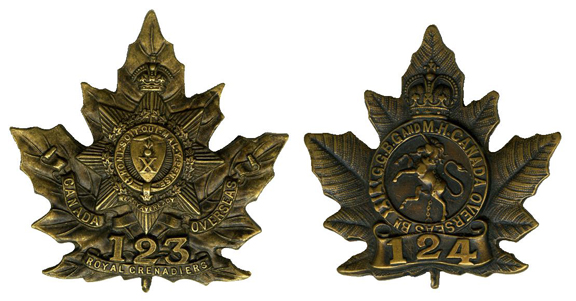
Badges of the 123rd and 124th Batalions which were converted to Pioneer battalions. Courtesy http://www.britishbadgeforum.com
The Canadian Pioneers of the Great War served valiantly, some of whom were decorated for their bravery and conspicuous gallantry in the face of the enemy. Their officers were respected by the men who served under them, which often was not the case in infantry battalions, where the men were contemptuous of their officers. The Commanding Officer of the Princess Patricia’s Canadian Light Infantry (P.P.C.L.I.) became particularly fond of the men of the 123rd Pioneer Battalion, Royal Grenadiers for the services they rendered to the P.P.C.L.I. on battle fronts such as Passchendaele and Ypres.
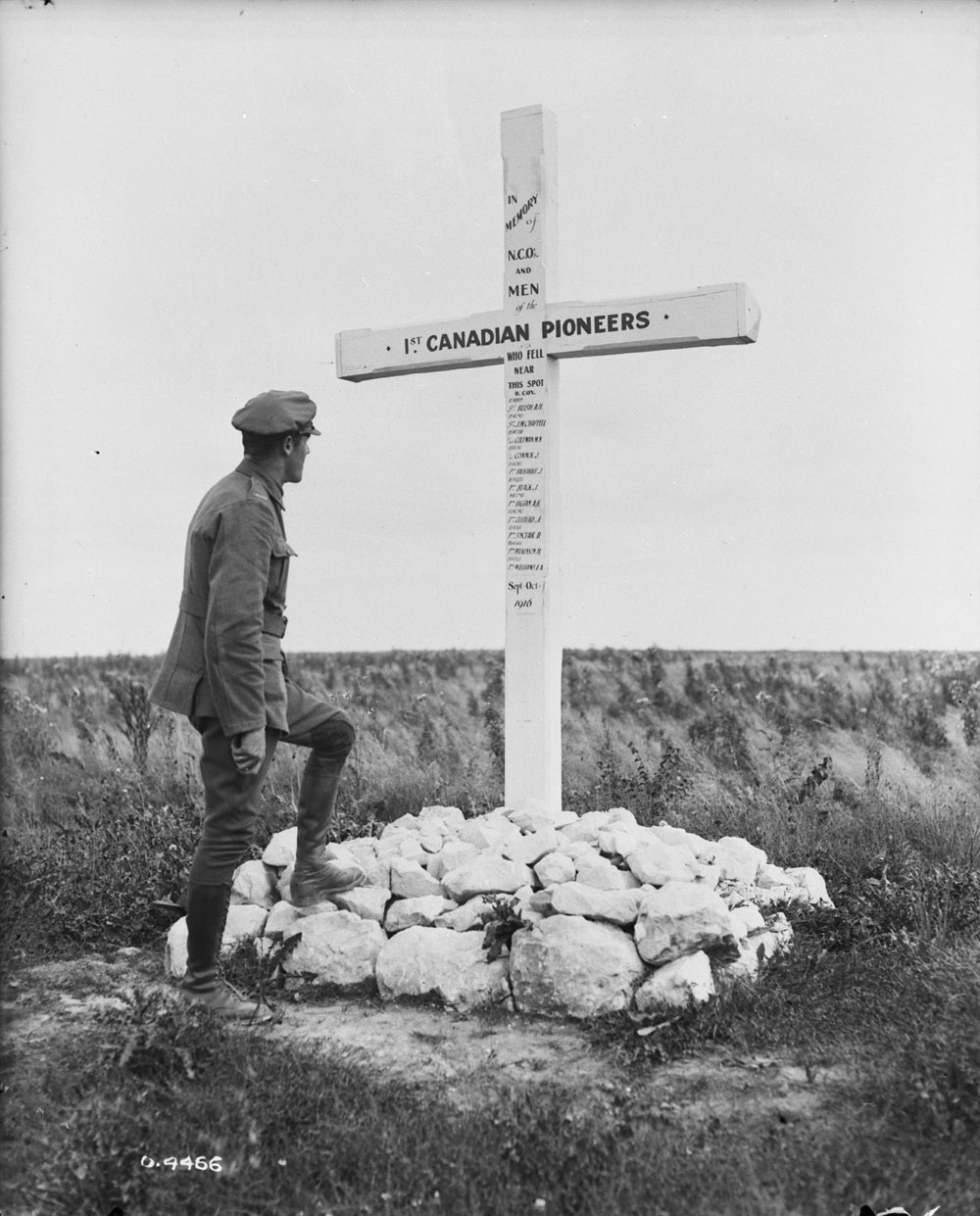
Memorial to 1st Canadian Pioneers, Somme. January 1918.
[1] An Universal Military Dictionary, 4th Ed. Egerton, London, 1816, pg. 636
[2]An Universal Military Dictionary, 4th Ed. Egerton, London, 1816, pg. 29
[3] An Universal Military Dictionary, 4th Ed. Egerton, London, 1816, pg. 156
[4]An Universal Military Dictionary, 4th Ed. Egerton, London, 1816, pg. 240
You can rate this article by clicking on the stars below
by Mark W. Tonner
The Canadian Armoured Corps was formed, as a new branch of the ‘Active Militia of Canada,’1 effective 13 August 1940. Canadian units converted to armoured regiments, in this new branch, were organized under the then current British war establishment for an armoured regiment, which called for the regiment to be organized, and consist of:
a Regimental headquarters, of five officers and 12 other ranks, equipped with four cruiser tanks
a Headquarters squadron, of five officers and 120 other ranks, within:
- – a squadron headquarters
- – an intercommunication troop, equipped with ten scout cars
- – an administrative troop
three squadrons:
- – each of seven officers and 138 other ranks, within a squadron headquarters and four troops
- – each squadron headquarters was equipped with two cruiser tanks, and two close support tanks
- – each troop was equipped with three cruiser tanks
for a total regimental strength of 31 officers and 546 other ranks, equipped with 46 cruiser tanks, six close support tanks, and ten scout cars.
Due to a lack of equipment and production delays, an amendment of 18 November 1940, stated that the scout cars, may vary in type, and that the tanks of an armoured regiment, may consist of a combination of various types of tanks.
The British war establishment for an armoured regiment, was replaced by a new Canadian war establishment for an armoured regiment, effective 30 September 1941. Under this Canadian war establishment, the basic allotment of scout cars and tanks remained the same, but there was an increase of two other ranks in regimental strength, bringing the total for an armoured regiment, to 548 other ranks. Also, under this new war establishment, provision was made for the attachment to an armoured regiment, of a paymaster (Royal Canadian Army Pay Corps), a medical officer (Royal Canadian Army Medical Corps), and two Royal Canadian Ordnance Corps armourers (for the maintenance and repair of weapons). Effective 1 April 1942, Canadian armoured regiments, that were equipped with five-man crewed tanks,2 were allowed an increase of 55 other ranks, to their overall regimental strength.
This new Canadian war establishment, was the war establishment, under which the six armoured regiments of the 1st Canadian Armoured Division (later renamed the 5th Canadian Armoured Division), were organized under, upon the formation of the division, effective 27 February 1941. The six armoured regiments of the 4th Canadian Armoured Division, were also organized under this war establishment, upon the conversion and renaming of the 4th Canadian Division, to that of the 4th Canadian Armoured Division, effective 26 January 1942.
By the end of 1942, the Canadian Army Overseas,3 due to the effects of manpower restrictions, and a serious shortage of shipping, from Canada, decided to completely reorganize based on British war establishments, in order to facilitate co-operation between formations and units of the British Army, and First Canadian Army.4 This reorganization of the Canadian Army Overseas, came into effect on 11 January 1943. As part of this reorganization, and to conform more closely to the British war establishment for an armoured regiment, a new Canadian war establishment, to replace that of 30 September 1941, was authorized, effective 1 January 1943. Under this war establishment, a Canadian armoured regiment was organized, and consisted of:
a Regimental headquarters
- – equipped with one command tank, and 11 cruiser tanks (eight of which were to be anti-aircraft tanks, if available)
a Headquarters squadron, with:
- – a squadron headquarters
- – a reconnaissance troop, equipped with ten universal carriers
- – an intercommunication troop, equipped with nine scout cars
- – an administrative troop
three squadrons:
- – each of a squadron headquarters and five troops
- – each squadron headquarters was equipped with four cruiser tanks
- – each troop was equipped with three cruiser tanks
for a total regimental strength of 37 officers and 646 other ranks, equipped with 68 cruiser tanks, one command tank, ten universal carriers, and nine scout cars.
In addition, this new war establishment, allowed for an increase in regimental strength, of 64 other ranks, for those armoured regiments equipped with five-man crewed tanks, and an increase of 125 other ranks, for those equipped with six-man crewed tanks,6 and an increase of 189 other ranks, for those equipped with seven-man crewed tanks.7 The six armoured regiments of the reorganized 4th and 5th Canadian Armoured Brigades,8 in the United Kingdom, adopted this new war establishment, effective 31 January 1943.
Effective 8 May 1943, one recovery tank9 with three tradesmen, was allotted, to each squadron headquarters of an armoured regiment, and the strength of regimental headquarters, was increased by eight other ranks. Later in the month, a new war establishment was issued, effective 29 May 1943, which replaced that of 1 January 1943. This new war establishment, provided for a total strength of 37 officers and 727 other ranks, per armoured regiment. It also allowed for an increase in regimental strength, of 125 other ranks, for those armoured regiments equipped with six-man crewed tanks, and an increase of 189 other ranks, for those equipped with seven-man crewed tanks. Under this war establishment, a Canadian armoured regiment was organized, and consisted of:
a Regimental headquarters
- – equipped with one command tank, and 11 cruiser tanks (eight of which were to be anti-aircraft tanks, if available)
a Headquarters squadron, with:
- – a squadron headquarters
- – a reconnaissance troop, equipped with ten universal carriers
- – an intercommunication troop, equipped with nine scout cars
- – an administrative troop
three squadrons:
- – each of a squadron headquarters and five troops
- – each squadron headquarters was equipped with four cruiser tanks, and one recovery tank
- – each troop was equipped with three cruiser tanks
for a total regimental strength of 37 officers and 727 other ranks, equipped with 68 cruiser tanks, one command tank, three recovery tanks, ten universal carriers, and nine scout cars.
This war establishment, stayed in effect, until it was replaced by a new Canadian war establishment for an armoured regiment, effective 12 January 1944. Under this war establishment, a Canadian armoured regiment was organized, and consisted of:
a Regimental headquarters
- – equipped with four cruiser tanks
a Headquarters squadron, with:
- – a squadron headquarters
- – a reconnaissance troop, equipped with 11 light tanks
- – an anti-aircraft troop, equipped with six anti-aircraft tanks
- – an intercommunication troop, equipped with nine scout cars
- – an administrative troop
three squadrons:
- – each of a squadron headquarters, an administrative troop, and five troops
- – each squadron headquarters was equipped with four cruiser tanks, and one recovery tank
- – each troop was equipped with three cruiser tanks
for a total regimental strength of 38 officers and 657 other ranks, equipped with 61 cruiser tanks, 11 light tanks, three recovery tanks, six anti-aircraft tanks, and nine scout cars.
By this time, as the ‘Sherman’ tank10 with a crew of five, had become the standard cruiser tank used by a Canadian armoured regiment, the increases to regimental strength, for six-man, and seven-man, crewed tanks, was removed. The three armoured regiments of the 1st Canadian Armoured Brigade (Independent), who were at this time, in Italy, where they were organized on a special British war establishment for an armoured regiment, Middle East, did not adopt this new Canadian war establishment, until April 1944. Based on the special British war establishment for an armoured regiment, Middle East, the three armoured regiments of the 1st Canadian Armoured Brigade (Independent), in Italy, were organized, and consisted of:
a Regimental headquarters
- – equipped with four cruiser tanks, and one anti-aircraft tank
a Headquarters squadron, with:
- – a squadron headquarters
- – a reconnaissance troop, equipped with six scout cars, and ten universal carriers
- – an intercommunication troop, equipped with eight scout cars
- – an administrative troop
three squadrons:
- – each of a squadron headquarters, an administrative troop, and five troops
- – each squadron headquarters was equipped with three cruiser tanks, and one anti-aircraft tank
- – each troop was equipped with three cruiser tanks
Due to the favourable air situation which developed in both Italy and North-West Europe, later in 1944, the anti-aircraft troop with its six anti-aircraft tanks was deleted, and provision was made for the addition of seven tracked armoured vehicles, per armoured regiment, for the carriage of ammunition to replenish tanks in forward areas during ‘active’ battle conditions, effective 15 October 1944.
A new Canadian war establishment for an armoured regiment, which replaced that of 12 January 1944, was authorized effective 30 November 1944, and was the war establishment under which Canadian armoured regiments were organized, through to the end of hostilities, in North-West Europe, in May 1945. Under this war establishment, a Canadian armoured regiment was organized, and consisted of:
a Regimental headquarters, of five officers and 16 other ranks, equipped with four cruiser tanks
a Headquarters squadron, of nine officers and 172 other ranks, within:
- – a squadron headquarters
- – a reconnaissance troop, equipped with 11 light tanks
- – an intercommunication troop, equipped with nine scout cars
- – an administrative troop, equipped with one tracked armoured ammunition carrier
three squadrons:
- – each of eight officers and 153 other ranks, within a squadron headquarters, an administrative troop, and five troops
- – each squadron headquarters was equipped with four cruiser tanks, two tracked armoured ammunition carriers, and one recovery tank
- – each troop was equipped with three cruiser tanks
for a total regimental strength of 38 officers and 647 other ranks, equipped with 61 cruiser tanks, 11 light tanks, seven tracked armoured ammunition carriers, three recovery tanks, and nine scout cars.
A note on squadron organization within armoured regiments
In some Canadian armoured regiments, the three squadrons were each organized as consisting of a squadron headquarters, equipped with three cruiser tanks (instead of four), and four troops (instead of five), each equipped with four cruiser tanks (instead of three), which still gave the squadron a total of 19 cruiser tanks each.
Adoption of the Canadian war establishment for an armoured regiment, by armoured reconnaissance regiments
The creation of an armoured reconnaissance regiment, for each Canadian armoured division, had been part of the reorganization of the Canadian Army Overseas, in early 1943. Both regiments, upon conversion from that of ‘an armoured regiment,’ to that of ‘an armoured reconnaissance regiment,’11 were organized under the newly created and authorized Canadian war establishment for an armoured reconnaissance regiment. This was subsequently replaced, by a new war establishment, effective 14 May 1943, which in turn, was replaced by another new war establishment, for an armoured reconnaissance regiment effective 12 January 1944. In March 1944, so that an armoured division could at any time split into two brigade groups, each of two armoured regiments, and two infantry battalions, General B.L. Montgomery, General Officer Commanding-in-Chief, 21st Army Group,12 directed that all the armoured reconnaissance regiments, within 21st Army Group, adopt the war establishment of an armoured regiment, effective 13 March 1944.
As such, the 29th Canadian Armoured Reconnaissance Regiment (The South Alberta Regiment) of the 4th Canadian Armoured Division, reorganized under the then, current Canadian war establishment for an armoured regiment, and subsequently, that of 30 November 1944. The 3rd Canadian Armoured Reconnaissance Regiment (The Governor General’s Horse Guards), of the 5th Canadian Armoured Division, who at this time (March 1944), were in Italy, remained organized, under the Canadian war establishment for an armoured reconnaissance regiment, of 12 January 1944, until they moved to North-West Europe, in March 1945, at which time, they to, reorganized under the then, current Canadian war establishment for an armoured regiment, as per the 21st Army Group policy, of armoured reconnaissance regiments, adopting the war establishment of an armoured regiment.
Sources:
– Army Headquarters Report No. 57, A Summary of Major Changes in Army Organization, 1939-1945, dated 22 December 1952, complied by Major R.B. Oglesby, Historical Section (General Staff), Army Headquarters, Ottawa, Ontario.
– General Orders 1940, as issued to the Canadian Militia/Army by order of the Minister of National Defence.
– Part “A,” General Orders 1941, as issued to the Canadian Army by order of the Minister of National Defence.
– Part “A,” and Part “B,” General Orders 1942, as issued to the Canadian Army by order of the Minister of National Defence.
– Part “A,” and Part “B,” General Orders 1943, as issued to the Canadian Army by order of the Minister of National Defence.
– Part “B,” General Orders 1944, as issued to the Canadian Army by order of the Minister of National Defence.
– Part “B,” General Orders 1945, as issued to the Canadian Army by order of the Minister of National Defence.
– The Governor General’s Horse Guards, 1939-1945, The Canadian Military Journal, Toronto and Montreal Publicists (undated).
– South Albertas, A Canadian Regiment at War, by Donald F. Graves, Robin Brass Studio, Toronto, Ontario, 1998.
Endnotes:
1. The ‘Active Militia of Canada,’ was renamed the Canadian Army, effective 7 November 1940.
2. The Canadian designed and built Ram cruiser tank (Mark I or Mark II).
3. For the purposes of reference and description, that portion of the Canadian Army (Active), serving in the United Kingdom and Europe, was designated the Canadian Army Overseas, effective 7 November 1940.
4. First Canadian Army was the senior Canadian operational formation in the United Kingdom and Europe during the period of the Second World War, and was formed in the United Kingdom, on 6 April 1942, with Headquarters First Canadian Army, having been embodied, effective 1 April 1942.
5. On 26 September 1939, the Minister of National Defence authorized the creation of a Canadian Military Headquarters overseas (located in London, England). This headquarters held responsibility for coordinating the arrival, quartering, completing equipment requirements, and training of Canadian Active Service Force units and formations and to command and administer these units and formations in the United Kingdom and at base in the theatre of operations. In addition, the headquarters had an important liaison role, particularly liaison with the British War Office and with the General Officer Commanding Canadian Forces in the theatre of operations, as well as furnishing information to the Canadian High Commissioner in London.
6. The American M3 Medium tank built to British specifications, and known in British and Commonwealth service, as the Grant (or Grant I).
7. The American designed and built M3 Medium tank, which in British and Commonwealth service, was known as the Lee (or Lee I).
8. As part of the reorganization of the Canadian Army Overseas, the 4th and 5th Canadian Armoured Divisions, were reorganized as armoured divisions of one armoured brigade, and one infantry brigade each, from their pervious organization of two armoured brigades, and an armoured divisional support group each, which left the 4th Canadian Armoured Division, with the 4th Canadian Armoured Brigade, and the 5th Canadian Armoured Division, with the 5th Canadian Armoured Brigade.
9. A recovery tank was essentially a towing vehicle, which was used to recover a stuck, broken-down, or battle-damaged or mine-damaged tank from the battlefield to a location where unit mechanics could attempt quick repairs.
10. The American designed and built M4 Medium tank, which in British and Commonwealth service, was known as the Sherman.
11. The two regiments concerned, were converted from an ‘armoured regiment’ to that of an ‘armoured reconnaissance regiment,’ effective 1 January 1943.
12. 21st Army Group, was a British headquarters formation, in command of two field armies and other supporting units, consisting primarily of the Second British Army, and First Canadian Army, which was established in London during July 1943, under the command of Supreme Headquarters Allied Expeditionary Force, it was assigned to Operation Overlord, the Allied invasion of Europe, and was an important Allied force in the European Theatre of Operations. 21st Army Group operated in Northern France, Luxembourg, Belgium, the Netherlands and Germany from June 1944, to the end of hostilities in North-West Europe, in May 1945.
by Graham Humphrey
The Queen’s Own mobilized for the Second World War on 24 May, 1940. The Regiment’s first assignments were the defence of the two strategic airfields of Botwood and Gander, Newfoundland. This was followed by a posting to New Brunswick for additional training, and then, integration into 8th Brigade. Eventually, the Regiment was posted to England in July 1941 as a part of the 8th Canadian Infantry Brigade of the 3rd Canadian Division. During the Regiment’s training in the UK, the Colonel-in-Chief, Queen Mary, visited the battalion in Aldershot.
The Queen’s Own’s first action came while forming part of the assault wave of the D-Day invasion, 6 June 1944. The Dalton brothers — Majors Charles O. and H. Elliott– were the assault company commanders in the landing. The Regiment hit the beach at the small Normandy seaside resort of Bernieres-sur-Mer shortly after 0800 hours on 6 June 1944. They fought through Normandy, Northern France, and into Belgium and Holland, where they liberated the crucial channel ports. In capturing the tiny farming hamlet of Mooshof, Germany, Sergeant Aubrey Cosens was posthumously awarded the Victoria Cross.1
The last action of the war for The Queen’s Own Rifles came at 1200 hours on 4 May when C Company attacked a crossroads just east of Ostersander, Germany. It was taken by 1500 hours. Immediately after the order came to discontinue fire on the enemy unless fired upon. Unfortunately, two members of The Queen’s Own lost their lives on this the last day of the war in Europe. The official cease fire came at 0800 hours on 5 May 1945 followed by VE Day on 8 May. The battalion paraded to a church at Mitte Grossefehn and Major H.E. Dalton, now the acting Commanding Officer, addressed the Regiment. During the war, 463 Queen’s Own were killed in action and were buried in graves in Europe. Almost 900 were wounded, many two or three times. Sixty more QOR personnel were killed serving with other units in Hong Kong, Italy, and Northwest Europe.
Mobilization
29 june 1940 Camp Borden, Canada
During the mobilization of the Regiment in 1940 the regiment was sent straight to Camp Borden (CFB Borden) on June 29th. There, the Regiment got its first issue of uniforms which consisted of; Canadian Khaki Drill shorts, shirt, ammo boots, puttees, knee-high socks, pre-war QOR wedge cap, battledress tunic, battledress trousers, and Wolsley-pattern helmets. The QOR has been using the Rifleman green wedge cap ever since roughly the 1870s. The cap was a green melton wool with a scarlet pom-pom attached to the front as well as two small black buttons. Scarlet piping was added along the top seam of the cap with the QOR cap badge mounted on the left side.
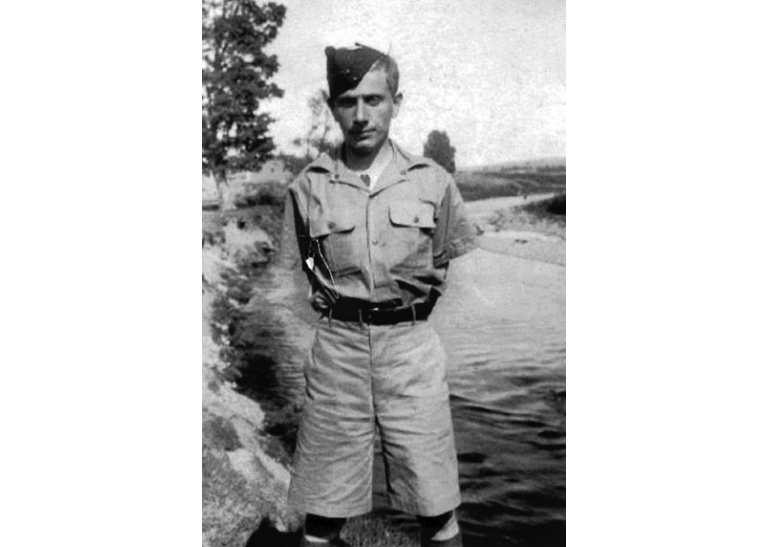
Camp Borden 1940 – QOR Museum’s Photo
Regimental Orders by Major MacKendrick E.D. Comd 1st Bn QORofC
Camp Borden, Ontario 12 July 1940
Dress, Officers & Other Ranks
Extract C.A.S.F. R.O.521
- The collar of the battle dress may be worn open on all occasions during the summer season.
- The regulation Khaki shirt will be worn with battle dress. The wearing of various coloured shirts and collars is not permitted.
- Other ranks will not wear ties
- The collar of the blouse may be lined to protect the neck.
- The ribands of orders, decorations, and medals will be worn in undress, service dress and battle dress in the prescribed manner.

Camp Borden – 1940 Rfn Jim Wilkins Personal Photos
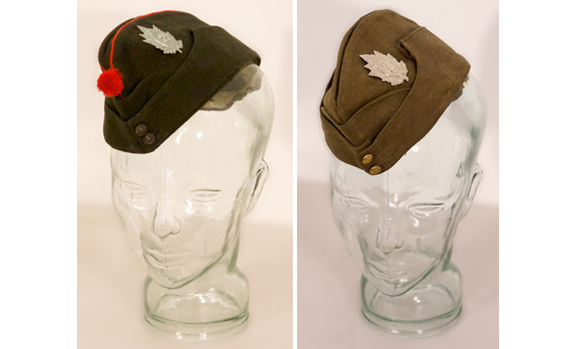
Pre-war QOR wedge cap and 1941-dated field service cap – Graham Humphrey Collection

QOR cap badge 1940 made of white metal – Graham Humphrey Collection
1940
7 August 1940 Botwood and Gander, Newfoundland
6 December 1940 Sessex, New Brunswick
Before leaving Borden in August 1940 the Regiments dress was fresh new stocks of the new Canadian made battle dress uniform. Consisting of ankle boots, ankle gators, wool trousers, suspenders, wool tunic, and wool greatcoat. As well, Canadian-made Pattern 37 webbing which consisted of basic front pouches, web belt, cross straps, canteen and holder, entrenching tool and sheath, bayonet frog, and the chest respirator were included. Additionally, Canadian-made denim working uniforms were adopted for use in training and work around camp. The headdress was the QOR pre-war Rifleman green field service cap, the Mk1 helmet, or a wool winter toque. Shoulder insignia was a black pin-on QOR title or a worsted black QOR on a wool slip-on worn on the epaulette of the battledress. The standard rifle was the Short Magazine Lee-Enfield No. 1 Mk. III* with the long bayonet (termed a ‘sword’ in Rifle regiments) which had been in use since the First World War. Transferring from Newfoundland to Sussex, New Brunswick several changes occurred with the exchange of the Mk1 helmet to the new Mk2 helmet, and the adoption of a winter wool cap. This was worn squarely on the head with the Regimental cap badge fixed centre on the front of the front flap of the cap.
Regimental Orders by Major MacKendrick E.D. Comd 1st Bn QORofC
Camp Sussex, N.B 11 mar. 1941
Wearing of Chevrons on Greatcoats; Chevrons will be worn on both arms of greatcoats in the following manner: – above the elbow, the points of the 1 bar chevrons 9 inches, the 2 bar 9 ½ inches, and the 3 bar 10 ½ inches from the top of the sleeve, point downwards.
Regimental Orders by Major MacKendrick E.D. Comd 1st Bn QORofC
Camp Sussex, N.B. 21 dec 1940
Dress – Winter Order
Attention is drawn by the Brigade Major to the following Brigade Orders.
(a) Winter caps will be brought into wear for all purposes with effect from 27 Nov. 1940
(b) Greatcoats and/or overshoes may be worn in camp and on training parades at the discretion of Officers Commanding units.
(c) Until further orders greatcoats and overshoes will be worn on all parades, both training and ceremonia,l at which more than one unit is present.
(d) Greatcoats will be worn on all occasions in “Walking-Out Order” on duty in the town of Sussex and on leave or pass until further orders. Overshoes may be worn at discretion of Officers Commanding units in “Walking-Out Order”.
Wearing of Winter Caps; Winter caps will be worn squarely on the head. (Bde. Order 176)
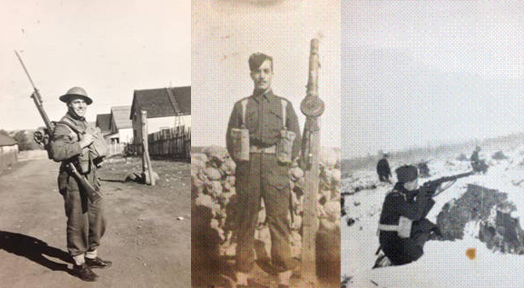
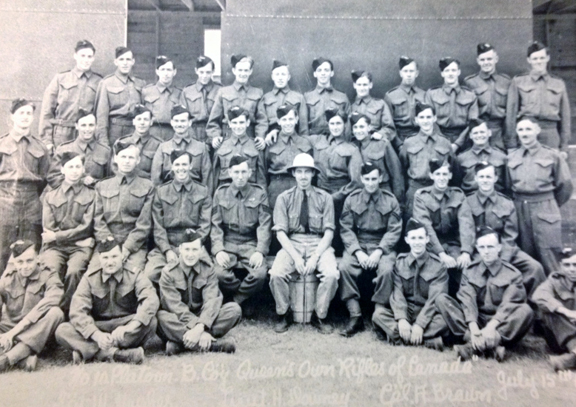
- QOR in Newfoundland 1940 – QOR Museum Photo
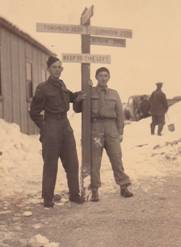

QOR in Newfoundland 1940 – Rfn Jim Wilkins Personal Photo
1941
With the transfer of the Regiment to England in July 1941, a number of changes to the accoutrement of the Regiment occurred. The change from the QOR pin-on or worsted QOR slip-on to a red stitched “QUEEN’S OWN RIFLES” on a rifle green backing occurred. Since the shoulder title didn’t include “CANADA”, the QOR adopted the white-stitched “CANADA” title – either curved or straight – which was stitched below the Regimental shoulder title. Also, we see the addition of a QOR Decal on the Mk II helmet which consisted of a red, green, red, green, and red. At this time, each Regiment in the Canadian military was permitted to adopt a lanyard colour. The QOR retained their red lanyard, which differs from the the black lanyard worn by today’s Rifle regiments. This red lanyard was worn until the end of the war.

Top, Canadian-made, circa 1940.
Bottom, British-made, circa 1943. Graham Humphrey Collection

Top, Curved pattern, Canadian-made, circa 1940. Bottom, circa 1941 – Graham Humphrey Collection

QOR Helmet Decal seen here in 1942 – QOR Museum Photo
22 May 1925 Standing Orders and Instructions
204. WHISTLE CORD shall be of red cord worn around left arm under shoulder strap.
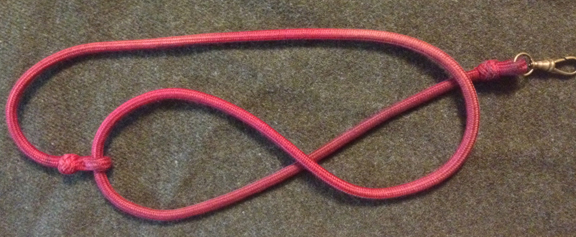
QOR Red Whistle Lanyard – Graham Humphrey Collection
15 Dec. 1942 Standing Orders and Instructions
- Dress
Officers
(b) Officers will wear black anklets and boots and black ties with battledress, in field service dress, black shoes and socks, black tie and F.S.Green.
Other ranks
(e) A red whistle cord will be worn on the left shoulder by all officers, warrant officers and sergeants.
(i) Some of the irregularities noticed in the dress of the Cdn. Corps are as follows:
The wearing of canvas shoes when walking out. The battle dress blouse undone at neck, except when marching easy. Men either without F.S. Cap or carrying it under shoulder strap.
(j) Badges – On joining the unit each man will be provided free with regt. Badges, cap, shoulder badges Q.O.R., Canada and Div. Patch also cap F.S. Green. From then on he will be held responsible that he is always in possession of these articles.
(k) The F.S. Cap green will not be worn when on duty with troops, but will be only worn off duty, church parades or when walking out.
(o) Chin straps and regimental flashes will be worn on the left side of the helmet.
(p) Good conduct Stripes are awarded after two years good service and are worn on the left arm below the elbow.

Left, QOR Officer looking over the channel .
Right, QOR Sgt in Holland 1945. QOR Museum Photo

QOR Rifleman’s 1943 tunic – Graham Humphrey Collection

Canadian made 1944 Left, Beret with QOR badge and backing.
Right, British-made Mk III “Turtle shell” helmet
with Canadian helmet net, scrim and field dressing. Graham Humphrey Collection
- Order of dress
Uniformity of dress is to be stressed at all times.
(a) Battle Order
- Battle Dress – anklets
- Steel Helmet (With of without net as ordered)
- Web Equipment (braces to be worn)
- Respirator (slung over right shoulder under waistbelt. Mounted personnel will wear respirator at alert)
- Water Bottle (on right side)
- Haversack (with ground sheet or gas cape as ordered)
- Sword under left arm
- Gas cape (on shoulder if ordered)
- Entrenching tool
- G1098 ammunition.
(b) Marching Order
- As above except – pack carried in place of haversack.
- Haversack slung at left side.
- Respirator at “Alert Position”.
(c) Fatigue Order
- Battle dress, denim and boots.
- Other equipment as ordered
(d) Church Parade Order
- Battle Dress and anklets.
- F.S. Green Cap.
- Respirator and helmet (if ordered)
(e) Guard and Picket Order
- Battle Dress and anklets
- Steel Helmets
- Skeleton web
- Respirator at “alert position”
- Gase Cape (rolled on shoulder)
- Detector sleeves
(f) Walking Out Order
- Battle Dress
- F.S. Green Cap
- Anklets – (may or may not be worn).
- Black shoes and socks may be worn by those in possession of them in lieu of boots.
(g) Drill Order with Pouches
- Steel Helmet
- Web braces, belts & pouches
- Sword at left side of the belt
- Battledress and anklets
(h) Piquet Order
- F.S. Khaki cap
- Waistbelt and sidearm
- Battledress and anklet
With the formation of the 3rd Canadian Infantry Division, the QOR was place in its 8th Brigade with Le Regiment de la Chaudiere and the North Shore (New Brunswick) Regiment. The Divisional formation patch was of French Grey Melton wool fabric which measured 3 inches by 2 inches. A number of shades of this French Grey were seen throughout the war.
Starting in 1941, the headdress of the Canadians changed from the pre-war QOR Rifleman Green Wedge to a Khaki wool “Field Service Cap”. This was worn with a slight angle to the right and centred on the head. The location in which the QOR cap badge was mounted was on the left side similar to the QOR rifle green wedge cap.
1943 In mid 1943, the headdress of the Canadians changed once again with the adoption of the beret. In keeping with rifleman tradition, the wearing of a rifle green backing behind the cap badge was authorized. The backing was of Melton Rifle Green wool and roughly measured 25cm by 25 cm with the Cap Badge centred within the patch. The wearer would have the leather band of the beret two fingers over the eye brows with the cCap badge over the middle of the left eye. The excess material was draped over the right side and pulled back.
1944 With the coming invasion of France, the 3rd Division was issue additional kit and equipment. The most noticeable was the Mk III “turtle shell” helmet which offered more protection for the wearer than the Mk II helmet.
The second most noticeable change was the adoption of the high-top buckle boots which were tried in Italy and widely issued to the 3rd Division. This lead to the term “3rd Div boots” or “Invasion boots”. Constructed with 9 eyelets and a buckle at the top of the boot, these boots put on a more modern look and were sought-after boots.
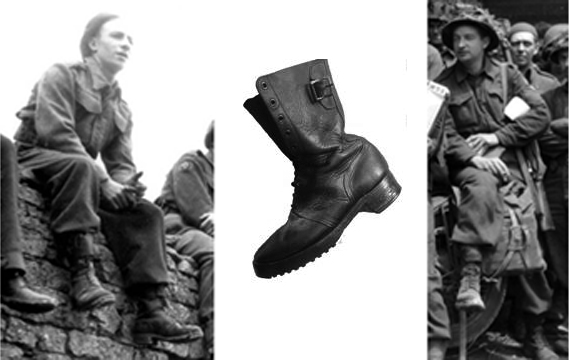
Rfn Jim Wilkins “Invasion boots” – Rfn Jim Wilkins Collection
Introduced around mid-1944 was the British-made canvas insignia. Examples of this come in the 3rd Division French Grey flashes, Canada titles, and “QUEEN’S OWN RIFLES” shoulder titles. These had a tendency to fade and fray. This characteristic was not desireable.
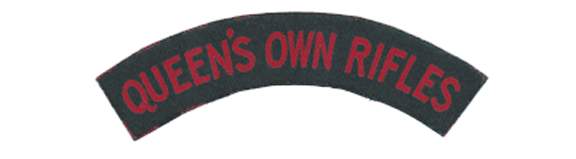
QORofC canvas insignia – Graham Humphrey Collection
1945 With the war coming to a close, the QOR was put onto occupation duty in 1945-46. To demonstrate that they were part of the occupation force, a single 2 cm wide bar was added at the base of the 3rd Division patch. With the QOR being the senior Regiment in this Brigade, a green occupation bar was added on top of the 3rd Division patch as well. The order to blacken ones P37 Web belt and Acklets was introduced with the coming of the end of the war in Europe.
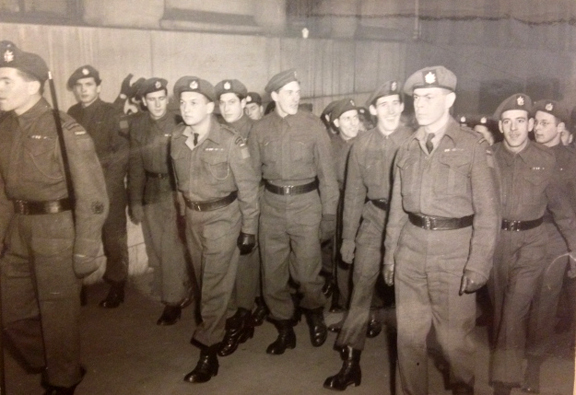
QOR Holland 1945, clearly showing the blackened Pattern 1937 web belts – QOR Museum Photo
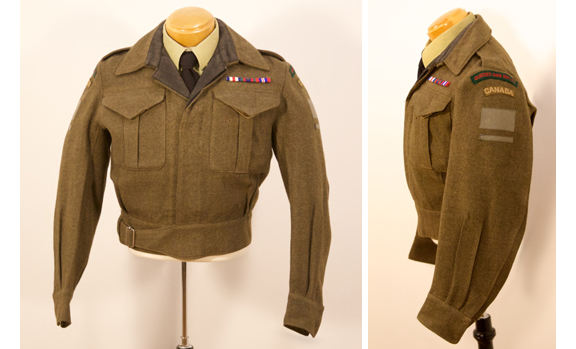
A 1945-46 occupation tunic. Notice the addition of the occupation stripe and the tailored collar with black cloth.

Battledress of the Commanding Officer of the Occupation force, Lt. Col. J. N. Medhurst OBE ED 4th Bn, QOR of C (CAOF) 8 June 1945 – 25 December 1945.
In 1945, a different QOR cap badge was introduced. Mainly seen on replacements of this time period, the cap badge contains less detail and the Arabic number “2” less defined. As well, a new QOR shoulder title was introduced with a more foliage green backing and hand-embroidered “QUEEN’S-OWN-RIFLES”.

1945 QOR cap badge – Graham Humphrey Collection
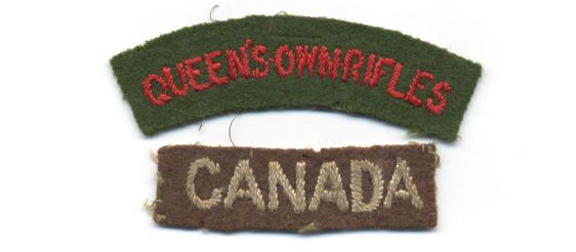
1945 British-made QOR title and Canada title – Graham Humphrey Collection
Notes
1. See also Rifleman J. William (Bill) Ross’ Memoirs for one man’s story of the war.
by Mark W. Tonner
During the period of the Second World War, Canada fielded three types of infantry battalions, the infantry (rifle) battalion, the infantry (machine gun) battalion, and the infantry (motor) battalion. This article, is focussed on the organization of a Canadian infantry (rifle) battalion, from the embodiment of the Canadian Active Service Force, in September 1939, to the end of hostilities in North-West Europe, in May 1945.
In September 1939, when Canada embodied the Canadian Active Service Force1, for service overseas, Canadian infantry (rifle) battalions were organized under the then current British War Establishment (WE) II/193l/l2B/3 (of 6 April 1938), which called for the battalion to be organized, and consist of:
– a Battalion headquarters of four officers and 43 other ranks
– a Headquarters company of five officers and 210 other ranks, within
– a company headquarters
– a signal platoon
– an anti-aircraft platoon
– a mortar platoon
– a carrier platoon
– a pioneer platoon
– an administrative platoon
– four rifle companies each of three officers and 97 other ranks, within a company headquarters and three platoons, with each platoon consisting of three rifle sections, of eight other ranks each.
The anti-aircraft, mortar, pioneer, and two platoons of each rifle company, were led by a Warrant Officer Class III, with the remainder being led by a subaltern (a junior officer) for a total battalion strength of 21 officers and 641 other ranks. Battalions with a Scottish or Irish affiliation, were allowed six additional pipers, each, and battalions of Foot Guards, were allowed two additional Warrant Officer Class II, each. Additionally, Canadian infantry (rifle) battalions, also carried a paymaster and his batman (a personal servant), due to the differences in Canadian and British pay procedure.
Following the initial deployment of the British Expeditionary Force (BEF) to France, in September 1939, the fact was brought to light, that the infantry (rifle) battalion, required more men then its current war establishment provided for. In March 1940, to meet this need, the British superseded WE II/193l/l2B/3, with a new war establishment for a rifle battalion, WE II/1931/l2F/l, which called for an additional 111 other ranks per battalion (three men per rifle section and three cooks per battalion). This new war establishment was adopted by Canadian authorities as WE II/1931/l2F/l ‘An Infantry Battalion (Higher Establishment),’ effective 15 March 1940 (as promulgated in General Order Number 169 of 1940), under the authority of Privy Council Order PC 84/3896 of 14 August 1940. Shortly afterwards, Canadian authorities decided to replace all Warrant Officer Class III, leading platoons, with a subaltern (a junior officer), which was authorized under Privy Council Order 29/2370 of 4 June 1940, effective 1 May 1940. This step was concurrently taken by the British, under the authority of Army Council Instruction 804. With the adoption of WE II/1931/l2F/l ‘An Infantry Battalion (Higher Establishment),’ the strength of a Canadian rifle battalion, including the paymaster and his batman (a personal servant), was now 33 officers and 753 other ranks.
After a further thorough study of the campaign of the BEF in France, the British decided in October 1940, to retain the basic organization of an infantry (rifle) battalion, but to increase the size of the mortar and carrier platoons. In order to compensate for these increases, the British later found it necessary, in view of the shortage of manpower, to reduce the rifle section by one private, which was incorporated into WE II/1931/12F/2, which superseded WE II/1931/l2F/l , effective 11 September 1941. A Canadian equivalent war establishment Cdn II/1940/12F/1 ‘A Canadian Infantry Battalion (Higher Establishment),’ effective 1 August 1941 (as promulgated in General Order Number 228 of 1941), was authorized under Privy Council Order 77/7841 of 9 October 1941, and superceded WE II/1931/l2F/l. This new Canadian war establishment, provided for an overall strength of 32 officers and 767 other ranks, in a rifle battalion. Each rifle company within the battalion, would now have five officers and 119 other ranks each, with a rifle platoon consisting of one officer and 36 other ranks, and each section consisting of ten other ranks.
To conform to British changes in the organization of a rifle battalion, a new revised Canadian war establishment, Cdn II/12F/2 ‘A Canadian Infantry Battalion,’ effective 3 September 1942 (as promulgated in General Order Number 472 of 1942), was authorized under Privy Council Order 44/3723 of 4 May 1942, to supercede Cdn II/1940/12F/1 ‘A Canadian Infantry Battalion (Higher Establishment).’ Under this new war establishment, a Canadian rifle battalion, was now organized, and consisted of:
– a Battalion headquarters consisting of:
– a signal platoon
– an anti-aircraft platoon
– an administrative platoon
– a Support company consisting of:
– a company headquarters
– a mortar platoon
– a carrier platoon
– an anti-tank platoon
– a pioneer platoon
– four rifle companies each of five officers and 110 other ranks, within a company headquarters and three platoons, with each platoon consisting of three rifle sections, of nine other ranks each for a total battalion strength of 37 officers (inclusive, of a paymaster (Royal Canadian Army Pay Corps), a medical officer (Royal Canadian Army Medical Corps), and a signals officer (Royal Canadian Corps of Signals)) and 782 other ranks.
By the end of 1942, the Canadian Army Overseas2, due to the effects of manpower restrictions, and a serious shortage of shipping, from Canada, decided to completely reorganize, based on British war establishments, in order to facilitate co-operation between formations and units of the British Army, and First Canadian Army3. This reorganization of the Canadian Army Overseas, came into effect on 11 January 1943 (as promulgated in Canadian Military Headquarters4 Administrative Order No. 2 of 1943). As part of this reorganization, and to conform more closely to the British war establishment for an infantry (rifle) battalion, a new Canadian war establishment, Cdn II/12F/3, ‘A Canadian Infantry Battalion,’ effective 1 January 1943 (as promulgated in General Order Number 144 of 1943), was authorized under Privy Council Order 2339 of 23 March 1943, to supercede Cdn II/12F/2 ‘A Canadian Infantry Battalion.’ Under this new war establishment, a Canadian rifle battalion, was now organized, and consisted of:
– a Battalion headquarters
– a Headquarters company consisting of:
– a company headquarters
– a signal platoon
– an administrative platoon
– a Support company consisting of:
– a company headquarters
– a mortar platoon
– a carrier platoon
– an anti-tank platoon
– a pioneer platoon
– three rifle companies each of five officers and 142 other ranks, within a company headquarters and three platoons, with each platoon consisting of three rifle sections, of ten other ranks each for a total battalion strength of 32 officers (inclusive, of a paymaster (Royal Canadian Army Pay Corps), a medical officer (Royal Canadian Army Medical Corps), and a signals officer (Royal Canadian Corps of Signals)) and 741 other ranks.
The rifle battalions, in the United Kingdom, of the Canadian Army Overseas, were directed to adopt this new war establishment, effective 31 January 1943 (as promulgated in Canadian Military Headquarters Administrative Order No. 18 of 1943). The reference number for this new Canadian rifle battalion war establishment, was changed to that of Cdn II/233/1, effective 15 March 1943 (as promulgated under Canadian Military Headquarters, General Staff Branch Letter 77 of 12 March 1943).
In April 1943, the British reintroduced the fourth rifle company, into the organization of an infantry (rifle) battalion (as promulgated in War Office Letter 20/Inf/3502 (Staff Duties (SD) 1), of 11 April 1943). This change was incorporated in a new Canadian war establishment, Cdn II/233/2, ‘A Canadian Infantry Battalion,’ effective 27 April 1943 (as promulgated in General Order Number 466 of 1943), which was authorized pursuant to Privy Council Order 44/3723 of 4 May 1942. Under this new war establishment, a Canadian rifle battalion, was now organized, and consisted of:
– a Battalion headquarters
– a Headquarters company consisting of:
– a company headquarters
– a signal platoon
– an administrative platoon
– a Support company consisting of:
– a company headquarters
– a mortar platoon
– a carrier platoon
– an anti-tank platoon
– a pioneer platoon
– four rifle companies each of five officers and 122 other ranks, within a company headquarters and three platoons, with each platoon consisting of three rifle sections, of ten other ranks each for a total battalion strength of 37 officers (inclusive, of a paymaster (Royal Canadian Army Pay Corps), a medical officer (Royal Canadian Army Medical Corps), and a signals officer (Royal Canadian Corps of Signals)) and 811 other ranks.
The nine rifle battalions, of the 1st Canadian Infantry Division5, which had just been informed of their upcoming participation in the invasion of Sicily, were ordered to immediately reorganize, on this new Canadian war establishment (Cdn II/233/2). However, owing to manpower shortages, the rifle battalions, of the 2nd and 3rd Canadian Infantry Divisions, and those of the 4th and 5th Canadian Armoured Divisions6, temporarily retained the lower war establishment, Cdn II/233/1, which Cdn II/233/2, had superceded. These remaining rifle battalions, were eventually ordered to reorganize, on this new Canadian war establishment (Cdn II/233/2), effective 1 August 1943 (as promulgated in Canadian Military Headquarters Administrative Order No. 107 of 1943).
Within days, of receiving the order to reorganize, on Canadian war establishment, Cdn II/233/2, the rifle battalions, of the 2nd and 3rd Canadian Infantry Divisions, and those of the 4th and 5th Canadian Armoured Divisions, received word to reorganize, on a new war establishment, for a Canadian rifle battalion, which was that of Cdn II/233/3, ‘A Canadian Infantry Battalion,’ effective 5 August 1943 (as promulgated in General Order Number 466 of 1943), which was authorized pursuant to Privy Council Order 44/3723 of 4 May 1942. This new war establishment, made no changes in the basic organization and strength (37 officers and 811 other ranks), of a Canadian rifle battalion, but provided for all four rifle company commanders, to hold the rank of Major. The nine rifle battalions, of the 1st Canadian Infantry Division, remained organized under Cdn II/233/2, until February 1944, at which time they converted to the new organization of Cdn II/233/3 (as promulgated in Canadian Military Headquarters Administrative Order No. 29 of 1944, dated 26 February 1944, with an effective date of 5 August 1943).
Incorporating numerous minor amendments to war establishment, Cdn II/233/3, a new Canadian war establishment, for an infantry (rifle) battalion, Cdn II/233/4, ‘A Canadian Infantry Battalion’ (as promulgated in General Order Number 553 of 1944), was authorized pursuant to Privy Council Order 44/3723 of 4 May 1942, and superceded Canadian war establishment, Cdn II/233/3, ‘A Canadian Infantry Battalion,’ effective 15 August 1944. Again, this new war establishment, made no changes in the basic organization and strength (37 officers and 811 other ranks), of a Canadian rifle battalion, but provided for an additional Private (to be employed as a driver), in each of the four rifle companies, of the battalion, serving in an armoured division, which in the case of the Canadian Army overseas, where those of the 10th Canadian Infantry Brigade (4th Canadian Armoured Division) and the 11th, and 12th Canadian Infantry Brigades7 (5th Canadian Armoured Division), thus slightly raising their strength to that of 37 officers and 815 other ranks.
Amendment No. 4, to Canadian war establishment, Cdn II/233/4, ‘A Canadian Infantry Battalion’ (as promulgated in General Order Number 19 of 1944, and authorized pursuant to Privy Council Order 44/3723 of 4 May 1942), added an additional officer (to be employed as the Scout officer) and his batman (a personal servant), effective 30 September 1944, thus increasing the strength of a rifle battalion, in the 1st, 2nd, and 3rd Canadian Infantry Divisions, to 38 officers and 812 other ranks, while those of the 4th and 5th Canadian Armoured Divisions, increased to that of 38 officers and 816 other ranks. War establishment, Cdn II/233/4, ‘A Canadian Infantry Battalion,’ remained the war establishment under which Canadian infantry (rifle) battalions, were organized, until the end of hostilities in North-West Europe, in May 1945.
Under WE Cdn II/233/4, a Canadian infantry (rifle) battalion in an infantry division, was organized, and consisted of:
– a Battalion headquarters of six officers and 54 other ranks
– a Headquarters company of five officers and 94 other ranks, within
– a company headquarters
– a signal platoon
– an administrative platoon
– a Support company of seven officers and 184 other ranks, within
– a company headquarters
– a mortar platoon
– a carrier platoon
– an anti-tank platoon
– a pioneer platoon
– four rifle companies each of five officers and 120 other ranks, within a company headquarters and three platoons, with each platoon consisting of three rifle sections, of ten other ranks each for a total battalion strength of 38 officers (inclusive, of a paymaster (Royal Canadian Army Pay Corps), a medical officer (Royal Canadian Army Medical Corps), and a signals officer (Royal Canadian Corps of Signals)) and 812 other ranks.
And a Canadian infantry (rifle) battalion, in an armoured division, was organized, and consisted of:
– a Battalion headquarters of six officers and 54 other ranks
– a Headquarters company of five officers and 94 other ranks, within
– a company headquarters
– a signal platoon
– an administrative platoon
– a Support company of seven officers and 184 other ranks, within
– a company headquarters
– a mortar platoon
– a carrier platoon
– an anti-tank platoon
– a pioneer platoon
– four rifle companies each of five officers and 121 other ranks, within a company headquarters and three platoons, with each platoon consisting of three rifle sections, of ten other ranks each for a total battalion strength of 38 officers (inclusive, of a paymaster (Royal Canadian Army Pay Corps), a medical officer (Royal Canadian Army Medical Corps), and a signals officer (Royal Canadian Corps of Signals)) and 816 other ranks.
Sources:
– Army Headquarters Report No. 57, A SUMMARY OF MAJOR CHANGES IN ARMY ORGANIZATION, 1939-1945, dated 22 December 1952, complied by Major R.B. Oglesby, Historical Section (General Staff), Army Headquarters, Ottawa, Ontario.
– General Orders 1940, as promulgated and issued to the Canadian Militia/Army by Order of the Minister of National Defence, by Command, of the Adjutant-General, Militia/Army Headquarters, Ottawa, Ontario.
– Part “A,” General Orders 1941, as promulgated and issued to the Canadian Army by Order of the Minister of National Defence, by Command, of the Adjutant-General, Army Headquarters, Ottawa, Ontario.
– Part “A,” and Part “B,” General Orders 1942, as promulgated and issued to the Canadian Army by Order of the Minister of National Defence, by Command, of the Adjutant-General, Army Headquarters, Ottawa, Ontario.
– Part “A,” and Part “B,” General Orders 1943, as promulgated and issued to the Canadian Army by Order of the Minister of National Defence, by Command, of the Adjutant-General, Army Headquarters, Ottawa, Ontario.
– Part “A,” and Part “B,” General Orders 1944, as promulgated and issued to the Canadian Army by Order of the Minister of National Defence, by Command, of the Adjutant-General, Army Headquarters, Ottawa, Ontario.
Endnotes:
1. The Canadian Active Service Force was redesignated the Canadian Army (Active), effective 7 November 1940 (as promulgated in General Order Number 273 of 1940), under the authority of Privy Council Order 6645 of 19 November 1940.
2. For the purposes of reference and description, that portion of the Canadian Army (Active), serving in the United Kingdom and Europe, was designated the Canadian Army Overseas, effective 7 November 1940 (as promulgated in General Order Number 301 of 1941), under the authority of the Minister of National Defence.
3. First Canadian Army was the senior Canadian operational formation in the United Kingdom and Europe during the period of the Second World War, and was formed in the United Kingdom, on 6 April 1942, with Headquarters First Canadian Army, having been embodied under the authority of Privy Council Order 51/2757 of 11 April 1942, effective 1 April 1942 (as promulgated in General Order Number 131 of 1942).
4. On 26 September 1939, the Minister of National Defence authorized the creation of a Canadian Military Headquarters (CMHQ) (London, England) overseas. This headquarters held responsibility for coordinating the arrival, quartering, completing equipment requirements, and training of Canadian Active Service Force units and formations and to command and administer these units and formations in the United Kingdom and at base in the theatre of operations. In addition, the headquarters had an important liaison role, particularly liaison with the British War Office and with the General Officer Commanding (GOC) Canadian Forces in the theatre of operations, as well as furnishing information to the Canadian High Commissioner in London.
5. A Canadian Infantry Division, contained three infantry brigades, each of which contained three infantry (rifle) battalions.
6. A Canadian Armoured Division, contained one infantry brigade, of three infantry (rifle) battalions.
7. At this point in the war, owing to the nature of the operations in Italy, that the 5th Canadian Armoured Division was involved in, it was found necessary to augment the division with a second infantry brigade. The 12th Canadian Infantry Brigade, was formed for this purpose, effective 13 July 1944, and was disbanded effective 13 March 1945, upon the move of the 5th Canadian Armoured Division to North-West Europe.
by Bill Alexander ©2014
During the Second World War many innovative programs were devised to train personnel for service in the Canadian armed forces. Among these was a unique partnership between the army and Canadian universities. Perceiving a shortage of officer and technical specialists, the army instituted a program to give selected high school graduates, with high academic standing, an initial year of a university engineering program combined with basic military training. From this group the army would select potential officer candidates, while the others would continue their training in various technical trades. The program ran for two years and was respectively designated No 1 Canadian Army University Course and No 2 Canadian Army University Course.[i]
Initiated in the 1942-1943 school year, the CAUC program was extended into 1943-1944. Basic military training started during the summer months and in the autumn the student-soldiers moved to a university campus for academic instruction, the syllabus consisting of a first year engineering course and some military instruction. With an enrolment of 160 men, No 1 Canadian Army University Course (No1CAUC), the pilot course was held only at the University of Toronto during1942-1943. Reviewed at the end of the school year it received positive evaluations and was deemed a success.
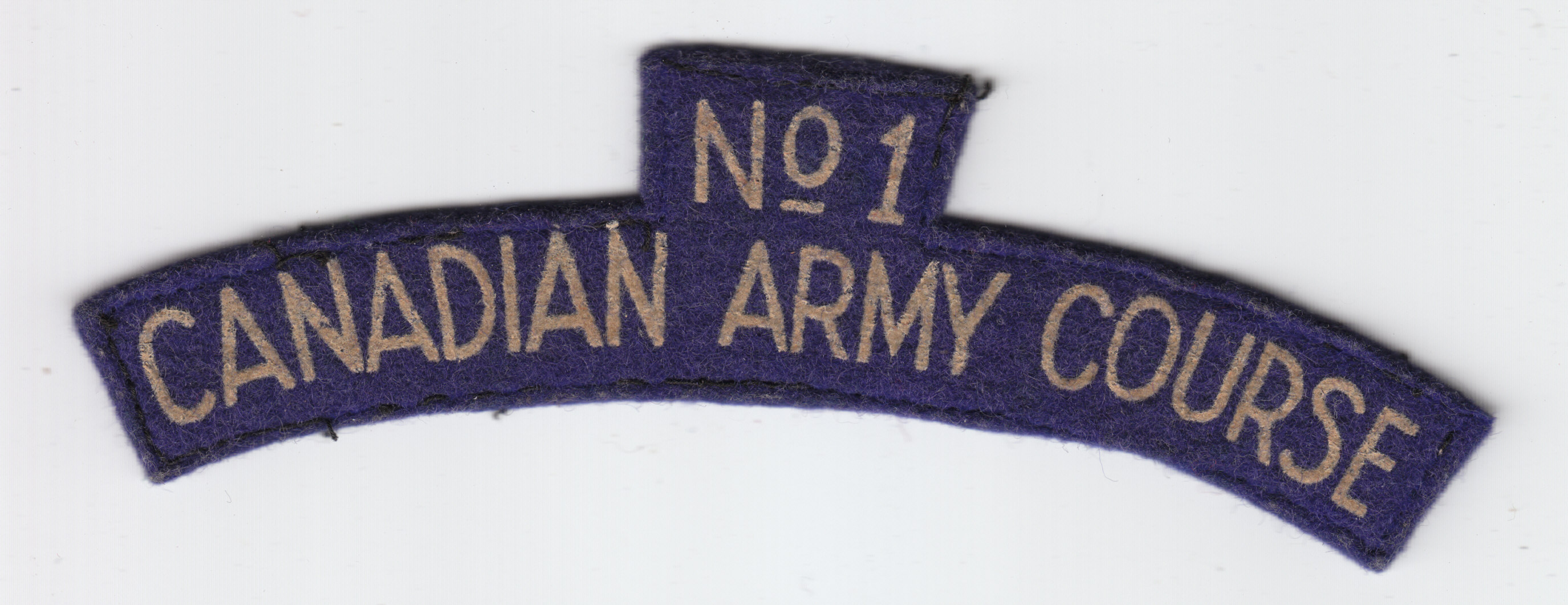
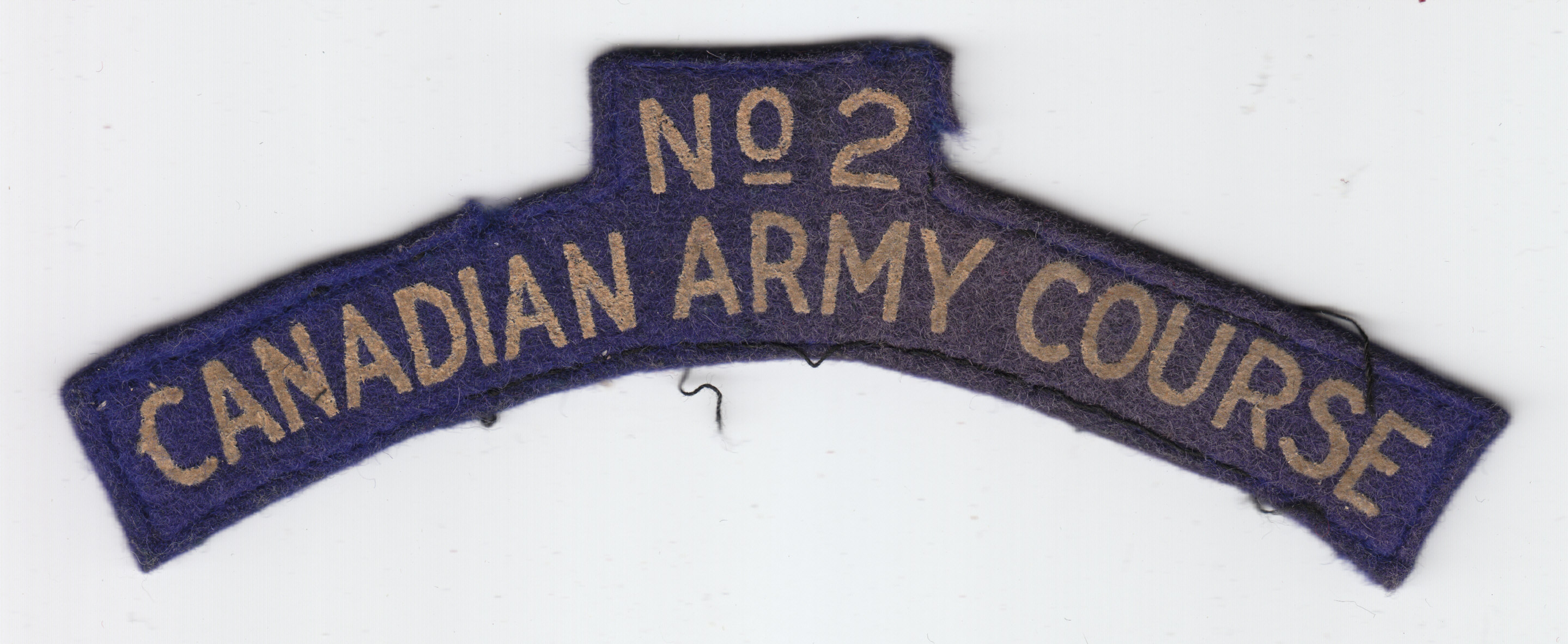
Flocked titles for University of Toronto No 1 and No 2 CAUC’s.”
For the next school year, the program was expanded and No 2 Canadian Army University Course (No 2 CAUC) was organized at universities across Canada. Over 1,200 student soldiers were enrolled in serials at the University of British Columbia, University of Alberta, Western University, University of Toronto, Acadia University, McGill University, McMaster University, Queen’s University, University of New Brunswick, and the University of Saskatchewan. At least two more universities participated, but to date they have not been identified. No. 2 CAUC was also deemed a success, but by 1944 a surplus of officer personnel had developed. Having met the army’s needs, the program was suspended at the end of the second session. Most graduates of the program went on to officer training for specific corps, including RCA, RCE, RCCS, and RCEME. They also served in infantry and armoured units overseas. Those not selected as officer candidates continued in technical trades training for various corps. Several officer graduates volunteered for the Canloan officer scheme and served overseas under that program. [ii]

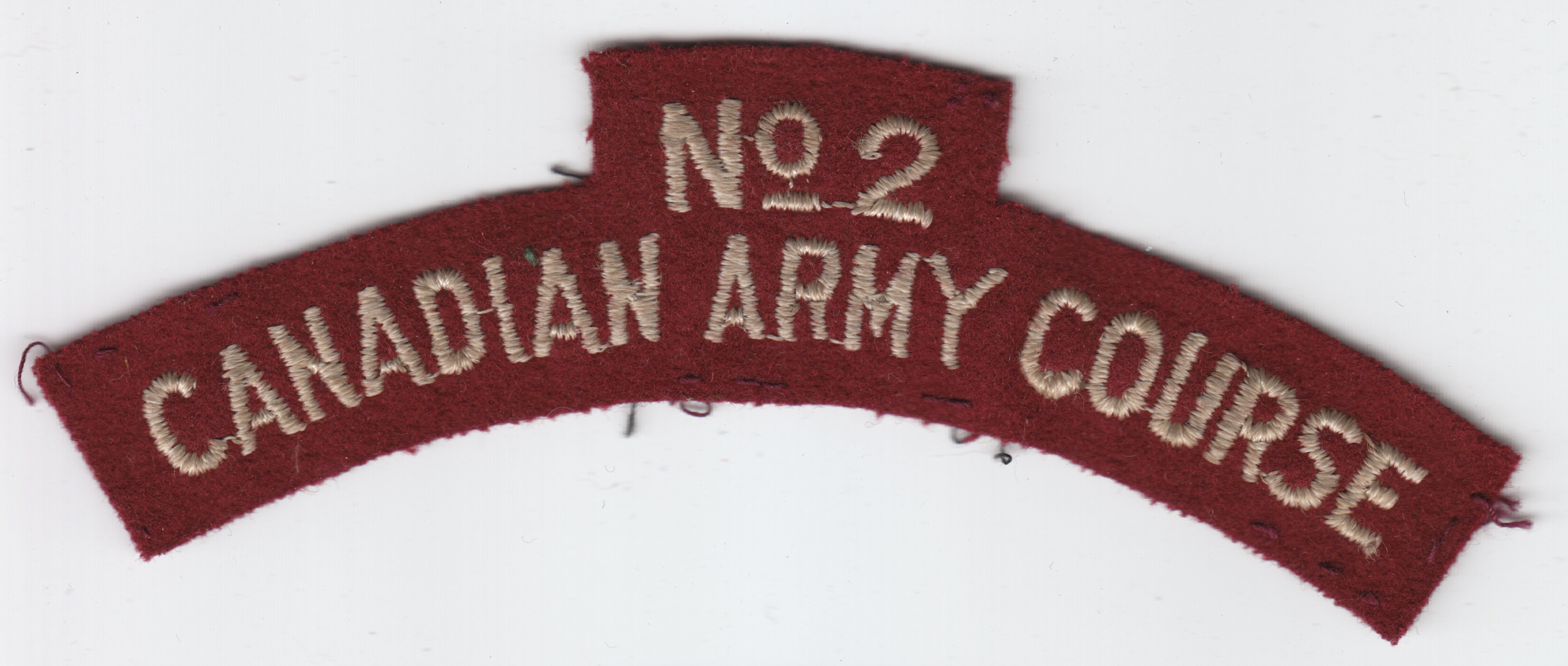
Embroidered No 2 CAUC titles. Chain link stitch oyster on green, silver on maroon. Universities not identified
The student-soldiers enrolled in the Canadian Army University Courses wore battle dress and the drab field service cap. A chrome or rhodium plated general list cap badges of the First World War pattern was worn on the cap. Consistent with NDHQ policy, collar badges were not provided; they were not to be worn on battle dress. [iii]


Embroidered No 2 CAUC titles. Top, scarlet embroidery on yellow. University not identified. Bottom title. This pattern, in yellow on dark green has been identified as the generic No 2 course title.
Distinctive shoulder titles were worn by the CAUC contingents, but authorizations have not been located. The shoulder titles bore the number of the course, either “No 1” or “No 2”, over “CANADIAN ARMY COURSE”. No 1 Canadian Army Course is only found in one pattern. Issued to the small enrolment of the program’s first year, the title was flocked (sprayed) in off white lettering on medium blue felt.[iv] No 2 Canadian Army Course titles are found in several patterns and colours, including flocked and embroidered examples. The standard No 2 pattern was yellow/gold embroidery on dark green melton. Other No 2 embroidered examples were made using a chain link stitch, white on medium green, standard red (scarlet) embroidered lettering on yellow melton, with a black embroidered border, oyster (silver) embroidery on maroon, and yellow embroidered lettering on medium blue base. The base materials were either felt or melton. Flocked No2 titles, on felt material are found in off white (officially called “oyster”) on medium blue and on red. The wide range of titles for No 2 CAUC is likely attributable to the course being held at different universities. Their identity and morale would be enhanced by a unique title for each serial.


No 2 CAUC yellow embroidered on blue felt, and No 2 CAUC flocked (sprayed) on red felt. Universities not identified
In addition to the numbered course titles, a title exists without a course number, reading CANADIAN ARMY COURSE, in white lettering sprayed on red felt. Its provenance has not been established, but it has been suggested that this pattern was worn by the instructional cadre.
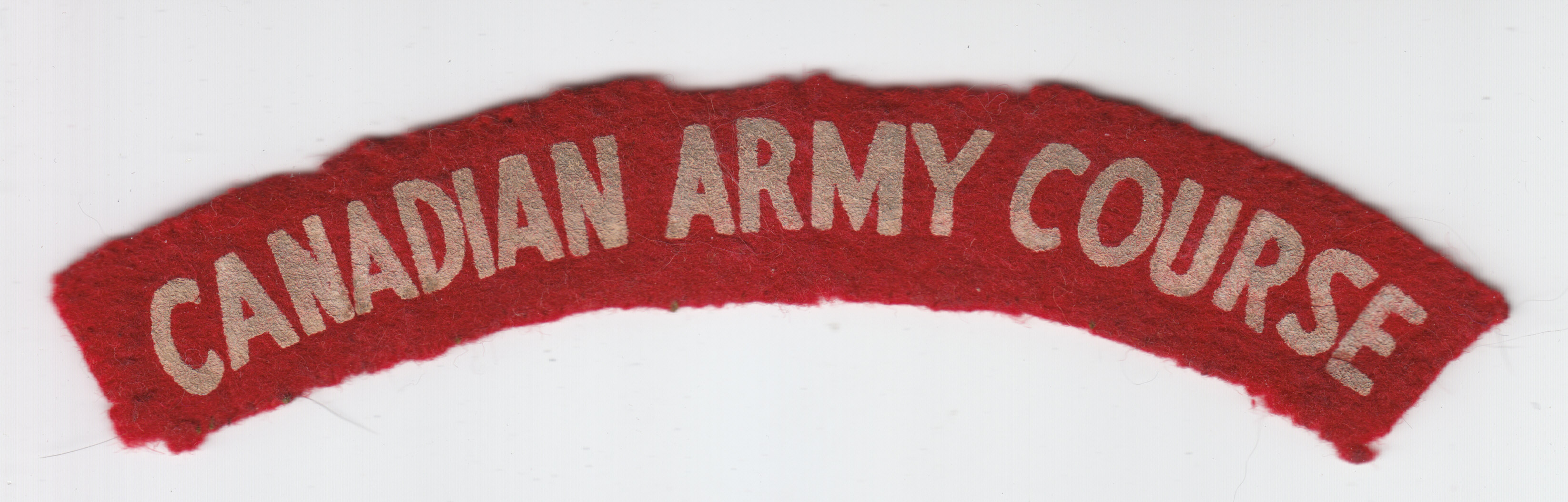
No number, flocked white on scarlet. It has been suggested that this title was worn by the instructional cadre
An unique solution to recruiting and training officers, the CAUC’s legacy was significant. Many of the recruits went on to distinguished careers in the army and in civilian life. Their success was grounded in the CAUC programs.
We welcome you to rate this article by clicking on the stars below
The author is currently researching the use and authorizations of shoulder titles in the Canadian Army. Service Publications looks forward to pubishing this definitive reference in the near future.
[i] Stacey C.P. Six Years of War, Queen’s Printer, Ottawa, 1955. P139.
[iii] Thompson R., Cap Badges of the Canadian Officer Training Corps, Vol. 2, Nova Scotia, Canada. 1972. Pg 56. The plated cap badge may have been used by COTC contingents who did not have a unique pattern.
[iv] Spraying (also called flocking) was a process where the naming or inscription was sprayed or painted using a stencil or screen on the base material. Spraying was usually done on a stable base fabric, usually felt.
by Doug Knight
The Army Technical Development Board (ATDB) coordinated military research and development in Canada during the Second World War. Many of their endeavours were reasonably successful, while others should probably never have been started. In the “weird projects” category, the ATDB opened a project in September 1943 to develop a “Mobile Armoured Rotating Carriage (MARC)”.The project had been initiated by the Director of Artillery, and the aim was to design a gun carriage that could fulfill the role of both a field gun and an anti-tank gun. The field gun in service at the time was the 25-pounder gun, and this was incorporated in the original discussions. However, in less than a month, the headquarters of the Canadian Army Overseas (CAOS) stated that they had no requirement for this type of gun carriage, and the project was considered cancelled in October 1943. No work had been undertaken.
In December 1943, the project was revived based on a new requirement for a combined anti-tank / anti-aircraft gun. CAOS requested that the carriage be evaluated in conjunction with the high-velocity 6-pounder gun that was being developed by another ATDB project. CAOS insisted that the carriage had to be capable of -5º depression to +80º elevation. It had to have 360º traverse and be covered by a bulletproof shield. Three gunners had to work inside the shield, and they had to have immediate access to twelve rounds of ammunition. The weight of the whole carriage should not exceed 7,500 lb (3,400 kg).

By February 1944, the contractors, Specialty Equipment and Machinery Company of New York, and Ward LaFrance Truck Division of Elmira, New York, had carried out the necessary stress calculations, and had prepared assembly drawings of the MARC. In March, the contractors offered to build a pilot model at their own expense, using the standard 6-pounder 7-cwt anti-tank gun that was then in service.
 A wooden mockup was constructed and demonstrated during the late springat Camp Petawawa, Ontario, in an attempt to determine the feasibility of the concept. No actual development took place, and there were some contractual problems with the two companies involved. By the summer, it had been established that there was no service requirement for an equipment of this nature, and the project was finally cancelled on 11 July 1944.

You can rate this article by clicking on the stras below.
by Clive M. Law
Immediately prior to the introduction of identity discs into the British Army, individual identification was satisfied by the issue of a printed identity card which remained in the possession of the soldier while in service. This card, (Army Form B 2067) was surrendered when the soldier entered into the Reserves, with the intent of re-issue should the soldier be called back to active service. Needless to say, the card itself suffered the typical hardships of rough use and was often indecipherable when needed to identify its owner.
The first mention of identity discs appears in January, 1907 when a single aluminum disc, fitted with a 42 inch cord, was approved for use on mobilization. Instructions stated that the discs were to be kept ready marked, showing the soldier’s number, name, rank, regiment and religion.

The use of the soldier’s rank on the disc required that a new disc be issued with every promotion.
The marking of the disc was to be done locally and units were to indent for 1/8 inch steel stamps. The orders do not state either the religions or the approved abbreviations which could be used.
By May, 1907 an amendment addressed the use of the soldiers rank on the discs by removing the requirement. The illustrated sample also did away with the smaller scripted letters for the abbreviation to regiment.
The second pattern ID disc disposed of the rank as well as the smaller characters for both rank and Regiment – which required a second set of smaller stamps.
A further amendment, introduced in April, 1908 allowed for the discs to be stored with the regiment’s name already stamped. The soldier’s name, number and religion would be added upon mobilization. At some point, near the beginning of World War 1, the disc, previously manufactured in aluminum, was replaced with a red disc. This disc was manufactured of a non-ferrous, fibre compound which resembled linoleum.
The marking of the discs in Canada was identical to that of Great Britain, with the addition of the word ‘CANADIANS’ or the abbreviation ‘CDN’. It is not unusual to find the discs marked with the information equally divided between the two sides.
The identity disc remained unchanged until 1916 when it was decided by the War Office that a disc should remain with the remains while a second disc was removed and used in the computation of battle fatalities. Until the Great War, the remains of soldiers killed on active duty could be buried in situ, or removed to a central burial site by the Regiment. With the static warfare of the trenches and the requirement to move the remains to a central burial ground, the introduction of a second disc was a logical step.
Army Order 3287, of April, 1916 instructed that each officer and soldier would be issued two identity discs. The upper, octagonal, disc was to be known as “Disc, Identity, No.1, Green” and was to be worn around the neck. The second, “Disc, Identity, No. 2, Red” was then suspended from the first.

By the end of the First World War soldiers were issued with two discs – one of which remained with the body in case of death.

Example of the two-disc era as issued during the First World War in the CEF. Courtesy Alistair Taylor
The green disc was issued with six inches of cord and the soldier was expected to remove his red disc, substitute it (in the upper position) with the new green disc and then suspend the red disc in the lower position. No mention was made in these orders of the procedure to be followed, and the resulting confusion led to a clarification, issued in October, 1916;
The upper disc, known as “Disc, identity, No.1, green” will not be removed but will be buried with the body. Consequently, in cases where a body can be reached and identified but cannot be brought back for burial, the lower disc will be removed, to ensure proper notification of death, while the upper disc will remain as a safeguard against loss of identity when it becomes possible to bury.
The status of the identity discs remained virtually unchanged until World War 2 when Routine Order #29 for the Canadian Army Active Service Force outlined the procedure to be used. This procedure called for the discs to be issued by the local District and that they be in the possession of the men and officers before they leave the District to proceed overseas.

The style used throughout the Second World War. Routine Orders allowed for a number of additional religious denominations to be inscribed.
The style of the discs was unchanged – there were still two discs, one red, one green. RO 29 called for the stamping to be in straight lines across the discs, except in cases of lengthy names which could be “stamped in other than a straight line.” Once again members of the Canadian Army were identified as ‘CANADIANS’ on the discs. By the end of the war the number of religions which could be included on the discs grew to include;
- Church of England – C of E
- Roman Catholic – R C
- United Church – UNC
- Presbyterian – PRES
- Baptist – BAPT
- Lutheran – LUTH
- Pentecostal – PENT
- Christian Science – C SCI
- Greek Catholic – GC
- Greek Orthodox – GO
- Jewish – J
- Other Denominations – OD
In August, 1943, the Army Technical Development Board (ATDB) undertook a project to develop new identity discs on behalf of the Director of Ordnance Services (DOS). This project, number 1032, included the National Research Centre (NRC), the Royal Canadian Air Force and the Royal Canadian Navy. Minutes of the project show that $50.00 was set aside to cover incidental expenses during the course of the project.

Second World War discs issued to B114388 M.H. Lively. Note the use of a numeral ‘1’ in lieu of an ‘i’ in the name. Courtesy Ed Storey
The purpose of the project was to develop an improved disc with a greater resistance to heat and corrosion. At the same time, General Service (GS) requirements called for a disc that was lightweight and readily embossable.
In August, 1943, the NRC had developed a material which was readily embossed, had a much lower moisture absorption point than the current disc and which could withstand a heat treatment of 1200°F for a period of three hours, with no loss of legibility. It was also found that temperatures could rise to 2500-3000°F for relatively short periods, did not break down the material.
As promising as this appeared, samples submitted by the manufacturer in September, 1943 were not completely satisfactory and new samples were ordered to be issued two discs, one of which was to remain with the body. subjected to tests. These were received in November and, when tested, were found to meet all of the requirements, except that the outer laminations were found to contain too much resin. Meanwhile, it was thought that stainless steel discs would be the ideal substitute.

Front view of discs issued to A42406 Pte C. Little. Courtesy Ed Storey

Rear view of Pte Little’s red disc. The inclusion of a blood group is unusual.
Australia had advised Canada that they had been using them from the start of 1943. Australia had also examined the use of zinc as a replacement but found that zinc was subject to corrosion in the jungle. Canadian authorities also rejected zinc because of its properties – zinc melts at 786°F, whereas temperatures in a burning tank or aircraft can reach 1100-1300°F. Samples of stainless steel were ordered from a US manufacturer. These were found to be too hard to permit ready embossing with the current equipment. In December, 1943, it was suggested that a 13/4 inch stainless disc could be recycled from the eyepieces of old respirators. 100 stamped samples were made up but, again, difficulty was encountered in embossing these.

Officer’s discs, in this case to Lt A. Raymond. Courtesy Ed Storey
By February, 1944 samples of a new plastic material were received from a Canadian contractor and when tested by the NRC showed definite failure to withstand extreme heat. Notwithstanding this failure, a sample of the plastic discs and of the US stainless steel discs were sent to the Department of Munitions & Supply with the request for information as to the availability of stamping machines in Canada, and a request that a quantity of both stainless steel and monel metal discs be supplied for further trials.

The final style was decided upon in early 1945 but was put on hold after VJ-day. The new disc was finally issued in time for use in Korea. Author’s collection
While these trials were continuing, an investigation was being carried out to ascertain whether or not a design of disc similar to the German disc should be adopted. In August, 1944 the ATDB brought the question of improved discs before the Dress & Clothing Committee who decided that the NRC should continue development of the one-piece monel metal disc similar to the German disc and of sufficient thickness to withstand stamping by existing equipment. The project was given an added impetus by the urgent request of the Canadian Military Headquarters (CMHQ) in London, for 600,000 monel metal discs with stainless steel bead chains. A drawback to the steel bead chain was a US report that the Japanese had a tendency of stripping these from the bodies. This left the corpse without any identification at all. In answer to this the British War Office suggested the use of nylon or plastic cords. Canada chose not to follow this suggestion and continued development of the discs using the steel bead chain.
By September the newly developed monel metal disc, after the design of the German type identity disc, was submitted along with a modified stamping machine, for the approval of the Director, Ordnance Stores. This approval was readily given and the discs were forwarded to the Dress & Clothing Committee to obtain final blessing. Before this body could take any action, the discs and specifications were passed to the Director General Medical Services for further investigation. Upon approval by that branch it was found necessary to pass the discs to the Quartermaster General, the Adjutant General and the Chief of the General Staff, each of whom also gave their support to the new design.
Finally, in January 1945, provisioning action was taken to supply 100,000 of these discs for the Canadian Army and the ATDB considered project 1032 closed as of 26 January, 1945.
The new design was issued in time for the Special Service Force which saw action in Korea. Again the basic information was provided on the discs, along with a serial number which, instead of identifying the unit as it did in World War II, identified the Military District in which the soldier was recruited. For the first time also, officers were allotted serial numbers.

Postwar pattern displaying officer’s service number. This marking style was superceded with unification of the Canadian Forces and the use of Social Insurance Numbers. Courtesy Alex Itenson
At unification a decision was made to use the soldiers Social Insurance Number (SIN) as his military serial number. This was continued until the early 1990s when it was decided that this policy encroached on a soldier’s right to privacy and on his human rights. Since the mid-1990s the CF has reverted to unique numbers, known as Personal Records Identifier, (PRI) which are, in turn, used on the soldiers’ identity disc. The current discs can also display one of 18 religious options.

CF pattern disc issued to Canadian government employees deployed to Afghanistan. The top line exhibits the persons Public Service paylist number and the last line reads “CDN CIV CDN”. Author’s collection

CF pattern disc issued by the RCMP to Canadian poice officers deployed on overseas police missions. This disc is to a civilian Public Servant and in lieu of an RCMP Regimental Number, the employees personnel number is used. Note that, by policy, no religion is included on this ‘CIVPOL’ disc.
You can rate this article by clicking on the stars, below. You can also scroll to the bottom of the page and leave a comment.
A listing of Regimental numbers used on identity discs from 1936 to 1960. Available from Service Publications.
© Bill Alexander 2014
The Canadian Armed Forces Land Force Central Area embarked on a new three year training cycle for the reserve units of Ontario in 2003. The culmination of the training year was an annual summer concentration called Exercise Stalwart Guardian, held in 2003, 2004, and 2005. Exercise Stalwart Guardian combined reservists from 31, 32, and 33 Brigade Group into one formation known as 3 Light Brigade Group. The Light Brigade Group included composite infantry battalions made up of soldiers from the infantry regiments, which were designated 31, 32 and 33 Light Infantry Battalions. Ontario reservists from artillery and engineer units and area support units also contributed personnel to form composite operational units for the exercises. To identify these units and the exercise staff, small patches were produced to be worn in place of the nationality patch on the cadpat and combat uniforms.
Stalwart Guardian 2003. A member of the First Hussars wearing the 3 CAR patch. DND photo.
For 2003 and the two subsequent Stalwart Guardian Exercises, a series of approximately 18 identifying patches were issued for infantry, armour, artillery, engineers, signals, logistics and other supporting branches and exercise control and support staff. Some changes in the series of patches took place over the three summers of Stalwart Guardian exercises, but to date, the changes have not been documented. (For example, 3 Airborne Company was only deployed in 2003.) In 2006, the summer exercise was named Valiant Guardian. A revised order of battle resulted in several new formations and units with the respective patches being issued for Valiant Guardian concentration.
Stalwart Guardian 2003. A member of the Lorne Scots, wearing combat dress, with the 32 LIB patch on upside down. DND photo
The Stalwart/Valiant Guardian insignia were a hybrid formation/unit patch. These small patches identified the battalions, composite units, support units and the exercise cadre, much like a regimental or branch title. They were designed like a formation patch, but much smaller. The patches had exercise unit abbreviations embroidered on different coloured backgrounds. The coloured backgrounds often reflected branch or corps colours, as seen with the yellow and red of the armoured units, or the combinations of blue and red for the artillery and engineers. The patches measure 1 inch high by 2 inches wide and have a velcro backing. They were fully embroidered, most including a unit abbreviation embroidered directly on the panel. These patches were strictly controlled, with a limited issue per soldier or participant.
Exercise Stalwart Guardian 2003

Stalwart Guardian 2003. Members of 33 Light Infantry Battalion, including one soldier from the Hastings and Prince Edward Regiment, wearing a mixture of cadpat and combat dress. All wear the 33 LIB Stalwart Guardian patches. Credit: Department of National Defence photo.
A full coloured poster titled DZ PATCES Ex SG 03 was printed for Exercise Stalwart Guardian in 2003.[1] The following patches were illustrated on the poster, but the actual patches were constructed with the unit abbreviation imposed (embroidered) on the fully embroidered backing. Changes were made in the order of battle for SG 04 and SG 05, which changed the series of patches issued for the exercises. No poster or list of patches has been documented for SG 04 and SG 05.

A selection of Stalwart Guardian DZ patches.
|
Exercise Patch |
Unit | Description |
| Communications(No Lettering on patch) | Communications | Equally divided horizontal panels of gray over blue |
| EXCON | Exercise Control | White lettering on black |
| TRG CADRE | Training Cadre | Black lettering on canary yellow |
| TRG SP GP | Training Group Support | Equally divided horizontal panels, white over orange. Black lettering on the orange panel |
| RGE SAFETY | Range Safety | Black lettering on an orange panel. |
| O/Cs and O/CS(note different lettering size) | Observer / Controllers | Black lettering on white panel. |
| EX SP GP | Exercise Support Group | Black lettering on three equally divided vertical panels, from left to right canary yellow, white and orange. |
| 3 LBG | 3 Light Brigade Group | White lettering on three equally divided vertical panels, from left to right, green, blue and dark gold. |
| 31 LIB | 31 Light Infantry Battalion | Two varieties exist, one black lettering on green, the other white lettering on green. (Likely two different year issues.) |
| 32 LIB | 32 Light Infantry Battalion | White lettering on blue panel. |
| 33 LIB | 33 Light Infantry Battalion | Black lettering on dark gold. |
| 3 CAR | 3 Composite Armoured Regiment | Equal horizontal panels of yellow over red, with white lettering on the red portion. |
| 3 ARR | 3 Armoured Recee Regiment | Patch divided equally from top left to bottom right, yellow on top, red on bottom, white lettering on the red portion of the patch |
| 4 RCA | 4 Fd Regt Royal Canadian Artillery (Number 4 was used as 3 Fd already existed in the order of battle.) | Patch horizontally divided, red over blue, with white lettering on the blue panel |
| 3 CER | 3 Combat Engineer Regiment | Three equal vertical panels, blue, red and blue with white lettering |
| 3 CS BN | 3 Composite Service Battalion | Three equal horizontal panels, blue on top, yellow centre, red bottom, with blue lettering on yellow panel |
| 3 FD AMB | 3 Field Ambulance | Green over maroon equally sized horizontal panels, with white lettering on maroon panel |
| 3 MP COY | 3 Military Police Company | White lettering on red panel |
| 3 AB COY | 3 Airborne Company (only deployed in 2003) | Equally divided horizontal sky blue over maroon panel with white lettering on the maroon panel |

Stalwart Guardian / Valiant Guardian Observer / Controller patches. Note the different font size of the “S”. The variation is likely attributed to two different years of the SG exercises.
Stalwart Guardian / Valiant Guardian Observer / Controller patches. Note the different font size of the “S”. The variation is likely attributed to two different years of the SG exercises.
Members of the composite 3 CER unit bridgelaying during Stalwart Guardian 2005. DND photo LC2005-026-087.
Exercise Valiant Guardian 2006
In 2006 the next phase in the training cycle, Valiant Guardian, was held for reserve units in Ontario. Patches were again issued for the VG exercise, but significant changes were made in the organization of the force. This in turn required changes in the series of patches. Similar in style and construction to the Stalwart Guardian patches, the VG patches reflected the new order of battle. (Note: Information for the series of patches has not been found. Some of the following patches may have also been produced for Stalwart Guardian exercises.)

Valiant Guardian 2006 Canadian Rangers patch.
|
Title Reads |
Explanation |
Description |
| 3(CA)MNB | Unidentified | white letters on three equal vertical coloured panels from left to right, green, blue,and gold |
| CANIC | Canadian National Intelligence Center | Black letters on diagonally divided patch, from left down to right, green on top, white diagonal stripe, red on bottom |
| CDN RGRS | Canadian Rangers | Black letters on three equal vertical coloured panels, from left to right, yellow, white, orange |
| HSS | Health Services Support | whiteletters on equal horizontal panels of from the top green, maroon |
| MEDIA | Media | blackletters on a purple/blue background |
| NCE | National Command Element | red letters on equally divided horizontal panels white over black |
| NSE | National Support Element | black letters on equal horizontal panels from top to bottom, blue,yellow, and red |
| OPFOR | Opposition Force | black letters centred on a white over red patch, divided from topleft to bottom right. |
| PAff | Public Affairs | White on maroon |
| RGE/CONDUCTING/GROUP | Range Conducting Group | Equal white and orange horizontal panels, black lettering. |
| TF31 | Task Force 31(31 Brigade composite battalion) | Black letters on green |
| TF32 | Task Force 32(32 Brigade composite battalion) | White letters on blue |
| TF33 | Task Force 33(33 Brigade composite battalion) | Black letters on old gold |
| VISITORS | Visitors | red letters centered on awhite over black patch, divided from top left to bottom right |
[1] (DZ or Drop Zone patches, is not truly reflective of an airborne capability, but was term used to describe the type of patch issued for the SG and VG exercises.)
You can ‘rate’ this article by clicking on the stars, below.
 CSMMI MILART