
by Keith Wright, CD
The author joined the 1 Service Battalion in Calgary in the summer of 1978, as a private fresh from trades training in Borden. Sometime later that year the Commanding Officer decided he wanted a unit drum and bugle band and the call for volunteers went out. A Band Sergeant was brought in to train and conduct the band. During the winter/spring of 1978/79 we practiced twice a week in a little shack down the hill in Sarcee, Alberta. I remember that it wasn’t normally heated until we used it and we would practice in our parkas. By the summer we were starting to sound like a band.
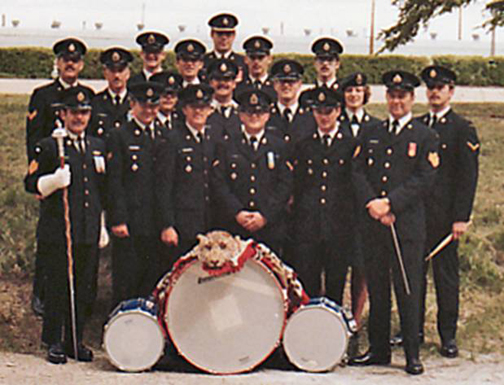
The 1 Service Battalion band. This unauthorised band is shown at Wainwright, Alberta, June 1979.
In June 1979, while on concentration at CFB Wainwright (WAINCON 79) we brought our instruments and dress uniforms to the field. We practiced band drill and playing while marching on the parade square in Camp Wainwright. It also gave us a chance to get a break from the field and enjoy a shower.
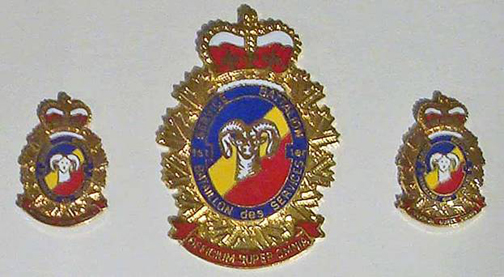
Cap and collar badges of the 1 Service battalion band. Courtesy the author from a display he mounted in 1982.
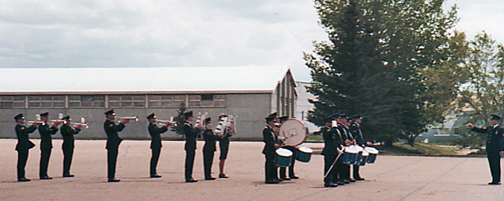 At this time the band consisted of the Band Sgt (conductor), a Band Administration Officer, a Drum Major (Sgt), four snare drummers, two side drummers, a bass drummer, three glockenspiel players, three buglers, and two baritone buglers (which included the author). During Waincon there was a female augmentee from the Canadian Scottish Regiment playing the glockenspiel.
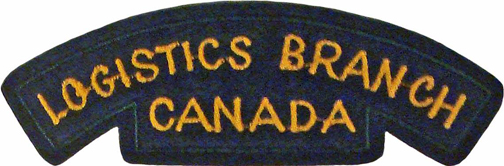
Proposed CF LOGISTICS BRANCH shoulder flash. Author’s collection
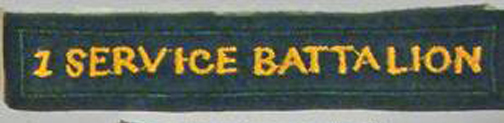
Proposed (early to mid 1970s) CF dress badge to be worn under the proposed CF LOGISTICS BRANCH shoulder flash. Author’s collection
In the spring of 1979 each band member was issued with a cap badge and pair of collars. 50 sets of these were purchased using unit funds. The cap badge is a very nice looking metal and enamel representation of the 1st Service Battalion crest. It measures 2 inches high by 1- 5/16 inches wide. It has a beret slider that is quite deep at 5/16 inches. A gold coloured crown inlaid with enamel – white upper, red middle and white on the bottom – surmounting the crest. Surrounded by ten gold maple leaves is an upright oval consisting of the gold and white ram’s head of 1 Canadian Mechanised Brigade Group on the diagonal colours of the Service Battalions (blue over yellow over red). This is enclosed by a blue border with the gold words: 1 SERVICE BATTALION – 1 BATAILLON des SERVICES. The bottom consists of a red banner with the gold motto: OFFICIUM SUPER OMNIA. The back is a gold-coloured, fine lined cross pattern. At about 5/16 inches from the bottom, under the beret slider, is the makers’ name, NORMANDY.
Our first command performance at which we wore the 1 Service Battalion Band cap badge and collars was (if I remember correctly) for the Battalion Change of Command Parade shortly after we returned from Wainwright. While there were a couple more performances the band died a quiet death through postings and a lack of interest from the new CO. When I left the battalion in the summer of 1981 all that was left was a single piper who played at battalion mess functions and parades. The piper wore the battalion band cap badge on his Glengarry.
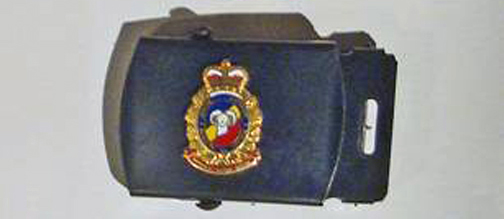
The belt buckle worn with CF Service Dress utilises a collar badge as its device. Author’ collection
The collars are the same design and colours but half size. The ram’s head is less detailed and has more white in it. The back has two vertically mounted clutch pin fasteners. There is no name on the back of these collar badges. As a point of interest the collar badge is the same as the one used on the 1 Service Battalion belt buckle as they all came from the same supplier.
You can rate this article by clicking on the stars below
by Clive M. Law
It has often been said that Truth is the first casualty of war as governments immediately limit the freedom of mass media. Twinned with this imposition is the increase in government propaganda and mass-advertising.
At the outbreak of the Second World War there was the expected rush to the colours by both the patriotic and those who, following the Great Depression, had few options and saw the war as an opportunity for regular meals and shelter from the coming winter. However, by 1941 the Canadian government, spurred on by the Army, was examining ways to increase recruitment. In August of that year the Canadian Women’s Army Corps (CWAC) was raised, in response to the shortage of personnel caused by the increase in the size of Canada’s military. Although hesitant at first to employ women in uniform (or what one senior army officer called a “petticoat army”) these women soon proved their worth, by assuming duties that would release men for Active Service.
So successful was this ‘social experiment’ that the Army engaged in an advertising campaign to attract even more women. This campaign included press advertising, posters and the extended use of roadway billboards.
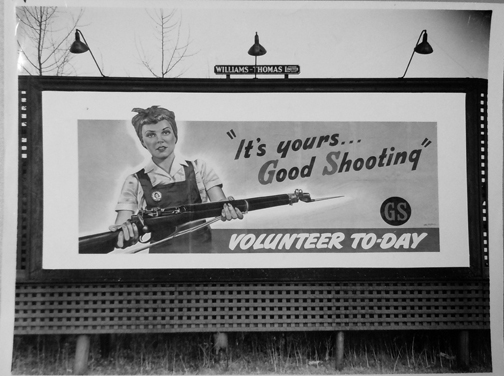
A photograph of an actual roadside billboard. Here a female factory worker, presumably from Long Branch, offers a Lee-Enfield rifle. The billboard plays on the “GS” badge which represented General Service (denoting a volunteer who has indicated a willingness to serve overseas) with Good Shooting.
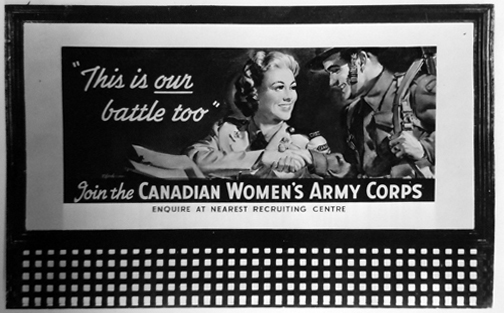
A mock-up showing the equality between men and women in uniform and indicating that both had the same motivation and goal.
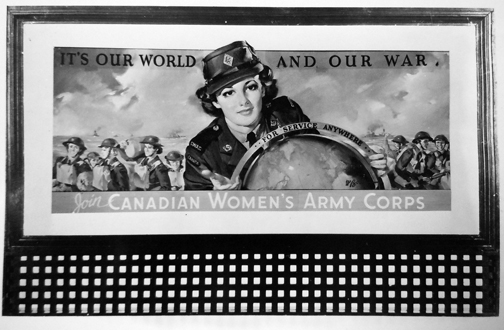
Not only did the Army wish to increase the numbers of women in uniform they also wanted them to volunteer for General Service in order to serve at locations in Great Britain and, as needed, overseas at various headquarters.
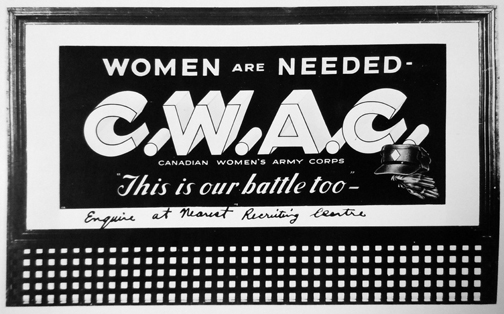
This mock up has the added text ‘Enquire at Nearest Recruiting Centre’ to maintain consistency with other billboards.
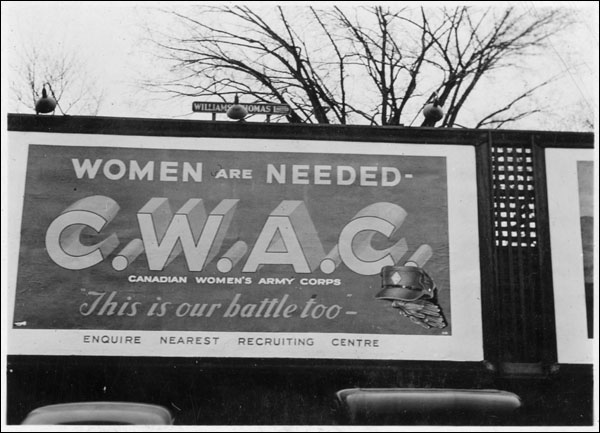
The finished billboard.
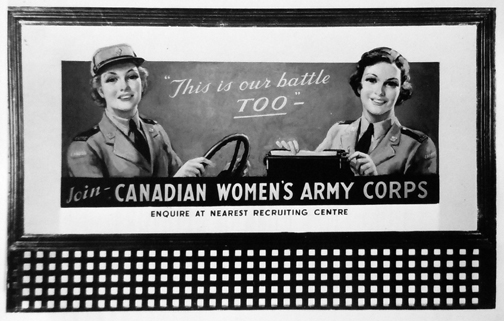
CWACs served in many occupations with clerical being the most common. In addition to drivers, some CWACs served in food service, instrument repair and machinery options. Short of actual combat there were many opportunities for women in uniform.
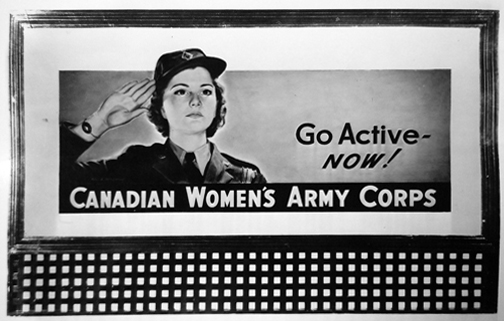
Another appeal to ‘Go Active’. In addition to encouraging new enrollment the billboards also encouraged existing CWACs to go to the next level by volunteering for oversea duty.
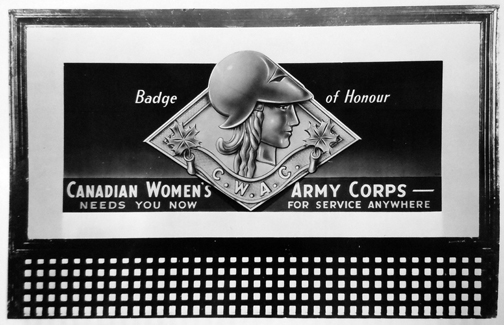
This mock up is leveraging the CWAC badge as used on the lapels of their uniform. The CWACs chose Athena, Goddess of War, as their symbol.
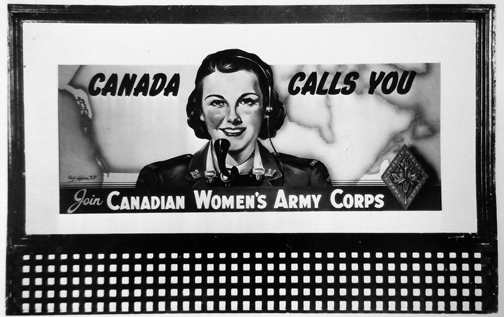
This mock up subliminally suggests that CWACs would only serve in Canada. The use of the model as a telephone operator would comfort many potential volunteers, and their parents, who saw this occupation as one that was suitable for women. Volunteers under the age of 21 required parental approval prior to enrolling.

This final mock up tugs on the patriotic heartstrings of young women. The badge is the result of an artist taking liberties with the CWAC cap badge.
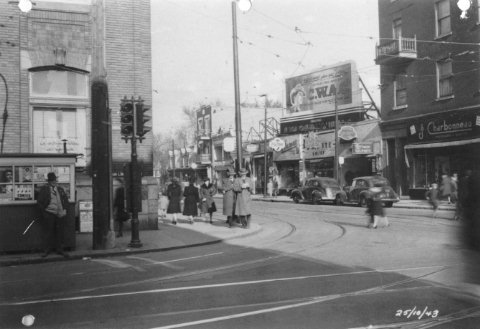
The billboards’ locations were noted limited to roadways. Here, one is placed above a shop in a town’s shopping district.
Prospective recruits had to be in excellent health, at least 5 feet (152 cm) tall and 105 pounds (48 kg) (or within 10 pounds (4.5 kg) above or below the standard of weight laid down in medical tables for different heights), with no dependents, a minimum of Grade 8 education, aged 18 to 45, and a British subject, as Canadians were at that time. They were paid two-thirds of what the men were paid in the same occupation although this was later changed to four-fifths.
CWACs served overseas, first in 1942 in Washington, DC, and then with the Canadian Army in the United Kingdom. In 1944 CWACs served in Italy and in 1945 in northwest Europe. Following VE-Day they served with the Canadian Army Occupation Force (CAOF) in Germany. Approximately 22,000 women served in the CWACs and, of these, 3,000 served overseas. In August 1946 the CWACs were disbanded.
by Mark W. Tonner
Continuing on from the ‘Ram’ Kangaroo armoured personnel carrier, Part 2, of 27 October 2014
Although not a ‘Ram’ Kangaroo armoured personnel carrier, another conversion of Ram, Mark II tanks, was to that of an armoured ammunition carrier, to replenish the tanks of armoured and armoured reconnaissance regiments, with ammunition, fuel, and personnel, during ‘active’ operations. This conversion consisted of the removal of the complete turret, with the turret ring and ball-race1 remaining in place, and the removal of the internal ammunition bins and racks. The No. 19 Wireless Set (a radio)2 was reinstalled in the left-hull pannier3, on the left of the bow machine gunner’s position, and the vehicle batteries were moved from the hull floor, up into the rear of the left-hull pannier. A circular 1-inch (14-millimetre) thick armoured plate, with a 28-inch (71-centimetre) square door (with two 14×14-inches (36×36-centimetres) hinged hatches), in the centre, was placed over the turret ring and ball-race (enabling the armoured plate to be rotated), with a 7-inch (18-centimetre) high splash plate4, being installed around the 28-inch (71-centimetre) square double hinged hatches. The drive shaft was also to be covered over, as in the conversion of Ram tanks, to that of ‘Ram’ armoured gun towers, as mentioned in the ‘Ram’ Kangaroo armoured personnel carrier, Part 2, of 27 October 2014. This would account for the references in some contemporary accounts of the drive shaft being covered over, as part of the initial conversion of Ram, Mark II tanks, to that of ‘Ram’ armoured personnel carriers, when in fact, only those ‘Ram’ armoured personnel carriers, based on the conversion of ‘Ram’ armoured gun towers, would have the drive shaft covered over.
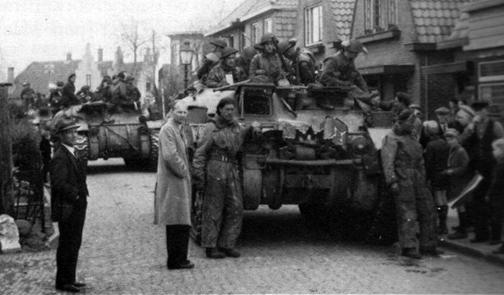
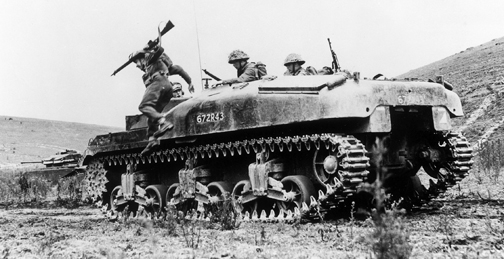
Although, as mentioned in the ‘Ram’ Kangaroo armoured personnel carrier, Part 2, of 27 October 2014, the front towing hook was to have been removed from ‘Ram’ armoured gun towers, as part of their conversion to that of a ‘Ram’ armoured personnel carrier. As can be seen, this was not always the case, as evidenced by the towing hook assembly being still in place on the front of the lead ‘Ram’ Kangaroo in this photo. Source: Author’s collection
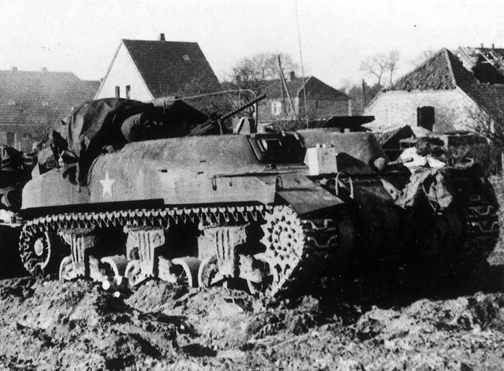
A ‘Ram’ Kangaroo armoured personnel carrier of the 1st Canadian Armoured Personnel Carrier Regiment. Note the forward facing secondary .30-calibre Browning machine gun mounted in the turret ring, and the vehicle tarpaulin, which as been pulled back from over a ‘tarp/bivouac’ support, which can be seen with one leg mounted in the front of the turret ring, while the other leg is mounted in the rear of the turret ring, with the centre pole of the
‘tarp/bivouac’ support, in between. Source: 1 CACR Association & Archive
One innovation, which wasn’t part of any conversion of Ram tanks or Ram armoured gun towers, to that of armoured personnel carriers, was that of ‘tarp/bivouac’ supports, which were improvised by the crew members of ‘Ram’ armoured personnel carriers, themselves, for use with the large vehicle tarpaulin. These supports (or poles) either were crescent shaped, or had a downward leg at either end of a straight pole, and were mounted into any of the bolt holes left in the circular opening of the hull top, by the removal of the turret ring during the initial conversion of Ram tanks to either Ram armoured gun towers, or that of ‘Ram’ armoured personnel carriers. Once in place, the large vehicle tarpaulin could be put up over these, leaving an opening at the front for the crew to enter or exit the carrier, while keeping the elements out (i.e., rain or snow). These ‘tarp/bivouac’ supports, were normally used when the crew knew that they were going to be in a static position for a time, and could easily be cleared away and stowed before they had to move off again.
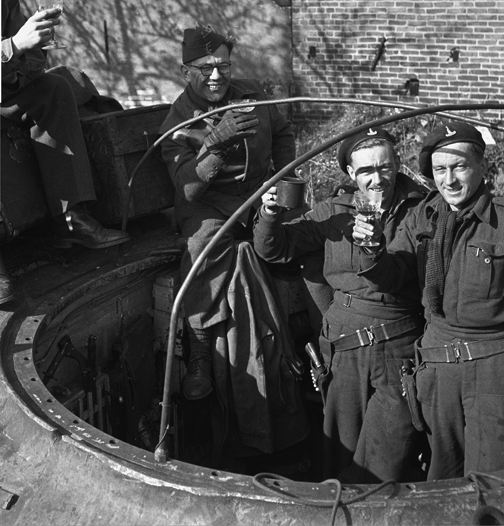
An example of crescent shaped ‘tarp/bivouac’ supports being used on a ‘Ram’ Kangaroo armoured personnel carrier of the 1st Canadian Armoured Personnel Carrier Regiment. Source: 1 CACR Association & Archive
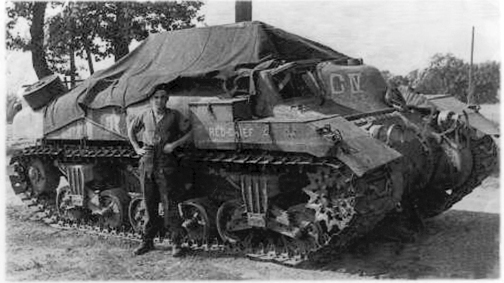
Another example of the ‘tarp/bivouac’ supports in use, seen here on RED-CHIEF, a ‘Ram’ Kangaroo armoured personnel carrier of the 1st Canadian Armoured Personnel Carrier Regiment. Source: 1 CACR Association & Archive
On 14 October 1944, in a letter, in which First Canadian Army Headquarters, informed Canadian Military Headquarters (London), that 162 ‘Ram’ Kangaroo armoured personnel carriers would be required, to form the Canadian armoured personnel carrier regiment, consisting of two squadrons of 53 carriers each, and a reserve of 50 armoured personnel carriers, an entitlement for six ‘Ram’ armoured ammunition carriers, was allotted to the 1st Canadian Armoured Personnel Carrier Regiment, Canadian Armoured Corps. These six ‘Ram’ armoured ammunition carriers, were to be used as ‘command’ carriers, within the regiment. Two each, were to be held by Regimental Headquarters, “A” Squadron Headquarters, and “B” Squadron Headquarters. As of 21 November 1944, 1st Canadian Armoured Personnel Carrier Regiment, Canadian Armoured Corps, held four (CT159532, CT159702, CT1598715, and CT159896) of their entitlement of six ‘Ram’ armoured ammunition carriers. At this time, First Canadian Army Headquarters decided that there was no priority for the issue of the remaining two, and that their issue be deferred until such time as either, 1st Canadian Armoured Personnel Carrier Regiment, was under command of First Canadian Army6, or that the two were particularly requested. However, that being said, a fifth ‘Ram’ armoured ammunition carrier, CT159891 (named MARION), was issued to the regiment sometime after 21 November 1944, and remained in service with 1st Canadian Armoured Personnel Carrier Regiment, as a ‘command’ carrier. These ‘command’ carriers, would have been among those designated carriers that were fitted with a second No. 19 Wireless Set, or with No. 18, No. 22, or No. 38 Wireless Sets, as the need arose, as referred to in the ‘Ram’ Kangaroo armoured personnel carrier, Part 2, of 27 October 2014.
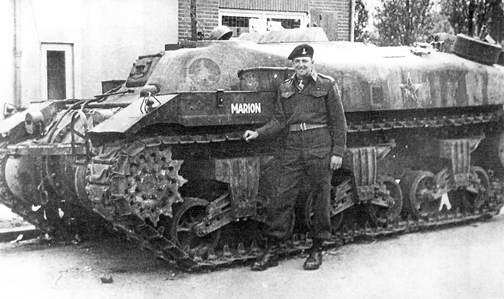
One of the ‘Ram’ armoured ammunition carriers issued to 1st Canadian Armoured Personnel Carrier Regiment, as a ‘command’ carrier, bearing the name MARION (CT159891), seen here, in June 1945, as the ‘Kangaroo’ of Major W.A. Copley, Officer Commanding, “B” Squadron, which he named after his wife Marion. Just above Major Copley’s head, on the top of the hull, can be seen, the 7-inch (18-centimetre) high, splash plate, which was installed around the 28-inch (71-centimetre) square double hinged hatches, in the centre of the circular armoured plate that was placed over the turret ring, as described in the text. Source: Bill Miller
As mentioned in the ‘Ram’ Kangaroo armoured personnel carrier, Part 1, of 16 October 2014, part of the initial conversion of the Ram, Mark II tank, to that of a ‘Ram’ armoured personnel carrier, was the repositioning of the No. 19 Wireless Set in the forward left-hull pannier, and as noted above, was also the case with the initial conversion of Ram, Mark II tanks, to that of ‘Ram’ armoured ammunition carriers. One interesting revelation which came to light, as 1st Canadian Armoured Personnel Carrier Regiment started receiving ‘Ram’ Kangaroo armoured personnel carriers, was that, in some cases, the No. 19 Wireless Set was mounted to far forward in the left-hull pannier, thus overhanging the edge of the pannier and protruding into the carrier, which restricted the traverse of the bow ball-mounted .30-calibre Browning machine gun, to the right by 5-degrees. This overhanging of the edge of the pannier and protruding into the carrier, of the No. 19 Wireless Set, was also noted in those ‘Ram’ armoured ammunition carriers, that had been initial conversions of earlier Ram, Mark II tanks, which had an auxiliary turret, on the left front of the tank. Although the problems mentioned above, had been rectified in ‘Ram’ armoured gun towers, converted to ‘Ram’ armoured personnel carriers, by mounting the No. 19 Wireless Set over the transmission, between the co-driver’s, and driver’s position, as mentioned in the ‘Ram’ Kangaroo armoured personnel carrier, Part 2, of 27 October 2014. While awaiting a response to this latest problem (from Canadian Military Headquarters (London)) of the wireless set being mounted to far forward in the left-hull pannier, 1st Canadian Armoured Personnel Carrier Regiment Signal Troop, Royal Canadian Corps of Signals, as an expedient measure, remounted the No. 19 Wireless Set in the forward right-hull pannier, of those carriers, in which the mounting of the wireless set in the forward left-hull pannier, was causing problems with the protrusion of the set into the carrier, or that was interfering with the operation of the bow mounted .30-calibre Browning machine gun. In January 1945, having been notified of what measures 1st Canadian Armoured Personnel Carrier Regiment Signal Troop, had taken to rectify the problem with the No. 19 Wireless Set mounting, the Deputy Director of Mechanical Engineering, First Canadian Army7, in a letter dated 17 January, recommended to First Canadian Army Headquarters, that they make representation to Canadian Military Headquarters (London), that this work be done in the United Kingdom, prior to replacement ‘Ram’ armoured personnel carriers, being shipped over to North-West Europe.
Although, as stated earlier, the No. 19 Wireless Set was to have been mounted in the forward left-hull pannier of ‘Ram’ armoured personnel carriers, the reality was, that it could, and was, mounted in one of the three positions, as mentioned above, either in the forward left-hull pannier, or in the centre-front over the transmission, between the co-driver’s, and driver’s position, or in the forward right-hull pannier. Those ‘Ram’ armoured personnel carriers that were eventually equipped with a second No. 19 Wireless Set, would have had it mounted in one of these three positions, as well.
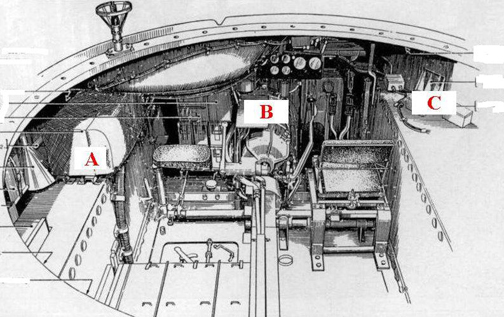
A diagram of the interior of a ‘Ram’ Kangaroo armoured personnel carrier showing the three possible mounting positions for the No. 19 Wireless Set, as explained in the text.
A – in the forward left-hull pannier,
B – in the centre-front over the transmission, or
C – in the forward right-hull pannier. Source: Author’s collection.
Also, as of 14 October 1944, with Canadian requirements having been met, for the foreseeable future, for the conversion of Ram, Mark II tanks, to either armoured personnel carriers, armoured gun towers, or armoured ammunition carriers, Canadian Military Headquarters (London), agreed to provide the British with 330 Ram tanks8, subject to financial agreement, to meet their armoured personnel carrier needs, since on 11 October, Headquarters 21st Army Group, had authorized the formation of a second armoured personnel carrier regiment, to support the Second British Army. Having obtained approval from National Defence Headquarters (Ottawa), these 330 Ram tanks, were released to the British in mid-December 1944, with the understanding that any additional ‘Ram’ armoured personnel carriers required by First Canadian Army, would come from this source. This was accepted by the British War Office9, on 21 December 1944, under the understanding, that a financial adjustment would be made for any issued to First Canadian Army.
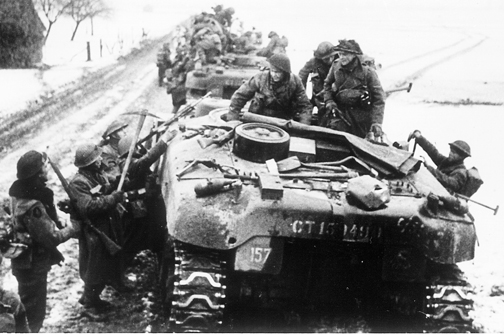
Infantrymen of the 2nd Battalion, Devonshire Regiment, of 131st British Infantry Brigade, loading onto ‘Ram’ Kangaroo armoured personnel carriers of “B” Squadron, 1st Canadian Armoured Personnel Carrier Regiment, near Dieteren, Holland, on 15 January 1945, during Operation BLACKCOCK. Note that the crew of the ‘Kangaroo’ in the foreground has left their pioneer tools strapped in place on the rear deck, common practice within the Regiment was to remove these, so that their infantry passengers wouldn’t make off with them for their own use. Source: Bovington Tank Museum (BTM 2293-A5)
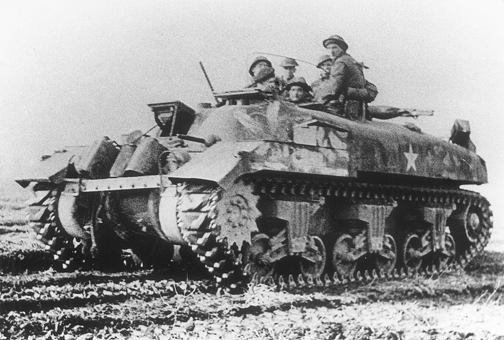
A ‘Ram’ Kangaroo armoured personnel carrier of “A” Squadron, 1st Canadian Armoured Personnel Carrier Regiment, lifting infantrymen of the Royal Winnipeg Rifles, 7th Canadian Infantry Brigade, in a thrust along the Cleve to Calcar road (Germany), on 16 February 1945, during Operation VERITABLE. Note the forward facing secondary .30-calibre Browning machine gun mounted in the turret ring, with its barrel pointing skyward. Source: MilArt photo archives
Having spent November and December 1944, in Tilburg, Holland, readying themselves and their ‘Ram’ Kangaroo armoured personnel carriers for battle, the 1st Canadian Armoured Personnel Carrier Regiment, Canadian Armoured Corps, resumed active operations on 8 January 1945, when two Troops from “B” Squadron lifted two companies of the British 1st Battalion, The Suffolk Regiment10, in an attack near Venray, Holland. From this attack to the end of hostilities in North-West Europe, on 5 May 1945, the ‘Ram’ Kangaroo armoured personnel carriers of the 1st Canadian Armoured Personnel Carrier Regiment, were continually in action, carrying infantrymen of both the First Canadian Army, and of the Second British Army, into battle. Although the pace of these operations limited thorough maintenance, in a workshop setting, the ‘Ram’ Kangaroo armoured personnel carriers of 1st Canadian Armoured Personnel Carrier Regiment, were kept in serviceable condition throughout, by the valiant efforts the men of No. 123 Light Aid Detachment (Type E), Royal Canadian Electrical and Mechanical Engineers, which during the more fluid operations in which the regiment was involved in, would split into two sections. “A” Section, would accompany “A” Squadron, with “B” Section, accompanying “B” Squadron, to aid the crews of the regiments ‘Ram’ Kangaroo armoured personnel carriers, in both maintenance and repair tasks, as the need arose. On 9 March 1945, in preparation for the forthcoming crossing of the River Rhine (Operation PLUNDER), “B” Squadron, was ordered into workshops, followed by “A” Squadron (on 11 March), for a major overhaul and refitting of their ‘Ram’ Kangaroo armoured personnel carriers. By 20 March, both squadrons had returned from workshops, during which as part of the refitting process, their ‘Ram’ Kangaroo armoured personnel carriers, had been equipped with the new track extended end connectors. These end connectors greatly widened the width of the track, which in turn, further reduced the track pressure resulting in better performance on soft ground.
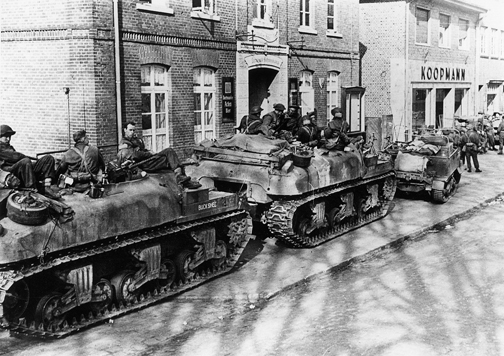
BUCKSHEE and another ‘Ram’ Kangaroo armoured personnel carrier of “B” Squadron, 1st Canadian Armoured Personnel Carrier Regiment, with infantrymen of “A” Company, The Argyll & Sutherland Highlanders of Canada (Princess Louise’s), 10th Canadian Infantry Brigade, in Werlte, Germany, on 11 April 1945. Note the track extended end connectors on the outside edge of the right track, of both ‘Kangaroos’, and also the position of the secondary .30-calibre Browning machine gun mounted in the turret ring. Source: MilArt photo archives
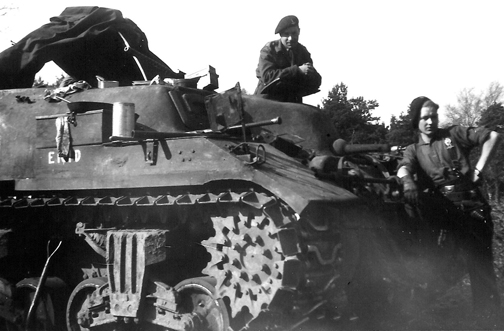
ENID, a Kangaroo of the 1st Canadian Armoured Personnel Carrier Regiment, showing a closer view of examples of the crescent shaped ‘tarp/bivouac’ supports, the secondary .30-calibre Browning machine gun (with the feed tray) mounted in the front of the turret ring, with its barrel pointing to the right, the track extended end connectors on the outside edge of the track, and the later style of bogie assembly, with the return roller mounted on a trailing arm behind the bogie assembly. Source: 1 CACR Association & Archive
By April 1945, the Ram tanks upon which the ‘Ram’ Kangaroo armoured personnel carriers, was based, were now two to three years old. Prior to conversion to armoured personnel carriers, these Ram tanks had been used extensively in the United Kingdom for training purposes by units of the Canadian Armoured Corps, before being converted to ‘Ram’ armoured personnel carriers, and having been, more or less in continuous use since arriving in North-West Europe, were now showing their age. Both the men of the 1st Canadian Armoured Personnel Carrier Regiment, and those of No. 123 Light Aid Detachment (Type E), Royal Canadian Electrical and Mechanical Engineers, worked heroically to keep them maintained and ready for battle. As testament to the work of both the crew members, and of No. 123 Light Aid Detachment, in keeping their carriers in serviceable condition, and in response to some maintenance issues that were raised while his regiments armoured personnel carriers, were in workshops during March, Lieutenant-Colonel Churchill, Commanding Officer, 1st Canadian Armoured Personnel Carrier Regiment, in a letter of 4 April 1945, to the Brigadier, Royal Armoured Corps11, First Canadian Army Headquarters, stated, that at no time had a Kangaroo failed to reach the objective, once an attack had commenced, unless it had been knocked out by enemy anti-tank fire, or suffered damage from enemy land mines, or had become stuck in mud, or had been stopped at the express request of the infantry commander of the infantrymen they carried. He also noted in his letter that since active operations had commenced for the regiment in January, neither of his Squadrons had failed to provide sufficient ‘Ram’ Kangaroo armoured personnel carriers, to meet the requirements of the infantry, they were to carry. He also commented, that since January, only five of the regiments ‘Ram’ Kangaroo armoured personnel carriers, had broken down due to maintenance problems prior to an attack, but that these breakdowns, had not impeded the attack or caused the infantry, not to have arrived at their objectives.
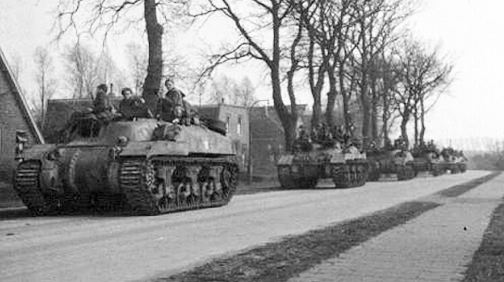
No. 1 Troop, “A” Squadron, 1st Canadian Armoured Personnel Carrier Regiment, carrying infantrymen of “B” Company, The Royal Hamilton Light Infantry, 4th Canadian Infantry Brigade, advancing on Groningen, Holland, on the morning of 13 April 1945. Source: 1 CACR Association & Archive
The end of hostilities in North-West Europe, on 5 May 1945, found all of the 1st Canadian Armoured Personnel Carrier Regiment, in Germany, with Regimental Headquarters, at Cloppenburg, “A” Squadron at Oldenburg, and “B” Squadron near Markhausen. On 15 May, 1st Canadian Armoured Personnel Carrier Regiment, was ordered to concentrate at Enschede, Holland, where they were to ready their ‘Ram’ Kangaroo armoured personnel carriers, for turnover to Ordnance. The .30-calibre Browning machine guns, and wireless sets, along with all associated equipment, were to be removed, as well as all tank tools, and pioneer tools. The carriers were also to be cleaned and painted. On 11 June 1945, 52 ‘Ram’ Kangaroo armoured personnel carriers, of “A” squadron, along with three belonging to “B” Squadron, were returned to Ordnance, followed on 15 June, by the remaining 50 ‘Ram’ Kangaroo armoured personnel carriers, of “B” Squadron. Thus with having received notification of disbandment, on 12 June, 1st Canadian Armoured Personnel Carrier Regiment, Canadian Armoured Corps, 1st Canadian Armoured Personnel Carrier Regiment Signal Troop, Royal Canadian Corps of Signals, and No. 123 Light Aid Detachment (Type E), Royal Canadian Electrical and Mechanical Engineers, were disbanded, with effect from 11:59 P.M., on 20 June 1945, under authority from Headquarters First Canadian Army Troops Area, dated 17 June 1945.
As of 28 July 1945, the Canadian Army Overseas12, held a total of 160 ‘Ram’ Kangaroo armoured personnel carriers, and an additional 20, that had been converted over from ‘Ram’ armoured gun towers, to that of ‘Ram’ Kangaroo armoured personnel carriers. Shortly afterwards, those that were held in vehicle parks within Holland, were handed over (at no cost) to the Royal Netherlands Army, as they began the process of rebuilding themselves, in the wake of the Second World War. Those that were held in the United Kingdom, eventually passed into service with the British Army.
The ‘Ram’ Kangaroo Armoured Personnel Carrier in British service
With Headquarters 21st Army Group, on 11 October 1944, having authorized the formation of a second armoured personnel carrier regiment, to support the Second British Army, the British 49th Battalion, Royal Tank Regiment (consisting of Regimental Headquarters, “A” Squadron, and “C” Squadron), was subsequently redesignated the 49th Armoured Personnel Carrier Regiment, Royal Armoured Corps (consisting of Regimental Headquarters, “A” Squadron, and “C” Squadron), with an authorized strength of 20 officers and 456 other ranks, under command of Lieutenant-Colonel N.H. King, Royal Tank Regiment, and were concentrated at Vilvoorde, Belgium, on 1 November 1944, for organizational purposes. From 2 to 7 November, as the crews of the 49th Armoured Personnel Carrier Regiment, received their ‘Ram’ Kangaroo armoured personnel carriers, they set about the task of preparing them for action. On 22 December 1944, the 49th Armoured Personnel Carrier Regiment, joined their sister regiment, the 1st Canadian Armoured Personnel Carrier Regiment, in the British 31st Tank Brigade13, of the British 79th Armoured Division14, with which they served until the end of hostilities in North-West Europe, in May 1945.
The British 49th Armoured Personnel Carrier Regiment was organized, under British War Establishment XIV/1643/1 ‘An Armoured Personnel Carrier Regiment, 21 Army Group,’ with effect from 16 October 1944, consisting of, a Regimental headquarters and two squadrons, with each squadron consisting of a Squadron headquarters with five armoured personnel carriers, an Administration Troop and four Troops, each consisting of a Troop headquarters with three armoured personnel carriers and three sections, each with three armoured personnel carriers. This armoured personnel carrier allotment to the 49th Armoured Personnel Carrier Regiment, gave it the capability of lifting two battalions of infantry as follows, using one Section – an Infantry platoon headquarters and three sections, using one Troop – an Infantry company headquarters and three platoons, using one Squadron – an Infantry battalion headquarters and four companies, and with using the whole Regiment – two battalions.
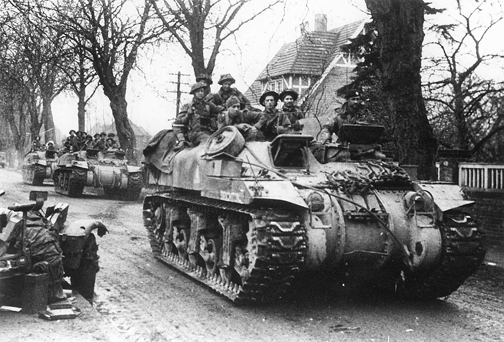
‘Ram’ Kangaroo armoured personnel carriers of “A” Squadron, 49th Armoured Personnel Carrier Regiment, Royal Armoured Corps. Source: Bovington Tank Museum (BTM 1115-B3)
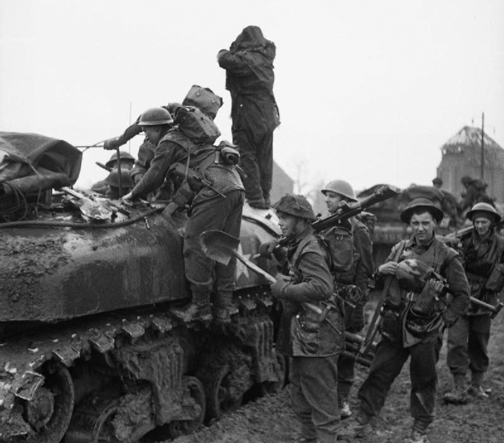
Infantrymen of the British 3rd Infantry Division loading onto Kangaroos of the 49th Armoured Personnel Carrier Regiment, Royal Armoured Corps, prior to an attack on Kervenheim, Germany, 2 March 1945. Source: Imperial War Museum (B 14972)
The ‘Ram’ Kangaroo armoured personnel carriers for the British 49th Armoured Personnel Carrier Regiment came from Ram Mark II tank stocks in the United Kingdom, previously transferred to the War Office (see Note 8), and earmarked for conversion, by the British, to Armoured Vehicle Royal Engineers. The majority of the Ram Mark II tanks transferred to the British, and then converted to ‘Ram’ Kangaroo armoured personnel carriers, were mid-production Ram Mark II tanks bearing census numbers15 between CT40101 and CT40437, and those between CT40438 and CT40937, with auxiliary turrets but without sponson doors16, although the British also converted some of the earlier production Ram tanks they had received from the CT39000 series, which had sponson doors. Most of these had the earlier ‘Vertical Volute Spring’ type suspensions with the return roller mounted in the centre on top of each bogie assembly (see the ‘Ram’ Kangaroo armoured personnel carrier, Part 1, of 16 October 2014). As mentioned earlier, an additional 330 Ram tanks, were released to the British in mid-December 1944, to meet their armoured personnel carrier needs.
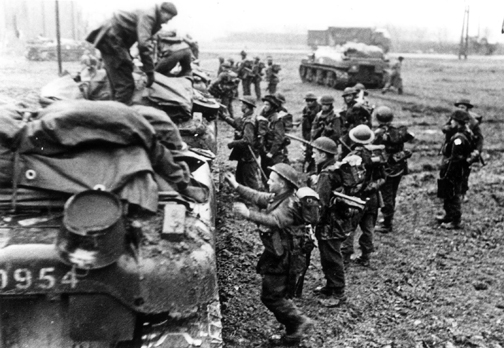
Infantrymen of the British 3rd Infantry Division loading onto Kangaroos of the 49th Armoured Personnel Carrier Regiment, Royal Armoured Corps, prior to an attack on Kervenheim, Germany, 2 March 1945. Courtesy Barry Beldom
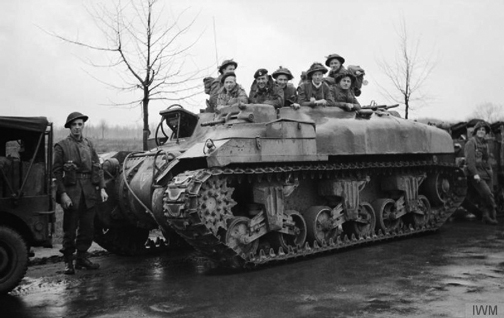
A ‘Ram’ Kangaroo armoured personnel carrier of “A” Squadron, 49th Armoured Personnel Carrier Regiment, carrying infantrymen of the 4th Battalion, Dorsetshire Regiment, 130th British Infantry Brigade, on the outskirts of Ochtrup, Germany, 3 April 1945, prior to the liberation of Enschede, Holland. Source: Imperial War Museum (BU 2956)
From 8 November 1944, through to 5 May 1945, the British 49th Armoured Personnel Carrier Regiment, like their sister regiment, the 1st Canadian Armoured Personnel Carrier Regiment, were actively involved in operations. In March 1945, because of the increasing demands made on the regiment, in the support of infantry operations, and at the recommendation of the Commanding Officer, Lieutenant-Colonel N.H. King, “F” Squadron, 49th Armoured Personnel Carrier Regiment, was authorized, consisting of a Squadron headquarters with five armoured personnel carriers, an Administration Troop and four Troops, each consisting of a Troop headquarters with three armoured personnel carriers and three sections, each with three armoured personnel carriers. At the end of hostilities in North-West Europe, the 49th Armoured Personnel Carrier Regiment (Regimental Headquarters, “A,” “C,” and “F” Squadrons), was concentrated in the area of Hamburg, Germany, where on 10 June 1945, they began turning in their ‘Ram’ Kangaroo armoured personnel carriers to the Royal Army Ordnance Corps. The 49th Armoured Personnel Carrier Regiment, was eventually disbanded effective 13 December 1945. The British Army retained their ‘Ram’ Kangaroo armoured personnel carriers in service, as armoured personnel carriers, or as driver training vehicles, to name but a couple of roles, until approximately 1955, when they were phased out of service.
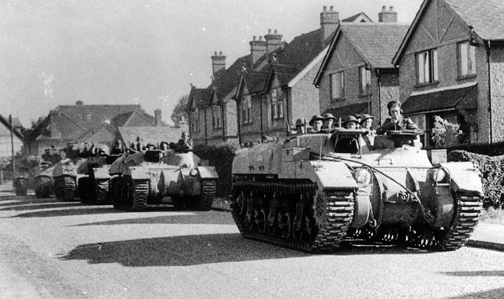
‘Ram’ Kangaroo armoured personnel carriers in postwar service with the British Army. Source: Bovington Tank Museum (BTM 2293-A1)
A ‘Ram’ Kangaroo armoured personnel carrier in postwar service with the British Army. Source: Bovington Tank Museum (BTM 2272-E1)
Conclusion
From their first use on the night of 7/8 August, 194417, through to the cease fire on 5 May, 1945, ‘Kangaroo’ armoured personnel carriers had been in the van of both major and minor assaults carried out by the infantrymen of 21st Army Group. The problem of lowering infantry casualties and moving the infantry at ‘tank’ speed from start line to the final objective, had been solved. The tactical handling of infantry in the ‘advance’, working with tanks, had been revolutionized by the advent of the ‘Kangaroo’ armoured personnel carrier.
Part of the Commanding Officer’s (Lieutenant-Colonel Churchill) address to 1st Canadian Armoured Carrier Regiment, on 11 May, 1945, best sums up the story of the ‘Kangaroo’ in Canadian service:
“ ……we have also been instrumental in saving the lives of countless soldiers who, without the Kangaroos, would have had to advance on foot unprotected from enemy fire. It is most comforting to reflect that many Canadian and British soldiers are alive today because of this Kangaroo Regiment.”
The original concept of the ‘Priest’ and ‘Ram’ Kangaroo armoured personnel carriers is still in use today by the Canadian Army, in the form of the Light Armoured Vehicle (LAV) III, although the Light Armoured Vehicle (LAV) III is an eight-wheeled vehicle, its function is that of an armoured personnel carrier for the infantry, still adhering to the phase of 1944 “The essentials are that the infantry shall be carried in bullet and splinter-proof vehicles to their actual objectives.”
Any errors and/or omissions, in Parts 1, 2, and 3, of ‘The ‘Ram’ Kangaroo armoured personnel carrier,’ is entirely the fault of the author.
Bibliography:
Law, C M, Making Tracks, Tank Production in Canada, Service Publications, Ottawa, Ontario, 2001
Library and Archives Canada, Records Group 24, National Defence, Series C-3, Volume 14301, Reel T-15430 and T-15431, Volume 16317, Volume 14995, and various other Files/Volumes – Records Group 24, National Defence
Lucy, R V, Canada’s Pride, The Ram Tank and its Variants, Service Publications, Ottawa, Ontario, 2014
Knight, D, Tools of the Trade, Equipping the Canadian Army, Service Publications, Ottawa, Ontario, 2005
Ramsden, K R, The Canadian Kangaroos in World War II, Ramsden-Cavan Publishing, Cavan, Ontario, 1998
Roberts, P, The Ram Development and Variants, Volume 1, Service Publications, Ottawa, Ontario, 2002
Roberts, P, The Ram Development and Variants, Volume 2, Service Publications, Ottawa, Ontario, 2005
The National Archives Kew, Richmond, Surrey, United Kingdom – WO 24 – War Office: Papers concerning Establishments – Sub Series WO 24/954 – War establishments – 1945 January-March – An Armoured Personnel Carrier Regiment, 21 Army Group, War Establishment XIV/1643/1 (4 pages).
Tonner, M W, The Kangaroo in Canadian Service, Service Publications, Ottawa, Ontario, 2005
Notes:
- The metal rings, within the turret ring, which have a circular track inside of them, in which the ball bearings enable the rotation of the turret.
- The No. 19 Wireless Set consisted of an “A” set for general use and a “B” set for short range work and an intercommunication unit for the crew. The No. 19 set had a maximum voice range of 10-miles (16-kilometres) and a maximum morse range of 15½-miles (25-kilometres).
- On a Ram tank, the hull pannier, was the armoured portion of the hull which extended outwards above the tracks to the outer edge of the track.
- An armoured plated lip.
- In error, in early October 1944, CT159871, was issued to the 1st Canadian Armoured Personnel Carrier Squadron, Canadian Armoured Corps, from “F” Squadron, 25th Canadian Armoured Delivery Regiment (The Elgin Regiment), Canadian Armoured Corps, but stayed in service with the regiment throughout the remainder of the war, with “B” Squadron Headquarters.
- At this time, the 1st Canadian Armoured Personnel Carrier Regiment, was under command of the Second British Army.
- The officer responsible for the maintenance and repair of First Canadian Army’s equipment.
- These were in addition to the 446 Ram Mark II tanks that had been transferred to the British earlier, in exchange for Sherman tanks from British stocks, as agreed upon at a meeting between Canadian Military Headquarters (London), and the British War Office, which was held on 22 October 1943.
- The British War Office was a department of the British Government responsible for the administration of the British Army, until 1964, when its functions were transferred to the British Ministry of Defence.
- A component of the British 8th Infantry Brigade, of the 3rd Infantry Division.
- The Brigadier, Royal Armoured Corps, First Canadian Army Headquarters, was the advisor to the General Officer Commanding -in-Chief, First Canadian Army, and officer responsible for all matters dealing with armoured formations and units, within First Canadian Army.
- The Canadian Army Overseas was the name given to that portion of the Canadian Army that served in the United Kingdom and Europe, during the period of the Second World War.
- Which on 2 February 1945, was redesignated the 31st Armoured Brigade.
- The British 79th Armoured Division operated specialized armoured vehicles modified for specialist roles.
- In order to provide a positive means of identifying individual vehicles, every Canadian Army vehicle was given a separate serial number, commonly referred to as census number. In the case of the Ram tank, this number was preceded by the prefix letters “CT,” the letter “C” denoting the vehicle as Canadian, and the letter “T” denoting that the vehicle was a tank. These census numbers were normally stenciled onto the vehicle in white letters 3½-inches (9-centimetres) high.
- A door located in the centre of the left and right hull side.
- See the ‘Priest’ Kangaroo Armoured Personnel Carrier, in Canadian Service, 7 August to 30 September 1944, of 28 August 2014.
The ‘Ram’ Kangaroo armoured personnel carrier, Part 2
You can rate this article by clicking on the stars below
By Capt Keith Wright CD
Air Cadet League Officer Uniforms
From the formation of the Air Cadet Corps on 15 Nov 1940 until 1943, officers of Air Cadet Squadrons were not commissioned but held an Air Cadet League warrant. Officers and adult First Class Warrant Officers wore the RCAF Officer Uniform with Air Cadet Cap Badges, Collars, Buttons, Squadron shoulder flashes and shortened rank that did not go all the way around the sleeve. They could also wear medal ribbons and aircrew wings.
Air Cadet Corps Officer Uniforms
On 22 April 1943 the Governor General-in-Council authorized a further component of the RCAF known as the “Air Cadet Corps” in which qualified persons could be appointed to commissions and shall not be deemed to be on active service. Commissioning and training courses started in earnest in the summer of 1943. They wore the RCAF officer dress uniform and cap badge, which in most cases would have been a private purchase from a tailor as that was the norm for officers at the time.
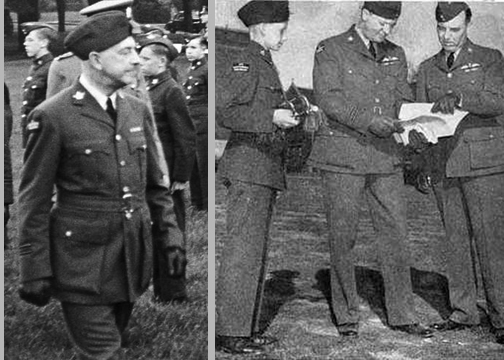
Left – Officers of No.1 Westmount Squadron, Montreal, 1942.
Air Cadet Corps Distinguishing Badge 1943
In the Air Force Routine Orders (AFRO) 2471/43 dated 26 Nov 43 Badges, Distinguishing – Air Cadet Corps, it states:
- A badge, similar in colour and design to the present officers’ type “Canada” badge, bearing the initials “A.C.C.” has been authorized for wear by R.C.A.F. Air Cadet Corps officers.
- These badges must be worn at all times in accordance with dress regulations, on both sleeves of the jacket and greatcoat, the top of the “ground” being one-half inch below the shoulder seam.
- Badges may be obtained by officer personnel on prepayment, at a cost of three cents per pair. Air Cadet squadrons are to submit demands by letter to C.H.Q., along with a cheque to cover the cost. When approval has been given, these demands are to be passed to the appropriate equipment depot to supply direct to the air cadet squadrons.
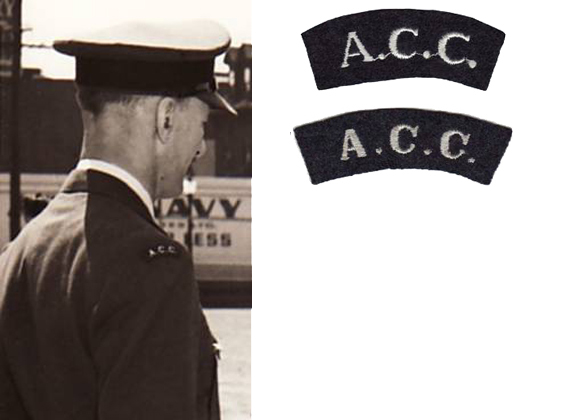
Top – Pattern 1 has thinner, more rounded, slightly larger letters and a fine black backing material.
Bottom – Pattern 2 has thicker, less rounded, slightly smaller letters and a coarse white mesh backing material.
AFRO 2122/44 dated 29 Sep 44 Badges, Distinguishing – RCAF (Air Cadets) states:
- AFRO 2472/43 is hereby cancelled and the following substituted.
- Badges, arm, distinguishing, “ACC”, similar in colour and design to the present officers’ type “Canada” badges, are authorized for wear by officers of the R.C.A.F. (Air Cadets).
Air Cadet Corps Distinguishing Badge 1945
It is not known if this is just a name change from RCAF Air Cadet Corps to RCAF (Air Cadets) or if the badge also changed from A.C.C. to ACC without the periods as no badge like that has been seen.
AFRO 152/45 dated 26 Jan 45 Badges, Distinguishing – RCAF (Air Cadets) it states:
- AFRO 2122/44 is hereby cancelled and the following substituted.
- Badges, arm, distinguishing, “Air Cadets”, similar in colour and design to the present officers’ type “Canada” badges, are authorized for wear by officers of the R.C.A.F. (Air Cadets).
The following photo of an officer wearing the AIR CADETS flash is in a No. 386 Sqn photo album from a picture taken at the April 1948 Annual Inspection. In other photographs from the 1947-48 year the officers appear to be wearing the AIR CADETS flash but the pictures are not clear enough to be certain. Pictures from the following year show the officers wearing the RCAF CANADA flash or nothing.
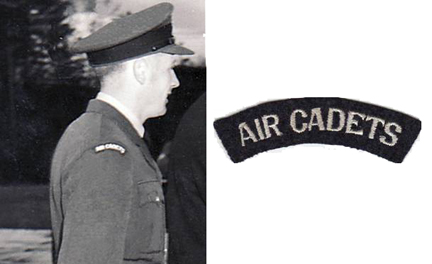
This badge is similar in shape & make to A.C.C. Pattern 2 and has a coarse white mesh backing material.
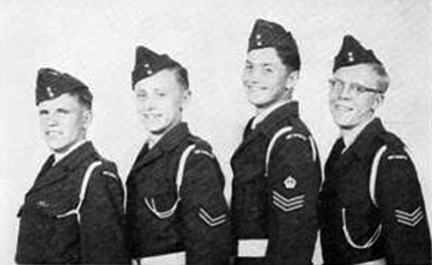
While it fits the description of the 1945 badge, this picture (below) of cadets from No.185 Olds Sqn wearing this same style badge in 1955 appeared in the 1956 Air Cadet Annual. So the above badge could have also been a proposed air cadet shoulder badge before the introduction of the standardized Air Cadet CANADA flash.
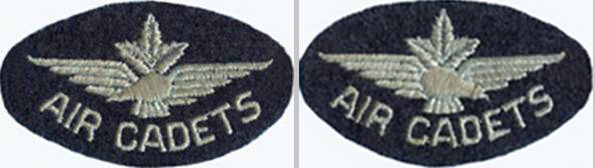
RCAF (Air Cadets) Distinguishing Badge, 1946(?)

This badge is one of a pair worn with the eagle facing backwards. It has a fine black backing material.
As no information on this badge is known and as no pictures have at this point come to light it is thought that this badge is possibly a proposed prototype or trial badge. Its similarity to the following badges seems to lend credence to that theory.
RCAF (Air Cadets) Distinguishing Badge, 1947
No official information on these badges is known and as the only pictures at this time are from the 1947 time period it is thought that this badge is possibly a trial badge. Photo evidence shows that it was never in general use or favour and was definitely replaced by April 1948.
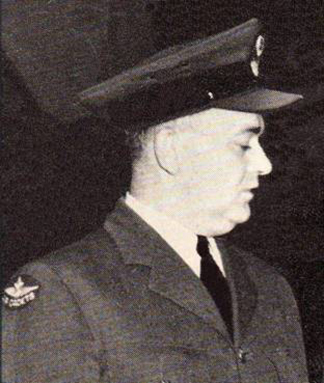
F/O E.A. Anderson, CO of No.211 Ottawa Kiwanis Sqn, wearing the 1947 distinguishing badges at his squadron’s annual inspection. The picture is from the cover of the Canadian Air Cadet September 1947 issue.
AFRO 222/48 dated 16 Apr 48 AIR CADET BADGES – OFFICERS; states:
- The present cloth shoulder badge worn by officers of the RCAF (Air Cadets) has been replaced by a collar badge.
- This is a small gilt metal badge in the form of an eagle surmounted with a maple leaf and inscribed with the letters “R.C.A.C.” underneath.
- The badge is to be worn on both collars. The bottom of the badge is to be one inch above the step opening of the collar; the vertical axis of the badge is to be parallel to the inside (rolled) edge and midway between that edge and the outside edge of the collar.
The existence of this metal collar badge is unknown at this time, as are details such as size or if they came in a left & right pair. From then on RCAF Officers working with Air Cadet Program wore the same uniform as regular RCAF Officers with just the standard CANADA distinguishing badges.
If anyone has any more information or pictures on these or other badges worn by the RCAF Officers of the Air Cadet Corps please contact me at kwright5@shaw.ca.
You can rate this article by clicking on the stars below
By Richard J.S. Law
Following the announcement by the Minister of National Defence during the summer of 2013 that the Canadian Army would revert to traditional rank nomenclature for certain trades and units, the adoption of Divisions to replace Commands (grouped by regions), and the re-adoption of “Pips and Crowns” for officer ranks, some units were left to redefine their Regimental traditions of dress.
Particularly affected were those with distinctive devices such as Guards regiments who traditionally wear the Star of the Order of the Garter rather than the Star of the Order of the Bath, as well as blackened devices for Rifle regiments. Specific regimental patterns were not be supplied by the Crown, and would have to be acquired by the units using their own funds.
From the period of March to November 2014, The Brockville Rifles undertook discussion on the appropriate pattern to be selected for their officers, remaining in line with its pre-1968 traditions. The regimental museum, curated by Maj (ret’d) Roger Hum, was instrumental in this process, as was the regimental senate who offered advice and opinion on the options available.
The regimental museum offered historical examples to the Commanding Officer, LCol M.S. Herron, for review. The first sample, provided as a concept, was a crudely cast copy in the appearance of pewter, and having the improper dimension requirements of 23mm x 23mm. This example, and particularly the definition of “pewter”, became a hurdle to selection in the following weeks. As no Rifle regiment could provide a definition of “pewter” as a description of the device, help was sought from the collector’s market via social media. London, Ontario-based collector, Mr. Michael Reintjes supplied a picture showing stark variations of “pips” worn by the Oxford Rifles during the Second World War, demonstrating the variety of construction, material and level of blackening, or lack thereof.
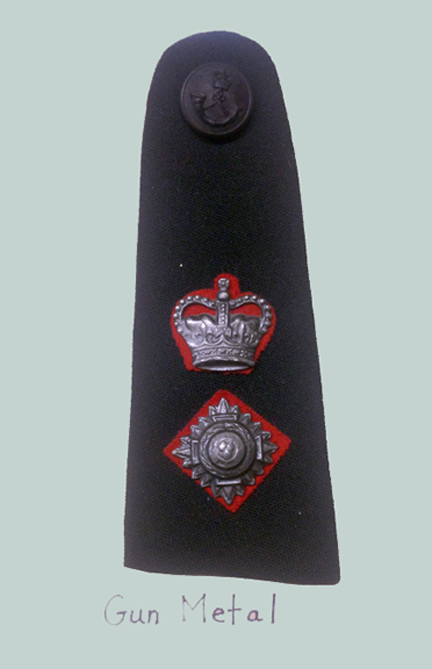
The proposed prototype which was assembled by the Regimental Museum from museum items.
Once the picture was circulated to those involved in the final decision, supporting documentation was sourced from archived dress instructions. These instructions stated that shoulder devices were to be “blackened”. A consensus was achieved that wartime usage of blackened device seems to have been conducted at the unit, or even individual level, using whatever shoulder devices were available and which were blackened by the use of locally available paint. The “pewter” appearance would have been the result of wear, where the paint would expose the original metal colour on the relief of the star or crown. The Adjutant took it upon himself to spray paint an issued Logistik Unicorp star with flat black paint and the judicious use of steel wool to expose the relief. Although this option was presented to the unit as a cost saving alternative, it was quickly dismissed in order to maintain uniformity and standardization
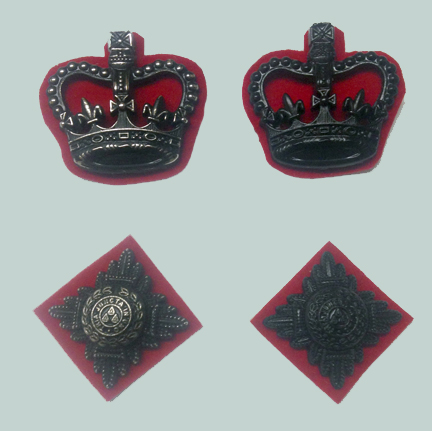
The initial samples provided by Penny’s in “shiny gun metal”, of note is the improper Star of the Bath with ‘Ich Dien’ scroll.
The CO, fond of samples showing exposed relief initially sought samples from Penny’s Ltd., of Thunder Bay. The first samples were described as “shiny gun metal”. The general consensus of the regimental senate was that the darkened silver was inappropriate and these were removed from further consideration.
The second sample from Penny’s in gloss black finish. The crown on the left was polished using steel wool to show relief.
In the June to August time-frame back and forth correspondence with Penny’s followed. Penny’s, submitted a second sample in gloss black which was of higher quality and displayed finer detail. Although these were well made, the red wool backing to be worn in conjunction with the insignia was, in fact, felted paper of poor quality and was rejected in favour of a flat black device which matched the blackened shoulder titles. Additionally, the crown was slightly different in shape and detail to that being issued by Logistik Unicorp.
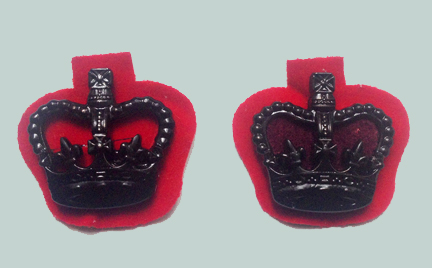
Crowns submitted by Penny’s: on the left from the second sample run, and on the right a third sample run. The background material within the crown was deemed to be too dark, nearing purple.
In late August, the Ottawa firm of Guthrie Woods Ltd., was contacted to provide samples. Their crown, being of the same pattern as the issued device, was favoured and the stars exhibited crisp detail. On 18 September 2014, a decision was made by the Commanding Officer to purchase metal devices pips and crowns from Woods. An initial order of 25 pairs of stars and 10 pairs of crowns was placed by the Officer’s Mess. These are to be stocked by the regimental kit shop for officers to purchase, following an initial issue. The decision for cloth slip-ons to be worn on the undress shirt and overcoat was sourced to Penny’s of Thunder Bay. The delivery of these officer’s slip-ons was delivered on October 28th, 2014.
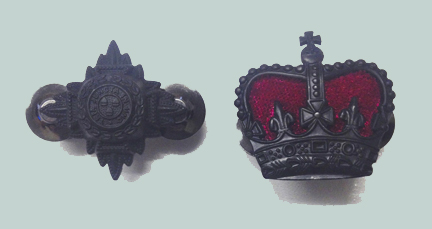
The approved, and selected pattern, manufactured by Guthrie Woods.
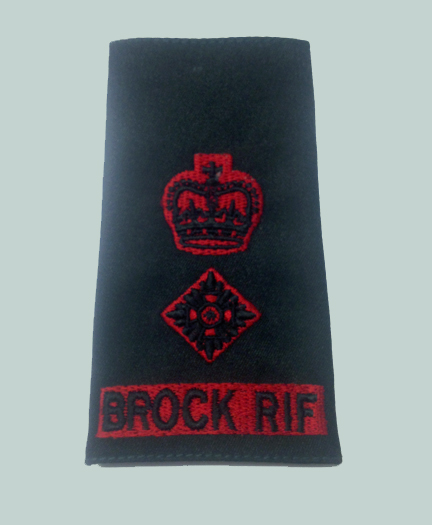
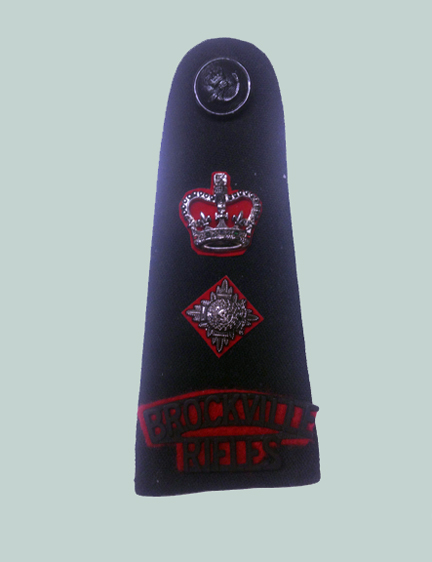
A LCol slip on showing the details of the embroidered crown, star and unit title in black over red.
You can rate this article by clicking on the stars below
by Mark W. Tonner
Continuing on from the ‘Ram’ Kangaroo Armoured Personnel Carrier, Part 1, of 16 October 2014.
On 9 October, a conference was held at Headquarters 21st Army Group, with, in attendance, representatives of Headquarters 21st Army Group, First Canadian Army Headquarters, and Second British Army Headquarters, to discuss armoured personnel carrier units. It was decided that such units were required to –
a.) – enable infantry in vehicles to accompany armour through areas still subject to fire from enemy weapons, thus assisting in preventing the enemy separating our armour and infantry
b.) – enable infantry to reach their objective more rapidly that at present possible by use of (i) armour protection to allow them to get closer to our own bomber targets whilst the latter are still being attacked. (ii) speed of the vehicle to reduce the time taken to reach the objective from the start line.
It was also agreed, that the squadrons of armoured personnel carrier regiments, must be organized to lift complete infantry battalions or subunits thereof. Therefore, it was agreed that an armoured personnel carrier regiment be organized and consist of a Regimental headquarters and two squadrons, with each squadron consisting of a Squadron headquarters with five armoured personnel carriers, an Administration Troop and four Troops, each consisting of a Troop headquarters with three armoured personnel carriers and three sections, each with three armoured personnel carriers.
This armoured personnel carrier allotment per regiment, was based on:
one Section (with three armoured personnel carriers)
– able to lift one infantry rifle platoon complete, with three armoured personnel carriers
one Troop (with 12 armoured personnel carriers)
– able to lift one infantry rifle company headquarters, with two armoured personnel carriers
– able to lift three infantry rifle platoons complete, with nine armoured personnel carriers
– one reserve armoured personnel carrier
one Squadron (with 53 armoured personnel carriers)
– able to lift one infantry battalion headquarters, with three armoured personnel carriers
– able to lift four infantry rifle companies complete, with 48 armoured personnel carriers
– two reserve armoured personnel carriers
one Regiment to consist of two Squadrons, with a total armoured personnel carrier strength per regiment of 106 armoured personnel carriers
It was also agreed, that each armoured personnel carrier regiment, should also have a reserve of 12 additional armoured personnel carriers, one for each of the regiments eight Troops, and two per squadron, and that squadrons, as far as possible, were to be administratively self-sufficient. Each regiment was to have an attached Light Aid Detachment (one officer and 52 other ranks, consisting of a headquarters and two sections, one section to each squadron) and a Signal Troop (one officer and five other ranks). The strength of each regiment was to be 25 officers and 522 other ranks (including the Light Aid Detachment and Signal Troop). The possibility of adding two more squadrons to each regiment was also discussed, and it was agreed that this would be put off for the time being. Eventually, the proposed two additional squadrons per regiment were dropped. With Headquarters 21st Army Group having come to the decision that two armoured personnel carrier regiments would be formed, one in the First Canadian Army, and the other, in the Second British Army, First Canadian Army Headquarters, informed Canadian Military Headquarters (London), on 14 October, that 162 ‘Ram’ Kangaroo armoured personnel carriers would be required to form the Canadian armoured personnel carrier regiment, consisting of two squadrons of 53 carriers each, and a reserve of 50 armoured personnel carriers.

A ‘Ram’ Kangaroo of 1st Canadian Armoured Personnel Carrier Squadron, in support of 12th British Corps operations, in Holland, during mid to late October 1944. CT160141, was one of the initial issue of ‘Ram’ Kangaroo armoured personnel carriers to the squadron, having been received from “F” Squadron, 25th Canadian Armoured Delivery Regiment (The Elgin Regiment), on 2 October 1944. Courtesy of Bovington Tank Museum (BTM 2293)
On 19 October 1944, Brigadier C.C. Mann, the Chief of Staff, First Canadian Army Headquarters, sought out the approval of Lieutenant-General G.G. Simonds, the Acting/General Officer Commanding -in-Chief, First Canadian Army1, for the authority to disband the 1st Canadian Armoured Personnel Carrier Squadron, Canadian Armoured Corps, and the Light Aid Detachment 1st Canadian Armoured Personnel Carrier Squadron, Royal Canadian Electrical and Mechanical Engineers2. At the same time, the authority to form the 1st Canadian Armoured Personnel Carrier Regiment, Canadian Armoured Corps, 1st Canadian Armoured Personnel Carrier Regiment Signal Troop, Royal Canadian Corps of Signals, and No. 123 Light Aid Detachment (Type E), Royal Canadian Electrical and Mechanical Engineers, was also asked to be approved. Having obtained Lieutenant-General G.G. Simonds’ approval, 1st Canadian Armoured Personnel Carrier Squadron, Canadian Armoured Corps, and the Light Aid Detachment 1st Canadian Armoured Personnel Carrier Squadron, Royal Canadian Electrical and Mechanical Engineers, were disbanded, effective 11:59 P.M., 23 October 1944. At the same time, the 1st Canadian Armoured Personnel Carrier Regiment, Canadian Armoured Corps, 1st Canadian Armoured Personnel Carrier Regiment Signal Troop, Royal Canadian Corps of Signals, and No. 123 Light Aid Detachment (Type E), Royal Canadian Electrical and Mechanical Engineers, were authorized to be formed, with effect from 00:01 A.M., on the morning of 24 October 1944.
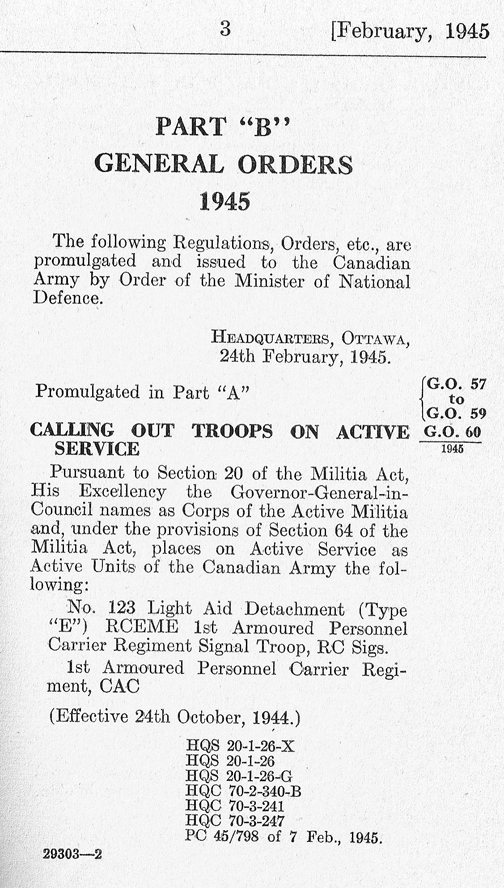
General Order Number 60 of 1945, under which the embodiment of 1st Canadian Armoured Personnel Carrier Regiment, Canadian Armoured Corps, 1st Canadian Armoured Personnel Carrier Regiment Signal Troop, Royal Canadian Corps of Signals, and No. 123 Light Aid Detachment (Type E), Royal Canadian Electrical and Mechanical Engineers, was officially announced by Army Headquarters, Ottawa, on page 3 of Part “B” General Orders 1945, dated 24 February 1945. Authors’ collection
Although, as stated above, 1st Canadian Armoured Personnel Carrier Squadron, Canadian Armoured Corps, was disbanded, effective 11:59 P.M., on 23 October 1944, but, since they were at that time involved with active operations, in support of the British 15th (Scottish) Infantry Division, in the Moergestel, (Holland) area, they were in reality, absorbed into the newly created Canadian armoured personnel carrier regiment, as “A” Squadron, 1st Canadian Armoured Personnel Carrier Regiment, Canadian Armoured Corps, under command of Captain Corbeau. Lieutenant-Colonel G.M. Churchill3 was appointed Commanding Officer, 1st Canadian Armoured Personnel Carrier Regiment, Canadian Armoured Corps, with Major F.W.K. Bingham4 being appointed Second-in-Command5. Lieutenant D.H. Simpson6, Royal Canadian Corps of Signals, was appointed Officer Commanding, 1st Canadian Armoured Personnel Carrier Regiment Signal Troop, Royal Canadian Corps of Signals, with Captain W.T.E. Duncan7, Royal Canadian Electrical and Mechanical Engineers, being appointed Officer Commanding, No. 123 Light Aid Detachment (Type E), Royal Canadian Electrical and Mechanical Engineers.

Letter from the Brigadier, Royal Armoured Corps, First Canadian Army Headquarters, to the Assistant Adjutant General First Canadian Army Headquarters, seeking approval for the appointment of Lieutenant-Colonel G.M. Churchill, and Major F.W.K. Bingham, as the Commanding Officer, and second-in-command, respectively, of 1st Canadian Armoured Personnel Carrier Regiment. Authors’ collection
On 24 October, Regimental Headquarters, 1st Canadian Armoured Personnel Carrier Regiment, was established in Antwerp (Belgium), to begin the process of organizing the regiment, with new personnel for the regiment being quartered in Rumst (Belgium), under control of Major Bingham (the regiment’s second-in-command), as they arrived to fill-up the positions in the organization of the regiment. On 28 October, Lieutenant-Colonel Churchill was informed that the regimental organization was to be completed by 6 November, followed, on 29 October, by the news that the regiment was to come under command of Second British Army on 1 November 1944. Arrangements were set in motion for the whole of 1st Canadian Armoured Personnel Carrier Regiment, to concentrate in the area of Tilburg (Holland). “A” Squadron’s support of 15th (Scottish) Infantry Division operations having been completed, were concentrated at Tilburg (Holland) on 30 October. Also, on 30 October, 1st Canadian Armoured Personnel Carrier Regiment, was informed by First Canadian Army Headquarters, that 106, .30-calibre Browning machine guns, had been released to the regiment, and were awaiting pick-up at 3 Sub Depot, 14 Advanced Ordnance Depot, Royal Army Ordnance Corps8. These additional .30-calibre Browning machine guns, were to be mounted, one a piece, on the outer edge of the circular hole left in the hull top, by the removal of the turret during conversion, on each of the regiment’s 106 ‘Ram’ Kangaroo armoured personnel carriers. The idea, was to use one of the bolt holes left by the removal of the turret ring, as a mounting point for the machine gun. These guns were picked up by the regiment on 1 November, from which point, Captain S.F. Rook, the regiment’s Technical Adjutant9, and Captain Duncan, Officer Commanding, No. 123 Light Aid Detachment (Type E), Royal Canadian Electrical and Mechanical Engineers, set about to devise a suitable device for the mounting of these guns, on the outer edge of the circular opening in the hull top of the regiment’s 106 ‘Ram’ Kangaroo armoured personnel carriers.
In an effort to minimize the potential hazard of infantrymen being exposed to shell splinters, or enemy fire, through the circular opening in the hull top of the ‘Ram’ Kangaroo armoured personnel carrier, while aboard, No. 2 Canadian Tank Troops Workshop, Royal Canadian Electrical and Mechanical Engineers, devised a two-foot (one-metre) high shield, which fitted around the forward edge of the circular opening in the hull top. Major Bingham (the regiment’s second-in-command), inspected a ‘mock-up’ of this shield, which was fitted to one of the regiment’s ‘Ram’ Kangaroo armoured personnel carriers, at No. 2 Canadian Tank Troops Workshop, on 27 October 1944. This proposed modification, however, was never adopted.

A mock-up of the proposed two-foot (one-metre) high shield, which fit around the forward edge of the circular opening in the Ram Kangaroo hull top, that was devised by No. 2 Canadian Tank Troops Workshop, Royal Canadian Electrical and Mechanical Engineers, and was inspected by the regiment’s second-in-command, Major Bingham, on 27 October 1944, but was never adopted. MilArt photo archives
On 1 November, “A” Squadron was split into two squadrons, “A” Squadron, with Major Corbeau still commanding and “B” Squadron, under command of Major H. Baldwin10. By 2 November, all of 1st Canadian Armoured Personnel Carrier Regiment was concentrated in Tilburg, along with both No. 123 Light Aid Detachment (Type E), Royal Canadian Electrical and Mechanical Engineers, and the 1st Canadian Armoured Personnel Carrier Regiment Signal Troop, Royal Canadian Corps of Signals. On 5 November, the overall strength of the regiment stood at 23 officers and 268 other ranks, holding a total of 85 ‘Ram’ Kangaroo armoured personnel carriers.
All of November was spent in Tilburg, organizing and getting the regiment ‘battle worthy’ for future operations, with maintenance being carried out on the carriers, which included the 100-hour check11 (an overhaul), since the ‘Ram’ Kangaroo armoured personnel carrier, was powered by a 450-horse power Continental R975/C1 radial air-cooled 9-cylinder engine, and on the incoming ones that dribbled in all month from Ordnance issues. Since the ‘Ram’ Kangaroo armoured personnel carriers, which 1st Canadian Armoured Personnel Carrier Squadron had been issued with back in October, had been converted and shipped to Normandy for issue, there had been no time for proper maintenance to have been carried out on them. Once landed in Normandy they were to have been ‘lifted’ by either rail or tank transporter to the point of issue to 1st Canadian Armoured Personnel Carrier Squadron, but ended up being driven from the Normandy coast to Pierreval (France), and once issued to the squadron, were committed right into ‘active’ operations, so it wasn’t until the coming together of all of 1st Canadian Armoured Personnel Carrier Regiment, in Tilburg, that the opportunity finally arose for full and proper maintenance to be carried out on these carriers. Captain Duncan’s, No. 123 Light Aid Detachment (Type E), Royal Canadian Electrical and Mechanical Engineers, were aided by the British 821, and 826 Tank Troops Workshops12, Royal Electrical and Mechanical Engineers, throughout the mouth of November, with both the 100-hour checks, and in doing minor repairs, on the regiment’s ‘Ram’ Kangaroo armoured personnel carriers. Captain Duncan, was also able to acquire much needed spare parts from both No. 2 Canadian Tank Troops Workshop, and No. 4 Canadian Armoured Troops Workshop, Royal Canadian Electrical and Mechanical Engineers13.

CT160003, one of the initial 100 Ram, Mark II tanks, that were earmarked for conversion to that of a ‘Ram’ armoured personnel carrier, on 10 August, and was shown as converted to a ‘Ram’ armoured personnel carrier, by 26 September 1944, seen here in service with the 1st Canadian Armoured Personnel Carrier Squadron, in support of operations by the British 53rd (Welsh) Infantry Division in the area of ‘s-Hertogenbosch, Holland, on
22 October 1944. Authors’ collection
1st Canadian Armoured Personnel Carrier Regiment Signal Troop, Royal Canadian Corps of Signals, was also kept busy throughout the month of November, in not only organizing themselves, but also in, insuring that all of the regiment’s communications equipment was in working order, and that all personnel of the regiment, who would be operating wireless sets (radios), knew the proper procedures, for there use. Eventually all of the regiment’s ‘Ram’ Kangaroo armoured personnel carriers, was fitted with a No. 19 Wireless Set, with other designated carriers being fitted with a second No. 19 Wireless Set, or with No. 18, No. 22, or No. 38 Wireless Sets, as the need arose. In an effort to better improve the supply of spare parts and other essentials that the Signal Troop required, to keep the communications equipment of 1st Canadian Armoured Personnel Carrier Regiment, in working order, on 4 February 1945, 1st Canadian Armoured Personnel Carrier Regiment Signal Troop, formally became a part of No. 4 Company, First Canadian Army Signals, Royal Canadian Corps of Signals, although the remained attached to 1st Canadian Armoured Personnel Carrier Regiment.
On 9 December 1944, the design for the secondary .30-calibre Browning machine gun pintle mounting device and feed tray (which held one box of .30-calibre belted ammunition), that Captain’s Duncan, and Rook, had designed was approved by First Canadian Army Headquarters, with a pilot model being ready for inspection by both, on 14 December, at No. 1 Canadian Advanced Base Workshop, Royal Canadian Electrical and Mechanical Engineers, Brussels, Belgium. These mounts, were immediately ordered into production, by the Deputy Director of Mechanical Engineering, First Canadian Army14, with him directing that No. 1 Canadian Advanced Base Workshop, produce 130 of these mountings, so as a reasonable reserve could be held, to replace battle damaged ones. On 30 December, 1st Canadian Armoured Personnel Carrier Regiment, received 110 mounts, with the remainder to follow. Some of the regiment’s ‘Ram’ Kangaroo armoured personnel carriers, were eventually fitted with a third .30-calibre Browning machine gun, or with a single .50-calibre Browning heavy machine gun M2, in the turret ring. On 20 December, 1st Canadian Armoured Personnel Carrier Regiment, along with their attached Light Aid Detachment (No. 123), and Signal Troop, were placed under command of the British 79th Armoured Division15, with the regiment becoming part of the British 31st Tank Brigade16, which at the time, consisted of the British 141st Regiment (The Buffs), Royal Armoured Corps (equipped with Churchill Crocodile flame-throwing tanks), the British 1st Fife and Forfar Yeomanry (equipped with Churchill Crocodile flame-throwing tanks), and the British 49th Armoured Personnel Carrier Regiment (equipped with ‘Ram’ Kangaroo armoured personnel carriers). 1st Canadian Armoured Personnel Carrier Regiment (along with their attached Light Aid Detachment, and Signal Troop), were the only Canadian unit, to serve as part of the British 79th Armoured Division. It was also on 30 December, that the decision was taken, to hold in abeyance, the matter of the proposed expansion of 1st Canadian Armoured Personnel Carrier Regiment, to four squadrons, as discussed at the conference which was held on 9 October 1944, at Headquarters 21st Army Group, to discuss the formation of armoured personnel carrier units.

An example of the simple .30-calibre Browning machine gun pintle mounting device, which Captains Duncan and Rook had designed. This fit into any of the bolt holes left by the removal of the turret ring during conversion to an armoured personnel carrier, enabling the mounting of a secondary .30-calibre Browning machine gun. MilArt photo archives

An example of the feed tray, which held one box of .30-calibre belted ammunition, of the simple .30-calibre Browning machine gun pintle mounting device, which Captain’s Duncan, and Rook, had designed. MilArt photo archives
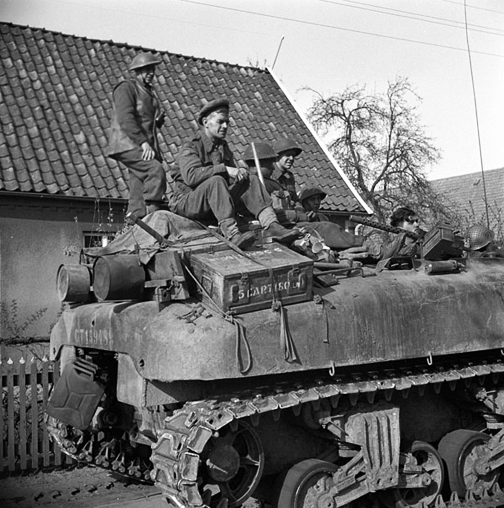
The secondary .30-calibre Browning machine gun pintle mounting device and feed tray (which held one box of .30-calibre belted ammunition), seen here mounted in the turret ring of CT159065, of “B” Squadron, 1st Canadian Armoured Personnel Carrier Regiment, in Wertle, Germany, 11 April 1945. Authors’ collection
Although, as noted in “The ‘Ram’ Kangaroo armoured personnel carrier, Part 1,” the basis of the ‘Ram’ Kangaroo armoured personnel carrier, was that they were based on the conversion of Ram, Mark II tanks, to that of ‘Ram’ armoured personnel carriers, other conversions of Ram, Mark II tanks, were also ‘converted’ to Ram armoured personnel carriers. On 2 November 1944, First Canadian Army decided that it no longer required any further ‘Ram’ armoured gun towers17, be produced to met its needs. Therefore, on 18 December 1944, Canadian Military Headquarters (London)18 instructed No. 1 Canadian Central Ordnance Depot, Royal Canadian Ordnance Corps (Bordon Camp, Hampshire), that since there was no further requirement for ‘Ram’ armoured gun towers, that the decision had been taken to convert all ‘Ram’ armoured gun towers, currently held on stock by No. 1 Canadian Central Ordnance Depot, and those currently in the process of being converted to ‘Ram’ armoured gun towers, at No. 1 Canadian Base Workshop, Royal Canadian Electrical and Mechanical Engineers, located at Bordon Camp, Hampshire, be converted to ‘Ram’ armoured personnel carriers. The initial conversion of Ram, Mark II tanks, to that of armoured gun towers, involved the removal of the complete turret, turret ring, and the internal ammunition bins, and the moving of the batteries up into the rear of the left-hull pannier, and the reinstallation of No. 19 Wireless Set, into the forward left-hull pannier. Stowage bins for 17-pounder ammunition, and a Tannoy loudspeaker system, were also installed, as was a towing hook on the rear, and one on the front hull. Therefore, their conversion to that of armoured personnel carriers, simply required the removal of the bins for 17-pounder ammunition, the Tannoy loudspeaker system, and the covering over of the drive shaft. The rear towing hook was to remain in place, while the front towing hook was to be removed, although this wasn’t always the case, as period photos show it still in place on some armoured personnel carriers. As a point of interest, during the initial conversion of Ram, Mark II tanks, to that of ‘Ram’ armoured gun towers, four hand grips (two on each side) were welded to the hull side to help the ‘gun detachment’19 in entering and existing the vehicle through the circular hole left in the hull top, by the removal of the turret. It is this author’s belief that these are the hand grips that are referred to in some contemporary accounts of the initial conversion of 100 Ram, Mark II tanks, to that of ‘Ram’ armoured personnel carriers, by No. 1 Canadian Base Workshop (for First Canadian Army), in August-September 194420, as also, are the covering over of the drive shaft.

An example of the ‘Ram’ armoured gun tower, seen here towing the 17-pounder anti-tank, and ammunition limber. Note the two hand grips welded to the hull side, which helped the ‘gun detachment’ in entering and existing the vehicle. Authors’ collection

A rear view of a ‘Ram’ armoured gun tower, showing the rear towing hook which was retained as part of the conversion to that of a ‘Ram’ armoured personnel carrier. Authors’ collection

A front view of a ‘Ram’ armoured gun tower, showing the front towing hook which was removed as part of the conversion to that of a ‘Ram’ armoured personnel carrier. MilArt photo archives
One draw back which was found from the conversion of ‘Ram’ armoured gun towers, to that of ‘Ram’ armoured personnel carriers, was that ‘Ram’ armoured gun towers, had been originally converted from earlier model Ram tanks that had the auxiliary turret, on the left front of the tank. When converted to armoured gun towers, and the No. 19 Wireless Set, was reinstalled into the forward left-hull pannier, it was found the wireless set protruded into the co-drivers position, due to the contour of the hull, and would not fit snugly into the forward left-hull pannier. This protrusion of the wireless set into the co-drivers position, made the handling of the auxiliary turret mounted .30-calibre Browning machine gun practically impossible. However a few ‘Ram’ armoured gun towers, converted to ‘Ram’ armoured personnel carriers, were issued to 1st Canadian Armoured Personnel Carrier Regiment, before the problem with the repositioning of the No. 19 Wireless Set was discovered. With 1st Canadian Armoured Personnel Carrier Regiment, having brought this problem to the attention of First Canadian Army Headquarters, they in turn, informed Canadian Military Headquarters (London), who in turn, advised No. 1 Canadian Base Workshop, Royal Canadian Electrical and Mechanical Engineers, the workshop responsible for conversions of ‘Ram’ armoured gun towers, to that of ‘Ram’ armoured personnel carriers. To remedy the problem, No. 1 Canadian Base Workshop, in December 1944, produced a simple kit for mounting the No. 19 Wireless Set over the transmission, between the co-driver’s, and driver’s position. These kits were made available to 1st Canadian Armoured Personnel Carrier Regiment Signal Troop, for the repositioning of the wireless set in those carriers which had been converted from armoured gun towers, to that of armoured personnel carriers. This modification, was also incorporated into the conversion of armoured gun towers, to that of armoured personnel carriers, by No. 1 Canadian Base Workshop.

An example of a ‘Ram’ Kangaroo armoured personnel carrier, of the 1st Canadian Armoured Personnel Carrier Regiment, with a single .50-calibre Browning heavy machine gun M2, mounted in the turret ring, as a secondary machine gun instead of a .30-calibre Browning machine gun. This particular vehicle, named JOAN III, was commanded by Captain (formerly Lieutenant) H. Kaiser, and was his third carrier, with his previous carriers, named after his wife, JOAN, and JOAN II, having become battle casualties. MilArt photo archives
To be continued in The ‘Ram’ Kangaroo armoured personnel carrier, Part 3.
Notes:
- Lieutenant-General G.G. Simonds, normally the General Officer Commanding, II Canadian Corps, was appointed the Acting/General Officer Commanding-in-Chief, First Canadian Army, during the absence of Lieutenant-General H.D.G Crerar, General Officer Commanding -in-Chief, First Canadian Army, while he was away on sick leave in the United Kingdom, from 27 September to 9 November 1944.
- The Light Aid Detachment 1st Canadian Armoured Personnel Carrier Squadron, Royal Canadian Electrical and Mechanical Engineers, had been authorized on 28 August 1944, to support the 1st Canadian Armoured Personnel Carrier Squadron, Canadian Armoured Corps.
- Formerly the Second-in-Command of the 25th Canadian Armoured Delivery Regiment (The Elgin Regiment), Canadian Armoured Corps.
- Formerly of the 6th Canadian Armoured Regiment (1st Hussars), Canadian Armoured Corps.
- The Deputy Commanding Officer.
- Formerly of the 2nd Canadian Armoured Brigade Signals, Royal Canadian Corps of Signals.
- Formerly the Officer Commanding the Light Aid Detachment 1st Canadian Armoured Personnel Carrier Squadron, Royal Canadian Electrical and Mechanical Engineers.
- 14 Advanced Ordnance Depot, Royal Army Ordnance Corps, was located in the Rear Maintenance Area of 21st Army Group, which at this time was located around the French city of Bayeux, in Normandy, and contained all the static administrative and maintenance units, supporting the Second British Army, and the First Canadian Army, which were the two armies that made-up the 21st Army Group.
- The unit officer responsible for the maintenance, repair and recovery, of a unit’s equipment.
- Formerly of the 25th Canadian Armoured Delivery Regiment (The Elgin Regiment), Canadian Armoured Corps.
- The ‘Ram’ Kangaroo’s 450-horse power Continental R975/C1 radial air-cooled 9-cylinder engine, required a thorough check after every 100-hours of operation.
- From I British Corps, and XII British Corps, respectively.
- Both components of First Canadian Army Troops.
- The officer responsible for the maintenance and repair of First Canadian Army’s equipment.
- The British 79th Armoured Division operated specialized armoured vehicles modified for specialist roles.
- Which, on 2 February 1945, was redesignated the 31st Armoured Brigade.
- Also referred to as the ‘Ram’ 17-pounder Tower, had been developed in late 1943/early 1944, as a towing vehicle, to tow the 17-pounder anti-tank gun, which weighed 4,625-pounds (2,098-kilograms), and for the transportation of both the 17-pounder’s crew, ammunition, and associated equipment.
- Canadian Military Headquarters (located in London, England), held responsibility for coordinating the arrival, quartering, completing equipment requirements, and training of Canadian units and formations and to command and administer these units and formations in the United Kingdom and at base in the theatre of operations. In addition, the headquarters had an important liaison role, particularly liaison with the British War Office and with the General Officer Commanding Canadian Forces in the theatre of operations, as well as furnishing information to the Canadian High Commissioner in London.
- A ‘gun detachment,’ is the term used by the Royal Canadian Artillery for an artillery piece’s crew.
- See the ‘Ram’ Kangaroo armoured personnel carrier, Part 1, of 16 October 2014.
You can rate this article by clicking on the stars below
by James J. Boulton
These Canadian Army vehicle pennants were acquired in 1994 and identified at that time by the Director of Military Traditions and Heritage at National Defence Headquarters.
The triangular pennant was used by the rank and appointment of brigadier on the General Staff, typically employed at the Canadian Defence Liaison Staff in either Washington DC or London UK prior to unification of the Canadian Forces in 1968.
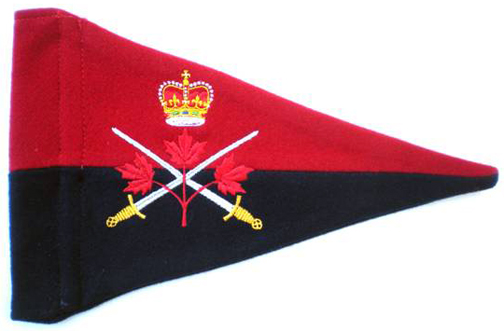 The rectangular pennant indicates the rank of lieutenant-general or above, at that time the Chief of the General Staff.
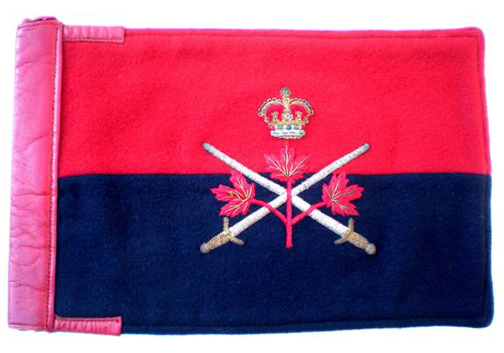 Both are made of very heavy fabric, double-sided and embroidered on both sides. Presumably they were installed on the vehicle fender in a plastic case.
The general’s pennant is embroidered in gold and silver wire and silk. Metric measure not being regulated at the time of their use, it is 11 x 7 inches (53 x 18 cm). The heading or header at the hoist end is bound with red leather.
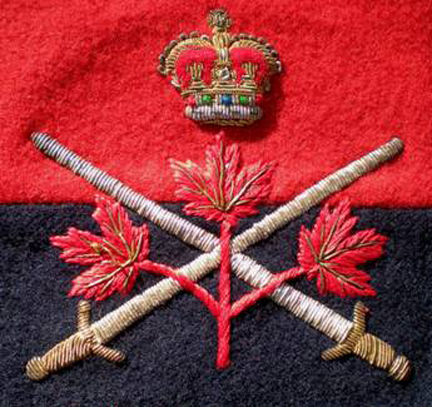 The brigadier’s pennant is embroidered in coloured silk and measures10 x 6-1/4 inches (25 x 16 cm).
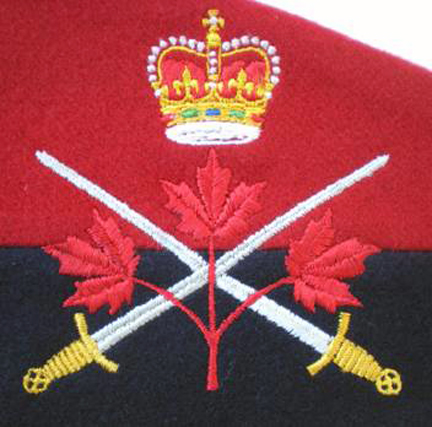 This article compliments WWII and Post-War Canadian Senior Officers’ Flags, Pennants, Swallowtails and Licence Plates All images are from the author’s collection
You can rate this article by clicking on the stars below
by Mark W. Tonner
In North-West Europe, during the later half of 1944 and into 1945, the Canadian Army used two types of armoured vehicles that came to be known as a Kangaroo. The Kangaroo was the world’s first fully tracked ‘Armoured Personnel Carrier.’ This ingenious concept was devised by Lieutenant-General G.G. Simonds, the General Officer Commanding, II Canadian Corps, as he searched for a way to reduce the high casualty rate amongst his infantry. His solution also allowed them to move at ‘tank speed,’ along with their supporting tanks, from start line too final objective.
The first of these two types of armoured vehicles that came to be known as a Kangaroo, was the ‘Priest’ Kangaroo armoured personnel carrier1, which made its battlefield debut in Normandy, during Operation TOTALIZE (7-10 August 1944), in which, the infantry was able to obtain their objectives without suffering heavy losses from the enemy’s defensive machine gun and mortar/shell fire, while traversing the ground from start line too objective. Also, the mobility provided to the infantry by the ‘Priest’ Kangaroo armoured personnel carriers, along with the armoured protection, resulted in fewer casualties and greatly increased morale. Their continued successful employment in Operation TRACTABLE (14-16 August 1944), convinced First Canadian Army that there was a continued requirement for armoured personnel carriers, for the transportation of infantry on the battlefield, in vehicles which had the same armoured protection and mobility as tanks. Due to the fact, that the ‘Priest’ Kangaroo armoured personnel carriers had been based on a ‘temporary measure’, and that, the vehicle it was based on, was on ‘loan’ from the Americans, steps were immediately taken to replace this ‘Priest’ Kangaroo armoured personnel carrier, with another type of ‘Kangaroo’ armoured personnel carrier, which was based on the Canadian designed and built, Tank, Cruiser, Ram, Mark II2.

An example of a ‘Priest’ Kangaroo armoured personnel carrier. Authors’ collection
Following discussions between Canadian Military Headquarters (London)3, and First Canadian Army Headquarters, the decision was taken on 9 August 1944, to convert 100 surplus Ram tanks held in the United Kingdom, to that of armoured personnel carriers, for use by First Canadian Army in the field. On 10 August, Canadian Military Headquarters, instructed No. 1 Canadian Base Workshop, Royal Canadian Electrical and Mechanical Engineers, located at Bordon Camp, Hampshire, to immediately convert 100 Ram, Mark II tanks, which were held on stock of No. 1 Canadian Central Ordnance Depot, Royal Canadian Ordnance Corps (Bordon Camp, Hampshire), to that of armoured personnel carriers on a ‘most urgent basis.’ These 100 ‘Ram’ armoured personnel carriers, were to be in France, ready for use by First Canadian Army, by 24 August 1944.
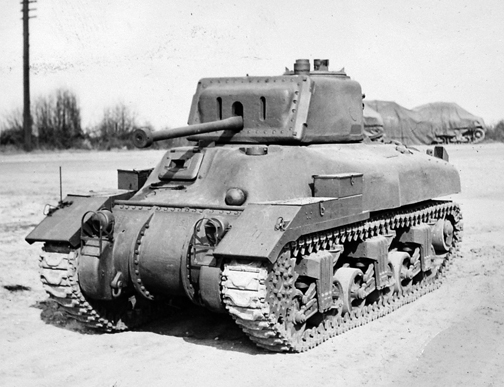
An example of a Tank, Cruiser, Ram, Mark II, without the auxiliary turret. MilArt photo archives
The conversion of these Ram, Mark II tanks, to that of ‘Ram’ armoured personnel carriers, consisted of the removal of the complete turret, turret ring, and the internal ammunition bins (to accommodate ten fully equipped infantrymen). As well, any unnecessary hull fittings were to be removed. The No. 19 Wireless Set (radio)4 was to be reinstalled in the left-hull pannier5, on the left of the bow machine gunner’s position. Also, if time permitted, the vehicle batteries were to be moved from the hull floor, up into the rear of the left-hull pannier. Most of the Ram gun tanks, to be converted to ‘Ram’ Kangaroo armoured personnel carriers, were of the latest variant of the Ram tank, Mark II, and did not feature the cupola-equipped auxiliary turret mounted on the left-front of the hull, however, a small amount of Ram, Mark II tanks, bearing census numbers6 between CT159415 and CT159486, which were converted to ‘Ram’ Kangaroo armoured personnel carriers, retained their auxiliary turret. The Ram, Mark II tanks, that were converted into ‘Ram’ Kangaroo armoured personnel carriers, were from the CT15000 series, in the CT159402 to CT160145 block of census numbers.
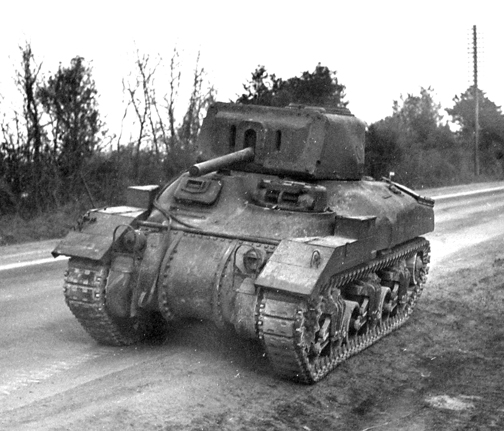
An example of a Tank, Cruiser, Ram, Mark II, with the auxiliary turret. MilArt photo archive
The removal of the complete turret, with turret ring, and internal ammunition bins, made the Ram an ideal armoured personnel carrier, which offered a lower silhouette, lighter weight, and reduced track pressure, which made it more manoeuvrable over soft ground. The ‘Ram’ Kangaroo armoured personnel carrier, was 19-feet (6-metres) in length, 9-feet, 1-inch (3-metres) wide, and stood at a height of 6½-feet (2-metres), with a ground clearance of 17-inches (432-millimetres). The hull was made from cast armour, and was two to three inches (51 to 76-millimetres) thick at the front, 1¼ to 2½-inches (32 to 64-millimetres) thick on the sides, and 1½-inches (38-millimetres) thick at the rear. The hull top armour was one to 1½-inches (25 to 38-millimetres) thick. The removal of the complete turret and internal ammunition bins, during conversion, reduced the overall weight of the vehicle from 65,000 lbs (29-tons), to that of approximately 53,760 lbs (24-tons). Access to the vehicle was gained through the large circular hole left in the hull top, by the removal of the complete turret, and turret ring. On those ‘Ram’ Kangaroos with the ball-mounted .30-calibre Browning machine gun, in the left-front bulge of the hull, there was a hatch provided for the co-driver in the top of the bulge, or if fitted, in the top of the auxiliary turret.

An example of a ‘Ram’ Kangaroo armoured personnel carrier, based on the conversion of a Tank, Cruiser, Ram, Mark II, without the auxiliary turret. Authors’ collection
The ‘Ram’ Kangaroo, was powered by a 450-horse power Continental R975/C1 radial air-cooled 9-cylinder engine, with a maximum speed of 25 miles-per-hour (40-kilometres-per-hour), a range of 144 miles (232-kilometres), and a fuel capacity of 150-gallons (682-litres). Access to the engine was provided through two engine compartment top plates, and through a set of rear engine doors, located below the rear plate of the upper hull. The main armament of the ‘Ram’ Kangaroo, was the ball-mounted .30-calibre Browning machine gun, which was mounted in the left-front bulge of the hull (or was mounted in the cupola-equipped auxiliary turret, if present), and was operated by the co-driver. The driver’s position was located in the right-front of the hull, and was provided with a large vision aperture, with a small vision port protected by very heavy glass, for use, when the large vision aperture was closed, although most drivers preferred to keep the large vision aperture open in all but the heaviest enemy fire. They felt it was not really safe to drive using the small vision port only, their field of view was too restricted and their vehicle was often used in rather tight quarters. The opening and closing of this aperture was carried out by the driver, from within the vehicle. The driver was also provided with a Vicker’s No. III, Mark I Periscope, which was mounted in the hull top, slightly to his left. On those ‘Ram’ Kangaroos with the ball-mounted .30-calibre Browning machine gun, in the left-front bulge of the hull, there was a Vicker’s No. III, Mark I Periscope mounted on the forward edge of the co-driver’s hatch, while on those ‘Ram’ Kangaroos with the auxiliary turret, a vision port protected by very heavy glass, was provided on the left of the .30-calibre Browning machine gun.
The suspension used on the ‘Ram’ Kangaroo, was the ‘Vertical Volute Spring’ type, which consisted of 12 wheels in six bogies, with three bogie assemblies per track. The two wheels in each bogie assembly were pivoted on arms against a vertical spring, which was protected by the bogie-carrying bracket. A return roller was mounted either on top of, or on a trailing arm behind the bracket, the entire bogie assembly forming a self-contained fitting unit. External stowage bins (for various tools, and equipment), were also provided, along with the standard compliment of pioneer tools (shovel, crowbar, pickaxe, axe) and recovery/breakdown equipment (tow cable, jack and wood blocks), which were carried on all tanks. Four towing shackles were provided on the vehicle, two at the front, and two at the rear. Various external brackets were also provided for the carrying of spare bogie wheels, tarpaulins, and other miscellaneous items. Internal stowage bins for six boxes of .30-calibre ammunition7, was provided for, in the co-driver’s position, in the left-front hull.
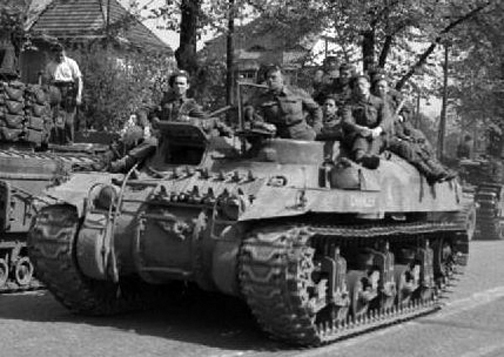
An example of a ‘Ram’ Kangaroo armoured personnel carrier, with ‘Vertical Volute Spring’ suspension, which has the return roller mounted on top of the bogie assembly. IWM (BU 4515)

An example of a ‘Ram’ Kangaroo armoured personnel carrier, with ‘Vertical Volute Spring’ suspension, which has the return roller mounted on a trailing arm behind the bogie assembly. Authors’ collection
The conversion of Ram tanks, to that of ‘Ram’ armoured personnel carriers, began on 15 August 1944, at a rate of 15 conversions per day. By 22 August, the initial order for 100 ‘Ram’ armoured personnel carriers was completed. On 16 August, First Canadian Army, requested an additional 25 ‘Ram’ armoured personnel carriers be produced, as a reserve to the initial order for 100, so as to have a ready replacement for battle-damaged ‘Ram’ armoured personnel carriers. This was followed on 16 September, with another request from First Canadian Army, for the production of an additional 25 ‘Ram’ armoured personnel carriers, as a reserve. On 26 September 1944, Headquarters, No. 1 Canadian Central Ordnance Depot, Royal Canadian Ordnance Corps, informed Canadian Military Headquarters (London), that to date, 101 Ram tanks had been converted to that of ‘Ram’ armoured personnel carriers.
As they arrived in Normandy, these ‘Ram’ Kangaroo armoured personnel carriers, were taken on charge of “F” Squadron, 25th Canadian Armoured Delivery Regiment (The Elgin Regiment), Canadian Armoured Corps8, starting on 18 September 19449, where they were held until arrangements could be made for their issue to the 1st Canadian Armoured Personnel Carrier Squadron, Canadian Armoured Corps10, in exchange for their ‘Priest’ Kangaroo armoured personnel carriers, with which they were equipped. On 21 September, in a letter to First Canadian Army Headquarters, it was noted by Lieutenant-Colonel G.C. Stewart, Commanding Officer, 25th Canadian Armoured Delivery Regiment (The Elgin Regiment), that the 25 ‘Ram’ Kangaroos, that “F” Squadron had received to date, were all found to be in reasonable condition, but that all would require through checking and minor adjustments to engines, track and suspension. He also noted, that they all still retained their No. 19 Wireless Sets.
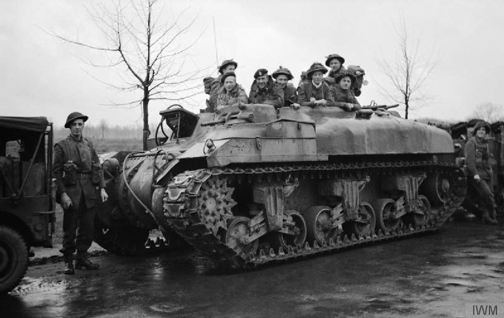
An example of a ‘Ram’ Kangaroo armoured personnel carrier, based on the conversion of a Tank, Cruiser, Ram, Mark II, with the auxiliary turret. IWM (BU 2956)
The primary users of the ‘Ram’ Kangaroo armoured personnel carrier in Canadian service, were the 1st Canadian Armoured Personnel Carrier Squadron, Canadian Armoured Corps, and later, the 1st Canadian Armoured Personnel Carrier Regiment, Canadian Armoured Corps. On 30 September, 1st Canadian Armoured Personnel Carrier Squadron, Canadian Armoured Corps, received orders from Headquarters, First Canadian Army, that all ‘Priest’ Kangaroos, were to be turned into the 2nd Canadian Tank Troops Workshop, Royal Canadian Electrical and Mechanical Engineers, in the Cassel (France) area, for a complete overhaul prior to being returned to the Royal Canadian Ordnance Corps11 for disposal. The squadron’s ‘Priest’ Kangaroos were to travel to Cassel on their own ‘tracks’ where, once turned in, the drivers would proceed to Pierreval, France (near Rouen, France) where they were to pick-up ‘Ram’ Kangaroo armoured personnel carriers from “F” Squadron, 25th Canadian Armoured Delivery Regiment (The Elgin Regiment), Canadian Armoured Corps. The issue of these ‘Ram’ Kangaroos was spread over the period of 1-5 October, during which, the squadron was issued with 64 ‘Ram’ Kangaroo armoured personnel carriers12. On 2 October, the Squadron was ordered to concentrate at Mill, The Netherlands. By the afternoon of 7 October 1944, all four troops of the squadron were concentrated at Mill, whereupon Captain F.S. Corbeau, Officer Commanding, 1st Canadian Armoured Personnel Carrier Squadron, organized each of his four troops with a Troop HQ with four ‘Ram’ Kangaroo armoured personnel carriers and three sections, each with four ‘Ram’ Kangaroo armoured personnel carriers
With having received reinforcements, each carrier now had a crew of two, instead of the one-man crews of the ‘Priest’ Kangaroo armoured personnel carrier. These ‘Ram’ Kangaroos all retained their bow ball-mounted .30-calibre Browning machine gun13. Most of the carriers were equipped with the No. 19 Wireless Set, and all still retained their intercom system, so the crew could communicate with each other and their infantry passengers.
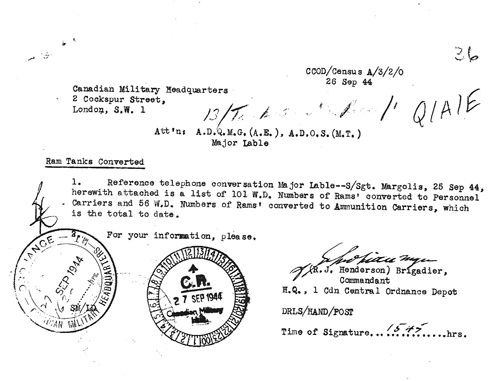
Letter of 26 September 1944, from Headquarters, No. 1 Canadian Central Ordnance Depot, informing Canadian Military Headquarters, that to date, 101 Ram tanks had been converted to that of ‘Ram’ armoured personnel carriers. Authors’ collection
1st Canadian Armoured Personnel Carrier Squadron, now equipped with ‘Ram’ Kangaroo armoured personnel carriers, was from 12 October, tasked to support the British 51st (Highland) and 53rd (Welsh) Infantry Divisions in the forthcoming operations to clear the Scheldt Estuary and the opening of the Port of Antwerp (Belgium), with Troops No. 1 and No. 4 (with 31 ‘Ram’ Kangaroos) assigned to the 53rd (Welsh) Infantry Division and Troops No. 2 and No. 3 (with 31 ‘Ram’ Kangaroos) assigned to the 51st (Highland) Infantry Division. These operations the squadron was involved with until 22 October, when the complete squadron was tasked to the 51st (Highland) Infantry Division for the capture of Tilburg (Holland), which was to take place the next day (23 October). Having secured Tilburg, the squadron was next tasked, to the British 15th (Scottish) Infantry Division for operations. Reporting to Headquarters 15th (Scottish) Infantry Division, on the evening of 23 October, and being assigned to ‘lift’ the 10th Battalion, Highland Light Infantry (City of Glasgow Regiment) (with 28 ‘Ram’ Kangaroos) and the 2nd Battalion, Argyll and Sutherland Highlanders (Princess Louise’s) (with 28 ‘Ram’ Kangaroos)14, the squadron went into harbour at Zon (Holland), to await the next day’s (24 October) operation.
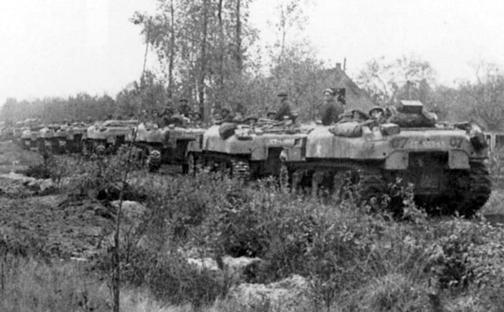
A rare photo of ‘Ram’ Kangaroo armoured personnel carriers of the 1st Canadian Armoured Personnel Carrier Squadron taken on 23 October 1944, carrying British troops of the 2nd Battalion, Seaforth Highlanders, 152nd (Highland) Infantry Brigade, of the 51st (Highland) Infantry Division. Courtesy Ed Storey
As noted earlier, Lieutenant-Colonel Stewart, Commanding Officer, 25th Canadian Armoured Delivery Regiment (The Elgin Regiment), on 21 September had sent a letter to First Canadian Army Headquarters, regarding the condition of those ‘Ram’ Kangaroos received to date in Normandy, from the United Kingdom. Also in this letter, Lieutenant-Colonel Stewart addressed Captain Corbeau’s (Officer Commanding, 1st Canadian Armoured Personnel Carrier Squadron) concerns regarding the proper maintenance of the squadron’s ‘Priest’ Kangaroos (with which they were then equipped), with the limited resources and personnel that he had, with Lieutenant-Colonel Stewart suggesting amendments to the squadron’s War Establishment15, in both personnel and vehicles, requesting, that in light of operational value of the squadron, that action be taken to implement such amendments. Upon receipt of Lieutenant-Colonel Stewart’s letter, a conference was arranged, to take place at First Canadian Army Headquarters, on 29 September 1944, at which the future organization of a suitable unit to operate approximately 125 ‘Ram’ Kangaroo armoured personnel carriers, based on the operational experience gained by the employment of ‘Priest’ Kangaroo armoured personnel carriers, to date, by 1st Canadian Armoured Personnel Carrier Squadron, would be discussed. Both, Lieutenant-Colonel Stewart and Captain Corbeau, attended this conference, along with representatives of I British Corps Headquarters, and of various branches of First Canadian Army Headquarters.
From this conference, it was agreed that First Canadian Army would recommend to 21st Army Group16 Headquarters, that a Canadian armoured personnel carrier regiment of three squadrons, capable of simultaneously lifting one-and-a-half infantry battalions be formed. It was also agreed, that Lieutenant-Colonel Stewart, in conjunction with Brigadier G.M. Grant, the Deputy Director of Mechanical Engineering, First Canadian Army17, would submit a recommendation of the personnel required within this armoured personnel carrier regiment, for the supervision of normal vehicle maintenance, and for the allotment of armoured recovery vehicles18 on the basis of one per squadron, and for the organization of a suitable light aid detachment19 to carry out all necessary repairs and adjustments within the regiment. It was also agreed, that a recommendation of the personnel required within this armoured personnel carrier regiment, for the maintenance of the communications equipment, would also be submitted, along with the recommendation, that the No. 19 Wireless Set, be retained in the carriers of a squadron headquarters, and in those of the individual Troop Leaders, while the rest of the carriers, be equipped with an intercommunication system, so the crew could communicate with each other and their infantry passengers. Lastly, it was agreed, that a crew of two each, would be recommended for each armoured personnel carrier within the regiment.
To be continued in The ‘Ram’ Kangaroo armoured personnel carrier, Part 2.
Acknowledgements
The author wishes to thank Miss Courtney Carrier, for proofing reading and offering constructive criticism, and comments, on my draft copy of this article, and Clive M. Law, for providing photos from the MilArt photo archives, and for publishing this article.
Notes:
- Which was based on the conversion of the M7 ‘Priest’ 105-millimetre self-propelled gun, to that of the ‘Priest’ Kangaroo armoured personnel carrier, see the MilArt article, ‘The ‘Priest’ Kangaroo Armoured Personnel Carrier, in Canadian Service, 7 August to 30 September 1944,’ published on 28 August 2014, for details.
- The Canadian designed and built, Cruiser Tank, Ram, Mark II, was armed with a 6-pounder (57-millimetre) Ordnance Quick Firing gun, and three .30-calibre Browning machine guns, one of which was mounted coaxially in the turret with the 6-pounder, while another, was mounted in an auxiliary turret, located on the left front of the tank, or in later production vehicles, without an auxiliary turret, in a ball mount in the left front hull. The third .30-calibre Browning machine gun, was mounted beside the commander’s hatch, on the turret roof, and used for anti-aircraft/ground defence.
- Canadian Military Headquarters (located in London, England), held responsibility for coordinating the arrival, quartering, completing equipment requirements, and training of Canadian units and formations and to command and administer these units and formations in the United Kingdom and at base in the theatre of operations. In addition, the headquarters had an important liaison role, particularly liaison with the British War Office and with the General Officer Commanding Canadian Forces in the theatre of operations, as well as furnishing information to the Canadian High Commissioner in London.
- The No. 19 Wireless Set consisted of an “A” set for general use and a “B” set for short range work and an intercommunication unit for the crew. The No. 19 set had a maximum voice range of 10-miles (16-kilometres) and a maximum morse range of 15½-miles (25-kilometres).
- On a Ram tank, the hull pannier, was the armoured portion of the hull which extended outwards above the tracks to the outer edge of the track.
- In order to provide a positive means of identifying individual vehicles, every Canadian Army vehicle was given a separate serial number, commonly referred to as census number. In the case of the Ram tank, this number was preceded by the prefix letters “CT,” the letter “C” denoting the vehicle as Canadian, and the letter “T” denoting that the vehicle was a tank. These census numbers were and were normally stencilled onto the vehicle in white letters 3½-inches (9-centimetres) high.
- Each box containing one 250 round belt of .30-calibre ammunition for the .30-calibre Browning machine gun mounted in the hull front.
- “F” Squadron, 25th Canadian Armoured Delivery Regiment (The Elgin Regiment), was employed as the ‘Army armoured delivery squadron’ of First Canadian Army Troops, and held reinforcement tanks and men to supply the needs of the armoured units which came under command and/or control, of Headquarters First Canadian Army Troops.
- From the initial issue to the squadron of nine of ‘Ram’ Kangaroo armoured personnel carriers on 18 September, issues continued on a daily basis, so that by the morning of 30 September, “F” Squadron held approximately 81 ‘Ram’ Kangaroo armoured personnel carriers, for issue to the 1st Canadian Armoured Personnel Carrier Squadron, Canadian Armoured Corps.
- 1st Canadian Armoured Personnel Carrier Squadron, Canadian Armoured Corps, had been authorized to form on a temporary increment basis, on 28 August 1944, to operate 100 ‘Priest’ Kangaroo armoured personnel carriers.
- One of the responsibilities of the Royal Canadian Ordnance Corps, was the storage and distribution of vehicles to the field army.
- In addition, CT159871, which was issued to the squadron on 3 October 1944, was in the configuration of a ‘Ram’ armoured ammunition carrier, having been converted too such from a Ram Mark II tank by No. 1 Canadian Base Workshop, Canadian Electrical and Mechanical Engineers, which was later converted into a ‘Ram’ Kangaroo armoured personnel carrier.
- Although one, CT40926, had an auxiliary turret, having been converted from an earlier sub-model of the Cruiser Tank, Ram, Mark II.
- Both battalions were components of the 227th (Highland) Infantry Brigade, 15th (Scottish) Infantry Division.
- A War Establishment is a detailed listing of the authorized complement of men, equipment, and vehicles of a military unit.
- First Canadian Army and Second British Army, were under command of 21st Army Group headquarters.
- The officer responsible for the maintenance and repair of First Canadian Army’s equipment.
- The armoured recovery vehicle was a tank developed to recover a bogged-down, broken-down, battle-damaged, or a mine-damaged tank from the battlefield to a location where unit mechanics could attempt quick repairs.
- A Light Aid Detachment, was made up of members of the Corps of Royal Canadian Electrical and Mechanical Engineers, and was attached to a unit, to assist the personnel of the parent unit in first line repair of its equipment, in so far as that repair was outside the capacity of the unit, to inspect unit equipment and supervise and advise on unit maintenance, to assist the unit in recovering its equipment when damaged or stranded, to assist liaison between the unit and second line workshops, and to advise the unit on technical matters.
You can rate this article by clicking on the stars below
By Clive M. Law
In order to meet pressing manning needs in the UK National Defence Headquarters (NDHQ) sought to identify opportunities to relieve fit troops, serving in Canada, with soldiers who did not meet the standards for overseas service. One solution was to raise battalions of soldiers who, due to age, fitness or other reason, were limited to Canadian domestic duties. These battalions would then be assigned guard duties at strategic points that had been identified as potential targets for sabotage by a ‘fifth column’.
Two such units were the No.1 and No.2 Special Service Infantry Battalions, the establishment of both being effective from 15 June 1942. Within days these two units were redesignated 1st and 2nd Garrison Battalions, again to be effective 15 June 1942.[i] The duties of the 1st Battalion consisted of guarding the locks and power plants in the Thousand Islands area of Kingston, taking over this function from active army regiments who then proceeded to England. It is believed that the 2nd Canadian Garrison Battalion was located at Barriefield, near Kingston and carried out similar duties.
On 3 September 1942, the two battalions were allocated to the Canadian Infantry Corps. This change in allocation may have been the catalyst for the Commanding Officer of 1st Garrison Battalion to seek unit insignia for his unit as, on the 22nd of that month, Lt-Col G. Carmichael wrote to Headquarters, Military District No.4, at Montreal, submitting a design for a cap badge.[ii] This included the comment that “badges of our own would have a great effect on morale and help in creating a Regimental “Esprit de Corps”.
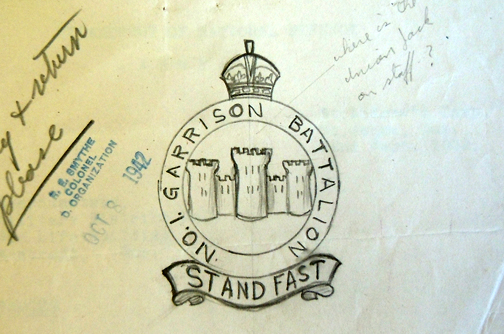
Initial drawing for the 1st battalion badge. A pencil notation asked “where is the Union Jack on staff?” Although Lt-Col Carmichael commands the ‘1st’ Garrison Battalion he has incorrectly used the naming convention ‘No.1’.
The file was transferred from MD5 to MD2 (Ontario and the ‘home’ of the battalion) whose Commanding Officer (Maj-Gen C.F. Constantine) supported the request in a submission to the NDHQ. In his letter Constantine writes;
“Attached hereto is a design suggested cap badge for the marginally noted Unit, forwarded for approval please, and the following information is submitted:
Dimensions – width one and nine sixteenth inches, height two and three eights, Scroll one and nine sixteenths inches by one and a quarter inches. Size of all letters three sixteenth of an inch. These are shown on the sketch.
Castle design to be white metal and remainder bronze. The area between top and bottom of castle and the enclosing circle to be blank. In case of Officers badges the castle is to be silver.
The castle and keep were chosen as significant of the name and purpose of the Battalion viz: to guard the battlements of the country and repel any enemy. So far as is known the choice of the devices is entirely original and copied from no other Regimental emblem or badge. The same applies to the motto except that there is Biblical precedent. The early issue of such badges would have a far reaching effect on the morale and Esprit de Corps of the Regiment and it is therefore requested please that the necessary steps be taken forthwith to have the design approved and the authority for the manufacture at public expense and issue of the badges given.”
It is pointed out that a second Garrison Battalion has been authorized and perhaps consideration should be given to this fact, as it is possible that when this second Battalion is mobilized they might care to adopt the same badge and merely change the Battalion number.”
The letter was acknowledged with the caveats that it was not policy to provide badges for battalions as theses were “provided on a regimental basis only”, and that the metal situation was such that early delivery could not be expected.
On 12 October (incredibly quick considering military bureaucracy) a written consultation was distributed between the Master-General of the Ordnance (MGO), the Adjutant-General (AG) and the Chief of the General Staff (CGS). This document asks whether a badge should be allowed on a battalion basis, identified the challenges of having these made in plastic at a time when the army was considering have all badges made of plastic and the need to have new dies made, and if it was desirable to be able to distinguish between members of the battalions. Hand-written comments by these officers suggest that the preference was for a single cap badge (i.e., on a regimental basis) with individual battalions identified by cloth shoulder titles.
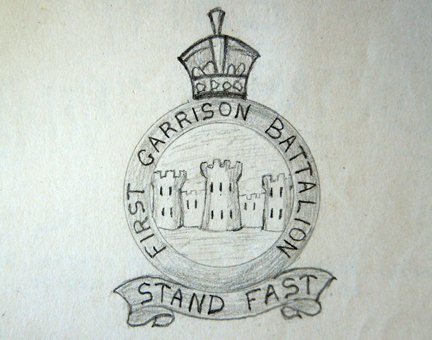
Drawing of the badge prior to the decision to remove any mention of battalion numbers.
In the meantime, a new drawing of the proposed cap badge was prepared which saw a change to the unit name in the scroll, changing from ‘No.1’ to ‘First’. This design was made obsolete almost immediately when, on 27 October, the MGO advised the Commanding Officer, MD2, that “It has been decided that a standard pattern cap badge will be provided for all Garrison Battalions.” By the end of November, Ministerial approval had been obtained for the expenditure of $900.00 to pay for the mold and an initial provision of badges to all Other Ranks of the battalion.
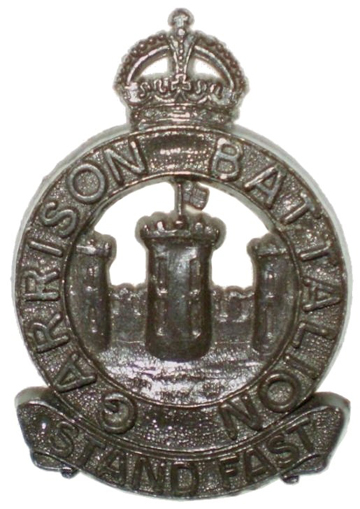
An example of a production badge. The thickness of the badge, required to prevent excessive wastage, was disliked by the battalion.
A draft Routine Order was also approved which described the badges for both officers and ORs;
The castle in silver, remainder of badge in bronze. Within an annulus inscribed “GARRISON BATTALION”, ensigned with the Imperial Crown, a castle with three battlemented towers, over the centre one a Union Jack flying from a flag staff: below, a scroll inscribed “STAND FAST”.
Extreme height – 2 inches
Extreme width – 1 7/16 inches
Collar badge – The castle in silver, remainder of badge in bronze. As for cap badge.
Extreme height – 1 5/8 inches
Extreme width – 1 inch.
Other Ranks. Badges of the same design as for Officers, but to be of brown plastic.
A sample badge was provided in April 1943. This sample made no provision for lugs and it was confirmed that it would be an arrangement identical to that used for plastic badges provided to the Canadian Parachute Corps. Although the sample was accepted NDHQ offered the following comments:
“It is requested that the Contractor be advised that the Garrison Battalion Badge has been accepted but that in future care should be taken to make the Badges a little thinner. Also that the plastic pin should fit the holes in the lugs better than in the Parachute Corps Badges as difficulty was observed in withdrawing and inserting the pin.”
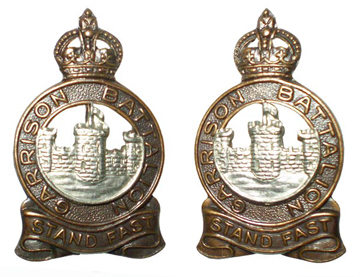
Examples of an officer’s cap badge and collar badges.
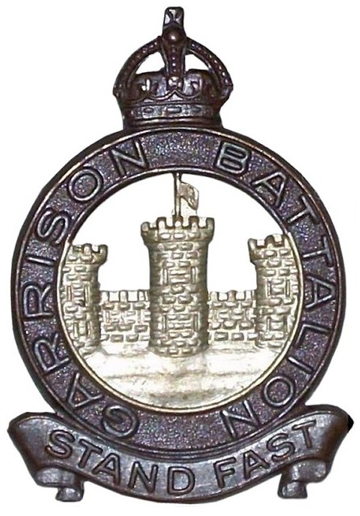
Throughout the process of approving a cap badge for the Garrison Battalions, references were made to including the battalion number on cloth shoulder titles. When the MGO advised MD2 of the decision on the cap badge he also included his approval for the shoulder title:
“The distinction between Battalions will be maintained by means of the regimental embroidered title worn on the top of the sleeve. The design of shoulder title submitted with your letter dated October 23rd is therefore considered quite satisfactory and provision action will be taken at once.” Following this approval for the title its ensuing production was considerably faster than for the cap badge.
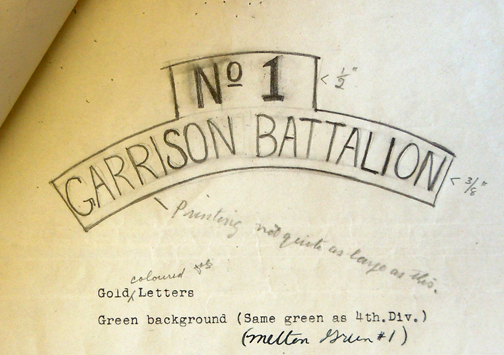
First drawing of the cloth shoulder title. The material was identified as Melton No.1 with gold coloured embroidery. Note that the size of “No.1” was larger than “Garrison Battalion”.
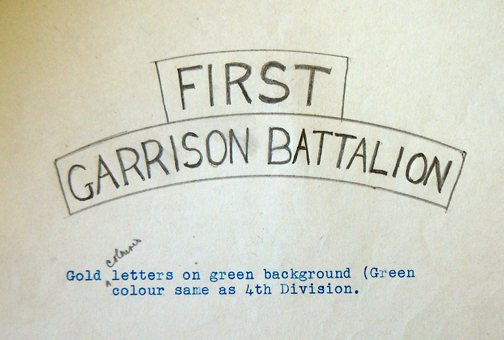
Final drawing upon which production was based.
The initial drawing used the “No.1” identifier in lieu of the later approved “First”.[iii] This was soon corrected and a new drawing prepared. Once the drawing was approved, the Inspection Board of the United Kingdom and Canada (IB) was tasked with the contracting process. On 17 November 1942, six sample titles, manufactured by S.A. Grant, were forwarded to NDHQ for approval. Once approval of the samples was obtained an order for 4,000 titles was placed and these were shipped to Toronto on 9 January 1943.
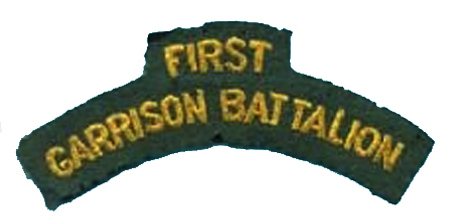
A contract was let for 4,000 shoulder titles to the First Garrison Battalion and these were delivered in January 1943.
In the meantime, the 2nd Garrison Battalion was stood up inquiries were made, in February 1943, if provision of shoulder titles should be undertaken. The IB was tasked, again, to obtain these with the only difference being the ‘Second’ was to be used in lieu of ‘First’. By the end of the month six samples had been produced by the Brocklehurst Swiss Embroidery Company of Toronto and forwarded to NDHQ. It is unknown from the surviving files if any further badges were produced although sufficient examples exist to believe that a production run was made. In any event, both battalions were disbanded; the Second Battalion, effective 1 May 1943, and the First Battalion, on 15 October 1943.[iv]
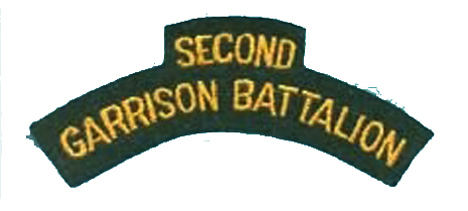
At least six samples were made but it is believed that a production contract was let for the Second Garrison Battalion titles.
[i] “On Active Service” Tonner, Mark W. Service Publications
[ii] The 1st Garrison Battalion was at St Andrew’s Camp, St-Jean, Quebec (now St-Jean-sur-Richelieu) undergoing training prior to taking up their duties.
[iii] The use of ‘No.1” was incorrect but then so was ‘First’. The unit’s official title was ‘1st’ as shown in all General Orders. Further, if the Canadian Parachute Corps could be used as an example, the 1st Canadian Parachute Battalion used a simple ‘1’ as the battalion identifier on the shoulder title.
[iv] Library and Archives Canada, Record Group 24, Vol. 2266. File H.Q. 54-28-1231-2
You can rate this article by clicking on the stars below
© B. Alexander 2013
The primary purpose and the need for large numbers of troops quickly diminished after the cessation of hostilities on V-E Day. With no need for a large standing army overseas, Canada began the demobilization of her forces but logistical bottle necks slowed the process. For the Canadian Army (Overseas), repatriation would take months. With demobilization underway and thousands of soldiers sitting idle overseas, the need to provide constructive activities for personnel was paramount. At the same time, the Canadian government was planning for the reintegration of service personnel into civilian life; education for civilian careers became a major tool. Opportunity to combine meaningful activity for some soldiers awaiting their turn to come home and at the same time furthering the process of education for civilian life was addressed by the establishment of the KHAKI UNIVERSITY.*
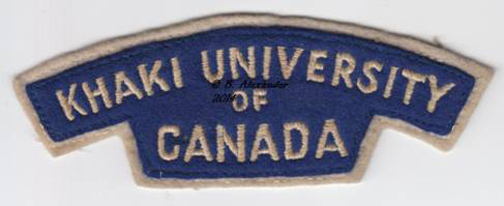
The Khaki University of Canada embroidered shoulder title. Author’s collection.
Announced on June 16, 1945, the campus was quickly established at Leavesden, just outside of London. Formerly the site of 23 Canadian General Hospital, the location, comprising of approximately 40 acres was easily converted to a campus. The Khaki University was to provide instruction to members of the Canadian armed forces in first and second year university courses, which could be credited towards degrees when the participants returned to Canada and completed their programs of study at Canadian universities. To “give a Canadian flavour to the campus, each of the roadways was named after an early explorer. Similarly, the names of the Governors-General denoted the different parts of the University premises and the Houses of the Junior College.”[1] With an initial enrollment of 565 students, supported by No 2 Administrative Company of 20 officers and 434 other ranks to run the facility, the Khaki University was officially opened by Field Marshall B. Montgomery on September 27, 1945.

Pte Doreen Exler CWAC Khaki University student in September 1945. LAC
Admission to the University was based on academic qualifications; rank was not a determining factor. As such the student body was a heterogeneous mix of officers and other ranks. With reintegration into civilian life as one of the purposes of the Khaki University, it was determined that the individual’s rank, pay, and allowances would be preserved, but “to simulate a civilian atmosphere on the campus university dress and recreational dress was provided. The former was a special issue battledress without badges of rank or ribbons. It had a blue and white University flash on both shoulders. In the case of a student it also had blue shoulder strap flashes with the name of his house embroidered in white. The shoulder strap flashes of a faculty member were red. Recreational dress consisted of blue jacket and grey flannels with shirt and tie. It was only when proceeding individually beyond the University bounds that normal military dress was worn.”[2]
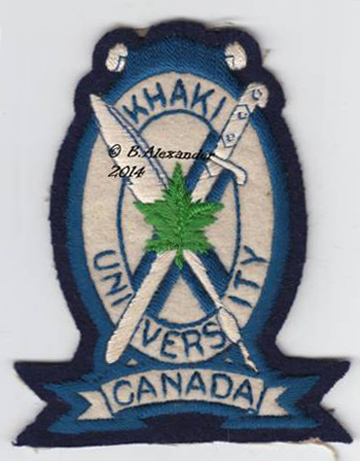
Khaki University embroidered blazer crest. Author’s collection.
The unique shoulder title reading “KHAKI UNIVERSITY / OF / CANADA” in white embroidery on a blue field, backed again by another piece of white material making a white border, was issued for wear on the battledress. The shoulder slip-ons for the five Houses were in white embroidery on blue, reading “ATHLONE”, “BESSBOROUGH”, “DEVONSHIRE”, “TWEEDSMUIR” and “WILLINGDON”, each of the names a former Governor-General of Canada. The faculty slip-ons were a plain red strip of red cloth worn in the same manner as the House slip-ons. Additionally, during the fall term, a blazer crest was designed for wear on the blue jacket. These insignia identified the student body of the Khaki University.
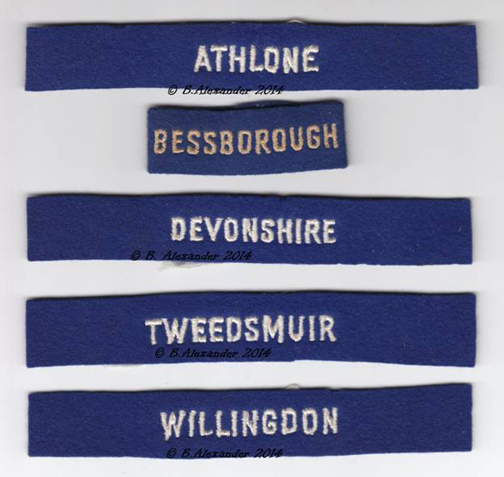
The five house slip-on titles for the Khaki University. The Bessborough slip-on has been stitched for wear on the shoulder strap. Author’s collection.
The easing of the logistical bottlenecks allowed for a faster repatriation of the Canadian army than had been anticipated. By the spring of 1946, the majority of the Canadian army had returned to Canada and the potential student body, and thus the need for the Khaki University had evaporated. The University only held two sessions, enrolling a total of 850 students in the Junior College before closing in April of 1946. The insignia remain as tribute to the unique educational experiment.
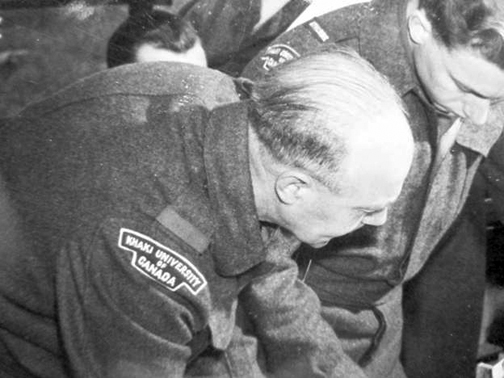
An unidentified instructor and an Athlone House student, September 18, 1945. DHH.
No part of this article may be reproduced in any manner without the express permission of the author.
(*During the First World War, the Khaki University had been organized to provide educational opportunities for the Canadian Expeditionary Force. Khaki University of the Second World War carried on the initiative introduced by the first incarnation.)
[1] Beament G.E. Brig.-Gen. The Khaki University of Canada in the United Kingdom, 1945-46. An experiment in post hostilities education. Pg 254-261, in As You Were, Ex-Cadets Remember, Volume II, 1919-1984. R.Guy C. Smith, Ed.RMC Club of Canada 1984. Pg 256.
[2] Ibid, Pg 258.
You can rate this article by clicking on the stars below
by Clive M. Law
The LCA (Landing Craft Assault) was the basic landing craft of the Second World War and was derived from a design by John I. Thorneycroft Ltd. of Woolston, Hampshire, UK. During the war it was manufactured throughout the United Kingdom in small boatyards and by furniture manufacturers.

Final exercise prior to assault landing at Dieppe. Note the early style of naming. Library and Archives, MIKAN 4341223
Designed to transport 30 to 35 fully-equipped soldiers it featured a flat-bottomed hull and was made of plywood with strategically-placed armoured plate to provide a measure of protection to the troops during run-ups to the beach. The design and subsequent weight limited the LCA to less than 8 knots even though powered by two 65hp Ford V8 engines. Armament of the 12.5m long LCA consisted of one .30 calibre (12,7 mm) machine gun and two Lewis (.303 calibre) machine guns.
Prior to July 1942, these craft were referred to as “Assault Landing Craft” (ALC) and the craft were marked with this designation. After that date, “Landing Craft, Assault” (LCA) was used to conform to the Allied naming standards.
Almost 50,000 seaman and officers, mostly from the Royal Naval Patrol Service, and the Royal Navy Volunteer Reserve (RNVR) crewed the landing craft, of all types. Of these, the Royal Canadian Navy provided 60 officers and 300 ratings, on the condition that they be formed into specifically Canadian companies.
During Operation Jubilee (the Dieppe raid of 19 August 1942) sixty LCAs were employed to carry the assault infantry of the 2nd Canadian Infantry Division, ‘A Commando’ Royal Marines, and No. 4 Commando. Until Dieppe, LCAs had only been used in small numbers.
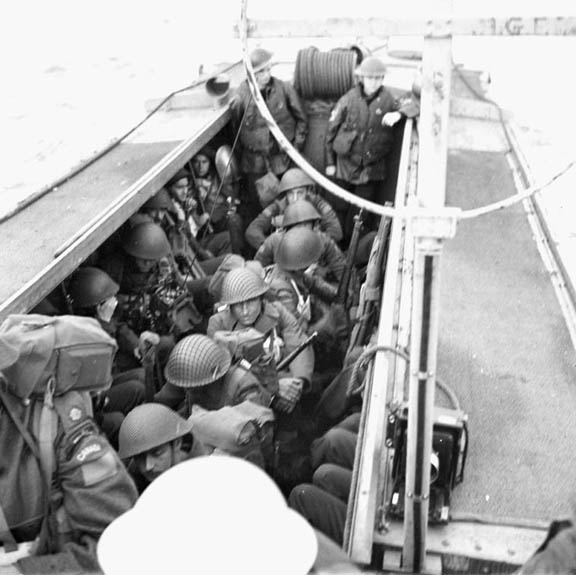
Infantrymen of Le Regiment de la Chaudiere alongside HMCS Prince David, off the coast of England, 9 May 1944.
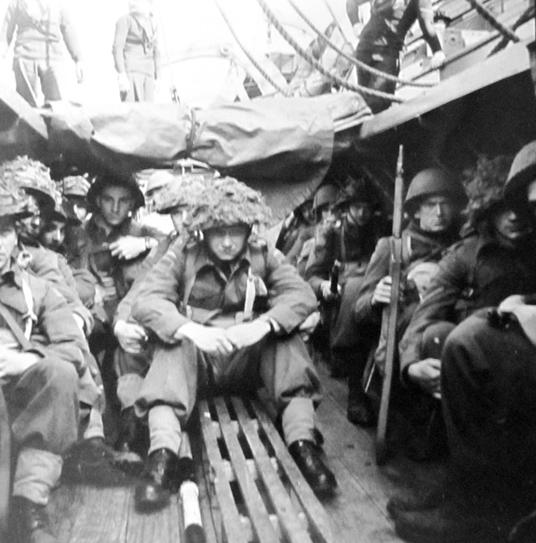
An indication of the cramped quarters that were an LCA. Here, Canadian troops take part in Exercise Fabious, 15 May 1944.
The Sicily Landings (Operation Husky, the invasion of Sicily in July 1943) was the first direct assault on the defended territory of an Axis homeland, and the most complex combined operations expedition yet. All together, 94 LCAs were employed in six of the seven landing areas. In addition, new craft and vehicles were used on some beaches in preference to LCAs.
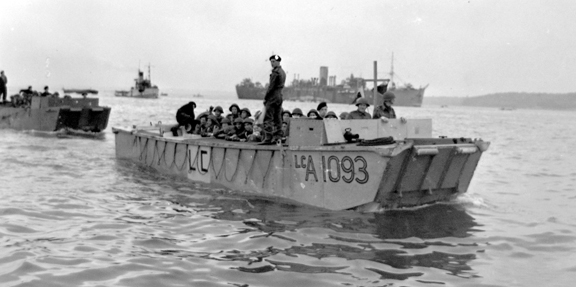
Final training exercise prior to D-Day. LAC PA197632
LCAs, along with many other types of landing craft, were employed on D-Day to land troops of the 3rd Canadian Infantry Division ashore at Juno Beach.
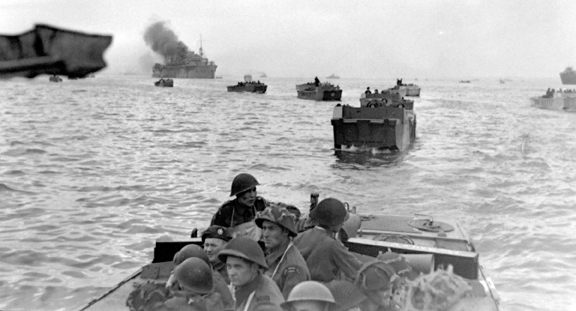
Royal Winnipeg Rifles running up to the beach on D-Day.
You can rate this article by clicking on the stars below
by Clive M. Law
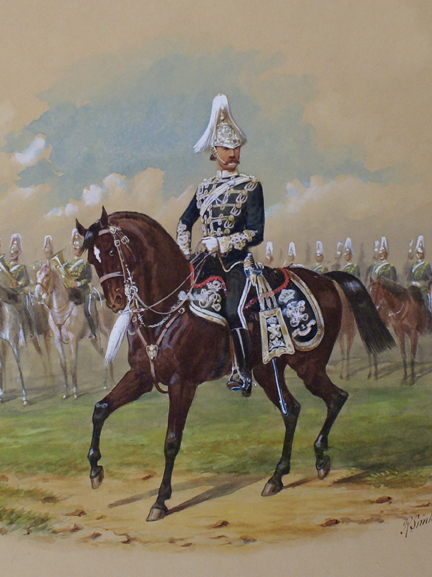
Note the highly detailed and colourful sabretache worn by this officer of the 2nd Cavalry Regiment. Anne S. K. Brown Library, Brown University, courtesy Rene Chartrand.
The sabretache is derived from a traditional Hungarian horseman’s flat leather bag called a tarsoly and was adopted by nearly all European armies.
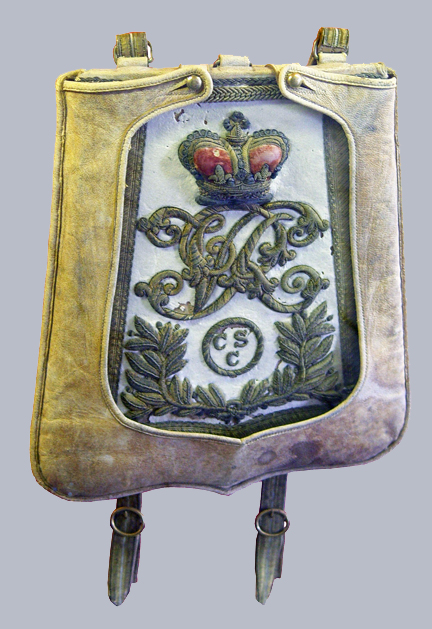
Cavalry School Corps, later the Royal Canadian Dragoons. Note the protective sheath. Courtesy Rene Chartrand
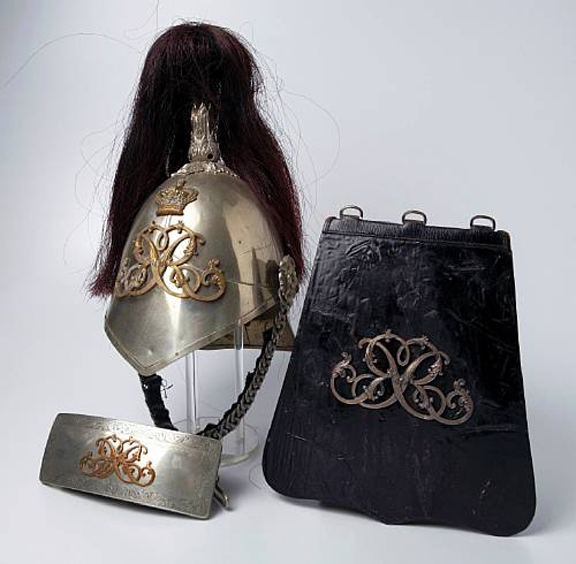
Helmet, cross-belt pouch and sabretache to Montreal’s Royal Guides, formerly in the Baraukus collection. Courtesy Bonham’s auction house
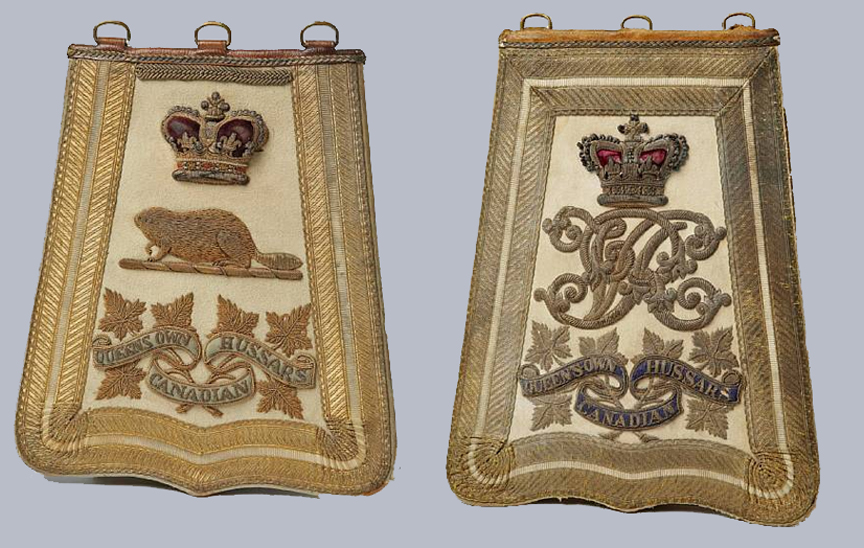
Variants on a theme – Queen’s Own Canadian Hussars. The lack of documentation makes it difficult to date variants. Courtesy Scott Duncan
In the early 18th century, hussar (light) cavalry became popular amongst the European powers, and the tarsoly was often a part of the accoutrements. By the 19th century, other types of cavalry, such as lancers, also wore them. The German name sabretache was adopted, tache meaning “pocket”. It fulfilled the function of a pocket, which was absent from the tight fitting uniform of the hussar. Part of the wartime function of the light cavalry was to deliver orders and dispatches and the sabertache was well suited to hold these. In its earliest form the sabretache’s large front flap was usually heavily embroidered with a royal cypher or regimental crest, and could be used as a firm surface for writing. In later years this style was set aside for full dress and a more utilitarian, “undress” sabretache was adopted for field use.
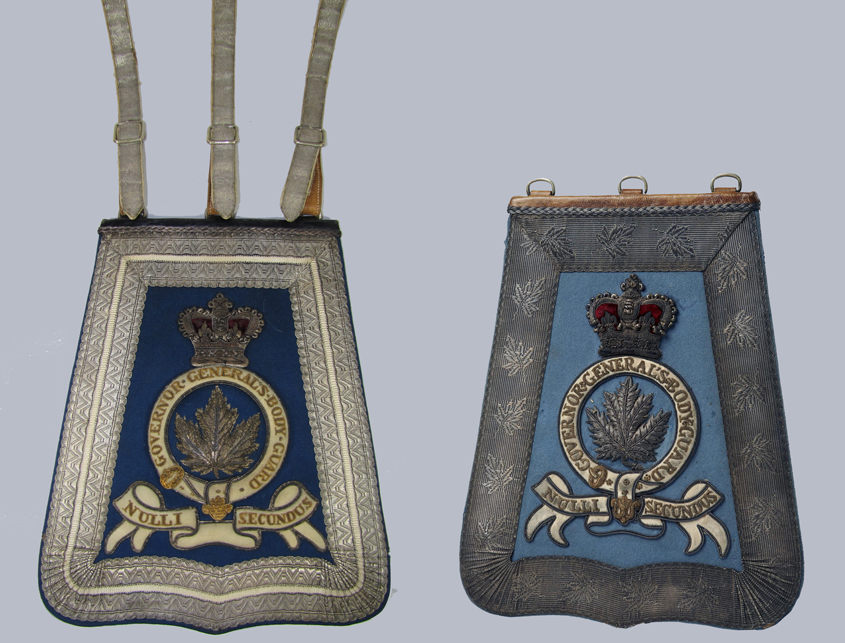
Variants to the Governor General’s Body Guards. Note the different lace styles. The Maple Leaf lace on the example on the right suggests 1870-1890. Courtesy Scott Duncan
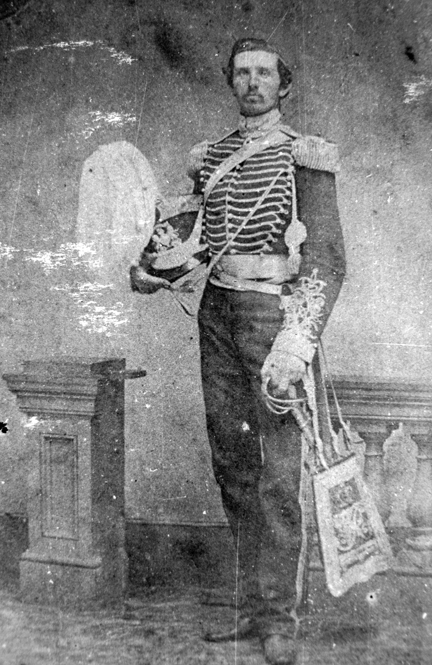
An officer of the Governor General’s Body Guards, Toronto. Note the attention to regulation in the length of the slings. Courtesy Scott Duncan
In the British Army, sabretaches were first adopted at the end of the 18th century by light dragoon regiments, four of which acquired “hussar” status in 1805. The Canadian cavalry adopted both Hussar and dragoon traditions and the hussar regiments naturally took to wearing the sabretache. Regulations for the Militia, published in 1887 describe its method of wear as:
“When mounted, the top of the sabretache is to be horizontal and in line with the bend of the knee. The same length of slings to be maintained when dismounted.”
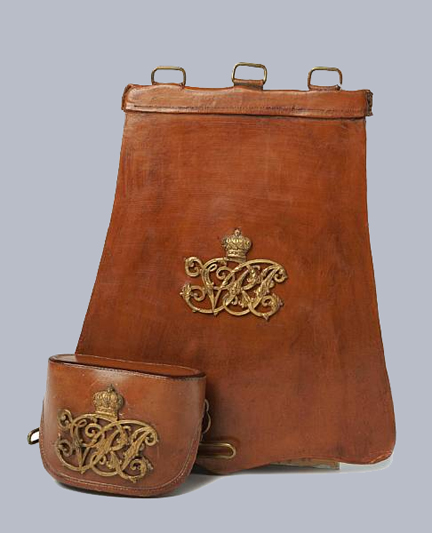
‘Undress’ version of the sabretache and cross-belt pouch to the Royal Canadian Dragoons, ca.1900. Courtesy Bonham’s auction house
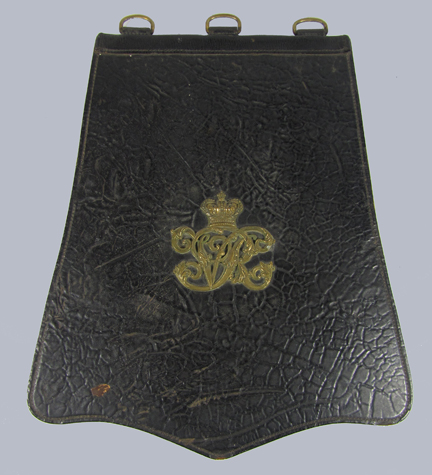
Another ‘undress’ pattern to an unidentified regiment.
The wear of this rather arcane item was abolished in the British Army in November 1901, and the Canadian Militia followed soon after. The name of this accoutrement lives on as the title of official newsletter of the Association of the 8th Canadian Hussars (Princess Louise’s) Inc.

As a para-military force patterned on the Cavalry, the North-West Mounted Police also adopted the sabretache, shown here in 1894. MilArt photo archives
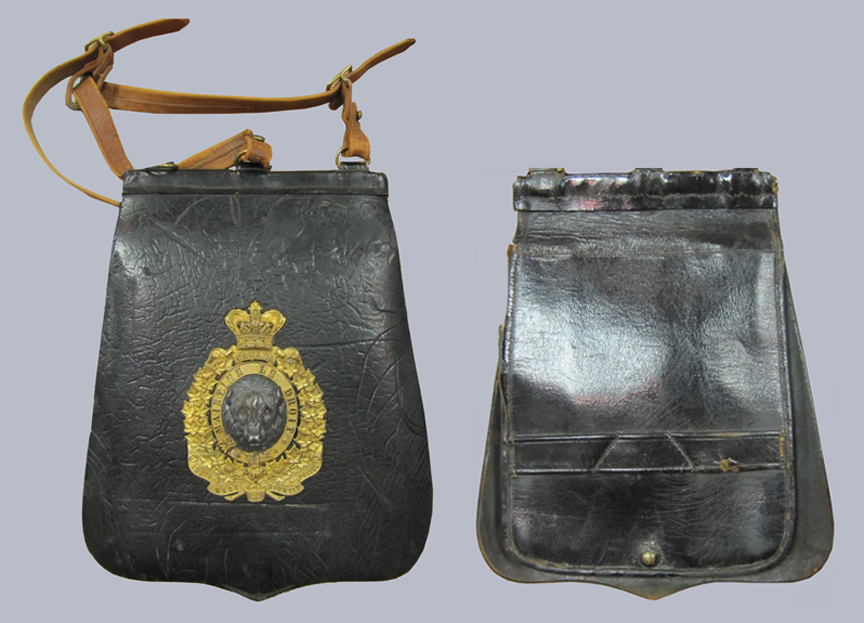
Obverse and reverse views of a NWMP sabretache, ca.1895. Courtesy Marway Militaria
You can rate this article by clicking on the stars below
© Bill Alexander 2014.
On August 4, 1914, with Britain’s declaration of war against Imperial Germany, the Dominion of Canada found itself automatically at war also. Immediately the Canadian government began mobilizing an overseas contingent. A wealthy Montreal merchant, manufacturer, and militia officer, Andrew Hamilton-Gault, offered to raise and equip an infantry battalion at his personal expense. To quickly field this unit the decision was made to recruit experienced soldiers and preference given to former British service personnel who had migrated to or were visiting Canada, and other suitable recruits, Canadian or colonial. Hamilton-Gault was granted permission to organize the battalion by the Canadian government and the unit was named the Princess Patricia’s Canadian Light Infantry in honour of the daughter of the Governor General of Canada. The task of organizing and commanding the battalion fell to Lt.-Col. F. Farquhar, formerly of the Coldstream Guards, assisted by the sponsor, Maj. A. Hamilton-Gault, who assumed the position of second in command. The call went out, and within days the P.P.C.L.I. was recruited to full strength.
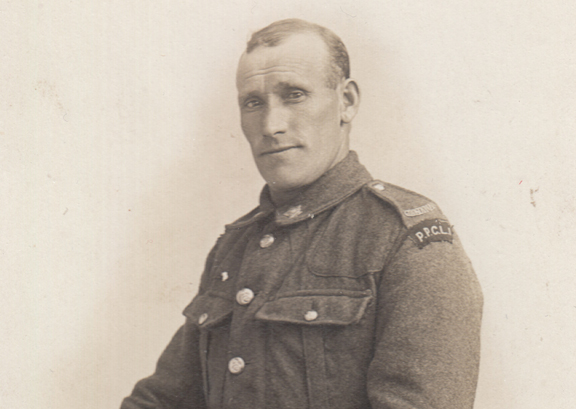
Note position of the title and the lack of a formation patch which dates this photo to pre-1916. Author’s collection.
Wishing to unify and instill regimental pride and esprit de corps in the new battalion, Lt.-Col. Farquhar and Maj. Hamilton-Gault sought ways to achieve these ends. Modelled on the Guards regiments of the British army, the PPCLI adopted many Guards practices. One distinction was the purchase of cloth shoulder titles, like those that had been worn early in the 1900’s by the Coldstream Guards.
The P.P.C.L.I. moved to Quebec City in September and prepared to embark for overseas. With the threat of German naval activity, the Royal Navy insisted that the P.P.C.L.I. proceed overseas in the convoy sailing with the first Canadian contingent. The P.P.C.L.I. encamped at Lévis, across from Quebec and waited for the Canadian contingent to be assembled.

A selection of First World War P.P.C.L.I. titles. Author’s collection. Copyright Bill Alexander

Reverse showing construction detail. Author’s collection. Copyright Bill Alexander
While at Quebec, the first cloth titles were acquired from the most unlikely of sources, the Sisters of Charity (The Grey Nuns). Hand embroidered by the Sisters, the first issue of titles for the battalion was constructed of white embroidery on a scarlet arc. Using the abbreviation of the unit’s name, the titles read P.P.C.L.I., with the colours reflecting those of the titles formerly worn by the imperial Coldstream Guards. Taken into wear while awaiting embarkation, the coloured flash on the drab service dress distinguished the unit from all the other Canadian battalions, and became a source of pride for the Regiment.[i]
Recruited from trained soldiers, the P.P.C.L.I. were ready to proceed to the front as part of the 27th Division, British Expeditionary Force, in early 1915. Under British command the battalion continued to wear the embroidered titles, which soon became a mark of distinction. In November of 1915, the P.P.C.L.I. was transferred to the 7th (Canadian) Infantry Brigade, part of the 3rd (Canadian) Division. The embroidered title remained in wear by the other ranks after the transfer; it was the only authorized embroidered battalion title in the Canadian Corps. In addition to the shoulder title, the P.P.C.L.I. wore their unique battalion patch for the 3 (Canadian) Division, the green semi-circle over the French gray rectangle. The white and red title continued in wear on the shoulder of the P.P.C.L.I. tunics through to the end of the war. In 1920, the Regiment was granted the dress distinction of wearing the embroidered title on their peacetime service dress.[ii]
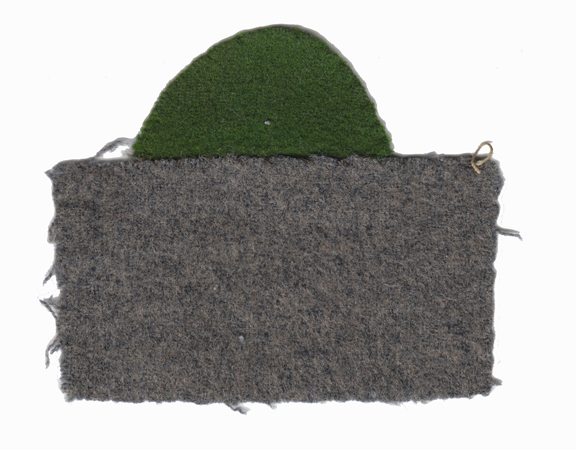
Distinguishing Patch. The traditional French Grey used by the P.P.C.L.I. has its origin in the colour of the divisional formation patch (also known as a Battle Patch) the official name of the colour was ‘bleu d’horizon’) and derives from the pantaloon colour of French soldiers. Author’s collection. Copyright Bill Alexander
Obtained from various makers, successive issues of the embroidered titles were acquired by the Regiment during the war. Typically, the titles were constructed on red or scarlet wool with various coloured backing material, usually a heavy weave white or buff coloured cotton with white or buff coloured embroidery. Documentation for the different issues has not been found; the First World War titles were typically embroidered in heavy cotton, showing heavy stitching on the reverse. The title shape varies from a pronounced upwards curve to being nearly flat. Similar construction was used until early in the Second World War, making it difficult to determine the date of titles. Private concerns, such as Gamages, Hemsleys, and other suppliers offered P.P.C.L.I. titles for sale. Of varying quality, these were available to any officer or soldier willing to spend a few pence. Machine embroidered titles replaced the heavy embroidery titles during the Second World War.
The P.P.C.L.I. claims the distinction of being the first British Empire battalion to wear embroidered shoulder titles in the First World War. Setting the precedent for other distinctive cloth shoulder titles, the Regiment earned well deserved honours on the field of battle. The white and scarlet title quickly identified them to friend and foe alike. The distinctive P.P.C.L.I. shoulder title continued in wear through the inter-war period, through the Second World War, Korea and up to unification. Made redundant by Canadian Forces uniform policy in 1968, it was reinstated for a period of time before it was finally withdrawn from wear on the Army’s green Distinctive Environment Uniform (DEU). In 2013, to celebrate the 100th Anniversary of the Regiment, the P.P.C.L.I. was granted the privilege of wearing their embroidered title on the DEU uniform until 2015.
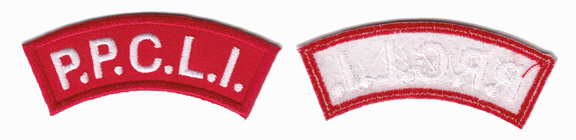
Modern issue title authorised for wear between 2013 and 2015. Author’s collection. Copyright Bill Alexander
[i] The P.P.C.L.I. claim to be the first regiment to wear embroidered titles in the British Empire. This may be true during the First World War, but embroidered titles were adopted for the British khaki service dress uniform introduced in 1902. The Army Clothing factory records, WO359 – War Office: Army Clothing Department – Register of Changes, show that “Titles, Embroidered, Foot Guards” in white on scarlet were approved on 30th April 1903. They proved expensive and difficult to manufacture and were abolished for the British Regular army at the end of 1907. Some British regiments, including the Guards, took embroidered titles into wear again during the First World War. Lt.-Col. Farquhar, a former Guards officer, drew upon his experience with the 1903 titles as the precedent for the P.P.C.L.I. Photographic evidence shows the titles in wear at Lévis in September of 1914.
[ii] The post-war dress distinction was authorized for other ranks. It appears officers wore the metal titles on their service dress during the inter-war period. In 1948, the P.P.C.L.I. was authorized to wear a grey backing behind their badges in recognition of their service in 3 Division, Canadian Corps.
You can rate this article by clicking on the stars below
The article’s author is currently working on a complete study of shoulder titles worn by the Canadian Army.
by Roger V. Lucy
In late 1942, the workshop at No.1 Proving Ground in Ottawa initiated the idea of improving the traction of the Ford 6×4 truck by converting it to a 6×6, with a self-locking differential on the rear bogie. The idea was formalized at the Army Technical Development Board (ATDB) as Project 48 in December 1942, and assigned to the Department of National Defence’s Directorate of Mechanization (DMech). Its aim was to produce a low-silhouette, high-mobility, lightly-armoured 6×6 vehicle for use as an armoured personnel carrier, ammunition carrier or a self-propelled mount for light anti-aircraft guns, anti-tank guns, field artillery, or mortars. Three pilots were authorized, one for each role. Another possible role considered was as the chassis for a medium armoured car.

The first vehicle, shown here with a cargo holder attached to the front bumper. MilArt photo archives
Three obsolete 6×4 Ford trailing-axle chassis were selected for conversion, one as an unarmoured 4×6, and the other two as armoured 6×6 vehicles. Thornton 4-wheel rear bogies, with self-locking differentials, were fitted. This US-made bogie gave the wheels a high degree of movement when traveling over broken ground.
The locked differential greatly improved traction, by ensuring all four wheels were powered, at all times. In addition, greater gear reduction was provided and heavier shock absorbers, adapted from the Ford Scout car. The clutch, transmission, and 95 HP, 239 cubic inch (4 litre) engine of the Ford Field Artillery Tractor were fitted in the prototypes, but the eventual use of a larger engine and tires was contemplated. The frame was redesigned so the driver and his mate were seated on each side of it, with their heads just above the engine cowling, allowing the gun mounting to be placed as low as possible in the vehicle. The wheelbase was 131 inches (3.3 metres), and overall dimensions were 211 inches (l) x 82 inches  x 55 inches (h) (5.25 metres x 2.05 metres x 1.4 metres). Ground clearance was 20 inches (50cm). The maximum weight of the two armoured prototypes was 16,000 lbs (7230 kg).

This is the second vehicle built and one of two sent overseas for testing. Here it takes part in trials to find a suitable tractor for the 6-pdr anti-tank gun. Here it is shown negotiating the long ascent – a trial segment it ultimately failed. MilArt photo archives

The 6×6 was also used as a trial tower for the trails of the 25-pdr MARS gun. See article. MilArt photo archives
The 6×6 could attain a top speed of 60 mph (100 km/h), or 50 mph (80 km/h) when towing a 6-pounder anti-tank gun. The Canadian distributor for Thornton bogies, H.V. Welles of Windsor, Ontario, carried out the conversions. One of the completed 6×6 prototypes was sent to the John Inglis plant for trials as an SP mount for the Quad 20 mm; the other underwent extensive road trials at Ottawa’s No.1 Proving Ground. Canadian views of the vehicles’ purpose were decidedly mixed. The Deputy Master General of the Ordnance and DMech saw them as test beds only. They did not consider that their mass production would be feasible in Canada. (The bogies were made in the USA, which had its own demands on them, and the Canadian automotive industry had little enthusiasm for self locking differentials). H.R. Crang, of the ATDB, was, however, a keen advocate. While visiting the UK in early 1943, he tried hard to persuade Canadian Military Headquarters (CMHQ) and the War Office to let the vehicles undergo trials in the UK. In March 1943, DMech reported that the vehicles had met all expectations, both as a General Purpose Light Armoured Vehicle and as a 20 mm SP. In July the Army Engineering Design Board (AEDB) concluded, at the end of the trials at No.1 Proving Ground, that they did not offer sufficient advantage over other vehicles to merit further development as a gun tractor and that the GMC 6×6 would better fit this role.

Although lower the 6×6 provided sufficient
space for the 6-pounder gun crew. MilArt photo archives
In April, on the basis of Crang’s recommendation, CMHQ requested that the vehicles be sent, without delay, for evaluation in the UK, as the British were very interested in 6×6 vehicles. In August, following the completion of their Canadian trials, the two 6×6 vehicles were returned to H.V. Welles for refurbishing, before being sent overseas. They arrived in the UK at the end of October. During Christmas week, 1943, one of the prototypes was tested, along with a number of wheeled and tracked vehicles, in trials to select a 6-pounder tower. These revealed the strengths and weakness of the 6×6. Its 14mm of armour provided good splinter protection, and its low silhouette gave good concealibility. Unlike several vehicles tested, it could carry the entire six-man gun detachment in relative comfort, as well as 72 rounds of ammunition (although, it was recommended that six ammunition racks be removed to allow all the crew to stow their kit). It was also the fastest vehicle tested, but – despite being able to pull the gun up a 50% grade with power to spare – its cross-country performance was deemed inadequate. It got stuck on the hummock test (and lacked a winch to extract itself ), and on the long hill test, where it stalled one quarter the way up a 1 in 7 slope. The two-foot (60cm) fording depth was deemed inadequate, and while it was easy to steer, the very low steering ration gave it a huge 72-foot (21 metre) turning circle. Other criticisms were that its design it did not allow for easy maintenance; access to the engine was poor to impossible, while the grease nipples on the suspension were completely inaccessible. In January 1944, the 6×6 was deemed completely unsatisfactory as a tower (rather unfairly, when compared to the other wheeled vehicles in the trials). The final blow appeared to be the change, in February 1944, to 21st Army Group’s requirements for 20 mm guns. Lacking any apparent requirement, the 6×6 project was declared complete by the ATDB on 14 March 1944.
The project took on a new lease of life in the summer of 1944. In April the 6×6 had been tested again by the Wheeled Vehicle Experimental Establishment (WVEE) at Farnborough, and compared to a 6×6 Studebaker truck. The Canadian vehicle’s cross-country performance, ability to handle mud, and 12-ton tractive effort compared very favourably to the Studebaker’s. Although its tires were deemed too small, the single-tired rear bogy performed better than the Studebaker’s double tires, and the 6×6 had very good ground clearance. WVEE recommended that a more powerful engine and a self-locking differential for the front wheels be installed. At about the same time, the USA advised the War Office that it was ending production of the M5E1 half-track, the chosen prime mover for the 17-pounder anti-tank gun. The War Office’s own gun tractor design, the Bedford Traclat – a half-track prime-mover based on the German Sd.Kfz 7 – would not be coming into production before late1946. An interim armoured gun tower was, therefore, required. In July the War Office asked DND to develop a new 6×6 prototype, incorporating the WVEE’s proposed modifications: a larger engine (the Chevrolet 140hp was under consideration), heavier clutch, improvements to the steering, and larger tires.

6-pdr towing trials. MilArt photo archives

Subsequently, the British suggested a number of other changes to the design: a 144 inch (3.6 metre) wheel base, a 12 foot (3.6 metre) body, and a tractive effort at least equivalent to the 10 ton 100hp Albion 6×6 artillery tractor. The vehicle was to be able to carry a two tonne payload, and almost 1,700 lbs (775 kg) of armour (10mm front, 6mm at the sides). DND estimated that it would take six months to convert the Canadian design, and 18 more to put it into production. The Directorate of Vehicles and Small Arms (DVSA) was instructed to determine if the Canadian auto industry could take on this project, and if so, when it could be completed. In November DND decided to base their design on GMC’s 3-ton, 145-inch wheelbase, 6×6. The AEDB estimated an unarmoured prototype would be ready by late January 1945, and the vehicle could go into production eight months later. By this time, the Ministry of Supply was beginning to look ahead to postwar requirements. In light of differences between North American and UK vehicle and manufacturing standards, British policy was moving toward sourcing post-war vehicles, as far as possible, domestically. In the end, Canada proceeded on its own with a new (and long-term) project, No. 908, approved by the ATDB in April 1945, to develop a 6×6 Interim Artillery Tractor. One version was to be an armoured tower for the 17-pounder.
Under McNaughton, the CAO had been looking at mobile anti-aircraft defence since the summer of 1941. Two Oerlikons were borrowed from the Admiralty to investigate mounting on an armoured chassis. In November, a British firm, Stohert & Pitt of Bath, was given a contract to develop a mock-up turret. Consideration was also given to mounting the guns on a Loyd Carrier chassis. This work seems to have been taken over by the British Ministry of Supply’s Directorate of Tank Design (DTD) eventually resulting in the Crusader AA tank. While the protection of armoured columns “under all conditions” could only be met by using a fully tracked vehicle, protecting road convoys required a wheeled vehicle that could keep pace with road traffic. In Canada – with development of the Inglis 20 mm now underway – the design of such mobile mountings came under consideration. On 4 December 1942, the AEDB approved Projects 41 and 42 to develop respectively quad and twin mounted 20 mm guns on a wheeled chassis. Responsibility was assigned to DVSA and DArty with assistance from the AEDB. The Armstrong Wood and John Inglis companies of Toronto provided commercial input.

The third, and last, vehicle built in the series. This one was built as a SP mount to
transport the Inglis 20 mm Quad AA gun. Canadian Army policy on the types of AA guns deemed acceptable for overseas use saw this gun. MilArt photo archives
become redundant and the vehicle found itself without a cause. MilArt photo archives


General Service (GS) specifications drawn up on 19 December 1942, called for a vehicle, which offered a stable platform for the operation of quadruple or twin 20 mm guns. These were to be installed in a Canadian-designed or other suitable gun mount. The vehicle should have sufficient speed and cross country performance to operate with armoured formations. Armour protection would be confined to protecting the driver and co-driver. Armour was confined to that integral to the Inglis mountings. No predictor equipment was required; nor were out-riggers unless they proved necessary to provide stability; 500 rounds per gun was required, ready for instant use and a No.19 wireless set would be fitted. Project 42, the twin mount, was cancelled in February 1943, after CMHQ advised the MGO that “the superiority of the Quad Mount as developed by the John Inglis Company, over any two gun mount was so great that no further consideration was given the twin.” A pilot quad 20 mm vehicle with an unarmoured cab, aeroplane shock absorbers and a ring for the mount was ready by 20 March 1943. Further work was held in abeyance as CMHQ wanted to test the Inglis quad mount in the UK before a decision on the SP was made.
In August 1943, successful road trials were held using one of the high mobility 6×6 chassis, the quad mount and ‘drill purpose’ guns. The trials included a 650 mile (1,030 km.) road test and 100 miles at 30 mph (50 km/h) on the Ottawa No.1 Proving Ground’s test track. On 22 August, firing trials were held with the guns mounted on a GMC 6×6 at the Inspection Board’s small arms test range at Long Branch. Firing tests, broadside and to the rear, firing 10 rounds per gun simultaneously, showed minimal movement in any direction. Dispersion of the rounds on the target (at a range of 1,000 yards -900 metres) was 18 inches (45 cm) and the gunner noted very little vibration to the sight.
Reports on these trials were forwarded to the UK, but, despite several reminders, no response was received until 18 February 1944, when CMHQ advised DND of 21st Army Group’s Oerlikon only policy. The vehicle was eventually demonstrated in the UK in May 1944. The British Army was not impressed by it; however, the RAF showed some interest.
On 14 March 1944, the ATDB declared the project to be completed. Canada did, however, mount 250 Quad Polsten guns on the Ford 132-inch wheelbase, 3-ton, 4×4 truck. Sixty were sold to the UK and, in early 1945, 72 were shipped to First Canadian Army, in line with a revised 21 Army Group policy that replaced two 40 mm troops in each light anti-aircraft regiment with 20 mm SP mounts. By the time the vehicles were delivered to the units, the war was virtually over.
You can rate this article by clicking on the stars below
For more information on the Canadian experimental projects order “Secret Weapons of the Canadian Army” from Service Publications
by Roger V. Lucy
Canada used the same suite of 2-inch, three inch and 4.2 inch mortars in the Second World War as the United Kingdom. In addition to a number of project to extend the range or lighten existing equipment, an effort was also made to develop a 120mm mortar based on a Finnish design.
Extended range 3-inch mortar
Canada, like other Commonwealth countries, adopted and put into production the British 3-inch (actually 80mm) mortar. Weighing a total of 126 lb.(57 kg) in action, it fired a 10 lb.(4.5 kg) bomb to a range of 2,800 yards (2,500 metres). It was widely believed by Allied troops that the Germans possessed mortars in greater quantity and with a longer range than their own. This was, in fact, not the case, the Germans simply made very effective and aggressive use of their mortars.. In 1942, in response to a report that the Germans were developing a long-range 81mm mortar, the Commander of the Canadian Army Overseas (CAOS), Lt.General McNaughton directed the Master General of Ordnance (MGO) to develop a 3-inch mortar capable of firing the standard bomb to a range of 4,500 yards (4,000 metres). The MGO brought the matter before the the Army Technical Development Board (ATDB), on 29 May, 1942. At first, it was decided to defer consideration of the project, pending receipt of a sample of an Italian 81mm mortar which was credited with such a range (the Italian Mod.35 could indeed achieve a range of 4,000 metres). On 16 June, with no example of the Italian mortar forthcoming, the ATDB approved project No.9 to develop a long range mortar. The project was assigned to Directorate of Artillery (DArty) with assistance from the Department of Munitions and Supply (DM&S0’ Army Engineering Design Branch (AEDB). [1]
As it was considered undesirable to reduce the weight of the bomb (the Italian solution), the best way to extend the range was to boost the muzzle velocity to 800 f/s (240 m/s) seemed to be by using a longer barrel. A design was prepared by 12 October. It comprised a standard 3-inch mortar with a reinforced base-plate and a 3 foot (90cm) barrel extension attached by interrupted lug locks. Preliminary tests, using a standard bomb with a 1,500 grain charge, achieved a range of 4,700 yards (4,200 metres).

A 3-inch mortar with a barrel extension, compared to regular mortar.

Fitting the barrel extension to a modified 3-inch mortar.
The total length of the barrel (6 feet 6 inches – 195cm) was, however, deemed excessive, and likely to expose the crew to enemy fire when loading the weapon. Lt.General McNaughton also requested that the barrel extension be detachable, so it need only be deployed when long-range targets were engaged. A removable 2 foot 6 inch (45cm) extension was therefore devised. Even so, the equipment weighed an additional 331/4 lbs. (15 kg), a feature not likely to endear it to the users.
Twelve 3-inch mortars with the detachable 2 feet 6 inch barrel extensions were produced and examples sent to the UK in May 1943. They were tested at Shoeburyness on 3 and 4 July. The tests were not successful, as the British used the standard, not the reinforced base-plates. Further tests with proper base-plates were carried out at Petawawa on 17 and 18 July. An impressive range of 5,160 yards (4,600 metres) was attained, but accuracy proved to be very disappointing – at a range of 4,600 yards (4,200 metres) 50% of the rounds fell within a zone 651 yards long x 45 yards wide (600×41 metres). The barrel and extension stood up to the stress, but after prolonged fire the welds in the base-plate showed signs of cracking. It also proved difficult to remove the barrel extension after prolonged fire.

A comparison of a reinforced base plate of a 3-inch Mortar Mk.II with that of an Italian 81-mm Stokes Brandt mortar taken in August 1943.
The British had had similar experiences in experimenting with an 18 inch (45cm) barrel extension, while other solutions, such as reinforcing the barrel and baseplate to take a higher propellant charge also posed unacceptable weight penalties. In September 1943, the British Board of Ordnance stated it would not accept any designs which significantly increased the weapon’s weight or barrel length. Board of Ordnance research also revealed the bombs became unstable as their muzzle velocity passed 700 f/s (210 m/s). The Board also questioned the utility of being able to send a relatively light projectile to such range, given the problems it posed in spotting the bombs’ impact. In November 1943, DND’s Directorate of Vehicles and Small Arms (DVSA) made enquiries about the USA’s success with a barrel extension device for their 81mm mortar (which saw some limited use in the Pacific theatre). The USA overcame the stability problem by fitting an extension to the bomb’s tail, and using a slower-burning propellant to create a higher pressure. DVSA wished to have the National Research Council (NRC) do research into this to determine the optimal tail length, however, in March 1944, the ATDB agreed that the project be terminated – the mortar’s poor accuracy and increased weight were unacceptable. After the War, the Canadian Armament Research and Development Establishment – CARDE) [2] undertook some trials using various barrel lengths to determine if there was a correlation between mortar barrel length and range and accuracy. These were completed in 1948, and found while it had little effect on accuracy, there was a marked correlation between barrel length and range.
120mm Mortar
In late October 1941, Lt.General McNaughton sent the London representative of the Department of Munitions and Supplies (DM&S) copies of drawings of the Finnish Tempella 120mm mortar (m/40), which was based on a French Brandt design. In his covering note, McNaughton noted that, as the War progressed, there would be a need to develop new or improved weapons and that to a large extent this would be the responsibility of DM&S new Army Engineering Design Branch (AEDB). He suggested that there could be no better project for the AEDB to get started on than the development of a Canadian version of the 120mm mortar. McNaughton envisaged a weapon capable of firing both chemical and HE rounds, with a range of 7,500 yards (6,700 metres). Its proposed roles would include: increasing the firepower of Chemical Weapons Companies and Brigade Heavy Support Companies; thickening artillery shoots; relieving the artillery of saturation tasks with HE, smoke or CW rounds; and providing a Brigade-level mobile fire power reserve.
On 10 January, 1941, DM&S advised the MGO of McNaughton’s wishes. On 29 May 1942, the project was considered by the ATDB, which approved it as Project 10, assigning it to DVSA. A contract to produce six pilot mortars was given to Dominion Engineering of Longueil Quebec, while DM&S was responsible for developing the rounds (a French Stokes-Brandt mortar bomb was used as the model). An initial 100 weighted rounds were ordered for range and accuracy (R&A) trials, to be followed, once the bomb design was proved, by an additional 500 rounds per mortar. Modified 3-inch mortar sights were used. The original two wheel trailer used with the Tampella mortar was adapted to motorized towing.
In May 1943, the War Office expressed some doubt about whether there was a requirement for this equipment. CMHQ justified the project’s continuation in light of intelligence reports that the Germans had reverse engineered the Soviet 120mm mortar, were issuing them on a generous scale, and making very effective use of them.
The pilot mortars were completed by 24 November, 1942. On 16 December, four were shipped to the UK. The ammunition took longer to produce and was not available until March 1943. Trials took place in Shoeburyness in the UK in June, and at Petawawa, in July. The mortars themselves performed very well and showed no signs of bulging, nor was there damage to the baseplates. The bombs’ performance, however, was disappointing. The propellant tended to swell in damp conditions and had to be sanded to allow the bomb to slide down the muzzle. The tail design was a major weak point, frequently detaching (sometimes while still in the mortar). Worse still accuracy was poor, with a very disappointing 50% zone.

A front view of the Canadian 120mm mortar.
Wind-tunnel tests at the NRC indicated that a six rather than twelve-finned tail might reduce the tendency of the bombs to yaw in flight. This was tried, but tests in December 1943, showed they remained very prone to fracture. At the same time, steps were being taken to develop a self- loading device, based on preliminary sketches developed by Lt.General McNaughton on 29 June, 1943. As well as seeking to alleviate crew-fatigue, McNaughton was concerned about the exposure of the loader when operating the mortar at high angles. It was hoped a rate of fire of 30 rounds per minute unaimed, or 10 rpm aimed could be achieved. (Crews of the manually-loaded German GW42 could sustain an aimed rate of fire of 8-10 rounds per minute).
In April 1944, the project was transferred from DVSA to DArty. In June, bombs with welded tails were fired at Valcartier. A m/v of 1060 f/s (310 m/s) was attained, with satisfactory stability. In July the designs for the propellant and exploders were finalized and approved. International Flare and Signal of Waterloo, Ontario was contracted to produce 100 bombs, which were shipped to Suffield Alberta for trials. These took place in the first week of October 1944. While there were clear improvements in performance, the overall results were still disappointing. Some 121/2% of the bombs still became unstable due to tail defects. The rate of fire was deemed to be too low, due to the bomb weight; fouling caused the firing pins to wear out very rapidly (the tubes had to be cleaned and the pins replaced every 10 rounds); and – due to excessive clearance between the driving band and the mortar tube – there was poor obturation While fixes were identified for these problems, the ATDB proposed scraping the project, deeming it obsolescent.

A rear view of the Canadian 120mm mortar.
Nonetheless work did continue. In February 1945, DArty tried to get an example of the Russian M38 120mm mortar, to see why it worked so well, while the Canadian version did not. The US War Department refused the loan – policy precluded lending one country’s equipment to a third country – but Canadian experts were allowed to go to Aberdeen Proving Ground to examine a specimen and take measurements. It was noted that barrels of the Russian mortar and its German imitator were some 10cm shorter, and had a m/v some 100 f/s (30 m/s) less. This likely helped improve accuracy, albeit at the expense of range (6,500 vs. 7,500 yards). They determined that while the M38 bomb was based on the same Brandt design, poor placement of the charges and faulty manufacturing had contributed to the weakness of the Canadian mortar.
On 7 May 1945, the ATDB approved project 88, a proposal by DArty to develop a “fish-tailed” bomb for the 120mm mortar. In this radical redesign, the fins were machined in one piece with the body and extended halfway up. It was hoped they would be less prone to fracture and excessive yaw. By fitting an expanding gas check and minimizing contact between the tail and the mortar tube, it was also hoped to improve obturation and reduce friction drag. The design was completed on 8 June and in July Dominion Engineering of Montreal received a contract to produce 20 pilot bombs. These were completed in September and sent for trials at Valcartier, and later at Suffield. Tests continued under under the aegis of CARDE until November 1946. These trials concluded that, while less prone to tail fractures, the fish-tailed bombs offered little advantage in terms of range or accuracy, over the conventional design. In response to DAD’s query of 24 July, 1947 whether there had been any further tests, CARDE responded, that there had been none and recommended that the project be dropped. Thus, after the completion of six equipments and 700 bombs, the Canadian 120mm mortar was allowed to pass into oblivion. The failure of this project – based on existing designs – stands in stark contrast to the Germans’ success in rapidly reverse engineering and modifying the Russian M38 120mm mortar, and fielding the first examples of their highly successful Granatenwerfer 42 by late 1942.

The “fish-tailed”120mm mortar bomb, which unsuccessfully tried to correct the ammunition shortcomings of the Canadian 120mm mortar.
Specifications – 120mm “Finnish Mortar”
| weight over all | 1056 lbs. (480 kg) |
| weight in action | 617 lbs. (280 kg) |
| barrel length | 78 3/4 inches (1.96 metres) |
| ammunition | heat treated steel shell with mild steel tail, weight 39 lbs. (17.7 kg) less chargesHE (50/50 amatol), CW and WP smoke rounds proposed. |
| rate of fire | 6 rpm |
| muzzle velocity | up to 1020 f/s (306 m/s) with 3oz ballistite primary, 20 oz secondary |
| range | 7,500 yards (6,750 metres) |
| weight shell | 25 (11.3 kg) |
| transport | detachable 450 lb.(200 kg) two wheeled carriage and towing attachment, “highly mobile behind a jeep” |
Other mortar projects
While efforts to develope a 120mm mortar and to extend the range of the 3-inch mortar went nowhere, other R&D effort went into lightening existing equipment. In response to a December 1943 War Office request for a lighter baseplate for the 3-inch mortar than the standard 37 lbs.(16.8 kg)version, the ATDB approved project 67 on 14 March, 1944. It was assigned to DVSA, which developed two designs. One, a three-footed high tensile steel base-plate with lightening holes, weighed only 25 lbs. (11.4 kg). The other, made of magnesium alloy, was trapezoidal in form and weighed 26 lbs.(12 kg). An aluminium alloy version was also investigated. After tests at Long Branch, which revealed problems with the welds in the steel base-plates, the final versions of the prototypes were completed in May 1944. After successful tests at the Canadian Small Arms School, samples were sent to the UK, USA and Australia for trials. The magnesium base plate performed particularly well on loose soil and gravel. Unfortunately it fractured after three to rounds in British Board of Ordnance tests – which used the Mk. IV barrel – the Canadian version had been designed around the Mk.III. The steel baseplate, while commended for its lightness, was deemed unsatisfactory for its lack of stability. After redesign work more pilots of both the steel and magnesium plates were produced and shipped to the UK. Trials by the Board of Ordnance continued to the end of 1945. In August, cancellation of further work on the magnesium plate was recommended due to the end of hostilities and its failure when fired on concrete. The steel plates also failed the Board of Ordnance trials and the project was formally terminated by the ATDB on 28 January, 1946. Work was also undertaken, as part of the project, on a lightened bipod made of magnesium alloy.

Lightened base-plate for a 3-inch mortar, socket side up, June 1944.

Lightened base-plate for a 3-inch mortar, under-side, June 1944.

Lightened base-plate for a 3-inch mortar, side view, June 1944.

A design for a lightweight 3-inch mortar base-plate made from high tensile steel.
Canada did, however, continue to work on a longer term project (No.68 approved on 11 July, 1944) to redesign the 3-inch mortar to increase its range and accuracy. One problem with mortars, which are smooth-bore muzzle-loading weapons, was achieving the right degree of clearance between the tube and the bomb. If too tight, an air cushion is created, which slowed the bomb’s descent down the tube and making it impossible to fire without a trigger mechanism. If too loose, the mortar’s poor obturation and the resulting windage reduced the range and accuracy of the projectile. In April 1944, DArty proposed a 3-inch mortar with a tapered barrel, designed so that its internal diameter swelled from 3.185 inches (79.6mm) for the first 12 inches (30 cm) below the muzzle to 3.207 inches (80.2mm) at the breech. This eliminated the air cushion and improved obturation, thereby reducing windage and increasing the stability and range of the bomb. By fabricating the mortar from high tensile steel – to take a heavier charge – and adding 2 inches to its length, it was estimated the range could be increased to 3,500 yards (3,200 metres). However, on the advice of the Inspection Board, which reminded DArty that increased muzzle velocity degraded accuracy, the project focused on reducing weight and improving accuracy.
Following the successful testing of two mild steel barrels, the ATDB authorized the construction of two high tensile steel pilot models, weighing only 28 lbs. (22 kg) compared to the 44 lb. (20 kg) barrel of the 3-inch Mk.IV mortar. In January 1945, three more prototypes – modified to reflect the earlier trials – were ordered. Two were sent to the USA, one for tests by the US War Department, the other for tests by Australia. Trials in March 1945 showed this design offered a 25% reduction in overall weight, a 10% improvement in accuracy and a 15% increase in strength. Five more barrels were ordered. Trials in April, firing 58 rounds to 2,900 yards (2,600 metres) showed dispersion similar to the standard 3-inch mortar. The Australian trials, in May 1945, also showed a significant increase in accuracy. The project was deemed a long term one (to be continued after the end of the War) and trials were still going on when the ATDB was disbanded at the end of 1946.

A drawing showing the barrel of a tapered barrel mortar.
Work on the tapered bore mortar continued into the late 1940s, including arctic trials at Churchill, Manitoba, in the winter of 1948/49. While liked for its ease of mounting and operation, further design changes were recommended to improve performance. Despite the design’s promise, there does not seem to have been any further development. One reason may have been CARDE’s opinion that, notwithstanding improvements in accuracy and ease of loading, mass production of a mortar tube with an internal taper would be difficult. Postwar efforts in mortar development- concentrated instead on achieving greater ranges using finer tolerances in the design and manufacture of the bombs.
Work was also done, from 1945 to late 1946 on a “drag-tail” 3-inch bomb. Such a design would permit better placement for the secondary charges, reducing damage to them when loading, and allowing longer ranges – up to 4,000 yards (3,600 metres). The bombs however, became unstable when used with No.9 and 10 super-charges, and the tails showed a tendency to fall off.
Work was also initiated on a lightened baseplate for the 4.2-inch(105mm) mortar, using high tensile steel. Project 81 was approved on 14 December, 1944. By January 1945, three prototype baseplates had been produced, weighing 82 lbs. (41 kg) – 40 lbs. (18 kg) less than the issue baseplate. Trialed in February, stability was very good; the lighter plates did not sink into the ground as readily as standard plates and were easier to unbed. There was one problem – when fired at high angles and extreme traverse – the plate fouled the bipod legs.
Extended firing tests at Borden in April 1945, however, revealed distortion to the revolving cup on the baseplate. In May, four modified pilots were ordered, but by September the ATDB decided that, with funds for the project now exhausted, it was not desirable to seek funding for further development. The Project was finally terminated by the ATDB on 28 January 1946 after the baseplates failed during Board of Ordnance tests in the UK. The Directorate of Armaments Design did, however, undertake further investigation into lightweight baseplates into the 1950s
Bibliography
Library and Archives Canada, RG24, Series C‑1, Reel C‑5170, file: 8236‑9‑189, Directorate of Artillery Trials ‑ Design of 120 millimetre Mortar Bomb;
Reel C‑8275, file: 3345‑3, Experimental base plate for 4.2 inch mortar;
Reel C‑8360, file: 8236‑9‑123, Directorate of Artillery trials ‑ Trial No. 123 ‑ Study of experimental taper barrels, 3 inch mortar;
File: 3345‑7 Army ‑ Design lightweight bipod 3 inch mortar
Reel C‑8386, file: 8928‑11‑9, Army Technical Development Board ‑ Project No. 9 ‑ 3 inch mortar shell ‑ Increased rangeFile: 8928‑11‑10‑2 Army Technical Development Board ‑ Project No. 10 ‑ 120 millimetre mortar
Reel C‑8388, file: 8928‑11‑67 Army Technical Development Board ‑ Project No. 67 ‑ Light base plates for 3 inch mortar
File: 8928‑11‑68, Army Technical Development Board ‑ Project No. 68 ‑ Taper barrel ‑ 3 inch mortar
Reel C‑8389, file: 8928‑11‑81 Army Technical Development Board ‑ Project No. 81 ‑ Lightweight base plate for 4.2 inch mortar
File: 8928‑11‑84 , Army Technical Development Board ‑ Project No. 84 ‑ Drag tail 3 inch mortar bomb Reel C‑8389 File: 8928‑11‑88 Army Technical Development Board ‑ Project No. 88 ‑ Fishtail bomb ‑ 120 millimetre mortar
DND Directorate of History and Heritage files in the 115. 41013 series on ATDB Projects 9, 10. 67. 68, 81, 84, 88
Notes
[1] For more information on the role of these organizations in R&D, and how the ATDB in funded the development of new equipment see Secret Weapons of the Canadian Army, Service Publications 2006.
[2] CARDE amalgamated a number of military R&D facilities at Valcartier in early 1945.
You can rate this article by clicking on the stars below
For more information on the Canadian experimental projects order “Secret Weapons of the Canadian Army” from Service Publications
 CSMMI MILART