
by Mark W. Tonner
Introduction
The Churchill Mark I was the first ‘Mark’ (the term (‘Mark’) used to designate different versions of equipment) of the Infantry Tank Mark IV, Churchill (A22). The Infantry Tank Mark IV, Churchill (A22) itself, was an ‘Infantry Tank,’ specifically designed for fighting in support of infantry operations. For this role, the requirements for an infantry tank, as the British General Staff saw it, were that the tanks have heavy armour, powerful armament, good obstacle-crossing performance, and reasonable range and speed. It was the fourth in the family of infantry tanks that had been developed by the British. The three previous infantry tanks developed by the British, was the Infantry Tank Mark I, Matilda I (A11), the Infantry Tank Mark II, Matilda II (A12), and the Infantry Tank Mark III, Valentine. Within the Canadian Army Overseas, the units of the 1st Canadian Army Tank Brigade were the main Canadian users of the Churchill infantry tank. Between July 1941 and May 1943, the brigade was equipped with the Churchill Mark I, Mark II, Mark III, and Mark IV tanks.
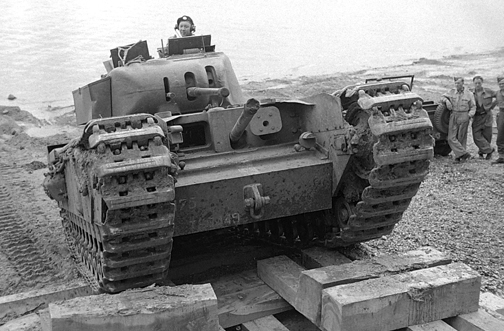
A Churchill Mark I of the Calgary Regiment training on a beach near Seaford, Sussex, in July 1942. Source: MilArt photo archives.
The British development of the Churchill Mark I
The Churchill Mark I was designed by Vauxhall Motors Limited in Luton, Bedfordshire, England, who also acted as parent to a group of companies charged with the production of the Infantry Tank Mark IV, Churchill (A22). Working under tremendous pressure, Vauxhall Motors had the first tank completed and ready for testing in December 1940, only twenty-two weeks after having started detailed design work. Unfortunately, because they had been instructed to have it in production within one year, the possibility of detailed user and development trails was virtually eliminated. With the issue of the first production models of the Churchill to units to begin in June 1941, Vauxhall was forced to work straight from the drawing board. This lead to some “teething troubles” with a few futures in the design and construction of the tank in early models only, which could give rise to troubles not normally expected in service. Vauxhall addressed this issue by inserting a four-page small yellow leaflet (dated May 1941) into the Churchill tank user handbook, addressed to crews, mechanics and workshop personnel, listing the defects known in advance to all who would handle the vehicle, and to outline the precautionary measures necessary to minimize them, and to explain that the defects existed solely because of the inadequate time that was available for comprehensive testing. Despite the problems, it did not take long to correct all the Churchill’s defects, and for the tank to become mechanically a very reliable vehicle. Vauxhall’s engineering teams, seconded to British and Canadian regiments who were training with Churchill tanks, sent a steady stream of information back to the factory, which constantly led to modifications and improvements. The combination of the Vauxhall teams and the Churchill crews, working hand-in-hand through the first formative months of the Churchill’s service, led to their crews knowing their tanks more intimately than could have been achieved with the most intensive training. Coupled with the aforementioned measures, the decision was taken in November 1941, that a rework programme would be carried out to correct some of the tank’s more glaring faults, and to bring many Mark I and Mark II tanks up to the current standard of the Churchill Mark III. Vauxhall Motors in Luton, Bedfordshire, and Broom & Wade in High Wycombe, Buckinghamshire, England, were both authorized to turn their production lines over to this rework programme, starting respectively, on 1 March and 1 April 1942.
A description of the Churchill Mark I
The Churchill Mark I had 102-millimetre thick armour (with a minimum thickness of 16-millimetres), making it one of the most heavily protected tanks built to that time. It weighed approximately 39-tons, and was 7.4-metres in length, by 3.3-metres in width, and stood at a height of 3.8-metres. It was powered by a 350-brake horsepower, 12-cylinder, horizontally-opposed engine, which could produce a road speed of 25-kilometres per hour and a cross-country speed of 13-kilometres per hour. The Churchill Mark I had an onboard fuel capacity of 682-litres, carried in six interconnected fuel tanks, three each side, located within the engine compartment. Also, the Churchill Mark I had an auxiliary fuel tank mounted on the outside rear hull, which carried an additional 148-litres. This auxiliary tank was connected to the main fuel system, but could be jettisoned from the tank in an emergency. This gave the Churchill Mark I a total fuel capacity of 830-litres allowing a cruising range of 145 to 201-kilometres.
The Churchill Mark I mounted a 2-pounder gun (capable of penetrating 57-millimetres of armour at 457-metres) and a coaxial Besa 7.92-millimetre machine gun in the turret, along with a 51-millimetre smoke bomb thrower in the turret roof, and a 3-inch howitzer (with a range of 1,829 to 2,286-metres) mounted in the hull front plate alongside the driver. The armour piercing capability of the 2-pounder and the high explosive capability of the 3-inch howitzer gave the tank a balanced armament. The 2-pounder was considered to be obsolescent by 1940, but was still being produced in quantity to replace losses in France. The factories could not spare the time to retool for the production of a heavier gun, due to the urgent need to re-equip the British Army after Dunkirk. The 2-pounder gun had an elevation of minus 15-degrees to plus 20-degrees, while that of the 3-inch howitzer was minus five degrees to plus nine degrees. The traverse of the 3-inch howitzer mounted in the hull front plate was restricted by the width of the hull between the horns. The Churchill Mark I had a crew of five (a commander, a gun layer, a loader/(radio) operator, a driver, a co-driver/hull gunner) men, all of whom was cross-trained.
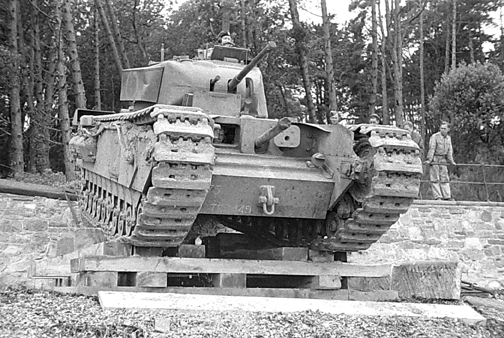
A Churchill Mark I of the Calgary Regiment, note the placement of the 3-inch howitzer in the front hull plate. Source: MilArt photo archives.

A Churchill Mark I of the Three Rivers Regiment, note the restricted traverse of the hull mounted 3-inch howitzer. Source: MilArt photo archives.
The hull was divided into four compartments. At the front, the driving compartment also housed the howitzer gunner. Behind that was the fighting compartment containing the electrically-operated three-man (commander, gun layer, and the loader/(radio) operator) turret. Further to the rear was the engine compartment, followed by the rear compartment housing the gearbox, main and steering brakes, air compressor, auxiliary battery charging set, and a turret power traverse generator. The hull was constructed of flat steel plates connected together with heavy steel angle irons, with rivets being used to secure the plates to the angle irons. The floor was flat and free from projections, and panniers were provided at each side between the upper and lower runs of the track for storage of equipment. The construction of the panniers was described as a double box girder, because each pannier formed a rectangular structure on each side of the hull, which created a hull of immense strength. The whole hull structure was suitably braced by cross girders and by the bulkheads that separated the various compartments.
The large square door (escape hatch) provided in each pannier just behind the driver and hull gunner positions was an unusual provision for British armoured fighting vehicles of this period, but was also very welcome by crews. Many a crewman who served as a driver or hull gunner on a Churchill is alive today because of these pannier doors. These doors could be opened or closed only from the inside, but the locking handles were designed so that the doors were automatically secured when they were closed. Each of these doors was provided with a circular pistol port, and two pistol ports were also provided in the turret. Double-hinged doors were provided in the hull roof above the driver and front gunner. They were normally operated from inside, but could be opened or secured from the outside by using a suitable key.
The turret of the Churchill Mark I, which was cast entirely as one piece, was the first attempt by British steel makers to create a complete turret as a single bulletproof steel casting. Also, the turret of the Churchill Mark I, had no protective mantlet, instead having just three slots in the bulletproof steel casting for the 2-pounder gun, the coaxial Besa 7.92-millimetre machine gun, and the sighting telescope. The turret could be controlled electrically when the engine was running, or it could be rotated by hand when the engine was stopped. When controlled electrically, the turret could be rotated at a fast speed of 360-degrees in 15 seconds, or at slow speed in 24 seconds. A cupola that could be rotated by hand independently of the turret was mounted in the turret roof for the use of the tank commander, which was rotatable by hand independently of the turret. A large hatch, closed by steel doors, was provided for the loader and gunner. A No. 19 wireless set (radio) was housed in the turret. This set included an “A” set for general use, a “B” set for short range inter-tank work at troop level, and an intercommunication unit for the crew, so arranged that each member could establish contact with any one of the others.
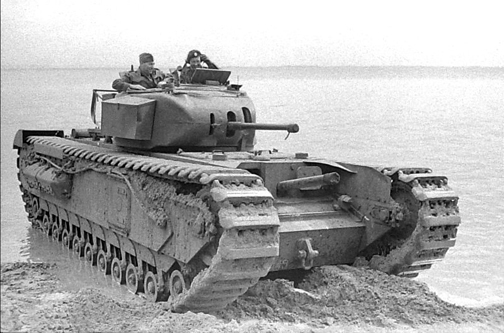
A Churchill Mark I of the Calgary Regiment, note the Mark I’s cast one-piece turret and the absence a mantlet. Source: MilArt photo archives.
For optics and viewing, the driver was provided with a large vision aperture, which could be reduced to a small port protected with very thick glass. When necessary the small port could also be closed. The driver and hull gunner both had periscopes, and there were two other periscopes mounted in the front of the turret for the loader and gunner. The commander’s cupola was fitted with two periscopes. A Churchill tank driver’s vision was more restricted than on other tanks, because the driving compartment was set back so far from the forward track horns. Churchill drivers could see ahead, but could see very little on either side of the vehicle, and they relied on the tank commander to warn them of obstacles.

The driver’s large vision aperture, which could be reduced to a small port protected with very thick glass. Source: MilArt photo archives.
As mentioned earlier, there was adequate provision for stowage of ammunition and equipment, with the Churchill Mark I, able to accommodate the stowage of 150 rounds of 2-pounder ammunition, 58 rounds of 3-inch howitzer ammunition, 4,725 rounds of 7.92-millimetre ammunition, and 25 smoke bombs. Additionally, each tank also carried one .303-inch Bren (Mark I) light machine gun with an anti-aircraft mounting and six 100-round drum type magazines, two .45 calibre Thompson sub-machine guns with six 50-round drum type and ten 20-round box type magazines each, and one Signal Pistol, No. 1, Mark III, with twelve cartridges (four red, four green, four white). Designated stowage locations for vehicle tools, spare parts, and equipment, and the crew’s personnel equipment, were also provided.

A Churchill Mark I of the Calgary Regiment, note the Bren light machine gun in its anti-aircraft mounting on the turret roof. Source: MilArt photo archives.
The Churchill Mark I in Canadian service
On 4 December 1941, No. 1 Sub Depot of No. 1 Canadian Base Ordnance Depot, Royal Canadian Ordnance Corps, located at Bordon Camp, Hampshire, England, began to receive Churchill Mark I tanks from the British for issue to the three army tank battalions (later redesignated army tank regiments on 15 May 1942) of the 1st Canadian Army Tank Brigade. The brigade (which was the first formation of the Canadian Armoured Corps sent overseas) had arrived in the United Kingdom at the end of June 1941, and was to have been equipped with the Canadian-built Infantry Tank Mark III, Valentine, before leaving Canada. However, because of delays in Canadian tank production, the British War Office was asked to lend tanks to the incoming 1st Canadian Army Tank Brigade. These would be replaced with Canadian-built tanks when Canadian production problems were overcome. With the support of the British Army’s Commander of the Royal Armoured Corps, this endeavour was successful, and immediately upon arrival in the United Kingdom, 1st Canadian Army Tank Brigade was able to draw equipment on a respectable training scale. The 11th Canadian Army Tank Battalion (The Ontario Regiment (Tank)) was equipped with the new Churchill Mark II tank (built to the same specifications as the Churchill Mark I, except that the 3-inch howitzer mounted in the hull front plate was replaced by a Besa 7.92-millimetre machine gun), straight from the Vauxhall Motors production line. In the meantime, until such time as more Churchill tanks became available, the Infantry Tank Mark II, Matilda II (A12), were issued to the 12th Canadian Army Tank Battalion (The Three Rivers Regiment (Tank)), and 14th Canadian Army Tank Battalions (The Calgary Regiment (Tank)), but by the end of December 1941, all three tank battalions of the brigade were equipped with Churchill tanks.
At this time, a Canadian army tank battalion was organized, equipped, and manned, as per the War Establishment of a Canadian Army Tank Battalion (Cdn III/1940/33A/1) of 11th February 1941. The war establishment was a document that specified the organization of a unit, and its authorized entitlement for personnel, vehicles, and weapons. The document was updated whenever the unit was reorganized or they received new equipment. Under War Establishment (Cdn III/1940/33A/1), a Canadian army tank battalion included a battalion headquarters, headquarters squadron, and three tank squadrons. The battalion headquarters included four cruiser or infantry close support tanks. The headquarters squadron had a squadron headquarters, an intercommunication troop with nine scout cars, and an administrative troop. Each of the three tank squadrons had a squadron headquarters and five tank troops, each with three infantry tanks. The squadron headquarters had three tanks: one cruiser or infantry tank, and two cruiser or infantry close support tanks. In all, each Canadian army tank battalion, was entitled to an overall tank strength of 58 tanks. Although initially issued to the army tank battalions of 1st Canadian Army Tank Brigade, against their war establishment entitlement of cruiser or infantry tanks, as time went on and more Churchill Mark II tanks became available (along with the Churchill Mark III in April 1942), the Churchill Mark I was employed in the squadron headquarters in place of the infantry close support tanks.
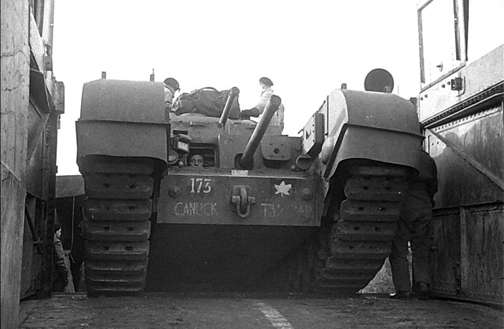
A reworked Churchill Mark I of the Ontario Regiment, note the driver’s small vision port protected with very thick glass. Source: MilArt photo archives.
Under the previously mentioned rework programme, Canadian-held Churchill Mark I tanks started to be withdrawn on 30 May 1942. These tanks were returned to the British Army’s Chilwell Mechanical Transport Sub-Depot, Royal Army Ordnance Corps, located at Vauxhall Motors in Luton, Bedfordshire, England. There, once all tank stores and wireless (radio) equipments were accounted for, the tank was struck off charge of the Canadian Army Overseas. New or reworked Churchill tanks were in turn issued to the Canadian Army Overseas through No. 1 Canadian Base Ordnance Depot, to replace those that had been turned in. From the end of May 1942 onwards, there was a continuous stream of Churchill Mark I tanks being withdrawn from the units of 1st Canadian Army Tank Brigade and new or reworked Mark I tanks being issued to replace them. This process continued until March 1943, when the decision was made to replace the brigade’s Churchill tanks with the Canadian-built Cruiser Tank, Ram Mk II. Not all of the Churchill Mark I tanks operated by units of 1st Canadian Army Tank Brigade had to be reworked. In July 1942, Canadian Military Headquarters (London, England) issued a list of tanks, that were not affected by the rework programme.

Two reworked Churchill Mark Is of the Three Rivers Regiment on exercise somewhere in England. Source: MilArt photo archives.
By the time of Operation Jubilee, the ill-fated combined operations raid carried out against the port of Dieppe, France, on 19 August 1942, the Calgary Regiment, held six Churchill Mark I tanks, all employed as close support tanks, with two each in squadron headquarters, of the regiments three squadrons. All six of these tanks were reworked Churchill Mark Is which had been recently issued (two on 20 June, and four on 6 July 1942) to replace Mark Is that had been withdrawn from the regiment under the rework programme. Of these six tanks, four were lost at Dieppe while serving with “B” and “C” squadron headquarters. The two Churchill Mark I tanks serving with “A” squadron headquarters returned to England, with the squadron not having landed. It would not be until 23 October 1942, that these losses to the Calgary Regiment would be replaced.
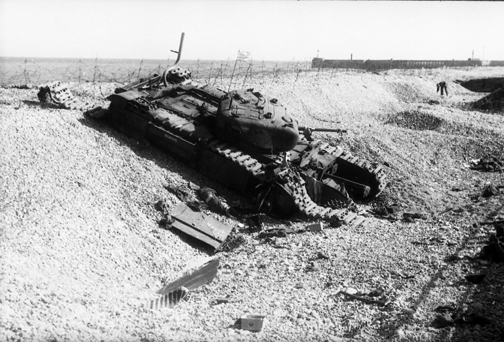
A reworked Churchill Mark I of the Calgary Regiment’s “B” Squadron Headquarters knocked out at Dieppe. Source: Authors’ image file.
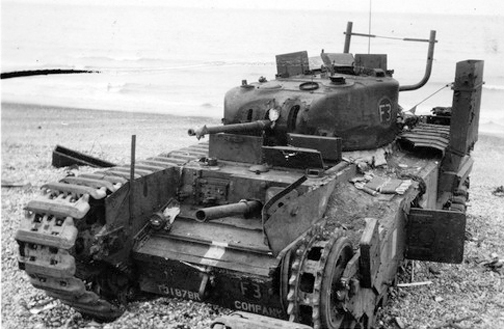
A reworked Churchill Mark I of the Calgary Regiment’s “C” Squadron Headquarters knocked out at Dieppe. Source: Authors’ image file.
As of 5 January 1943, among the three tank regiments of 1st Canadian Army Tank Brigade, a total of 36 Churchill Mark I tanks (11 of which were reworked), were held on strength of the brigade. As of 1 March 1943, 16 reworked Churchill Mark Is, were held among the three tank regiments of the brigade. With the previously mentioned decision having been made to replace the brigade’s Churchill tanks with the Canadian-built Cruiser Tank, Ram Mk II, the brigade’s Churchill Mark I tanks, began to be withdrawn on 22 March 1943, with three Churchill Mark Is of the Calgary Regiment, being returned to No. 1 Canadian Base Ordnance Depot, Royal Canadian Ordnance Corps (Bordon Camp, Hampshire). This was followed on 26 March, with the withdrawal of four Churchill Mark Is of the Ontario Regiment, and finally on 29 March, with the withdrawal of the six Churchill Mark I tanks of the Three Rivers Regiment, and the withdrawal of the remaining two from the Calgary Regiment. On 11 May 1943, the last remaining two Churchill Mark Is (which were held on strength of the Ontario Regiment), were turned over to the British 148th Regiment, Royal Armoured Corps, at the British School of Infantry at Catterick, North Yorkshire, England. In all, at one time or another, between 4 December 1941 and 11 May 1943, approximately 70 Churchill Mark I tanks (24 of which were reworked Mark Is), were held on the strength of units of the 1st Canadian Army Tank Brigade.
More information on the Churchill Mark Is which served with the Canadian Army Overseas can be found at Ram Tank under the Churchill Registry heading.
Acknowledgements:
The author wishes to thank Clive M. Law, for providing photos from the MilArt photo archives, and for publishing this article.
Any errors or omissions, is entirely the fault of the author.
Bibliography:
Tonner, Mark W., The Churchill in Canadian Service (Canadian Weapons of War Series), 2010, Service Publications; Ottawa, Ontario, Canada. ISBN 978-1-894581-67-7, and The Churchill Tank and the Canadian Armoured Corps, 2011, Service Publications; Ottawa, Ontario, Canada. ISBN 978-1-894581-66-0.
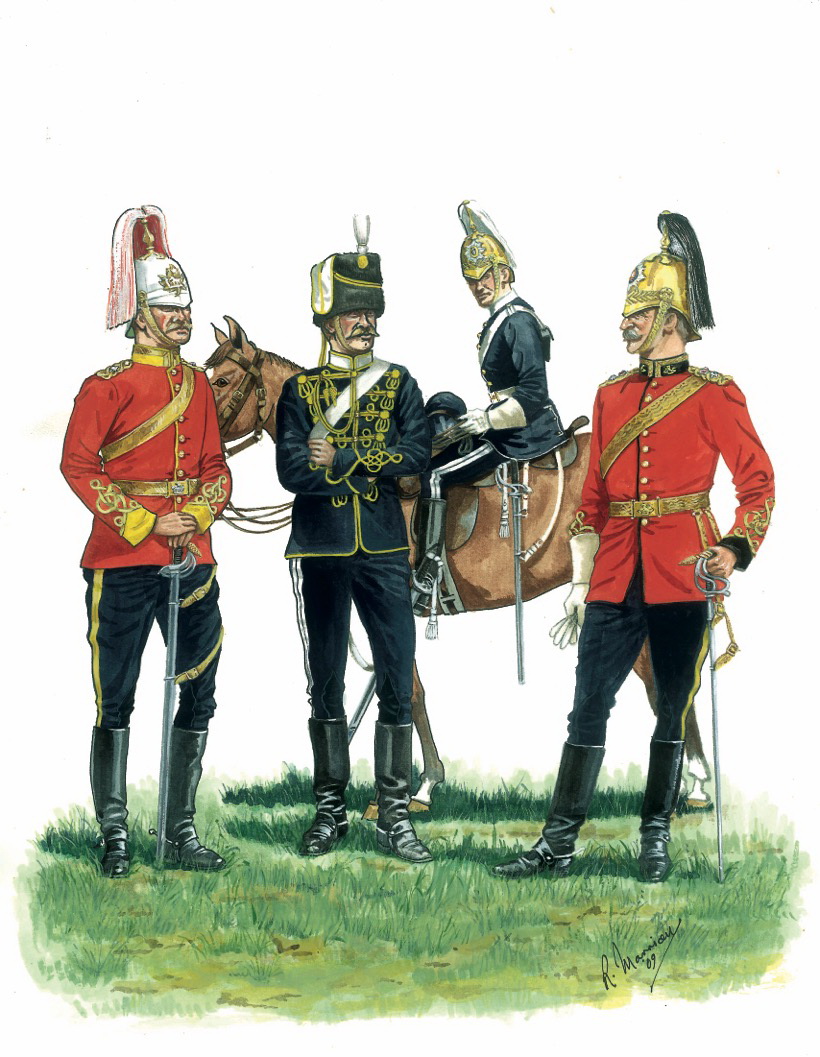
Art: Robert M. Marrion
- Canadian Militia List, published annually in Ottawa, years 1902 to 1914 ; Regulations for the Clothing of the Canadian Militia, Part II (Ottawa : Government Printing Office, 1909), pp. 37-38; for officer’s uniforms, see: David Ross and René Chartrand, ed., Canadian Militia Dress Regulations 1907 illustrated, with amendments to 1914 (St. John: The New Brunswick Museum, 1980). See the text of MUIA 852 for arms, accouterments and equipment.
- Regimental uniform notes taken in the Benson Freeman Collection, Army Museums Ogilby Trust, London, England (now closed) by the late Gen. Jack L. Summers in 1972, and transmitted to the author; “Short History of the Princess Louise Dragoon Guards”, The Salute, January 1936, pp. 11-14; William Y. Carman, “26th Canadian Horse (Stanstead Dragoons)”, The Bulletin of the Military Historical Society, August, 1985, pp. 26-28; 36th PEI Light Horse helmet in Worthington Museum, Canadian Forces Base Borden, Ontario; silken prints of Canadian uniforms done in 1913 for the Tuckett’s Tobacco Company of Hamilton, Ontario.
See the related article on Canadian Western Cavalry uniforms
by Mark W. Tonner
This brief article is a follow-up to my earlier article “Applications of unit serial numbers on vehicles of the Canadian Army Overseas, 1943-45,” of August 15, 2015.
During the period of the Second World War, as a Canadian unit was called out and placed on active service, it was allocated, a separate ‘Unit Serial Number.’ Each individual unit serial number, to all intents and purposes, became the unit identity code until such time as the unit was disbanded, although in some instances, a new unit serial number was sometimes allocated upon the conversion and redesignation of a unit. The unit serial number normally consisted of one, two, three or four digits. Early in the spring of 1943, with the pending involvement of formations and ancillary troops of the Canadian Army Overseas1, in the forthcoming invasion of the island of Sicily (in early July), Canadian Military Headquarters (located in London, England) in a series of mobilization orders, began the administrative process of preparing and organizing all units of the Canadian Army Overseas for operational duty outside of the United Kingdom. This process, basically ensured that all units were fully up to strength in terms of the number of personnel, types and number of vehicles, and equipment, each individual unit was authorized, as per their War Establishment and Equipment Tables. As units completed this mobilization process, a suffix of a backslash and the number ‘1’ was added to each individual unit’s serial number, by Canadian Military Headquarters. The addition of this suffix of a backslash and the number ‘1’ was twofold. Firstly it readily showed that a unit was ready for operational duty, and secondly, it differentiated between units of the Canadian Army Overseas and those of the British Army. This did not affect units of the Canadian Army (Active) serving within Canada, but upon transfer to the United Kingdom for service with the Canadian Army Overseas, the suffix of a backslash followed by the number ‘1’ was added to their unit serial number. This use of a backslash suffix followed by the number ‘1’ to a unit serial number as a means of identifying units of the Canadian Army Overseas, was purely administrative in nature, and after its inception came to be known as a unit’s ‘Mobilization Serial Number.’
Although an elaborate scheme of Arm of Service, and formation markings was used on vehicles of the Canadian Army Overseas to ensure identification of units and efficient traffic control, starting with the Canadian Army involvement with the allied invasion of Sicily in July 1943, the unit mobilization serial number (the unit serial number with the addition of the suffix of a backslash and the number ‘1’), was also used as a form of unit identification on vehicles, for the purpose of loading and shipping, as per the load tables for various types of vessels. In this form, they were sometimes referred to as an ‘Embarkation’ number, and were normally either chalked, stenciled, or painted free hand, in white on the front of a unit’s vehicles and were normally only carried on the vehicle for a brief period before embarkation, on the voyage, and for a brief period after landing. Besides being applied to unit vehicles, on their own, or as part of an embarkation number, unit mobilization serial numbers were also used to identify such things as unit kit bags, unit baggage, and unit stores. They were to be applied in white paint on dark coloured unit kit bags/baggage/stores, and in black paint on light coloured unit kit bags/baggage/stores, by use of a stencil, or free hand. In the case of unit kit bags, and other such baggage, an existing British War Office coloured bar code system was taken into use in the spring of 1943 (which was revised in May 1944), under which the last two digits of the unit serial number were represented by three horizontal coloured bars, which were normally painted on, directly below the application of the unit mobilization serial number, on a kit bag, or other such baggage, in which, the top and bottom bar represented the ‘tens’ digit and the middle bar represented the ‘ones’ digit. Purely as a point of interest, and although not part of the subject matter of this article, I’ve included as Table 1, a breakdown of the British War Office coloured bar code system that was taken into use in the spring of 1943, and of the revised May 1944 coloured bar code system.
The following images are some examples of soldiers’ kit bags, and unit stores, onto which a unit mobilization serial number as been applied, as a form of unit identification. The first image is of a kit bag belonging to a Trooper L.A. Watts, which is marked with the unit mobilization serial number ‘570/1,’ which although rather faded, appears near the top opening of the bag, and identifies the kit bag owner as a member of the 1st Canadian Armoured Car Regiment (Royal Canadian Dragoons), Canadian Armoured Corps, whose unit mobilization serial number was ‘570/1.’ Note the application of the three horizontal bars of the coloured bar code system near the bottom of the bag. The second image is of a kit bag marked with the unit mobilization serial number ‘743/1,’ thus identifying the kit bag owner as a member of Le Regiment de la Chaudiere, whose unit mobilization serial number was ‘743/1.’ Again, the three horizontal bars of the coloured bar code system appear applied directly below the unit mobilization serial number, along with one vertical coloured bar, which was added by the regiment, too perhaps, identify the sub unit of the battalion to which the kit bag owner belonged (for the organization of an infantry battalion, please see the MilArt article “Basic Organization of the Canadian ‘Infantry (Rifle) Battalion’ on Overseas Service during the Second World War,” of 7 March 2014). In the last image, three soldiers of the Highland Light Infantry of Canada are having a meal in the area of Thaon, France, on 6 August 1944. Note the two stacked, dark coloured stowage boxes, to the left-rear of the standing soldier, both of which are marked with the Highland Light Infantry of Canada’s unit mobilization serial number of ‘754/1.’ Also note the application of the three horizontal bars of the coloured bar code system, which are applied directly below the unit mobilization serial number, on both stowage boxes.

The number ‘570/1’ identifies the kitbag owner as a member of the 1st Canadian Armoured Car Regiment (Royal Canadian Dragoons). Source: Authors’ image file
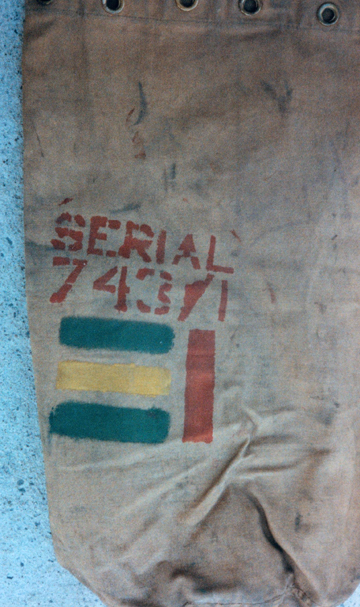
The number ‘743/1’ identifies the kitbag owner as a member of Le Regiment de la Chaudiere. Source: Courtesy of Ed Storey
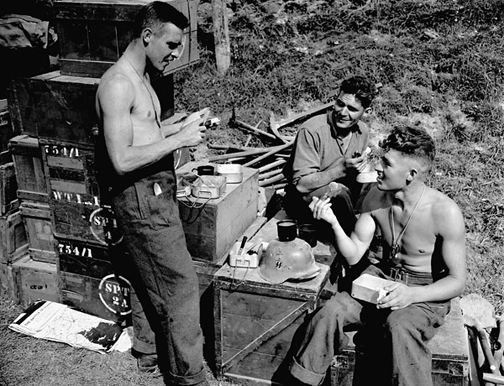
The number ‘754/1’ identifies the stowage boxes as property of the Highland Light Infantry of Canada. Source: LAC/PA-213681
Unit serial numbers, on their own, were also applied to a soldier’s kit, as a means of identifying the soldier’s parent unit. In the image below, is an officer’s haversack which bears the unit serial number ‘944,’ and the corresponding three horizontal bars of the coloured bar code system. The unit serial number ‘944,’ identifies the owner of this haversack, as belonging to the 25th Canadian Armoured Delivery Regiment (The Elgin Regiment), Canadian Armoured Corps. The unit serial number ‘944,’ was initially allotted to The Elgin Regiment, Canadian Active Service Force, upon their embodiment as an ‘infantry’ battalion, in May 1940, and stayed as the Elgin Regiment’s assigned unit serial number, throughout the various conversions and redesignations, the unit underwent, until disbandment in February 1946. From their embodiment as an ‘infantry’ battalion, in May 1940, The Elgin Regiment was subsequently converted from an ‘infantry’ battalion, to that of an ‘armoured’ regiment, and was redesignated Serial No. 944, the 25th Canadian Armoured Regiment (The Elgin Regiment), Canadian Armoured Corps, in January 1942. In September 1943, Serial No. 944, the 25th Canadian Armoured Regiment (The Elgin Regiment), was converted from an ‘armoured’ regiment, to that of a ‘tank delivery’ regiment, and was redesignated Serial No. 944, the 25th Canadian Tank Delivery Regiment (The Elgin Regiment), Canadian Armoured Corps. This was followed in March 1944, by the conversion of Serial No. 944, the 25th Canadian Tank Delivery Regiment (The Elgin Regiment), from a ‘tank delivery’ regiment, to that of an ‘armoured delivery’ regiment, and redesignation to that of Serial No. 944, the 25th Canadian Armoured Delivery Regiment (The Elgin Regiment), Canadian Armoured Corps, which designation they kept until disbandment in February 1946.
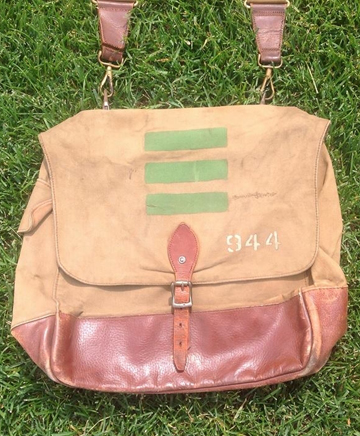
An officer’s haversack which bears The Elgin Regiment’s unit serial number ‘944.’ Source: Courtesy of Michael Reintjes
Another example of a unit serial number applied to a soldier’s kit, as a means of identifying his parent unit can be seen in the following image of a kit bag. In this case, the unit serial number ‘743’ of Le Regiment de la Chaudiere as been neatly stenciled onto the bag, with the corresponding three horizontal bars of the coloured bar code system (taken into use in the spring of 1943), applied directly below, thus identifying the kit bag owner as a member of Le Regiment de la Chaudiere. As a point of interest, Private J.C. Cournoyer, whose name and initials appear applied below his regimental number (E9138), near the bottom of the bag, transferred to the Royal 22e Regiment, and while serving in Italy was killed in action in December 1943. Also, the difference in the application of just the unit serial number ‘743,’ on Private Cournoyer’s kitbag, as opposed to the unit mobilization serial number ‘743/1,’ on the kit bag mentioned earlier, is that, Cournoyer’s bears the initial application from the spring of 1943. That of the earlier mentioned kit bag, with the application of the unit mobilization serial number ‘743/1,’ was applied sometime later, perhaps to the kit bag of a new member of the unit, as Le Regiment de la Chaudiere completed their preparations for the allied invasion of Normandy in June 1944.
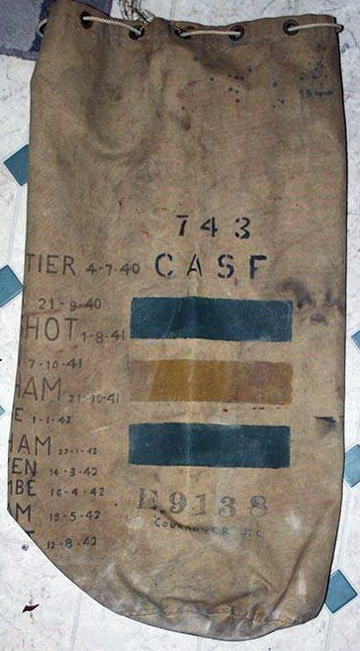
The number ‘743’ identifies the kitbag owner as a member of Le Regiment de la Chaudiere. Source: Courtesy of Pascal Auger
In the following image of a kit bag, belonging to a Lieutenant S. Fisher, the unit serial number of the unit he initially belonged to, No. 1 Canadian Artillery Reinforcement Unit, whose unit serial number was ‘292,’ as been crossed out, upon the Lieutenant moving onto a new unit. The new unit he moved to, No. 2 Canadian Artillery Reinforcement Unit, was allocated unit serial number ‘1132,’ which as been applied above the crossed out unit serial number of his former unit. The application of the three coloured bars of the coloured bar code system, corresponds to his new unit’s serial number of ‘1132.’ Also of note, is the absence of the suffix of a backslash and the number ‘1,’ on either unit serial number. Both the Canadian Artillery Reinforcement Units to which Lieutenant S. Fisher belonged, were both static Canadian base units permanently stationed within the United Kingdom and were therefore, not subject to Canadian Military Headquarters’ mobilization process.
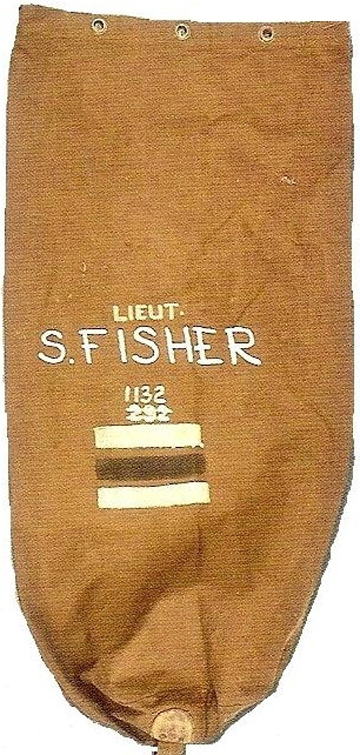
An officer’s kitbag, on which his old (‘292’) and new (‘1132’) unit serial numbers are applied. Source: Authors’ image file
In the image below of a kit bag, marked as belonging to a Captain R.A. MacDougall, the unit serial number ‘107,’ in white, to the right of the three horizontal coloured bars of the coloured bar code system, identifies Captain MacDougall as a member of The Perth Regiment. Captain MacDougall was later promoted to the rank of Major, and was killed in action on 17 January 1944, while leading an attack in Italy. Major MacDougall was the highest ranking officer of The Perth Regiment killed in action during the Second World War.
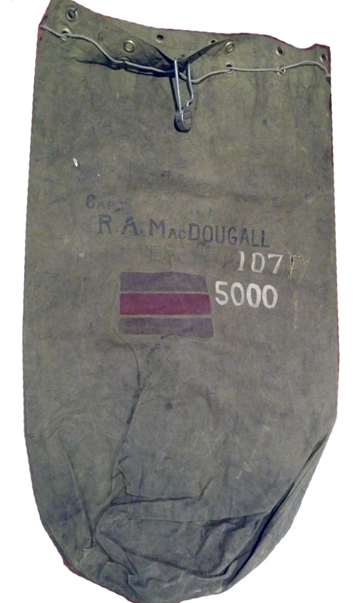
The number ‘107,’ in white, identifies the kit bag owner as a member of The Perth Regiment. Source: Courtesy of Bill Donaldson
The large pack in the following image, belonging to a Private L.H. Bedard, is marked with the unit mobilization serial number of the 1st Canadian Infantry Brigade Support Group (The Saskatoon Light Infantry), which was ‘39B/1.’ The 1st Canadian Infantry Brigade Support Group (The Saskatoon Light Infantry) was a component part of Serial No. 39, the 1st Canadian Infantry Division Support Battalion (The Saskatoon Light Infantry)2, whose corresponding coloured bar code can also be seen applied to the large pack, vertically, as opposed too horizontally, above the soldier’s name, initials, and regimental number. Although Serial No. 39B, the 1st Canadian Infantry Brigade Support Group (The Saskatoon Light Infantry) was absorbed into the conversion and redesignation of Serial No. 39, the 1st Canadian Infantry Division Support Battalion (The Saskatoon Light Infantry) to that of Serial No. 39, The Saskatoon Light Infantry (Machine Gun) effective 1 July 1944, it would appear that the original unit mobilization serial number of the 1st Canadian Infantry Brigade Support Group (The Saskatoon Light Infantry), of ‘39B/1,’ was retained on this particular large pack.
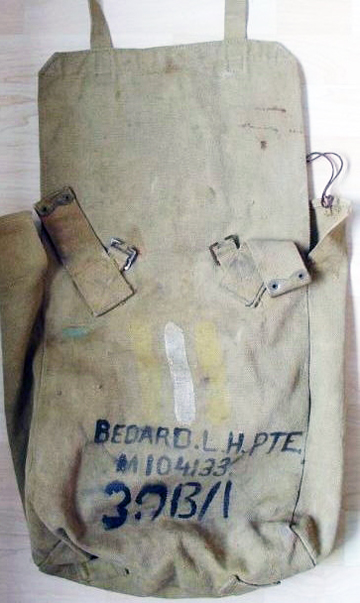
The number ‘39B/1’ identifies the large pack owner as a member of the 1st Canadian Infantry Brigade Support Group (The Saskatoon Light Infantry). Source: Authors’ image file
Table 1
a.) The British War Office coloured bar code system that was taken into use in the spring of 1943, under which numerals were represented by the following coloured bar:
- Red
- Blue
- Yellow
- Light Green
- Grey
- Buff
- Red Oxide
- Service colour (a deep bronze green)
- White
- Brown
b.) The revised British War Office coloured bar code system of May 1944, as promulgated in British War Office Publication 5697, entitled ‘Distinguishing Coloured Marks to be used on Stores Consigned in Bulk to Overseas theatres (British and US Forces),’ of 10 May 1944, under which numerals were represented by the following coloured bar:
- Red, bright, QD (Quick Drying)
- Blue, QD
- Yellow (Ammunition) (a bright yellow as used for ammunition markings)
- Green, light
- Grey (Ammunition) (a light grey as used for ammunition markings)
- Buff, QD
- Red, Oxide of Iron (a dark red similar to maroon)
- Deep Bronze Green
- White Lead, QD
- Brown, dark, QD
Acknowledgements:
The author wishes to thank Clive M. Law, Ed Storey, and Michael Dorosh, for reading over my initial draft copy of this article, and their constructive criticism, and comments on it, and also, Miss Courtney Carrier, for proofreading, and corrections to my draft of this article, and also, Bill Donaldson, Ed Storey, Michael Reintjes, and Pascal Auger, for providing photos, and Clive M. Law, for publishing this article.
Any errors or omissions, is entirely the fault of the author.
Bibliography:
Law, CM, Unit Serials of the Canadian Army, Service Publications, Ottawa, Ontario.
Library and Archives Canada, archived photographs database, and digitized images, and various other Files/Volumes, Records Group 24, National Defence.
Tonner, MW, On Active Service, A summary listing of all units of the Canadian Army called out and placed on active service, Service Publications, Ottawa, Ontario, 2008.
Notes:
- The Canadian Army Overseas, was the designation given, with effect from 30 December 1941, to that portion of the Canadian Army (Active), who were serving in the United Kingdom and would eventually serve in the Mediterranean (Sicily/Italy), and in the European theatres of operations.
- From the conversion and redesignation of Serial No. 39, The Saskatoon Light Infantry (Machine Gun) to that of Serial No. 39, the 1st Canadian Infantry Division Support Battalion (The Saskatoon Light Infantry), consisting of Serial No. 39A, Headquarters, 1st Canadian Infantry Division Support Battalion (The Saskatoon Light Infantry), Serial No. 39B, the 1st Canadian Infantry Brigade Support Group (The Saskatoon Light Infantry), Serial No. 39C, the 2nd Canadian Infantry Brigade Support Group (The Saskatoon Light Infantry), and Serial No. 39D, the 3rd Canadian Infantry Brigade Support Group (The Saskatoon Light Infantry), effective 1 May 1943.
Mark W. Tonner
With war in Europe inevitable, and as Canada prepared, starting on 1 September 1939, as a Canadian unit was called out and placed on active service, as a unit of the Canadian Active Service Force1, each unit was allocated, a separate ‘Unit Serial Number.’ Each individual unit serial number, to all intents and purposes, became the unit identity code until such time as the unit was disbanded, although in some instances, a new unit serial number was sometimes allocated upon the conversion and redesignation of a unit. The unit serial number normally consisted of one, two, three or four digits.
Some examples of the one, two, three, or four digit unit serial numbers allocated to Canadian units upon being called out and placed on active service:
a.) – Serial No. 2, was allocated to the Headquarters of the 1st Division (later redesignated Headquarters, 1st Canadian Division, and still later, was redesignated Headquarters, 1st Canadian Infantry Division) on 1 September 1939, and was retained as the unit serial number of the Headquarters until it was disbanded on 15 September 1945.
b.) – Serial No. 22, was allocated to the 2nd Field Park Company, Royal Canadian Engineers, on 1 September 1939, and was retained as the unit serial number of the 2nd Field Park Company until it was disbanded on 30 November 1945.
c.) – Serial No. 144, was allocated to No. 15 General Hospital, Royal Canadian Army Medical Corps, on 1 September 1939, and was retained as the unit serial number of No. 15 General Hospital until it was disbanded on 7 May 1945.
d.) – Serial No. 1177, was allocated to No. 6 Field Surgical Unit, Royal Canadian Army Medical Corps, on 1 February 1943, and was retained as the unit serial number of No. 6 Field Surgical Unit until it was disbanded on 1 June 1945.
In the case of units, such as a regiment of the Royal Canadian Artillery, that was made up of sub units that were each a component part of the parent unit, an alpha suffix letter was added to the one, two, three, or four digit unit serial number to identify each sub unit of the parent unit. As an example, Serial No. 10, was allocated to the 2nd Field Regiment, Royal Canadian Artillery, with the regiment’s sub units being allocated the following numeric/alpha unit serial numbers, Serial No. 10A, was allocated to Headquarters, 2nd Field Regiment, Royal Canadian Artillery, Serial No. 10B, was allocated to the 8th Field Battery, Royal Canadian Artillery, Serial No. 10C, was allocated to the 10th (St. Catharines) Field Battery, Royal Canadian Artillery, and Serial No. 10D, was allocated to the 7th (Montreal) Field Battery, Royal Canadian Artillery.
Early in the spring of 1943, with the pending involvement of formations and ancillary troops of the Canadian Army Overseas2, in the forthcoming invasion of the island of Sicily3, Canadian Military Headquarters in the United Kingdom4 in a series of mobilization orders, began the administrative process of preparing and organizing all units of the Canadian Army Overseas for operational duty outside of the United Kingdom5. As units completed this mobilization process, a suffix of a backslash and the number ‘1’ was added to each individual unit’s serial number, by Canadian Military Headquarters. The addition of this suffix of a backslash and the number ‘1’ was twofold. Firstly it readily showed that a unit was ready for operational duty, and secondly, it differentiated between units of the Canadian Army Overseas and those of the British Army. This did not affect units of the Canadian Army (Active) serving within Canada, but upon transfer to the United Kingdom for service with the Canadian Army Overseas, the suffix of a backslash followed by the number ‘1’ was added to their unit serial number. This also did not affect those units that were raised overseas under ‘Provisional War Establishments’ to cover experimental and temporary organizations and special courses of instruction under the authority of either Canadian Military Headquarters, or that of the General Officer Commanding-in-Chief First Canadian Army, these units continued to be identified by a number that was prefixed by the letters ‘CM’ (Canadian Military), ie: CM-xxx, which was assigned to them upon authority of their raising under either Canadian Military Headquarters or the General Officer Commanding-in-Chief First Canadian Army6. Some of these temporary units/organizations were eventually called out and placed on active service under either an Order-in-Council7, or the authority of the Minister of National Defence, at which point they were authorized under a unit serial number, and in most cases, a new designation.
This use of a backslash suffix followed by the number ‘1’ to a unit serial number as a means of identifying units of the Canadian Army Overseas, was purely administrative in nature, and after its inception came to be known as a unit’s ‘Mobilization Serial Number,’ and was used in such things as Canadian Military Headquarters Administrative Orders and in Canadian Army Overseas Routine Orders. It also appears in use in Part II Orders issued by the Canadian Section, General Headquarters, 2nd Echelon8, in the United Kingdom, Sicily/Italy and North West Europe. As an example of the above mentioned, Serial No. 615, No. 1 Light Aid Detachment (Type A), Royal Canadian Ordnance Corps (which was attached to Headquarters, 1st Canadian Infantry Brigade of 1st Canadian Infantry Division), was mobilized as promulgated in Canadian Military Headquarters Mobilization Order No. 6 of 18 April 1943, under the supervision of Headquarters, 1st Canadian Infantry Division, with an effective date of 1 May 1943, at which time the suffix of a backslash and the number ‘1’ was added to their unit serial number, thus becoming, Serial No. 615/1, No. 1 Light Aid Detachment (Type A), Royal Canadian Ordnance Corps.
Another example would be the previously mentioned example of the 2nd Field Regiment, Royal Canadian Artillery, whose sub units, after having gone through this mobilization process, and the addition of the suffix of a backslash and the number ‘1,’ would read Serial No. 10A/1 for Headquarters, 2nd Field Regiment, Royal Canadian Artillery, Serial No. 10B/1 for the 8th Field Battery, Royal Canadian Artillery, Serial No. 10C/1 for 10th (St. Catharines) Field Battery, Royal Canadian Artillery, and Serial No. 10D/1 for the 7th (Montreal) Field Battery, Royal Canadian Artillery.
Although an elaborate scheme of unit and formation markings9 was used on vehicles of the Canadian Army Overseas to ensure identification of units and efficient traffic control, starting with the Canadian Army involvement with Operation HUSKY10 (the allied invasion of Sicily in July 1943), the unit mobilization serial number (the unit serial number with the addition of the suffix of a backslash and the number ‘1’), was also used as a form of unit identification on vehicles, for the purpose of loading and shipping, as per the load tables for various types of vessels. In this form, they were sometimes referred to as an ‘Embarkation’ number, and were normally either chalked, stenciled, or painted free hand, in white on the front of a unit’s vehicles and were normally only carried on the vehicle for a brief period before embarkation, on the voyage, and for a brief period after landing.
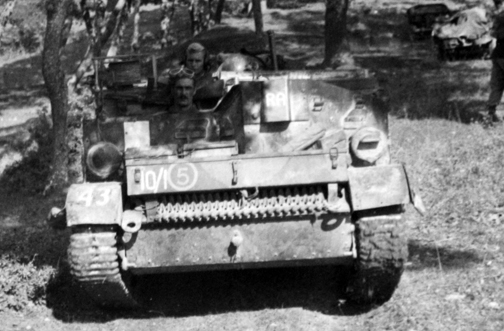
Examples of a unit’s mobilization serial number used as a form of ‘Embarkation’ number, for the allied invasion of Sicily, can be seen in the following three images, in the first of which (Image 1), the ‘32/1’ applied to the front edge of the fender of the two motorcycles, identifies these as belonging to the 48th Highlanders of Canada. In the next image (Image 2) although partially obscured by a length of chain, the ‘33/1’ applied on the left front fender, identifies this carrier as belonging to The Hastings and Prince Edward Regiment. In the third image (Image 3), the ‘10/1’ applied to the right-hand front of the storage box, on the carrier’s front, identifies this universal carrier as belonging to the 2nd Field Regiment, Royal Canadian Artillery.
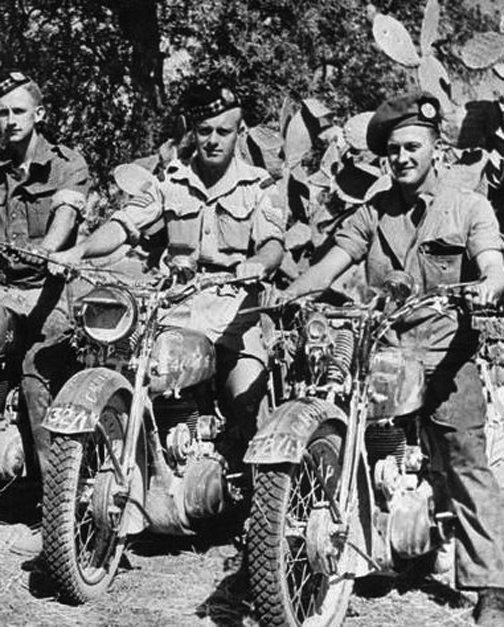
1. Source: Authors’ image file
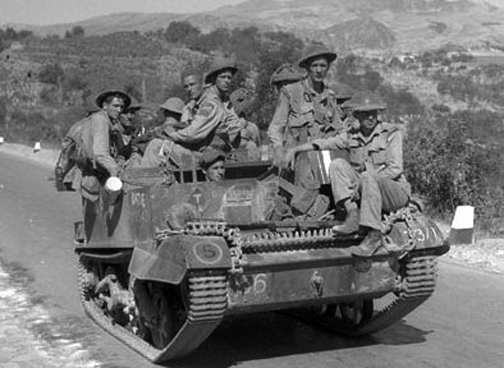
2. Source: Library and Archives Canada/PA-114511
3. Source: Courtesy of Ed Storey
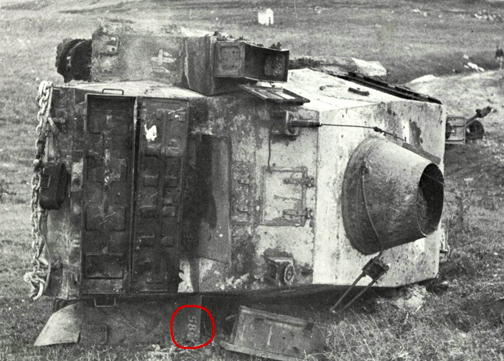
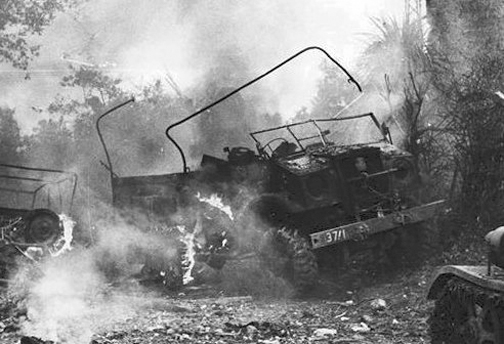
With the successful conclusion of the campaign on the island of Sicily, the Allies moved next against the Italian mainland, on 3 September 1943, with elements of the 1st Canadian Infantry Division, and the 1st Canadian Armoured Brigade (Independent)11, as part of Lieutenant-General Miles Dempsey’s XIII British Corps, crossing the Straits of Messina from Messina, Sicily, to Reggio di Calabria, Italy, as part of Operation BAYTOWN12. As can be seen in the following images, the application of a unit mobilization serial number on unit vehicles was still very much in evidence into the first few months of the campaign on the Italian mainland. In the below image (Image 4) from October 1943, although only partially visible and oddly enough placed on the rear of the right-rear stowage bin, the stenciled application of ‘580/1’ (circled in red on the image) identifies this burnt out Otter, light reconnaissance car, as belonging to the 4th Canadian Reconnaissance Regiment (4th Princess Louise Dragoon Guards), Canadian Armoured Corps. In the next image (Image 5) from December 1943, the ‘37/1’ applied to the right-side of the bumper of this burning fifteen-hundredweight truck, identifies the vehicle as belonging to the Seaforth Highlanders of Canada.
4. Source: MilArt photo archives
5. Source: Authors’ image file
By the time of Operation OVERLORD13 (the allied invasion of Normandy in June 1944), this use of a unit’s mobilization serial number (the unit serial number with the addition of the suffix of a backslash and the number ‘1’), as an embarkation number, had involved a bit more, especially on unit vehicles of the 3rd Canadian Infantry Division, and 2nd Canadian Armoured Brigade (Independent), and on unit vehicles of both Canadian Corps Troops, Canadian Army Troops, and ancillary units, that took part in the seaborne assault landings on 6 June 1944. Besides the unit mobilization serial number being used as an embarkation number, the ‘Landing Table Index Number (or Serial Number),’ which was the number specifically assigned to a vessel’s particular load, whether it was a load of vehicles, or personnel, or a mixture of both, and an abbreviation for the type of vessel in which the load was to travel, was now also added alongside the unit mobilization serial number.
As an example, Landing Craft Tank, pennant No. 1008, which was a Landing Craft Tank, Mark IV, was assigned Landing Table Index Number (or Serial Number) ‘1715.’ Part of her assigned load were four Sherman Mark III tanks (with crews) of the 27th Canadian Armoured Regiment (The Sherbrooke Fusilier Regiment), Canadian Armoured Corps (of the 2nd Canadian Armoured Brigade (Independent)), whose unit mobilization serial number was ‘1044/1.’ Each of these four individual Sherman Mark III tanks would have had the embarkation number ‘1044/1/1715/LCT(IV),’ applied to them, thus identifying each individual tank as belonging to the Sherbrooke Fusilier Regiment, which were assigned to load number ‘1715,’ which was assigned to a Landing Craft Tank, Mark IV. Also assigned to the same Landing Craft Tank (pennant No. 1008), were two universal carriers (each with a four-man crew, with each carrier towing a 6-pounder anti-tank gun) of The Stormont, Dundas and Glengarry Highlanders (of the 9th Canadian Infantry Brigade, of the 3rd Canadian Infantry Division), whose unit mobilization serial number, was that of ‘752/1.’ Each of these two universal carriers would have had the embarkation number ‘752/1/1715/LCT(IV),’ applied to them, thus identifying, each individual carrier, as belonging to the Stormont, Dundas and Glengarry Highlanders, which were assigned to load number ‘1715,’ which was assigned to a Landing Craft Tank, Mark IV. Another example, is for that of a 3-ton truck of The Highland Light Infantry of Canada (of the 9th Canadian Infantry Brigade, of the 3rd Canadian Infantry Division), whose unit mobilization serial number, was ‘754/1,’ and was the only vehicle of this unit, assigned to the load carried by Landing Craft Tank, pennant No. 667, which was a Landing Craft Tank, Mark IV, and was assigned Landing Table Index Number (or Serial Number) ‘1724.’ This solitary 3-ton truck of The Highland Light Infantry of Canada, would have had the embarkation number ‘754/1/1724/LCT(IV),’ applied, identifying it as belonging to the Highland Light Infantry of Canada, assigned to load number ‘1724,’ which was assigned to a Landing Craft Tank, Mark IV.
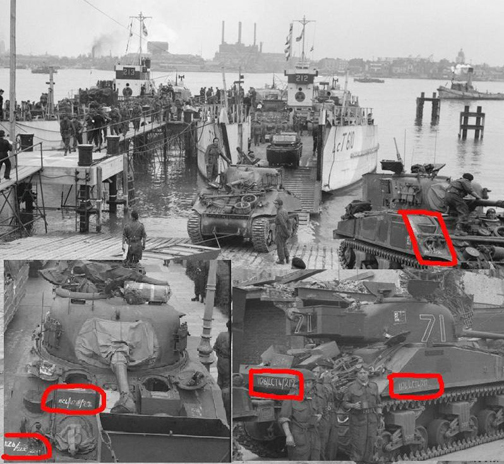
As an illustration of what was stated in the last two paragraphs, in the background of the image (Image 6) below is a Landing Craft Tank, pennant No. 610 (visible on the left-forward side of the vessel), which was a Landing Craft Tank, Mark IV, and was assigned Landing Table Index Number (or Serial Number) ‘212’ (which is displayed in large white numbers, on a placid, and is affixed to the front of the vessel’s bridge). All four Sherman tanks seen in this image, belong to the 13th/18th Royal Hussars (of the 27th British Armoured Brigade (Independent)), whose unit serial number, was ‘1126.’ Although marked in a slightly different fashion, then that, which was explained in the above paragraph, they are all marked with the embarkation number ‘1126/LCT4/212,’ or ‘1126/LCT(IV)/212.’ The ‘1126,’ identifying each vehicle as belonging to the 13th/18th Royal Hussars, the ‘LCT4’ (or ‘LCT(IV)’), identifying the type of vessel that would carry them, as a Landing Craft Tank, Mark IV, and the ‘212,’ identifying the load number (the Landing Table Index (or Serial) Number specifically assigned to the vessel’s particular load), that they were assigned to.
6. Sources: IWM H38992, H38995, and H39000
The following three images illustrate the application of the unit mobilization serial number, the landing table index number (or serial number), and the abbreviation for the type of vessel in which the vehicle was to travel, that was applied to Canadian vehicles taking part in the Normandy invasion of June 1944. In the first image (Image 7) of an M7 ‘Priest’ 105-millimetre self-propelled gun (named CARRIE), with the gun detachment preparing to take part in Operation OVERLORD, note the embarkation number ‘707/1/1524/LCT IV,’ that is applied across the bottom of the stowage rack on the front of the vehicle. This identifies the vehicle as belonging to the 14th Field Regiment, Royal Canadian Artillery (‘707/1’), that was to be part of load number ‘1524’ (the Landing Table Index (or Serial) Number specifically assigned to the vessel’s particular load), which was to be carried on a Landing Craft Tank, Mark IV (the ‘LCT IV,’ being the abbreviation for a Landing Craft Tank, Mark IV). In the next image (Image 8) from July 1944 in France, note the application of ‘2351/1’ ‘FILM & PHOTO’ ‘T143MTS’ across the front bumper of a jeep. This identifies the vehicle as belonging to the 3rd Canadian Public Relations Group (‘2351/1’), while the stenciled ‘FILM & PHOTO’ on the centre portion identifies the task, or job of the jeep user, while the ‘T143MTS’ on the right identifies the jeep as having been carried to Normandy aboard Mechanized (or Mechanical) Transport Ship, pennant number ‘T.143.’ In the last image (Image 9) also from July 1944 in France, note the painted embarkation number, which reads ‘733/1 1712 LCT (IV)’ on the right of the lower portion of the jeep’s windscreen, which identifies the vehicle as belonging to the Cameron Highlanders of Ottawa (‘733/1’), that was part of load number ‘1712’ (the Landing Table Index (or Serial) Number specifically assigned to the vessel’s particular load), which was carried on a Landing Craft Tank, Mark IV (the ‘LCT IV,’ being the abbreviation for a Landing Craft Tank, Mark IV).
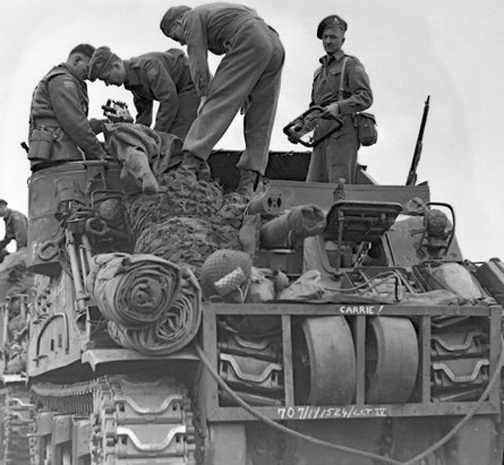
7. Source: MilArt photo archive
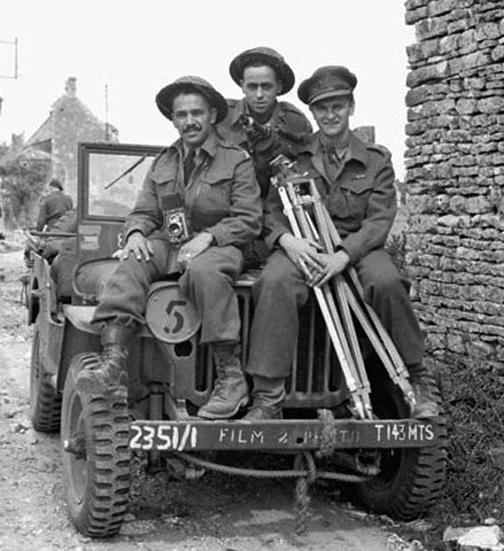
8. Source: Library and Archives Canada/PA-140209
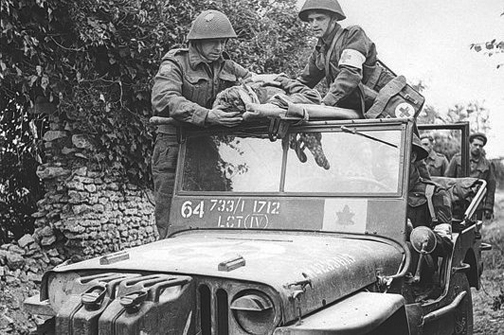
9. Source: MilArt photo archive
As mentioned earlier, in the case of units, such as regiments of the Royal Canadian Artillery, that were made up of sub units, that was each a component part of the parent unit, an alpha suffix letter was added to the one, two, three, or four digit unit serial number, to identify each individual sub unit of the parent unit. Add to this the suffix of a backslash and the number ‘1,’ that was added to a unit’s serial number, as they completed the mobilization process, initiated by Canadian Military Headquarters, and, as an example, the 8th Field Battery, Royal Canadian Artillery (of the 2nd Field Regiment, Royal Canadian Artillery), whose unit serial number was ‘10B,’ would now have the mobilization serial number ‘10B/1.’ Examples of a battery’s unit mobilization serial number applied to their vehicles, as a form of identifying the vehicle’s user unit (aside form the standard ‘Arm of Service,’ and ‘Formation’ sign markings), can be seen in the following two images. In the first image (Image 10), note the application of the unit mobilization serial number ‘449/D-1’ on the extreme right side of the bumper, of a 3-ton, 40-millimetre self-propelled anti-aircraft gun, which identifies the vehicle as belonging to the 32nd (Kingston) Light Anti-Aircraft Battery, of the 4th Light Anti-Aircraft Regiment, Royal Canadian Artillery, whose unit mobilization serial number was ‘449/1.’ In the second image (Image 11) of a T16 carrier towing a 6-pounder anti-tank gun, note the unit mobilization serial number ‘170D/1’ applied to the front edge of the right-hand fender, which identifies the vehicles as belonging to the 108th Anti-Tank Battery, of the 2nd Anti-Tank Regiment, Royal Canadian Artillery, whose unit mobilization serial number was ‘170/1.’
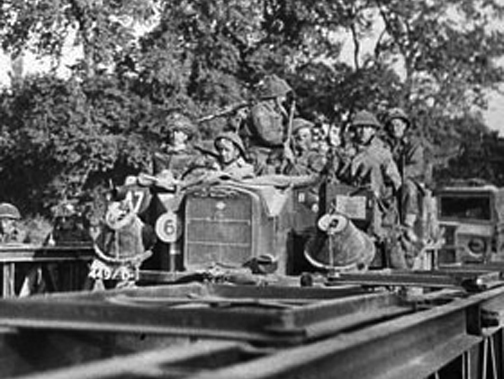
10. Source: Library and Archives Canada/PA-162434
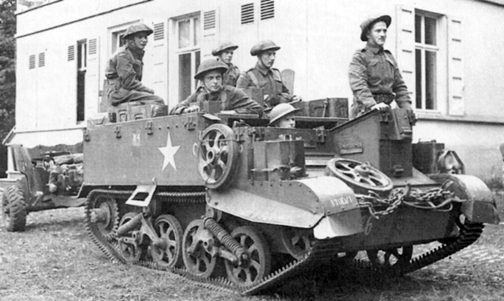
11. Source: Library and Archives Canada/PA-191132
In the following images are examples of a unit’s mobilization serial number applied to unit vehicles during First Canadian Army’s campaign in North-West Europe. In the first image (Image 12) from July 1944 in France, the mobilization serial number ‘1102/1’ applied in the upper left-hand corner on the front of the right-side fender of an armoured car identifies it as belonging to the 7th Canadian Reconnaissance Regiment (17th Duke of York’s Royal Canadian Hussars), Canadian Armoured Corps (the divisional reconnaissance regiment of the 3rd Canadian Infantry Division). In the next image (Image 13) from October 1944 in Belgium, note the unit mobilization serial number ‘192/1’ applied to the front edge of the right-side fender of the universal carrier in the background. This unit mobilization serial number identifies the carrier as belonging to The Calgary Highlanders. In the last image (Image 14), which is taken rather late in the campaign in North-West Europe, showing Canadian vehicles passing through Uedem, Germany, on 2 March 1945, although the motorcycle and the three trucks on the roadway, all carry the same ‘Arm of Service’ marking of ‘67’ the 3-ton truck directly behind the motorcycle, also carries the unit mobilization serial number ‘187/1’ on the extreme right-side of its bumper, thus identifying these vehicles as belonging to Les Fusiliers Mont-Royal.
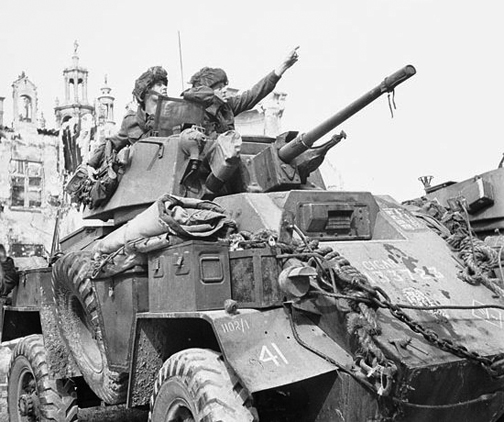
12. Source: Library and Archives Canada/PA-183737
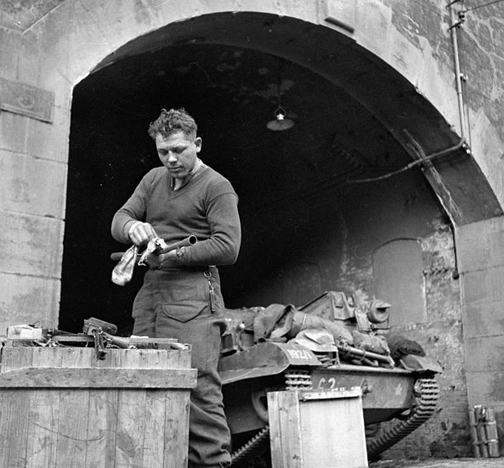
13. Source: Library and Archives Canada/PA-179271
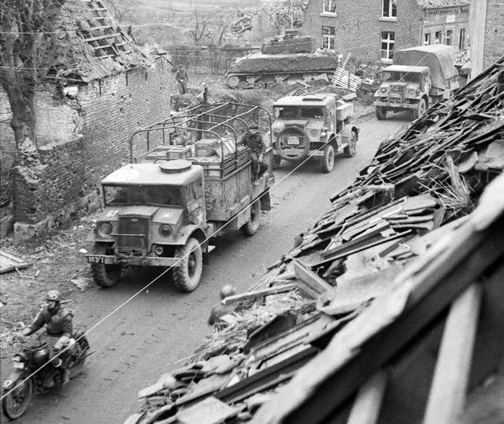
14. Source: IWM B14966
In a future article, the applications of unit serial numbers on kit/baggage/stores of the Canadian Army Overseas, 1943-45, will be looked at.
Acknowledgements:
The author wishes to thank Clive M. Law, Ed Storey, and Michael Dorosh, for reading over my draft copy of this article, and their constructive criticism, and comments, on the draft, and also, Miss Courtney Carrier, for proofing reading, and corrections to my draft copy of this article, and Clive M. Law, for providing photos from the MilArt photo archives, and for publishing this article.
Any errors or omissions, is entirely the fault of the author, who unfortunately, cannot always remember everything.
Bibliography:
Law, CM, Unit Serials of the Canadian Army, Service Publications, Ottawa, Ontario.
Library and Archives Canada, archived photographs database, and digitized images, and various other Files/Volumes, Records Group 24, National Defence
MilArt photo archive, Service Publications, Ottawa, Ontario.
Tonner, MW, On Active Service, A summary listing of all units of the Canadian Army called out and placed on active service, Service Publications, Ottawa, Ontario, 2008.
Notes:
- The Canadian Active Service Force, was the designation given to those units of the Military Forces of Canada, that was called out and placed on active service, between the period of 3 September 1939, to 7 November 1940, upon which date, the Canadian Active Service Force, was redesignated the Canadian Army (Active).
- The Canadian Army Overseas, was the designation given, with effect from 30 December 1941, to that portion of the Canadian Army (Active), who were serving in the United Kingdom and would eventually serve in the Mediterranean (Sicily/Italy), and in European theatres of operations.
- The involvement of the 1st Canadian Infantry Division, and the 1st Canadian Army Tank Brigade, along with ancillary troops, in the forthcoming allied invasion of Sicily, as part of the Eighth British Army, was approved by Ottawa, on 27 April 1943, as communicated to the General Officer Commanding-in-Chief First Canadian Army, in the United Kingdom, by the Chief of the General Staff, Army Headquarters, Ottawa, in Telegram CGS 335, dated 27 April 1943.
- Canadian Military Headquarters (located in London, England), held responsibility for coordinating the arrival, quartering, completing equipment requirements, and training of Canadian units and formations and to command and administer these units and formations in the United Kingdom and at base in the theatre of operations. In addition, the headquarters had an important liaison role, particularly liaison with the British War Office and with the General Officer Commanding Canadian Forces in the theatre of operations, as well as furnishing information to the Canadian High Commissioner in London.
- This process, basically ensured that all units were fully up to strength in terms of the number of personnel, types and number of vehicles, and equipment, each individual unit was authorized, as per their War Establishment and Equipment Tables.
- As an example, the 1st Canadian Pile Driving Platoon, Royal Canadian Engineers, was embodied under unit serial number ‘CM 941,’ under the authority of Canadian Military Headquarters Administrative Order Number 20 of 1945, with effect from 1 February 1945. Serial No. CM 941, 1st Canadian Pile Driving Platoon, Royal Canadian Engineers, was disbanded under the authority of Canadian Military Headquarters Administrative Order Number 81 of 1945, effective 16 June 1945.
- A legal instrument made by the Governor in Council pursuant to a statutory authority or less frequently, the royal prerogative. All orders in council are made on the recommendation of the responsible Minister of the Crown and take legal effect only when signed by the Governor General.
- The Canadian Section General Headquarters, 2nd Echelon, was a Canadian Section that was attached to a “higher” headquarters’ 2nd Echelon (Example: to 2nd Echelon, 21 Army Group, in Northwest Europe, and to 2nd Echelon, Allied Forces Headquarters, in Italy), and whose primary responsibility was the provision of Canadian reinforcements for units in the field.
- Unit markings, also known as the ‘Arm of Service’ markings, were normally a 9½-inches by 8½-inches (24.1 by 21.6-centimetres) rectangle, consisting of a coloured background, appropriate to the formation, corps or branch of the service, to which the unit belonged, onto which a centrally located one, two, three, or four digit number, in white, was stenciled. These numbers, referred to as the ‘Arm of Service Serial,’ were blocks of numbers that were assigned to formations to identify individual units. Formation signs, which were normally a 6½-inches by 9-inches (16.5 by 22.9-centimetres) rectangle, were used to indicate the parent formation to which a vehicle’s unit belonged. The standardization, sizes, and positioning of all markings used on vehicles, followed the policy, as set down by either the Senior Officer, Canadian Military Headquarters, for formations under Canadian Military Headquarters control, or Staff Duties, Headquarters First Canadian Army, for formations under First Canadian Army control, which in turn, followed vehicle marking polices, as set down by the British War Office.
- Operation HUSKY, was the code name given to the allied invasion of Sicily, in which elements of the 1st Canadian Infantry Division, and 1st Canadian Army Tank Brigade, took part in the seaborne assault landings on 10 July 1943, as part of General Bernard Montgomery’s Eighth British Army.
- The 1st Canadian Army Tank Brigade, had been redesignated the 1st Canadian Armoured Brigade (Independent), with effect from 26 August 1943.
- Operation BAYTOWN, was the code name given to the Eighth British Army’s part, in the allied invasion of Italy, which commenced on 3 September 1943.
- Operation OVERLORD, was the code name given to the allied invasion of Normandy, in which elements of the 3rd Canadian Infantry Division, and 2nd Canadian Armoured Brigade (Independent), took part in the seaborne assault landings on 6 June 1944, as part of Lieutenant-General Miles Dempsey’s Second British Army.
by Clive Law
During the summer of 1959, the Queen, accompanied by Prince Philip, undertook the longest Royal tour in Canadian history (Buckingham Palace officials and the Canadian government opted to dub this a “Royal tour”, as opposed to a “Royal visit”, to dispel any notion that the Queen was a visiting foreigner.) The catalyst for the tour was the ceremonial opening of the Saint Lawrence Seaway, but beyond that, the intent was to visit many outlying districts never before visited by royalty. All ten provinces, four of the Great Lakes, both Territories (as existed at the time) and a visit to the United States were covered in an exhausting fifteen thousand mile, forty-five day tour.

The 1959 Continental Mark IV
In order to accomplish this task the Government of Canadian, with the logistical support of the Royal Canadian Army Service Corps and the Royal Canadian Air Force, made plans for both road and air travel for the Royal guests. In the expectation of large crowds who would line the Queen’s route in every town and city it was decided that an appropriate limousine would be needed. The Government contacted each of the ‘big three’ car manufacturers and each offered to provide a limousine suitable for Royalty.
“For the Royal Tour of Canada in 1959, the Big Three auto manufacturers, General Motors. Ford and Chrysler, competed once more for the honour of transporting royalty, Her Majesty the Queen andPrince Philip. On lune 13, 1959 a Lincoln, a Chrysler, and a Cadillac — all to be used on the tour — were displayed before the Peace Tower at the Parliament Buildings. At first the government had considered using fourteen limousines and fourteen convertibles, stationing two in each of the cities to be visited. Then the decision was made to use only three and to fly them ahead of the royal couple. The Chrysler and Cadillac had removable glass tops over the rear passenger compartment and only the Lincoln was a convertible. “Her Majesty and Prince Philip will have every conceivable luxury… the flooring material looks like dyed mink. There is a button that enables the Queen to shift the seating arrangement in any one of six ways. The Ottawa wrote “Prince Philip gets to move his two ways, forwards and hack. The cars cost about $ 150,000 and look every dollar of it. The spare tires are covered in special cloth, which somebody recalled as mohair…. There is no armour plate or bulletproof glass, confided the Citizen reporter, “The royal couple have nothing to fear but too much affection from Canadians.” “Very handsome,” said Prime Minister John Diefenbaker, who left a cabinet meeting to be photographed with the three cars. After the tour, the cars were auctioned off to the highest bidder.”[1]
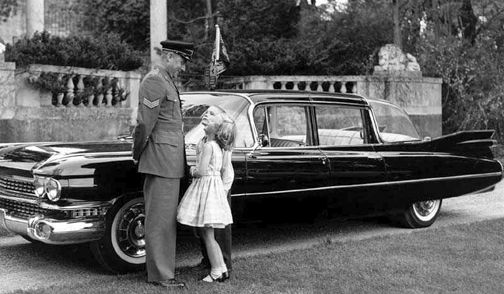
The driver drawing special interest from this young lady.
These three cars were: A Continental Mark IV, a Cadillac Custom 1959 Fleetwood Limousine and a Chrysler-Ghia Crown Imperial (this was a 1957 model upgraded for 1959). The Cadillac and the Continental were customized with a Landau-style roof permitting the Queen and Prince Philip to not only be seen by her loyal subjects but also to allow them to stand. Individually powered rear seats are installed with controls for the horizontal and vertical movement located on the individual arm rests [in the right-hand armrest, the Queen’s side, was also located a knob for remote-control of the car’s radio]. The Cadillac seats were tailored in silver-grey McLaughlin Carriage cloth, with matching cushions, in a distinctive square biscuit and button design and the floor was carpeted with luxurious mouton which extended up the doors.
During the tour each of the three cars was air-lifted by an RCA C-119 Flying Boxcar requiring that each car be used on a rotation basis during the 6-week tour.
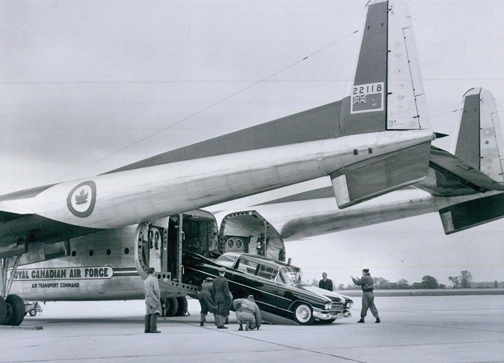
During the tour the three cars were ferried across the country by RCAF C-119 ‘Flying Boxcar’ aircraft.
The cars featured a maximum of comfort, convenience and luxury for the passengers with the greatest possible outside-inside visibility for the millions who lined the coast to coast parade routes. To provide an even greater measure of air-conditioned comfort, two additional outlets are installed in the rear compartment. The two new air-conditioned outlets are on the back of the front seat. In the Cadillac other special appointments included mouton-covered hassocks, a lap robe carrying a hand embroidered crest of the royal household [in hues of red and gold] and special lights to illuminate the Royal Couple during after-dark processions. Her Majesty certainly earned the right to some luxury as the 45-day visit included 17 military parades, 21 formal dinners, 64 guards of honour and 381 platform appearances.
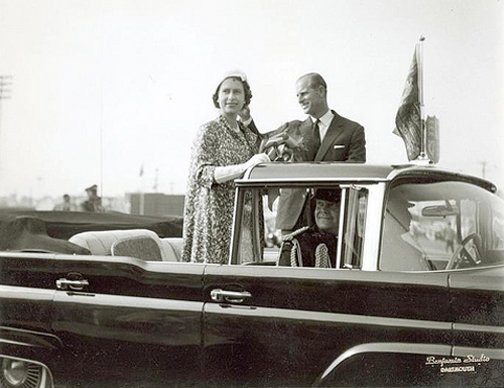
Their Majesties taking advantage of their freedom to stand in the car.
A more complete description of the Cadillac states:
The upper portion of the car quarter panel has been removed from the rear door post on back. It has been replaced with a removable Plexiglas canopy that will permit onlookers the opportunity to view the royal procession even if the weather fails to co-operate. It is anticipated that in most parade points the car will operate with the top removed in the true landau concept. The roof is further modified with the addition of a 24-inch by 43-inch sliding panel. Electrically operated, the roof panel can be opened or closed from both the rear and front compartments.
Each of the three cars had a Royal shield and had an anchored staff on the leading edge of the roof, centered above the windshield, for the royal standard. The Royal standard was fitted with a chrome rings that fit snugly into the staff.
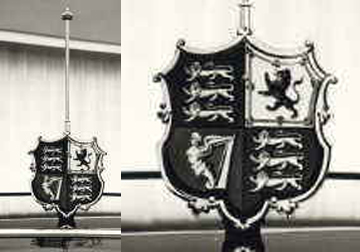
The Royal shield and the Royal standard’s chrome staff.
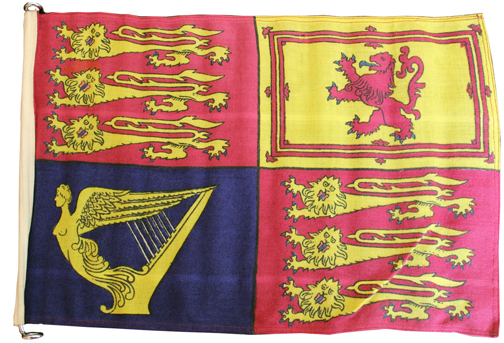
One of the Royal standards used during the tour. The chrome stand with integral rings can be seen. Courtesy Dean Owen
Acknowledgement – Dean Owen for the loan of photographs as well as an original standard with staff.
[1] Royal Transport: An Inside Look at The History of British Royal Travel. Peter Pigott, Dundurn Press.
You can rate this article by clicking on the stars below
by Clive M. Law
The 48th Highlanders were authorized under General Order # of 1891 as the 48th Battalion (Highlanders) and took the spot vacated by the 48th Lennox and Addington Battalion when the latter were dissolved. As a highland regiment in the centre of Toronto the regiment attracted many of Toronto’s leading citizens and was, for many years, considered a wealthy regiment.
The 48th Highlanders chose a falcon over the number ‘48’ the whole encircled by a buckled belt upon which were the words ‘Dileas Gu Brath’ (Faithful Forever). The falcon’s head was taken from the family arms of the 48th’s first Commanding Officer, John Irvine Davidson. In approximately 1904 the badge was changed by adding a semi-circular banner below the falcon’s head upon which were the words ‘Highlanders’.

Original badge authorized for the 48th Battalion (Highlanders) (Black & white image). Courtesy Mark Passmore
It was with variants of this badge that the 48th went to war in 1914, having raised the 15th Battalion CEF as well as two reinforcement battalions, the 92nd and 134th Battalions CEF. All three battalions wore badges that immediately identified their link with the pre-war Militia Regiment.
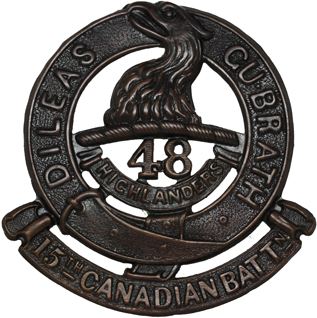
Badge of the 15th Battalion, CEF. The link to the 48th Highlanders is unmistakable. Courtesy Mark Passmore
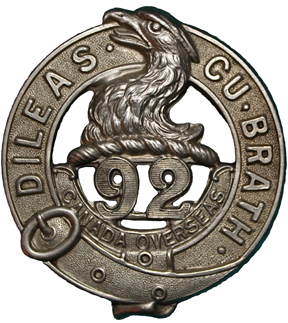
Badge of the 92nd Battalion, CEF. This battalion was broken up for reinforcements once in England. Courtesy Mark Passmore
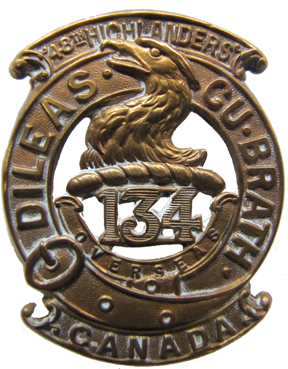
Badge of the 134th Battalion, CEF. As with the 92nd Bn, the 134th was broken up and never saw active service in France. Courtesy Mark Passmore.
Following the First World War, the Commanding Officer of the 48th responded to a survey being undertaken by Militia and Defence Headquarters (later National Defence Headquarters (NDHQ)) by supplying a card with all of the regiment’s badges. The purpose of this 1921 survey was to update the badge descriptions in Dress Regulations, the last comprehensive set of these dating to 1907. In the 1907 Dress Regulations the badge was described as:
A falcon’s head (compel), or, resting on a bar, beneath which is placed the numerals “48”, in Roman block, all surrounded with a circular ribbon bearing the motto Dileas Gu Brath. Silver for officers, white metal for N.C.O.s and men.

Badge adopted in 1904 but not recorded in the 1907 Dress Regulations. It was this badge that the Regiment wished to maintain after the First World War and through the argument over the ‘Garter’ belt. Courtesy Mark Passmore
NDHQ approved the design that had been taken into use in the intervening years and published General Order 71 of 1922 which now described the badge as:
Gilt. Within a circular riband inscribed “Dileas Gu Brath” the numerals “48” above which, on a bar, is a falcon’s head: Below the numerals is a semi-circular scroll, inscribed “Highlanders”.
It is surprising that NDHQ approved this design as it was contrary to Militia Order 208 of 1906 which had already raised the issue of the improper use of the Garter and which was quoted in the March 1929 letter.
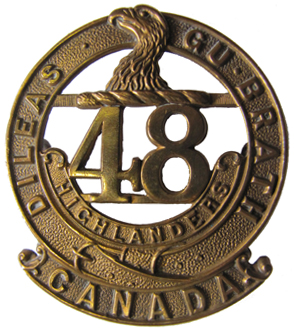
48th Highlanders badge with “Canada” scroll. Courtesy Mark Passmore
Regrettably, a number of documents are missing from the archival files but it is known that in May 1929 the Adjutant of the 48th Highlanders wrote to NDHQ (via the Military District No.2 Adjutant) that a drawing showing their badge was incorrect. The author infers that the drawing provided by NDHQ was instigated by a policy change for badges in the Canadian Militia that required all badges featuring the Belt of the Order of the Garter to be replaced. By policy, any buckled belt was seen as an infringement of this ‘honourable and ancient’ design. The use, or permission to use, was solely a Royal prerogative.
The policy saw a number of Militia regiments forced to change their badges; however, the cost of such change was to be borne by NDHQ and not on the individual regiments. It was immediately obvious that the 48th Highlanders were not pleased with the proposed change and the Adjutant drafted a letter, on 6 May 1929, complaining about the drawing, stating:
The attached drawing is not concurred in by this Regiment. […] The design submitted [by NDHQ] is not a garter but just a circle. There is no buckle nor strap; also the scroll under the falcon is not properly finished but disappears in an uncertain way underneath the circle. The falcon head also seems to lack a spirited, erect carriage…
The 48th Highlanders Adjutant referred to his letter’s letterhead which, according to the Adjutant, was the badge which the regiment wished to continue wearing. NDHQ replied that the regiment’s design ‘is incorrect’ and referred the Adjutant to Circular Letter No. 7, dated 5 March, 1929 (the original letter stating that it was ‘incorrect and improper for the ‘Garter’ to bear any inscription other than the motto of that Order.)
Little more was said until the 21 September, 1929 when Lt-Col Sinclair, DSO MC, Chairman of the Regimental Dress Committee forwarded a report to NDHQ. Copies of the report have not been located but it was not well-received at NDHQ. However, a copy of Headquarters’ reply survives. No less than the Adjutant-General himself, Major-General Panet, wrote “…the nature of the remarks […] constitutes a serious breach of discipline.”
Panet’s letter caused Lt-Col Sinclair to immediately apologise and explain that the report had not been endorsed by Lt-Col H.M. MacLaren, Commanding Officer of the 48th Highlanders and he regretted any idea of discourtesy. Lt-Col MacLaren also wrote to the District Officer Commanding, to be forwarded to NDHQ, asking that the report be returned in order that the regiment could submit a new report.
A few days later the MacLaren wrote:
This Regiment had no idea that our Badge infringed in any way on the Badge of the Garter and had no desire or intention of doing so. It was authorised officially when the Regiment was formed, has been used ever since and was worn with honour by our service battalion in France. In this way it is carved on many graves in France and Belgium and the regimental monument in Toronto, as well as on our cups, plate and equipment.
The suggested badge does not meet with the approval of the officers of the Regiment and it is with the greatest reluctance that we bring ourselves to consider any change. As this is a matter that affects all officers, both past and present, we would like to bring it to their attention, which we intend to do shortly, when a further report will be forwarded.
NDHQ was satisfied that the 48th Highlanders would now give due consideration to their future badge and agreed to a delay. However, on 10 December 1929, the 48th Highlanders submitted new arguments for the retention of their existing badge:
On carefully examining the Badge of the Order of the Garter and comparing it with the Regimental Badge, a number of differences are noted.
The Regimental Badge should be more correctly described as a Buckle, and not a Garter, as the Garter has a completes circle for its clasp, whereas the buckle of ours has only a single piece for the clasp. Moreover, the loose end of the Garter in its dependent part finishes as a tassel, as in garters, known in Highland dress as a garter knot, whereas ours has no such tassel. Further, the circle in our Badge is broken in the upper part with the Falcon’s head erased which is superimposed upon it and projects over the upper edge.
The Garter being of such antiquity that, we are sure, nothing would be allowed to be placed over it, thus upsetting its continuity.
The motto in the circle of our Buckle is a Gaellic (sic) one, fitting for a Highland Regiment.
We would therefore respectfully suggest that for these reasons our Crest is in no way an infringement on the Ancient and Honourable Order of the Garter, and that permission be granted to us to continue in the use of our present badge which has been in use for years and is engraved on our monument, silver, etc.
Headquarters was not swayed by the argument and replied that the ‘actual shape or design of the buckle used’ was immaterial and that there was ‘no doubt that the buckled band…is incorrect’. NDHQ re-iterated that, while present stocks could be used up, future supply was to conform to the amended design.
In mid-January 1930, NDHQ followed up with the 48th Highlanders who requested that as a change in the regimental title (from 48th Regiment (Highlanders) to the 48th Highlanders of Canada) was the subject of a meeting with the officers of the regiment, that their reply be held in abeyance. NDHQ agreed to the delay.
On 20 March 1930, NDHQ was asked to approve the name change but, before NDHQ agreed to this, they raised the question of badges – again. On 12 July NDHQ wrote:
National Defence Headquarters advises that before further action is taken to approve the change in title of the 48th Regiment (Highlanders) the question of the cost of new badges is to be brought to attention.
As stated in previous correspondence the cap badge of the Regiment requires modification, viz, the Garter has to be replaced by a double circle.
The cost to the Department of this alteration would be approximately $50.00
Should you desire to have new designs of badges as the result of the proposed change in designation, the cost at new dies and tools and a complete issue of badges must be borne regimentally.
In order to move forward with the new regimental designation they reluctantly agreed to the change in badge design and, consequently, General Order 99 of 1930 authorized the change. Within days NDHQ asked the 48th Highlanders what action they had taken to ‘with a view to correcting the badge’ and that, if no action had yet been taken, at what date ‘that such will be done’. The regiment replied that ‘the unit is not at the present time in a financial position to undertake the expenditure involved in furnishing dies, tools and new badges’ and that the matter be ‘left in abeyance for the time being’. This reply was to set the tone for several years to follow.
In June 1931, NDHQ asked again. The regiment again stated that they could not afford to make the change-over.
In October 1932, NDHQ asked again. The regiment pleaded poverty again.
In March 1933, NDHQ asked again. The regiment repeated their inability to pay at that time.
In April 1934, NDHQ asked again. The regiment asked for the matter to be held over, again.
In October 1934, NDHQ asked again. The regiment asked for yet another extension.
In October 1935, NDHQ asked again. The regiment repeated their request for yet another extension.
Finally, in October 1936, NDHQ draws a line in the sand and sets distinct expectations from the 48th Highlanders:
With reference to your letter of the 25th October and previous correspondence on the marginally noted subject, I am directed to forward to you the following information on this matter.
The design of the “ground” upon which the motto “DILEAS GU BRATH” is placed comes within the scope of what is deemed to be a “garter”. As the Garter motto only, is permitted by His Majesty to appear on the “garter” in any crest or badge, it is regretted that the continuance of the “garter” design on the badges worn by the unit under your command must cease.
On account of this change and also on account of the change of name of the Regiment adopted since the badge at present worn was designed, you may wish to submit for approval an entirely new design of badge. Should you wish to take this course, the cost of making the necessary dies will have to be borne regimentally.
Should you on the other hand decide to retain the present design of badge but with the motto being on a “double circle” (as authorised by G.O. 71 of 1922) in place of on the garter, the Department is prepared to pay for making the necessary dies and supply of badges. Your attention is drawn to the fact that the change of design in badges will in no way affect any present regimental property such as mess plate, drums, pipe banners and so forth.
The changes that would be necessary after the effective date of the change has been given might be summarized as follows:
All newly appointed officers to wear the new pattern badges.
The remaining officers to replace old badges with the new pattern by a date to be determined.
All other ranks to wear new pattern badges as soon as issued.
Badges placed on regimental property purchased (or in the case of drums, etc., on being repainted) after the effective date of the change to be of new pattern.
While the feelings of the unit at this change are fully understood, nevertheless you are reminded that many regiments in all branches of His Majesty’s Empire Forces have been affected in like manner in recent years.
There is no indication of a reply from the regiment and, on 9 January 1936, NDHQ followed up again, asking if the regiment intended to propose a new design or if they would accept the motto to be placed on a ‘double circle’? Incredibly, the Commanding Officer, now Lt-Col J.P. Girvan, asked for an extension until March, at which time the options would be brought forward to all of the officers of the regiment. Perhaps more incredibly, NDHQ agreed to the delay, bringing the question of a change in badge design to almost seven years.
Finally, on 3 March 1936, Lt-Col Girvan agrees to adopt the badge authorized by G.O. 71 of 1922, with the addition of the words ‘of Canada’. Girvan also committed to sending a revised drawing, which he did several weeks later.
One would expect that the situation was finally resolved and that the 48th Highlanders had bowed to the rules of heraldry. However, a parsimonious NDHQ entered the fray yet again. In April 1936, the Master-General of the Ordnance wrote to the 48th Highlanders and explained that the offer to change the badge at DND expense was based on removing the offending buckle. If the regiment wished to otherwise change the badge or add the words ‘of Canada’ then the expense was to be borne regimentally – the same position they held in 1929. Several days later, the new Commanding Officer of the 48th Highlanders, Brevet Lt-Col G.M. Alexander, agreed to accept Design No.90, as proposed by NDHQ years before.
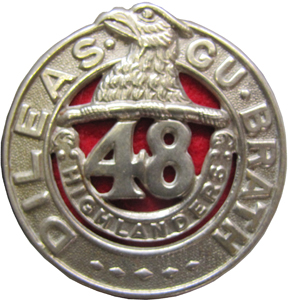
The final post-buckle design. Notwithstanding that this badge was accepted (albeit reluctantly) by the 48th Highlanders in 1936 many of the older style continued to be worn throughout the Second World War. Courtesy Mark Passmore.
As if to add insult to injury, NDHQ corresponded with the regiment once again, in January 1938, about badges. In this case it was the badge shown on the regiment’s letterhead which continued to feature a buckled belt.

The offending letterhead which, in 1938 still used the buckled belt.
Although no documentation has been located, it has been stated that the 48th Highlanders were redeemed post-Second World War when it was finally agreed that the buckled belt was not a garter belt but was a traditional Scottish device. Had this decision been made in the 1920’s this article would never have been written.
Source – Library and Archives Canada, Record Group 24, File 325-009 (D219)
You can rate this article by clicking on the stars below
by Clive M. Law
In 1907, the Red Deer’s first militia unit, an independent troop of the 15 Light Horse, was formed. The creation of a permanent presence for the militia in Red Deer was greeted with great enthusiasm. The troop grew so rapidly that it was soon expanded into the Red Deer Independent Squadron of the 15th Light Horse.[1]
On April 5, 1911 the District Officer Commanding (DOC) Military District 13 (MD13) submitted a badge design for the Red Deer Independent Squadron of Light Horse.
Lieutenant Lionel F. Page and members of his troop of the Red Deer Independent Squadron of the 15th Canadian Light Horse on manoeuvres at Sarcee Camp near Calgary, Alberta. Inscribed in pencil on verso: “Page’s troop”. Circa 1910
The design sketch is long missing but we know that both cap and collar badges were identical in design but differed in size, with the cap being 1.5 inches high and 1.25 inches wide, while the collars were 1.25 high and 1 inch wide. The badge was to be of gilding metal. It can be inferred from later correspondence that the proposed badge lacked a motto.
Three months later the Commanding Officer of the squadron, Major Harold L. Gaetz[2], was asked to explain the significance of the badge in order to advance the proposal and publish the design in Dress Regulations. Regrettably, Major Gaetz was not forthcoming. In fact, Gaetz was the subject of eight separate letters from the DOC MD13 to which he did not reply.
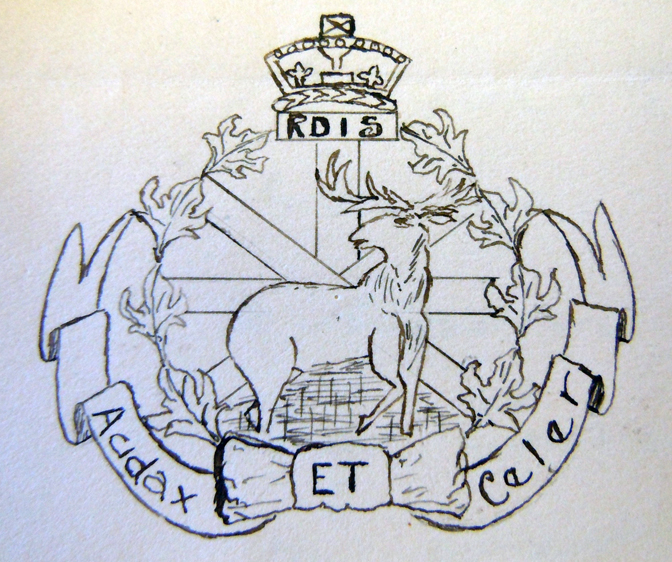
Hand drawing of the badge from the Archives files.
Finally, in mid-October, Major Gaetz finally replied and provided a detailed drawing as well as a more complete description of the badge;
Circular wreath [of] maple leaves, on ribbon scroll on which is inscribed Regimental motto ‘Audax et Celer’ (Bold and Swift). The top of the wreath joined by straight bar on which is inscribed the letters R.D.I.S. the whole surmounted by Tudor crown. The wreath surrounds a Union Jack, in the foreground is a Canadian Red Deer standing in water.
The badge was to be in gilt with the stripes of the Union Jack, maple leaf wreath and letters in silver.
Surprisingly, Militia Headquarters responded on 8 November with a draft authority pending the unit’s response to HQ’s concern that the ‘silver motto on a gilt scroll’ was not practicable. In spite of the squadron’s motto’s suggestion of ‘swift’ it would be 25 December before Gaetz replied that ‘The cap and collar badges will be satisfactory with the alterations as per your letter.”
Notwithstanding the approval, there is no indication that a badge was ever produced.
Postscript – The final document on file has two hand-written minutes, both undated. One refers to an amendment to Dress Regulations while the other effectively closes the file, not just on the badges but on the entire squadron; “This independent squadron is now merged in the 35th Central Alberta Horse.” This Alberta unit was formed in 1913 with headquarters at Red Deer and squadrons at Red Deer, Pine Lake and Wetaskiwin.
Library and Archives Canada, RG24, Volume 271
[1] Michael Dawe, Red Deer Express. Published, November 13, 2013
[2] Harol Leonard Gaetz died at Courcellette, 26 September 1916 and is buried at the Vimy Memorial, Pas de Calais, France
You can rate this article by clicking on the stars below
by James J. Boulton
The 41st Brockville Battalion of Rifles was raised in Brockville, Ontario on 5 October 1866, It was re-designated the 41st Regiment “Brockville Rifles” on 8 May 1900, and then sequentially The Brockville Rifles on 12 March 1920; and the 2nd (Reserve) Battalion, The Brockville Rifles on 18 March 1942. The regiment would have worn the entire historical sequence of British field service caps.
The regiment wore the British Forage Cap for Field Service and Peace Manoeuvres (the “ Torin” cap) from its inception, then in 1890, the Universal Pattern Field Service Cap was taken into service for other ranks. All other regiments wore blue caps but rifle green was ordered for Rifle regiments.
In Britain, the field service cap was abandoned in 1902 in favour of a homely Broderick cap for other ranks and the 1898 staff pattern for officers, but it remained in service in Canada and in India.
In 1937, with the introduction of a new Battle Dress order of dress, there was new interest in the Universal Pattern, re-established in khaki and in colours and distributions of piping or braid on the curtain, crown and / or front and back seams of the crown according to regimental preference. This distinguished units and provided relief from the drab khaki uniform.
The dates for the authorization of the pattern for the Brockville Rifles are so far unknown. The Dress Regulations 1943 specify only “green”. The regimental colours were rifle green and scarlet but the colour of an available example is a very dark green, similar to that seen in the Dufferin and Haldimand Rifles of Canada.
The regulation pattern for the regiment was specified to be: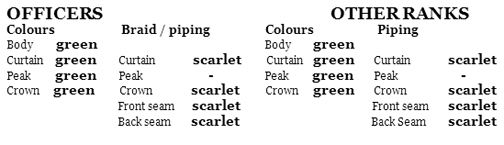
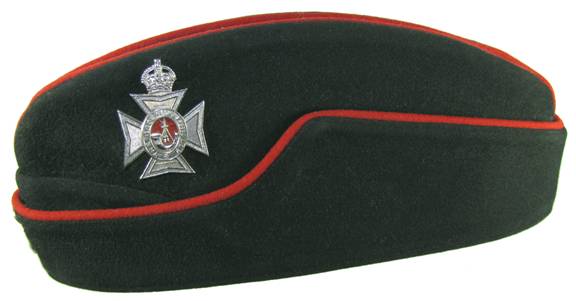
An officer’s cap by William Scully Ltd. White metal General Service buttons (CML collection)
The Universal pattern was finished with two buttons at the front of the curtain. The buttons for this cap could correctly be white metal, gilt or brass General Service buttons, or black Universal Rifle pattern or General Service buttons.
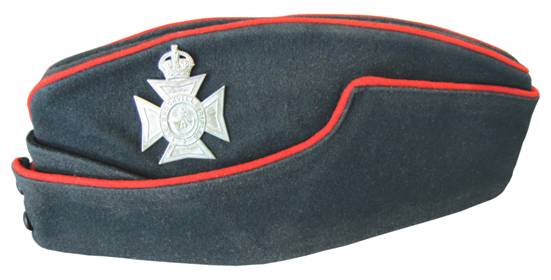
A quality-made other ranks’ cap. The buttons are plain black. (CML collection)
Some British and Canadian rifle regiments finished the officers’ coloured field service caps with a traditional boss, a hemispherical cord badge worn on the front of the cap. The Queen’s Own Rifles of Canada was unique in providing for a scarlet pompon for other ranks. A boss was not worn by the Brockville Rifles.
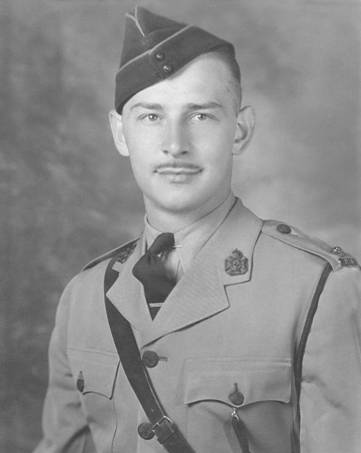
Lieutenant Henderson of the Brockville Rifles. His cap buttons are black, and either General Service or the Universal Rifle pattern. (MilArt Photo Achives)
Coloured field service caps continued to be worn for a time after the war and there were no changes for the regiment in the Dress Regulations 1947. Although they were never formally abolished, there was not a suitable order of dress for their use in the Dress Regulations 1953 and the caps gave away to attrition.
Rifle regiments of the Canadian Militia however showed a continued interest in their coloured Field Service caps.
On March 8, 1988, the Directorate of Ceremonial at National Defence Headquarters requested that the five remaining Rifle regiments confirm the design specifications for their coloured Field Service caps, as well as their accoutrements. The intent was to provide standardization within and among the regiments and to provide guidelines for the use of makers of these items at regimental expense.
No changes were made in the patterns described in the Dress Regulations 1943 for the Queens Own Rifles of Canada, the Voltigeurs de Québec and the Royal Winnipeg Rifles
There were changes for the remaining two regiments. The Brockville Rifles and the Regina Rifles, then the Royal Regina Rifles. For The Brockville Rifles, there was a considerable change in the distribution of the piping.
 The 2011 Canadian Forces Dress Instructions (A-DH-265-000/AG-001) provided in Chapter 6, Paragraph 16f for headdress for undress order in accordance with branch or regimental custom, including
Berets or wedge caps (including those latter styled and coloured as field service caps for undress wear with full dress)
and Chapter 5, Section 1, Paragraph 4c that for rifle regiments
Customary approved pattern undress field service (wedge) caps are authorized for wear as optional items by all ranks of rifle regiments with ceremonial, mess and service orders of dress, in lieu of other authorized headdress.
Several named photographs of members of the Brockville Rifles taken in 1942 show the other ranks’ equivalent of a boss in wear, a scarlet pompon. It would appear that the other ranks had defaulted to this distinction authorized for the Queen’s Own Rifles of Canada.

Left, Cpl. B. Lampkin. Right, Rfmn C.R. Hyndman. Both wear OR CFSCs with the unauthorized pompom. Photo courtesy Major Roger Hum, The Brockville Rifles Museum
Ref: Boulton, J.J and C.M. Law The Canadian Field Service Cap Service Publications 2014
Special thanks to Captain Richard J.S. Law, The Brockville Rifles, for the 2011 updates.
You can rate this article by clicking on the stars below
by Casey Anderson
The Canadian Corps Cyclist Battalion was formed from the Canadian Divisional Cyclist Companies and existed from May 1916 until the battalion was disbanded on 15 November 1920. Ironically, the “gas-pipe cavalry” was done-in by peace and not war. As has been outlined in other historical texts, the Cyclists were an instrumental unit of Brigadier-General Raymond Brutinel’s “Independent Force” (also known as the Canadian Automobile Machine Gun Brigade or simply “Brutinel’s Brigade”) in the 100-Day offensive which brought about the conclusion of the First World War, and the Canadian Corps Cyclist Battalion distinguished themselves in the offensive. Today, the Intelligence Branch of the Canadian Armed Forces perpetuates the Canadian Cyclists as they were originally formed from the Corps of Guides troops massed at Valcartier Camp, outside Quebec City, and were intended to fill what we would recognize today as a tactical field intelligence/reconnaissance role on the battlefield.
A cyclist of Brutinel’s Brigade, at Rockliffe (Ottawa) on the occasion of the Governor General’s inspection. MilArt photo archives
An un-named officer of the Canadian Cyclists. Note the distinguishing patch (also termed a ‘battle patch’ by the troops) on the sleeve of his service dress.
The Canadian Corps Cyclist Battalion Association took a stand of flags (a “battalion” and “King’s” Colour) into use at their Annual General Meeting in August of 1934. The Union Jack, in cotton (140cm in length and 67.2cm in height), was used as the King’s Colour. The “Battalion Colour” was a field of white cotton emblazoned with the triangular battle patch of the Canadian Corps Cyclist Battalion (126.8cm in length and 88.5cm in height). Although the Battalion was formed from all of the Canadian Corps’ Divisional Cyclist Companies, the Battalion was primarily comprised of men from the 1st (Red), 2nd (Royal Blue) and 3rd (French Grey) Divisions; therefore, their combined divisional patches formed the basis of the triangular Canadian Corps Cyclist Battalion patch.1
The “King’s Colour”. Courtesy of the author.
The ‘Battalion Colour’. The battle patch was believed to be sufficient symbology for immediate recognition. Courtesy of the author
Neither flag was emblazoned with battle honours. In spite of the heavy losses taken by the Cyclists, the Canadian Corps Cyclist Battalion had not yet been awarded battle honours. This is peculiar as other Commonwealth Cyclist Battalions were considered to be “bicycle infantry” and were therefore eligible for, and awarded, battle honours.This is even more unusual as the Cyclists’ role in Brutinel’s force can only be described as combative in nature; all other combative units in the force were awarded multiple battle honours in the final 100-Days offensive. The Canadian Corps Cyclist Battalion was likely not awarded battle honours because the battalion had been disbanded by the time the government was awarding battle honours in the late 1920s, and had no formal predecessor at the time in a position to advocate for it.2
Recruiting poster that promised the glamourous side of service. Courtesy of the author
Brutinel, Founder of the Canadian Automobile Machine Gun Brigade.
What is unclear, is whether Commonwealth Cyclist Battalions of the First World War were officially entitled to Stands of Colours or were they treated in the same fashion as Rifle regiments which received Battle honours but do not carry Colours? Nonetheless, the Canadian Corps Cyclist Battalion Association chose to adopt these flags as “Colours”. Insofar as the author has been able to discern, the only legal definition of a Colour is a flag or piece of bunting which has been consecrated in a ceremony. The Cyclists were justifiably proud of their service and the flags provided the Battalion Association with an outward symbol of that pride. To that end the Battalion Association ensured that the proper ceremonial protocols which transform flags into Colours were followed. The Battalion Association’s stand of Colours was consecrated by Bishop Robert John Renison (Anglican) in Toronto, Ontario on 27 June 1937 in a full consecration ceremony at that year’s Battalion Association Annual General Meeting. The ceremony likely took place at Trinity College at the University of Toronto, where Bishop Renison presided. The “Colours” were used at every subsequent Battalion Association meeting, given pride of place at all of their events, and treated for all intents and purposes as a Stand of Colours.

Line-up of cyclists parading next to the Autocars purchased by Brutinel. MilArt photo archives
Significantly (and symbolically), the “Colours” were deposited at the Canadian War Museum by the unanimous decision of the surviving members of the Canadian Corps Cyclist Battalion Association on 16 April 1987. The decision to deposit the “Colours” was significant because it was an acknowledgement on the part of the men of the Battalion Association that they would not live forever. Its symbolic importance must also be recognized: Colours can either be laid-up (as is the case with most retired Colours), or deposited (placed into safe-keeping). Those Colours which have been deposited (as opposed to laid-up) can be retrieved at a later date when the unit is revived to serve the nation again.The “Colours” of the Canadian Corps Cyclist Battalion Association remain deposited in the archives of the Canadian War Museum today.
One of the few photographs showing the Cyclists at the Front. Courtesy of the author
They were deposited by the Battalion Association’s National Secretary Capt (Ret) Wilfred Dancy “Dick” Ellis (then aged 91), who was at that time one of the final surviving members of the Canadian Corps Cyclist Battalion. In 1934, the same year as the Battalion Association adopted its “Colours”, Capt Ellis (then the Association’s National President) purchased a bottle of Pol Roger Champagne and donated it to the Battalion Association. It was Capt Ellis’ wish that the champagne should be consumed jointly by the final two survivors of the Battalion. Incredibly, Capt Ellis would go on to be one of these two survivors. Ellis (then 96) shared the bottle in 1992 with Billy Richardson (98) in Toronto and reminisced. These two men had also been members of the Corps of Guides before transferring into the Cyclists. Captain Ellis was the final known surviving member of both the Corps of Guides and the Canadian Corps Cyclist Battalion when he died on 14 August 1996.
1. For more information on the Battle Patches of the Canadian Expeditionary Force refer to Clive Law’s “Distinguishing Patches, Service Pubilcations, Ottawa.
2. The author intends to query this issue with DND.
You can rate this article by clicking on the stars below
by Clive M. Law
The following Parade State is the first step in an on-going research project on the Pattern 1908 ‘Star’ Helmet Plate worn by many of the troops on parade.
As more information is uncovered this article will be updated.
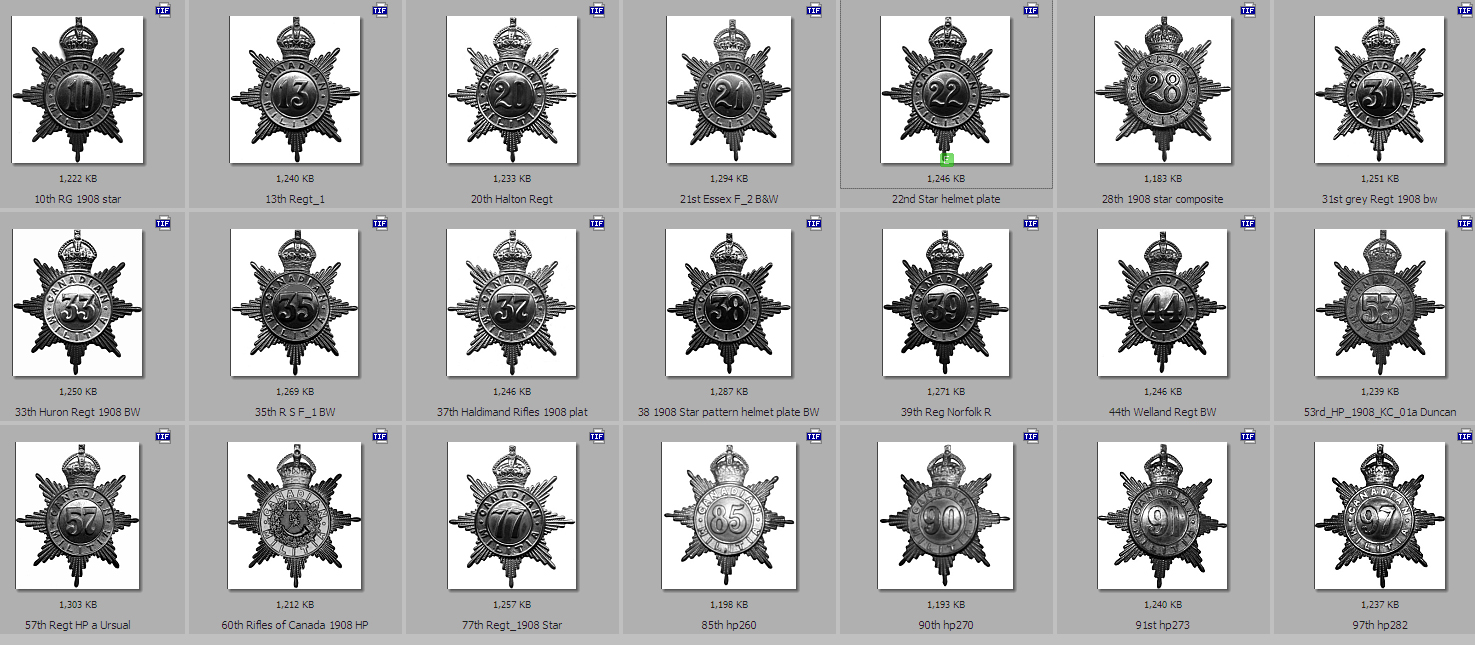
A small selection of Pattern 108 Helmet Plates. Please contact the author if you can add to this.
(1) Gentlemen Cadets, Royal Military College – 1 Company
(2) Corps Troops
Royal Canadian Horse Artillery
Royal Canadian Dragoons
Royal Canadian Garrison Artillery
Royal Canadian Engineers
Royal Canadian Regiment
Canadian Permanent Army Service Corps
Permanent Army Medical Corps
Canadian Ordnance Corps
Canadian Army Pay Corps
(3) 1st Division
1st Western Ontario Brigade
7th Fusiliers
13th Regiment*
21st Essex Fusiliers*
91st Canadian Highlanders*
2nd Western Brigade
2nd Queen’s Own Rifle*
10th Royal Grenadiers*
48th Highlanders*
Divisional Troops
Corps of Guides
No 6 Company Canadian Army Service Corps
No V Field Ambulance
(4) 2nd Division
3rd Western Ontario Brigade
1st Composite Battalion, composed of Companies from:
24th Kent
25th Regiment
26th Middlesex Light Infantry*
27th Lambton Regiment*
28th Perth Regiment*
29th Waterloo Regiment*
32nd Bruce Regiment
33rd Huron Regiment*
2nd Composite Battalion, composed of Companies from:
12th York Rangers*
19th St Catharines Regiment*
23rd Northern Pioneers
31st Grey Regiment*
34th Ontario Regiment*
35th Simcoe Foresters*
36TH Peel Regiment*
44th Lincoln and Welland Regiment*
77th Wentworth Regiment*
3rd Composite Battalion, composed of Companies from:
20th Halton Regiment*
22nd Oxford Regiment*
30th Wellington Rifles
37th Haldimand Rifles*
38th Dufferin Rifles*
39th Norfolk Rifles*
97th Algonquin Rifles*
4th Eastern Ontario Brigade
The Governor General’s Foot Guards
14th Princess of Wales Own Rifles (with a company attached from)
49th Hastings Rifles*
56th Grenville Regiment*
43rd Duke of Cornwall’s Own Rifles (with a company attached from)
41st Brockville Rifles
4th Composite Battalion, composed of Companies from:
15th Argyle Light Infantry*
16th Prince Edward Regiment*
40th Northumberland Regiment
42nd Lanark and Renfrew Regiment*
45th Victoria Regiment*
46th Durham Regiment*
47th Frontenac Regiment
57th Peterborough Rangers*
59th Stormont and Glengarry Regiment*
Divisional Troops
No. 5 Company, Canadian Army Service Corps
(5) 3rd Division
5th Quebec Brigade
3rd Victoria Rifles of Canada*
5th Royal Highlanders of Canada
65th Carabiniers Mont-Royal (with a company attached from)*
64th Chateauguay and Beauharnois Regiment*
5th Composite Battalion, composed of Companies from:
11th Argenteuil Rangers*
53rd Sherbrooke Regiment*
84th St Hyacinthe Regiment*
85th Regiment*
6th Quebec Brigade
8th Royal Rifles
9th Voltigeurs de Quebec
6th Composite Battalion (formation abandoned)
Maritime Provinces Brigade
62 St John Fusiliers
7th Composite Battalion, composed of Companies from:
67th Carleton Light Infantry*
69th Annapolis Regiment*
71st York Regiment*
73rd Northumberland Regiment*
74th Brunswick Rangers*
82nd Abegweit Light Infantry Regiment*
Divisional Troops
No. 5 Section, Signalling Corps
No. 10 Company, Canadian Army Service Corps
Composite Field Ambulance
(6) Cavalry Brigade
6th Duke of Connaught’s Royal Canadian Hussars
7th Hussars
10th Queen’s Own Canadian Hussars
11th Hussars
13th Scottish Light Dragoons
17th Duke of York’s Royal Canadian Hussars
(7) Field Artillery
6th Brigade Canadian Field Artillery, (3rd and 21st Batteries)
7th Brigade Canadian Field Artillery, (15th and 22nd Batteries)
(8) Garrison Artillery
Composite regiment drawn from:
2nd Montreal Regiment
3rd New Brunswick Regiment
Cobourg Company
6th Quebec and Levis Regiment
(9) Field Engineers
4th Field Company
(10) Western Contingent
Detachments of all Arms, from Military Districts No. 10, 11 and 13
Canadian Militia
902 Officers, 12,850 Other Ranks, 2,495 horses, 26 guns, 40 wagons
French Naval Contingent
3 Officers, 137 Other Tanks
USA Naval Contingent
12 Officers, 267 Other Ranks
British Naval Contingent –
Artillery (12-pdr 8cwt) – 13 Officers, 180 Other Ranks, 10 guns
Escort of Royal Naval Volunteer Reserve – 6 Officers, 50 Other Ranks
Seaman, 4 Battalions – 72 Officers, 1,080 Other Ranks
Royal Marines, 1 Battalion – 10 Officers, 325 Other Ranks
Band – 50 Other Ranks
* 1908 Pattern helmets plates are known to exist. Additionally, the 60th and 68th Regiments have a 1908 Pattern helmet plate but did not participate in the parade
Source – Library and Archives Canada, Record Group 24, Vol 1855 – Militia Council Minutes – 1909-1012, Page 78.
By Casey Anderson
The Corps of Guides, the predecessor to the Intelligence Branch of the Canadian Armed Forces, existed as a mounted corps of the Canadian Non-Permanent Active Militia from 1903 until 1929. General Order 61 of 1903 stipulated that each of the 12 Militia Districts across the young country would have a District Intelligence Officer (DIO). Part of a DIO`s duties included the command of the Guides, which were attached to the Headquarters of each Militia District. The Guides` role was a mix of what would today be recognized as the military intelligence staff function, as well as field intelligence work.
The Red River (1869) and North-West (1885) Rebellions had shown that when the military mobilized from across the country, its effectiveness was directly proportional to its ability to get into the fight as quickly as possible, with good tactical intelligence. At the turn of the 20th Century, the threat of an American invasion was not as farcical as it seems today, and so there was a bona fide need for the type of skills expected of the Corps of Guides. To meet these perceived threats, the Guides were directly responsible for the intimate knowledge of the terrain in their district, specifically; the location and quality of routes, water features and how they could be crossed, key personalities (and where the loyalties of those people lay), and any other information which might be exploited for a military purpose. When the Canadian militia deployed, the Guides were to be the forward reconnaissance screen of the force, literally to guide the force (which may not be familiar with its area of operations) into position the most efficient way possible.
Captain Tweedale, Corps of Guides. Courtesy Bryan Gagne
However, the purpose of this article is not to relate the operational history of the Guides, but instead to highlight their exquisite and highly distinctive Full Dress uniform. With General Order 61 of 1903 establishing the Corps of Guides, there was now a requirement for the corps to have a complete set of uniforms. General Order 60 of 1904 was an amendment to the 1903 Dress Regulations which authorized the Guides corps-specific variations for their Service Dress with further amendments to the 1903 Dress Regulations clarifying certain points on Full Dress and eventually authorizing a Mess Dress pattern uniform. What was perhaps most remarkable about any of the many amendments to the 1903 dress instructions (which included 128 other corps and regiments) was the uniform authorized for the Corps of Guides.
Officer’s Jacket, Corps of Guides, Canadian War Museum Collection
Several factors influenced the uniform eventually selected as the Full Dress uniform of the Corps of Guides. Foremost was that while military fashion at the turn of the 20th Century across the British Empire had been heavily influenced by the reign of Queen Victoria, with the sophistication of Full Dress uniforms reaching their zenith. Full Dress uniforms offered corps and regiments the chance to display their very best in an age when one`s dress at state events was directly related to one`s status. While cavalry regiments were the most infamous for the primacy they placed upon the intricacies of their dress, other corps and services were by no means exempt from adopting extravagant uniforms. Quite simply, it was part and parcel of soldiering at the time. The Full Dress uniform selected by the Corps of Guides represented a peculiar mixing of the greatest excesses of the Victorian-era with the more practical uniforms that had begun to be in Canada adopted since the Second Boer War (1899-1902).
New South Wales Lancers, Full Dress, 1895
Queen’s Own Corps of Guides, Full Dress, 1903
The uniform was of khaki serge wool, with scarlet facings with a plastron front. While khaki wool selected as the primary fabric with scarlet facingswas irregular in the British Empire,it was not unique, even for Full Dress. Both the Queen’s Own Corps of Guides (India, 1846) and the New South Wales Lancers (Australia, 1885) had worn khaki uniforms with scarlet facings since 1846 and 1895 respectively. Peculiarly, the Guides opted not to emulate the uniform pattern of their sister corps in India, but instead the “Uhlan” style of the New South Wales Lancers (which they adopted in 1895), simply replacing the headdress worn with the uniform. The Uhlan cut of jacket was extremely fashionable, and was nearly universal across the lancer and yeomanry regiments of the British Empire at this time. Its adoption by a non-cavalry corps speaks greatly to how the Guides perceived themselves, and their role in battle.
The Guides’ Full Dress jacket was relatively ornate. It had two rows of 30-ligne corps-pattern buttons worn in front, with seven in each row and with two additional buttons securing top of the plastron. Two additional 30-ligne buttons were worn under the jacket’s girdle. A three pointed flap at the back of each skirt was piped scarlet, andhad three30-ligne buttons on each flap. In all, the jacket required 28 buttons. The back seams and hind arm seams were piped scarlet, as was the front of the jacket skirt. The cuffs were peaked and trimmed with one row of ½ inch gold braid. The collar was edged all round with ½ inch gold braid. The amendments to the 1903 Dress Regulations never clarified specific variations by rank for the Corps of Guides Full Dress – likely because it was expected that only officers of the corps would purchase it. In the New South Wales Lancers rank was differentiated by badges, but also in that the cuffs of the jacket were unbraided for the Other Ranks, and instead of shoulder boards, a simple scarlet epaulette was worn.
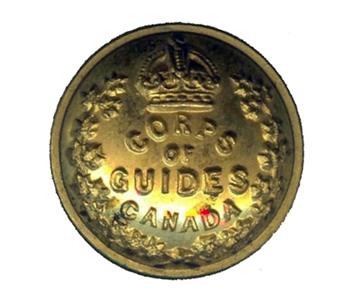
Button, Corps of Guides Pattern
The jacket was topped with a crossbelt and cartridge pouch in brown leather and plain metal fittings. The belt was worn from the left shoulder to the right hip, with the hat badge of the Corps of Guides centered on the cartridge pouch.
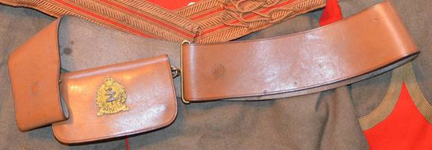
Crossbelt and Cartridge Pouch, Corps of Guides Pattern (desperately needing some polish), Courtesy Bryan Gagne
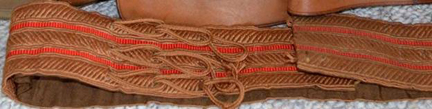
Girdle, Loop Fastener Detail, Courtesy Bryan Gagne
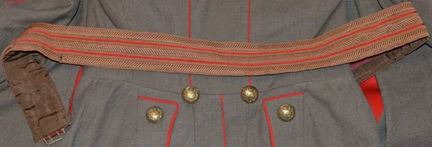
Girdle, Courtesy Bryan Gagne
Additionally, a girdle and aiguillette were also worn. These were once again both items which were nearly universal across the lancer regiments of the British Empire during this time period. These can be seen in the two prints by Robert Marion.
The trousers and breeches of the Corps of Guides were made of the same khaki material as the jacket, and had a scarlet stripe on the outside of the leg, 1 ¾ inches in width. Breeches are shown in wear in this second print produced by Robert Marion. The uniform is shown worn with trousers in the earlier print by Marion. It is fair to deduce that breeches were worn in Full Dress when the wearer expected to be mounted, and that trousers would have been worn otherwise. The decision to wear breeches or trousers also influenced the type of footwear. In breeches riding boots would have been worn, whereas in trousers Wellington boots would have been worn.
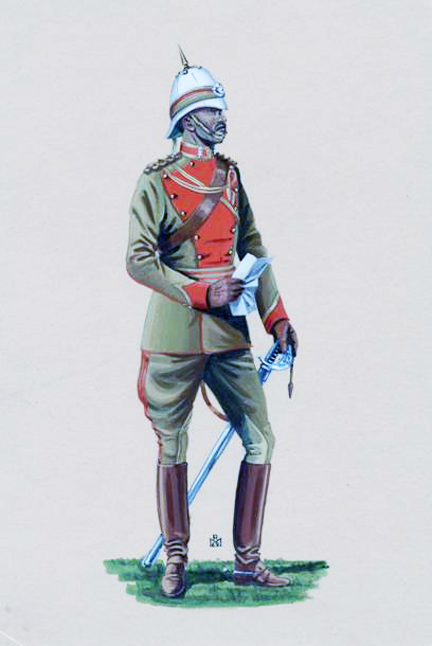
Corps of Guides, by Robert Marion
N.B.The 1897 pattern infantry sword and scabbard depicted by Marion are technically incorrect. The Guides were only authorized 1908/1912 pattern cavalry swords, and even in full dress their scabbards were to be of brown leather.
It should be noted that because the Corps of Guides was spread over 12 Militia Districts and that these bespoke uniforms were supplied by individuals and their tailors over a 26 year period, uniform samples often vary substantially in terms of the materials used to produce them. The most common variations are differences in colour and the material weight and may have been caused by anything from the preferences of the man purchasing the uniform, to the materials available to a tailor in a given region of Canada.
The headdress worn with the Full Dress by the Guides was the Canadian Universal Pattern Helmet with a gilt spike and a gilt curb chain. The Canadian helmet was nearly identical to the British Foreign Service Helmet of the late 19th Century. The Guides were authorized the wear of a six fold puggaree ofmuslin/khaki, with the two centre folds in scarlet in the same colouras the jacket plastron. All ranks in would have worn the cap badge of the Corps of Guides centered on the helmet’s puggaree.
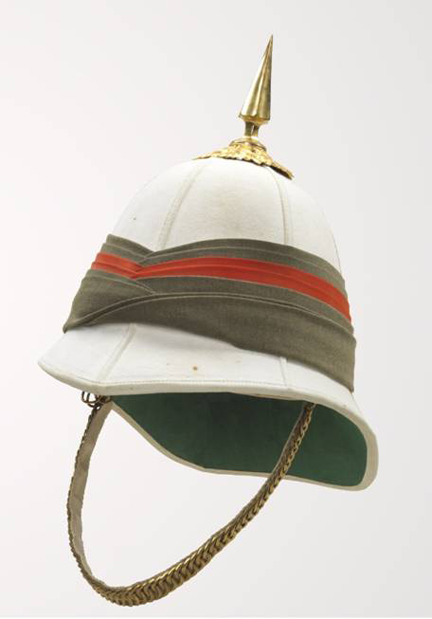
Corps of Guides Helmet, Canadian Universal Pattern

In 1911 the Wolesley pattern helmet replaced the Uiversal pattern. The Corps of Guides were allowed to continue using the distinctive pugaree. JVT Collection
The Corps of Guides were authorized a silver cap badge for wear on the puggaree with the Full Dress uniform; however, the author has been unable to find a physical badge or even a copy of an image of the badge that would have been worn on the helmet. It is possible that these were never made due to the very small size of the corps and the even more limited number of personnel requiring Full Dress cap badges. It is equally possible that only a very few were ever made, and that these have simply fallen out of circulation as the even the Service Dress hat badge depicted below is quite rare. All pugaree badges noted to date have been of gilt finish with a silver device.
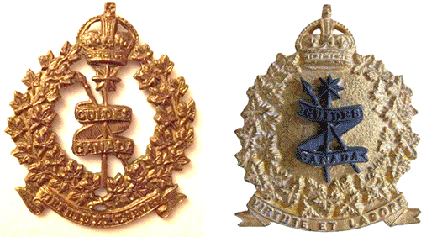
Left, Other Ranks’ Corps of Guides service dress hat badge, marked P.W. Ellis and Co 1914, Author’s Collection
Right, Officer’s service dress cap badge.
As a mounted corps, the Corps of Guides had to factor in the items their horses would wear as well. Appendix V of the 1907 Dress Regulations stipulated the type of the “horse furniture” authorized as the Universal Pattern (1902). The 1907 Dress Regulations stipulated that alternate saddle patterns were viable, so long as they were common throughout a unit. All tack was to be in brown leather, less the “tie down” [the white rope] as depicted in the image below.
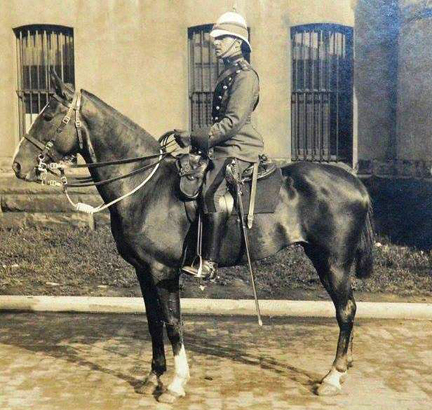
Captain Tweedale and his mount, Corps of Guides, Courtesy Bryan Gagne
In case of inclement weather, a cape of khaki serge was authorized for the Corps of Guides. It was of mid-thigh length, and was lined in scarlet. The front of the cape was fastened with five 30-ligne buttons. The cape would likely have been further fastened with a gilt (clasp and chain) lion’s head closure (not depicted below) as this style of cape closure was common at the turn of the 20th Century.
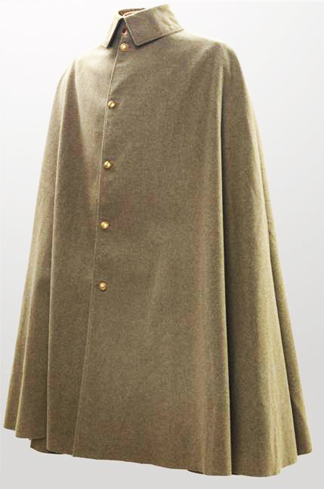
Cape, Corps of Guides, Canadian War Museum Collection
The Corps of Guides was a unique corps within the Non-Permanent Active Militia. They fulfilled a critical function within the structure of the army. Their efforts formed the underpinnings of military intelligence in Canada. While their highly specialized role in intimately knowing the human and physical terrain of the Canadian wilderness proved to be immaterial to the outcome of the First World War, the Guides transferred wholesale into the other arms at Camp Valcartier (notably the Canadian Divisional Cyclist Companies). The work of the Divisional Cyclist Companies was an essential component of the Canadian Corps’ Hundred Days Offensive in 1918, during which the Canadian Cyclists took heavy losses. For that reason alone, the Guides (who formed the Cyclists) should never be discounted. After the war, the Guides quietly resumed their service to Canada once more, and remained prepared to perform a domestic role which was thankfully never required of them. They should be remembered as a proud corps; one which deliberately adopted the uniform, customs, and arguably the even spirit of the lancer.
You can rate this article by clicking on the stars below
by Richard J S Law

A selection of various swagger sticks held by The Royal Canadian Regiment Museum in London, On. The fourth one from the left appears to read “Tricentenary (sic) Celebration” and is believed to date to the 300th Anniversary of Quebec City in 1908. Photo courtesy Michael O’Leary.
The significance of swagger sticks relates to that of staffs, batons, and riding crops denoting gentlemen of the upper class but also as a means to deliver immediate punishment to subordinates. Not limited solely to officers as a ‘stick’ was ordered to be carried by Other Ranks when ‘walking out’. Although the military stick was a common uniform accoutrement in an era when a gentleman’s canes was still in fashion, it has, since unification of the Canadian Forces in 1968, fallen out of use. This was an era which saw many Regimental and Army-wide traditions fall by the wayside.

An early RCR swagger stick, circa 1900. The VRI cypher shows meticulous detail of the intertwined letters, the belt surrounding read “Royal Regiment Canadian Infantry”. This stick was gifted by Capt Daniel Nolton, QM Corps, US Army, in Alaska to Ernest A. Frier Sr in 1912.Photo courtesy Michael Reintjes.
From 1883 to the late 1960’s, The RCR saw many different patterns of the swagger sticks being carried by soldiers and officers. The earliest reference found dates to the 1918, “A” Coy Dress Regulations that “All Officers will carry sticks at all times except on Battalion Parades.”However, pictorial evidence clearly demonstrates that swagger sticks were carried prior to this period.
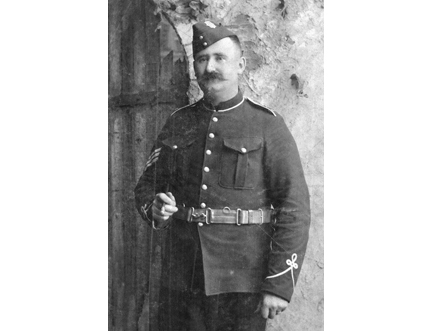
Sergeant McPhee of The RCR, circa 1900. Photo courtesy MilArt photo archives.
A kit list written by Capt H.T. Cock during the First World War identifies and suggests many notes for new Officers arriving to the unit. Among them Briggs on St James Street is recommended for the purchase of swagger sticks. Although pictorial evidence demonstrates that swagger sticks were carried by all Officers, they were equally a common item among soldiers and NCOs during the First World War, or at least used as props for staged photographs.

Sergeant George Webb of The RCR displaying a swagger stick. Photo courtesy of Michael O’Leary.
Details pertaining to the construction of these sticks, and in particular, the appropriate Regimental insignia to be embossed appear to be lacking. Variations exist where the eight pointed star has “Royal Canadian Regt” surrounding the monarch’s initials with a scroll underneath bearing “Pro Patria”. One has to keep in mind the great lengths the Regiment pursued in order to maintain Queen Victoria’s cypher as their official cypher to be worn in perpetuity, and that this was not officially granted until 1919 by His Majesty King George V. Although some references indicate that Officers continued to wear the VRI badges throughout the First World War, soldier would have worn the cypher of the reigning monarch. As such, it is feasible to imagine that when commissioning the making of a stick, the jeweler took it upon themselves to have the initial of the reigning monarch included, however this is purely speculative.

An undated, post First World War photo of a group of officers of The RCR. Most officers are clearly shown with a swagger stick. Ca. 1928. Courtesy Michael O’Leary
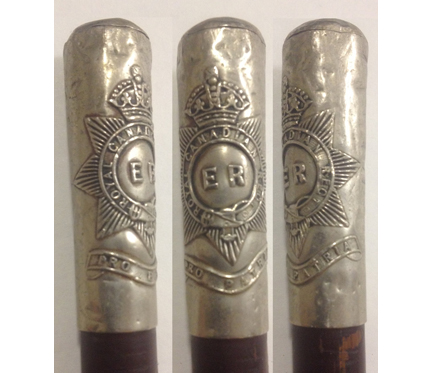
A composite image showing the details of the embossed badge on the ferrule.
Most examples with these incorrect Regimental crests tend to be 26 ½ – 27 ½ inches long and approximately ½ inch in diameter at the knob, tapering to 3/8 of an inch at the ferrule.Usually made of soft wood painted black or dark brown,these knobs have also been found of clear varnished bamboo sticks.
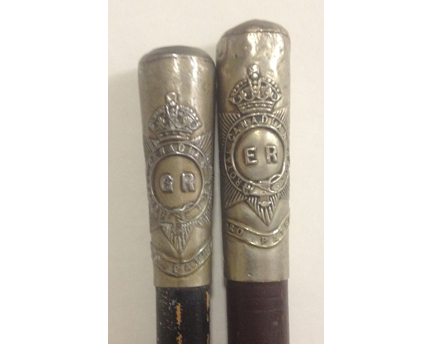
Two swagger sticks with improper Regimental Crests. On left a George V Pattern from 1910-1936, and (presumably) Edward VII 1901-1910, on right. Author’s collection
Major H.T. Cock’s revised “Hints for Young Officers” of 1931 directs that Officers in uniform, when not wearing a sword, carry a straight swagger cane without a crook or handle, and that this stick must not exceed 23 inches in length. Further restricting the use of the stick, the 1935 Regulations indicate that swagger sticks were only to be carried in Walking-Out orders of dress.
Major H.T. Cock of The RCR holding a round knob pattern swagger stick. Photo courtesy of Michael O’Leary.
The most commonly found RCR swagger stick depicts the well-known RCR cap badge sized at 7/8 of an inch as the crest, mounted centrally on a white metal or silver ferrule measuring 1 ¾ inches.
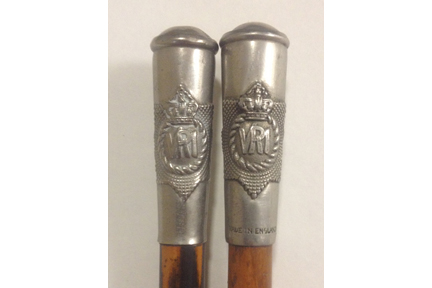
Two swagger sticks of The RCR with the proper Regimental Crest. Although similar in construction, the stick on the right has a “Made in England” stamp.
The 1960 Dress Regulations of The RCR direct “Officer’s swagger sticks will be a dark Malacca cane with a silver ferrule and knob. The Regimental Crest will be mounted centrally on the top of the ball knob. When the stick is placed or carried under the left arm the ferrule will be to the front.” This change in the appearance of the stick, from a cylindrical ferrule to a ball knob changed the placement of the Regimental crest.

An early stick attributed to The RCR with a very finely detailed cypher of Queen Victoria. Photo courtesy Michael O’Leary collection.
Further defined by the 1967 Regimental Standing Orders in Section 2, paragraph 202.14 – Sticks, the following details are provided:
a. All Officers will carry a swagger stick of dark Malacca cane with a silver ferrule and ball knob. Overall length will be 26 1/2 inches. The Regimental Crest will be mounted centrally on the top of the knob. When the stick is placed under the left arm the ferrule will be to the front.
b. All Warrant Officers will carry regulation Ordnance pattern pace sticks.
c. All Senior Non-commissioned Officers will carry a drill cane which will be sand coloured malacca. 33 inches long with a white metal ferrule and knob. Reproduction of the cap badge on the knob will be 7/8 inch in diameter. The ferrule will be 1 inch in diameter at the knob and taper to 3/4 inch at the ferrule.
d. Junior Non-commissioned Officers carry a swagger stick of Regimental pattern which will be 26 inches in length, a dark Malacca cane with white metal ferrule and knob. The Regimental cap badge 7/8 inch in size will be embossed centrally on the side of the knob. The knob will be I 3/4 inches in length, the ferrule 3/4 inch.
e. Sticks will not be carried on a Commanding Officer’s parade.
A 1960’s style RCR swagger stick with what appears to be a button being used as the Regimental crest. The round knob measures 1 ¼ inches in diameter, and 27 inches long. Author’s collection
With the unification of the Canadian Forces in 1968, the practice of carrying swagger sticks with any order of dress was dismissed. The RCR, however, in true Royal fashion was still known to carry Ash plant sticks from time to time well into the mid 1980’s.
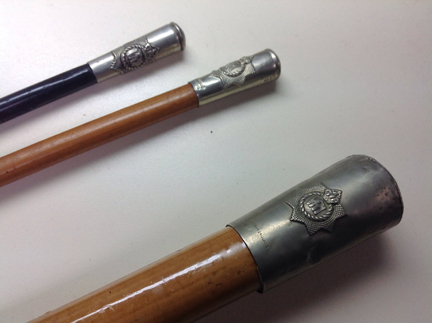
A selection of sticks used by The RCR. From left to right, an Officer’s dark Malacca, an OR/NCOs sand Malacca stick, and a Senior NCO’s drill cane as per the 1967 Regimental Standing Orders. Courtesy Michael Reintjes
Acknowledgements
The author wishes to thank Mr. Michael O’Leary for the breadth of knowledge and research made available on his website (http://regimentalrogue.com/), which was instrumental in piecing the history of the swagger stick in use by The RCR. Appreciations are also extended to Mr. Micheal Reintjes who graciously supported this article with additional photographs from his personal collection. Service Publications’ exhaustive photo archives (MilArt photo archives) provided period photographs and text editing. A special thank you goes out to Clive Law who got me addicted to the world of militaria at an early age.
Bibliography
Regimental Standing Orders of The RCR 1935 – Appendix 2 – Uniform http://regimentalrogue.com/srsub/1935_The_RCR_Standing_Orders_12_App2_uniform.html
Regimental Standing Orders of The RCR 1960 – Chapter 2 – Dress Regulations, Section 2 Dress Accoutrements. http://regimentalrogue.com/rcrbadges/rcr-dress_regs_1960.htm
Regimental Standing Orders of The RCR 1967 – Chapter 2 – Dress Regulations, Section 1 General. http://regimentalrogue.com/rcrbadges/rcr-dress_regs_1967.htm
COCK, H.T. Kit List for Officers, 1917-18, Original held by The Royal Canadian Regiment Museum, London ON. http://regimentalrogue.tripod.com/blog/index.blog/2313836/officers-dress-first-world-war/
COCK, H.T. Hints for Young Officers, Halifax, May 1931. http://regimentalrogue.com/srsub/RCSI_hints_1931.htm
You can rate this article by clicking on the stars below
by Mark W. Tonner
As a form of identifying unit and subunit commander’s tanks within Canadian armoured brigades, tank distinguishing flags or pennants were used. These tank distinguishing flags and pennants, were flown from the wireless (radio) aerials of the tank, and were in the colours allotted to the formation or unit using them
Prior to the reorganization of Canada’s two armoured divisions (the 4th and 5th Canadian Armoured Divisions), from each armoured division consisting of two armoured brigades1 and a divisional support group2, to that of each consisting of one armoured brigade3 and one infantry brigade4 and divisional supporting arms and services5, in the United Kingdom, in January 1943, the original 2nd Canadian Armoured Brigade, had been a component part of the 5th Canadian Armoured Division, and as such, used the tank distinguishing flags and pennants, of the junior armoured brigade of the division6. However, as part of the reorganization process, the original 2nd Canadian Armoured Brigade was broken up, with Headquarters, 2nd Canadian Armoured Brigade, being redesignated Headquarters, 5th Canadian Armoured Brigade, which became the only armoured brigade of the 5th Canadian Armoured Division. Thus, the tank distinguishing flags and pennants, that had been used by the 2nd Canadian Armoured Brigade, were rendered obsolete.
With the reconstitution of the 2nd Canadian Armoured Brigade, as an independent armoured brigade7, new tank distinguishing flags and pennants, were required, but since the question of what ‘Arm of Service’ markings8 the brigade was to use, was still not clarified, the manufacture of the former, would have to wait until the arm of service markings the brigade was to use was decided upon. While awaiting this decision to be made by First Canadian Army Headquarters, Headquarters, 2nd Canadian Armoured Brigade (Independent), issued a set of instructions as to what interim tank distinguishing flags, were to be flown by the applicable tanks of the brigade. These instructions were issued to the three armoured regiments of the brigade, and the brigade headquarters squadron, by the Brigade Major, Major R.P. Rothschild, under the date of 11 August 1943.
Under these instructions, the following flags (each measuring 12-inches (30-centimetres) high by 24-inches (61-centimetres) wide) were to be used in the interim on the brigade’s tanks. They were to be affixed, 2-inches (5-centimetres) from the base of the aerial, unless otherwise ordered. If two flags were to be flown, they would be affixed, one over the other, on the same aerial. The instructions also suggested, that since these flags were impossible to replace, that they be handled with extreme care.
Brigade Commander, 2nd Canadian Armoured Brigade (Independent) – two black flags
Commanding Officer, 6th Canadian Armoured Regiment (1st Hussars) – two red flags
Commanding Officer, 10th Canadian Armoured Regiment (The Fort Garry Horse) – two yellow flags
Commanding Officer, 27th Canadian Armoured Regiment (The Sherbrooke Fusilier Regiment) – two blue flags
Officer Commanding, “A” Squadron of each regiment – two flags, red over red
Officer Commanding, “B” Squadron of each regiment – two flags, blue over blue
Officer Commanding, “C” Squadron of each regiment – two flags, green over green
Troop Leaders in each “A” Squadron , as under
1st Troop – a single flag of solid red
2nd Troop – a single flag horizontally divided red over blue
3rd Troop – a single flag horizontally divided red over green
4th Troop – a single flag horizontally divided red over yellow
5th Troop – a single flag horizontally divided red over white
Troop Leaders in each “B” Squadron , as under
1st Troop – a single flag horizontally divided blue over red
2nd Troop – a single flag of solid blue
3rd Troop – a single flag horizontally divided blue over green
4th Troop – a single flag horizontally divided blue over yellow
5th Troop – a single flag horizontally divided blue over white
Troop Leaders in each “C” Squadron , as under
1st Troop – a single flag horizontally divided green over red
2nd Troop – a single flag horizontally divided green over blue
3rd Troop – a single flag of solid green
4th Troop – a single flag horizontally divided green over yellow
5th Troop – a single flag horizontally divided green over white
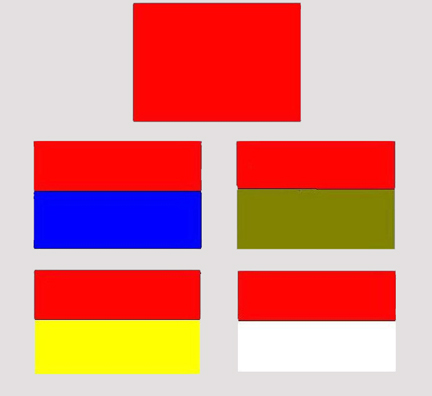
Artistic illustrations of the interim tank distinguishing flags for the Troop Leaders in each “A” Squadron, as described in the text. From the top, 1st Troop, 2nd Troop, 3rd Troop, 4th Troop, and 5th Troop. Source: author
The question of what ‘Arm of Service’ markings, the brigade was to use, were settled in October 1943. In a letter dated 18 October 1943, from Staff Duties, Headquarters, First Canadian Army, to Headquarters, 2nd Canadian Armoured Brigade, the arm of service serial numbers allotted to the brigade was made known. The ‘Arm of Service’ marking, in combination with the ‘Formation Sign’ on vehicles, was used as a means of identification and efficient traffic control of vehicles. The standardization, sizes, and positioning of all markings used on vehicles, followed the policy, as set down by either the Senior Officer, Canadian Military Headquarters (London), for formations under their control, or Staff Duties, Headquarters First Canadian Army, for formations under First Canadian Army control, which in turn, followed vehicle marking polices, as set down by the British War Office. The ‘Arm of Service’ marking, was normally a 9½-inches (24-centimetres) by 8½-inches (22-centimetres) rectangle, consisting of a coloured background, appropriate to the formation, corps or branch of the service, to which the unit belonged, onto which a centrally located one, two, three, or four digit number, in white (except for units of the Royal Canadian Corps of Signals, which were in red), was stencilled. Each individual digit, in a number, was to measure 2½-inches (6-centimetres) wide by 5-inches (13-centimetres) high. These numbers, referred to as the ‘Arm of Service Serial,’ were blocks of numbers that were assigned to formations to identify individual units. As set out in the CANADIAN VEHICLE MARKINGS 1943 pamphlet, these ‘Arm of Service’ markings, were to be stencilled, on the right front side of the tank nose plate, approximately 4½-inches (11-centimetres) below the right headlamp, and in a prominent position on the left of the rear hull plate.
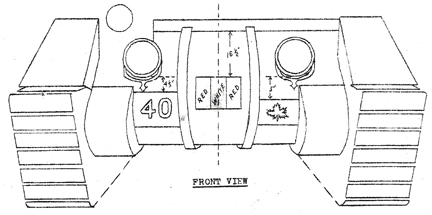
An illustration showing the position of the ‘Arm of Service’ marking, applied to the right front side of the tank nose plate, and of the ‘Formation Sign,’ applied to the left front side of the tank nose plate, as described in the text. Source: authors’ collection.
The ‘Arm of Service Serial’ numbers allotted to the component units of the 2nd Canadian Armoured Brigade (Independent), and the background colours to be used, as sent out in the letter of 18 October, were:
– Headquarters, 2nd Canadian Armoured Brigade (Independent) – 50 – on a red background
– 6th Canadian Armoured Regiment (1st Hussars) – 51 – on a red background
– 10th Canadian Armoured Regiment (The Fort Garry Horse) – 52 – on a red background
– 27th Canadian Armoured Regiment (The Sherbrooke Fusilier Regiment) – 53 – on a red background
– No. 84 Company, Royal Canadian Army Service Corps, employed as the 2nd Canadian Armoured Brigade
Company, Royal Canadian Army Service Corps – 81 – on a diagonally divided red over green background9
– 2nd Canadian Armoured Brigade Signals, Royal Canadian Corps of Signals – 50 – on a horizontally divided white over blue background
– 2nd Canadian Armoured Brigade Workshop, Royal Canadian Ordnance Corps – 50 (later changed to ‘99’) – on a horizontally equally divided blue over yellow over red background
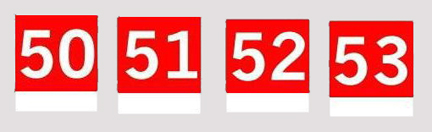
Artistic illustrations of the ‘Arm of Service’ markings for, from left to right, Headquarters, 2nd Canadian Armoured Brigade (Independent), 6th Canadian Armoured Regiment (1st Hussars), 10th Canadian Armoured Regiment (The Fort Garry Horse), and 27th Canadian Armoured Regiment (The Sherbrooke Fusilier Regiment), all with the horizontal 2-inch (5-centimetre) high white bar added to the bottom (denoting ‘Army Troops’), as described in the text. Source: author
No. 17 Canadian Light Field Ambulance, Royal Canadian Army Medical Corps, retained its ‘Arm of Service Serial’ number of ‘89’ (later changed to ‘1516’) on a black background, and No. 2 Canadian Tank Brigade Sub-Park, Royal Canadian Ordnance Corps, used ‘Arm of Service Serial’ number ‘69’ on a black background (changed to a background of three vertically equally divided bars of blue/red/blue, as of 8 December 1943). As the 2nd Canadian Armoured Brigade (Independent), were to be employed as Army Troops, a horizontal 2-inch (5-centimetre) high white bar (except in the case of units of the Royal Canadian Corps of Signals, who used red) was to be added to the bottom of the ‘Arm of Service’ markings, of all units within the brigade. This horizontal 2-inch (5-centimetre) high white bar carried below the ‘Arm of Service’ marking, denoted that the parent unit of the vehicle was employed as ‘Army Troops10.’
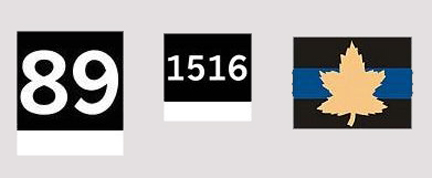
Artistic illustrations of the ‘Arm of Service’ markings for No. 17 Canadian Light Field Ambulance, Royal Canadian Army Medical Corps, and on the right, an example of the ‘Formation Sign’ used by all component units of the 2nd Canadian Armoured Brigade (Independent), as described in the text. Source: author
The ‘Formation Sign11’ marking used by 2nd Canadian Armoured Brigade (Independent), was that previously authorized for the 2nd Canadian Army Tank Brigade, which was a 6½-inches (17-centimetres) high by 9-inches (23-centimetres) wide rectangle with a centrally located gold (or yellow) maple leaf on a horizontally divided background of black over royal blue over black. Each of the two black bars were 2 3/16-inches (6-centimetres) high, and the royal blue bar was 2 1/8-inches (5-centimetres) high. Again, as set out in the CANADIAN VEHICLE MARKINGS 1943 pamphlet, these ‘Formation Sign’ markings, were to be stencilled, on the left front side of the tank nose plate, approximately 5-inches (13-centimetres) below the left headlamp, and in a prominent position on the right of the rear hull plate. This formation sign was also available as a water-based decal, or transfer (6½-inches (17-centimetres) high by 9-inches (23-centimetres) wide rectangle), with the maple leaf in gold only. Directions for the application of these transfers to a vehicle’s surface, were printed, along with illustrations, on the reverse of each transfer sheet. In preparation of the application of one of these transfers to a vehicle, all paint on the area where the transfer was to be applied, had to be scraped off, after which the surface was to be throughly cleaned with petrol (gasoline). Once the transfer was applied to the cleaned area, and it had dried throughly, a thin coat of varnish, was to be applied over it, as a sealant. These transfers, saved many hours of work for tank crews. Smaller sized ones were also available for use on various wheeled vehicles, trailers, etc12.
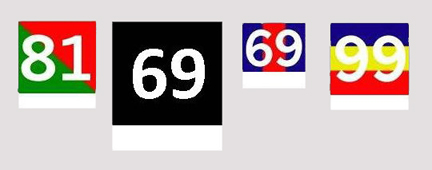
Artistic illustrations of the ‘Arm of Service’ markings for, from left to right, No. 84 Company, Royal Canadian Army Service Corps, No. 2 Canadian Tank Brigade Sub-Park, Royal Canadian Ordnance Corps, and 2nd Canadian Armoured Brigade Workshop, Royal Canadian Ordnance Corps, as described in the text. Source: author
The directions on the reverse of a water-based decal (or transfer) sheet, in this case for Catalogue Number BMT 3075, which was for a small Royal Canadian Ordnance Corps, ‘Arm of Service’ background of three vertically equally divided bars of blue/red/blue, onto which the Arm of Service Serial number would be applied in paint, as described in the text. Source: authors’ collection.
With the allotment of ‘Arm of Service Serial’ numbers on 18 October 1943, tank distinguishing flags and pennants, for the 2nd Canadian Armoured Brigade (Independent), could now be manufactured, for those of the brigade entitled to them. As with the ‘Arm of Service’ markings that were allotted to the brigade headquarters and three armoured regiments, which were those used by the armoured brigades of the 4th and 5th Canadian Armoured Divisions13, the tank distinguishing flags and pennants, for the 2nd Canadian Armoured Brigade (Independent), would be as the same pattern, as used by these armoured brigades, with these being:
i.) Brigade Commander:
Brigade Commander, 2nd Canadian Armoured Brigade (Independent) – a red triangular pennant, 12-inches (30-centimetres) high by 36-inches (91-centimetres) long.
ii.) Senior Armoured Regiment: – 6th Canadian Armoured Regiment (1st Hussars)
Commanding Officer – a red flag, 18-inches (46-centimetres) high by 36-inches (91-centimetres) long, with the unit arm of service serial number (51), in white, superimposed in the centre.
Officer Commanding, “A” Squadron – a red swallow-tailed triangular pennant, 9-inches (23-centimetres) high by 19-inches (48-centimetres) long, with the cut of the swallow-tail being, 8-inches (20-centimetres) deep, with the geometric squadron marking (a triangle, point upwards), in white, superimposed in the centre.
Troop Leaders, “A” Squadron – a red triangular pennant, 9-inches (23-centimetres) high by 13-inches (33-centimetres) long, with geometric squadron marking (a triangle, point upwards), in white, enclosing the Troop number, in white, superimposed in the centre.
Officer Commanding, “B” Squadron – a red swallow-tailed triangular pennant, 9-inches (23-centimetres) high by 19-inches (48-centimetres) long, with the cut of the swallow-tail being, 8-inches (20-centimetres) deep, with the geometric squadron marking (a square), in white, superimposed in the centre.
Troop Leaders, “B” Squadron – a red triangular pennant, 9-inches (23-centimetres) high by 13-inches (33-centimetres) long, with geometric squadron marking (a square), in white, enclosing the Troop number, in white, superimposed in the centre.
Officer Commanding, “C” Squadron – a red swallow-tailed triangular pennant, 9-inches (23-centimetres) high by 19-inches (48-centimetres) long, with the cut of the swallow-tail being, 8-inches (20-centimetres) deep, with the geometric squadron marking (a circle), in white, superimposed in the centre.
Troop Leaders, “C” Squadron – a red triangular pennant, 9-inches (23-centimetres) high by 13-inches (33-centimetres) long, with geometric squadron marking (a circle), in white, enclosing the Troop number, in white, superimposed in the centre.
iii.) Intermediate Armoured Regiment: – 10th Canadian Armoured Regiment (The Fort Garry Horse)
Same as above, but using yellow coloured flags and pennants14.
iv.) Junior Armoured Regiment: – 27th Canadian Armoured Regiment (The Sherbrooke Fusilier Regiment)
Same as above, but using blue coloured flags and pennants15.
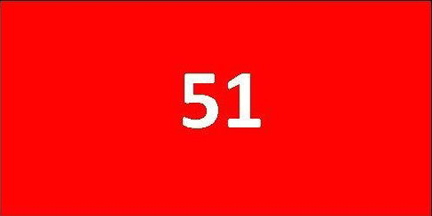
Artistic illustration of the Senior Armoured Regiment’s, Commanding Officer’s red flag, with the unit arm of service serial number, in white, superimposed in the centre, for the 6th Canadian Armoured Regiment (1st Hussars), as described in the text. Source: author
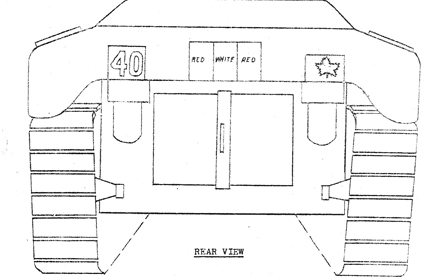
An illustration of the ‘Arm of Service’ marking applied in a prominent position on the left of the rear hull plate, and of the ‘Formation Sign’ applied in a prominent position on the right of the rear hull plate, as described in the text. Source: authors’ collection
Artistic illustrations of the geometric markings used to identify squadrons within an armoured regiment, from left to right, “A” Squadron (a triangle, point upwards), “B” Squadron (a square), and “C” Squadron (a circle). The senior armoured regiment used red for their squadrons’ markings, the intermediate armoured regiment used yellow for their squadrons’ markings, and the junior armoured regiment used blue for their squadrons’ markings. Source: author
Artistic illustrations of: top – a Brigade Commander’s pennant, right – Troop Leader’s pennant, No. 2 Troop, “B” Squadron, of the senior armoured regiment, and left – Officer Commanding “A” Squadron’s pennant, of the intermediate armoured regiment. Source: MilArt photo archives
General Note:
All grouped artistic illustrations used in this article, are relative to scale.
Acknowledgements:
The author wishes to thank Miss Courtney Carrier, for her assistance in offering constructive criticism, and comments, on the draft copy of this article, and on the artistic illustrations, and Clive M. Law for the use of MilArt graphics, and for publishing this article.
Bibliography:
Grodzinski, JR, Operational Handbook for the First Canadian Army, Formation Organization, Staff Technique and Administration (Revised Edition), The Regimental Historian, 1996, Revised 1998.
Library and Archives Canada, Records Group 24, National Defence, Series C-1, Reel C-8372, Reel C-8373, Series C-2, Volume 10079, Volume 10095, and various other Files/Volumes – Records Group 24, National Defence.
Lucy, RV, Canada’s Pride, The Ram Tank and its Variants, Service Publications, Ottawa, Ontario, 2014.
Tonner, MW, On Active Service, A summary listing of all units of the Canadian Army called out and placed on active service, Service Publications, Ottawa, Ontario, 2008.
Notes:
- Consisting of three armoured regiments of the Canadian Armoured Corps, and an infantry (Motor) battalion of the Canadian Infantry Corps.
- Consisting of a field regiment, an anti-tank regiment, and a light anti-aircraft regiment, all of the Royal Canadian Artillery, and an infantry battalion of the Canadian Infantry Corps.
- Consisting of three armoured regiments of the Canadian Armoured Corps, and an infantry (Motor) battalion of the Canadian Infantry Corps.
- Consisting of three infantry battalions of the Canadian Infantry Corps.
- Consisting of units of the Royal Canadian Artillery, Royal Canadian Engineers, Royal Canadian Corps of Signals, Royal Canadian Army Service Corps, Royal Canadian Army Medical Corps, Royal Canadian Ordnance Corps, Royal Canadian Army Pay Corps, Canadian Dental Corps, Canadian Postal Corps, Canadian Provost Corps, and the Canadian Intelligence Corps.
- The senior armoured brigade of the division being, the 1st Canadian Armoured Brigade.
- See the article, under the MilArt Organization tab, entitled The Evolution of the Reconstituted 2nd Canadian Armoured Brigade (Independent), 1943, of 2 December 2014.
- The ‘Arm of Service’ markings, in combination with the ‘Formation Sign’ markings, were a system that identified the unit that a vehicle belonged to and the parent formation to which the unit belonged.
- Diagonally divided, top left to bottom right, with the top right half red, and the lower left half green.
- Troops under the direct control of an army headquarters, and not that of a corps, divisional, or brigade headquarters.
- ‘Formation Sign’ markings were used to indicate the parent formation to which a vehicle’s unit belonged.
- Later in 1943, ‘Arm of Service’ markings, in basic background colours, in the form of a water-based decal, or transfer, was made available for use, in large or small sizes, onto which the one, two, three, or four digits, of the ‘Arm of Service Serial’ numbers, could be stenciled. Their preparation for use was the same as that for the ‘Formation Sign’ marking, water-based decal, or transfer.
- The 4th and 5th Canadian Armoured Brigades, respectively.
- With the Commanding Officer’s flag bearing the unit’s arm of service serial number of ‘52.’
- With the Commanding Officer’s flag bearing the unit’s arm of service serial number of ‘53.’
You can rate this article by clicking on the stars below
by Mark W. Tonner
Beginning in January 1943, the Canadian Army Overseas underwent an extensive reorganization of the formations and units serving within the First Canadian Army, then in the United Kingdom. This reorganization was carried out to bring them in line with the organizations used by British Army formations and units, so that they would be compatible in forthcoming joint operations on the European Continent. Part of this reorganization, was the reorganization of Canada’s two armoured divisions (the 4th and 5th Canadian Armoured Divisions), from each armoured division consisting of two armoured brigades1 and a divisional support group2, to that of each consisting of one armoured brigade3 and one infantry brigade4 and divisional supporting arms and services5. During this reorganization process, the 4th Canadian Armoured Division, went from consisting of the 3rd and 4th Canadian Armoured Brigades, and the 4th Canadian Armoured Divisional Support Group, and divisional supporting services to that of consisting of the 4th Canadian Armoured Brigade, and the 10th Canadian Infantry Brigade, and divisional supporting arms and services. The organization of the 5th Canadian Armoured Division, changed from that of consisting of the 1st and 2nd Canadian Armoured Brigades, and the 5th Canadian Armoured Divisional Support Group, and divisional supporting services, to that of consisting of the 5th Canadian Armoured Brigade6, and the 11th Canadian Infantry Brigade7, and divisional supporting arms and services.
In the ensuing reorganization of these two armoured divisions, six Canadian armoured regiments were displaced. Two of these regiments were converted and redesignated armoured reconnaissance regiments, with one each being assigned to the 4th and 5th Canadian Armoured Divisions8. One regiment was converted and redesignated a tank delivery regiment9, the remaining three armoured regiments, the 6th Canadian Armoured Regiment (1st Hussars), the 10th Canadian Armoured Regiment (The Fort Garry Horse), and the 27th Canadian Armoured Regiment (The Sherbrooke Fusilier Regiment), were converted to army tank regiments, and redesignated, the 6th Canadian Army Tank Regiment (1st Hussars), Canadian Armoured Corps, the 10th Canadian Army Tank Regiment (The Fort Garry Horse), Canadian Armoured Corps, and the 27th Canadian Army Tank Regiment (The Sherbrooke Fusilier Regiment), Canadian Armoured Corps, with effect from 15 January 1943. These three army tank regiments became component units of the newly formed 3rd Canadian Army Tank Brigade10, which was formed in the United Kingdom under the authority of the General Officer Commanding-in-Chief, First Canadian Army, Lieutenant-General A.G.L. McNaughton, with effect from 1 January 1943.
The formation in January 1943, of the 3rd Canadian Army Tank Brigade, comprising the three armoured regiments (converted to army tank regiments) which had become surplus to requirements because of the reorganization of the 4th and 5th Canadian Armoured Divisions, was on a purely temporary basis only. It was hoped that it might be possible to include these three regiments in the order of battle as a third army tank brigade, within First Canadian Army, so that there would be one army tank brigade each, with which to support the 1st, 2nd, and 3rd Canadian Infantry Divisions11. The 1st Canadian Army Tank Brigade12, was already in the United Kingdom, having arrived in July 1941, and the 2nd Canadian Army Tank Brigade13, was in Canada awaiting shipping space for transfer to the United Kingdom. By the end of March 1943, it had become apparent that it would be impossible to include all three army tank brigades in the First Canadian Army, although Lieutenant-General A.G.L. McNaughton, the General Officer Commanding-in-Chief, First Canadian Army, was convinced that at least two would be sufficient. As early as 25 January 1943, it had been agreed that 3rd Canadian Army Tank Brigade, which was composed of regiments that had been overseas longer, would have preference over the regiments of the 2nd Canadian Army Tank Brigade, which at that time, were still in Canada14. Accordingly, at a meeting held at First Canadian Army Headquarters, on 3 May 1943, it was proposed that 3rd Canadian Army Tank Brigade, be added to the order of battle of First Canadian Army, and that upon its arrival in the United Kingdom, the 2nd Canadian Army Tank Brigade be retained, with the expectation that it would eventually be broken up, with its personnel being used as Canadian Armoured Corps reinforcements.
This proposal met with opposition from Army Headquarters (National Defence Headquarters) in Ottawa, who wanted the second army tank brigade included in the order of battle of First Canadian Army, to be called the 2nd Canadian Army Tank Brigade, as this was the army tank brigade, that had been authorized under Privy Council Order Number 45/2757 of 11 April 1942, with effect from 26 January 1942, whereas, the 3rd Canadian Army Tank Brigade, had not been authorized under a Privy Council Order15. However, in a telegram of 11 May 1943, Army Headquarters (National Defence Headquarters), let it be known, that they had no objections to the present three army tank regiments16 of the 3rd Canadian Army Tank Brigade, being those that comprised the 2nd Canadian Army Tank Brigade, once the brigade arrived in the United Kingdom.
At a meeting held at First Canadian Army Headquarters on 15 June 1943, the decision was taken, that once the 2nd Canadian Army Tank Brigade, had arrived in the United Kingdom, the 3rd Canadian Army Tank Brigade, would be disbanded, and that the 2nd Canadian Army Tank Brigade would be reformed from the three most suitable of the six Canadian army tank regiments of either brigade. In a further meeting held at First Canadian Army Headquarters on 26 June 1943, it was agreed that the army tank brigades would be reorganized as armoured brigades, of three armoured regiments each, but without an infantry (Motor) battalion17. This decision was taken to facilitate the replacement of either the 4th Canadian Armoured Brigade, or the 5th Canadian Armoured Brigade, in the 4th and 5th Canadian Armoured Divisions, respectively, if the need to do so was ever required.
With the arrival in the United Kingdom on 24 June 1943, of the 2nd Canadian Army Tank Brigade, composed of the 20th Canadian Army Tank Regiment (16/22 Saskatchewan Horse), Canadian Armoured Corps, the 23rd Canadian Army Tank Regiment (The Halifax Rifles), Canadian Armoured Corps, and the 26th Canadian Army Tank Regiment (Grey and Simcoe Foresters), Canadian Armoured Corps, the question of which of the two army tank brigades (2nd or 3rd), should fill the ‘authorized’ army tank brigade position in the First Canadian Army order of battle, became more urgent. In response to this question, and in line with the decision that was taken on 15 June 1943, First Canadian Army Headquarters decided that a comprehensive competitive test of operational capability would be held between the army tank regiments of both army tank brigades to determine the three most suitable of the six Canadian army tank regiments of either brigade, that would make up the composition of the ‘authorized’ army tank brigade position in the First Canadian Army order of battle. Lieutenant-General H.D.G. Crerar, General Officer Commanding, I Canadian Corps18, and his Corps’ headquarters staff, was appointed to carry out this comprehensive competitive test of operational capability, which took place in early July 1943.
In the end, the three army tank regiments of the 3rd Canadian Army Tank Brigade (6th Canadian Army Tank Regiment (1st Hussars), 10th Canadian Army Tank Regiment (The Fort Garry Horse), and 27th Canadian Army Tank Regiment (The Sherbrooke Fusilier Regiment)), scored higher then those of the 2nd Canadian Army Tank Brigade (20th Canadian Army Tank Regiment (16/22 Saskatchewan Horse), 23rd Canadian Army Tank Regiment (The Halifax Rifles), and 26th Canadian Army Tank Regiment (Grey and Simcoe Foresters)), and were chosen (on 12 July 1943) to be the three army tank regiments which would comprise the ‘authorized’ army tank brigade (the 2nd) position in the First Canadian Army order of battle.
The resulting reorganization of these two army tank brigades was rather involved. Following the release of the test results on 12 July 1943, the three army tank regiments of the 2nd Canadian Army Tank Brigade (20th, 23rd, and 26th Canadian Army Tank Regiments), became components of the 3rd Canadian Army Tank Brigade (with effect from 21 July 1943). Those of the 3rd Canadian Army Tank Brigade (6th, 10th, and 27th Canadian Army Tank Regiments) became components of the 2nd Canadian Army Tank Brigade, which was converted and redesignated the 2nd Canadian Armoured Brigade (Independent), with effect from 22 July 1943 (under the authority of Privy Council Order Number 67/621 of 2 February 1944). The 6th, 10th, and 27th Canadian Army Tank Regiments, Canadian Armoured Corps, were reorganized and redesignated, the 6th Canadian Armoured Regiment (1st Hussars), the 10th Canadian Armoured Regiment (The Fort Garry Horse), and the 27th Canadian Armoured Regiment (The Sherbrooke Fusilier Regiment), Canadian Armoured Corps, respectively, and were allocated to the 2nd Canadian Armoured Brigade (Independent), under the authority of the General Officer Commanding-in-Chief, First Canadian Army, with effect from 22 July 1943. The personnel of Headquarters, 2nd Canadian Army Tank Brigade, would now function as Headquarters, 3rd Canadian Army Tank Brigade, until such time as the 3rd Canadian Army Tank Brigade was officially disbanded. The personnel of Headquarters, 3rd Canadian Army Tank Brigade, would function as Headquarters, 2nd Canadian Armoured Brigade (Independent), until such time as the final selection of personnel to form this headquarters was completed.
The services of the 2nd Canadian Army Tank Brigade, were also allocated to the newly formed 2nd Canadian Armoured Brigade (Independent), with the following conversions and redesignations taking place:
– the 2nd Canadian Army Tank Brigade Signals, Royal Canadian Corps of Signals, was converted and redesignated, the 2nd Canadian Armoured Brigade Signals, Royal Canadian Corps of Signals, with effect from 22 July 1943 (under the authority of Privy Council Order Number 67/621 of 2 February 1944)
– the 2nd Canadian Tank Brigade Workshop, Royal Canadian Ordnance Corps, was converted and redesignated, the 2nd Canadian Armoured Brigade Workshop, Royal Canadian Ordnance Corps19, with effect from 22 July 1943 (under the authority of Privy Council Order Number 67/621 of 2 February 1944)
– No. 2 Canadian Army Tank Brigade Sub-Park, Royal Canadian Ordnance Corps, was converted and redesignated, No. 2 Canadian Tank Brigade Sub-Park, Royal Canadian Ordnance Corps20, with effect from 22 July 1943 (under the authority of Privy Council Order Number 67/621 of 2 February 1944)
– No. 84 Company, Royal Canadian Army Service Corps, which had been employed as the 2nd Canadian Army Tank Brigade Company, Royal Canadian Army Service Corps, was allocated to the 2nd Canadian Armoured Brigade (Independent), to serve as the 2nd Canadian Armoured Brigade Company, Royal Canadian Army Service Corps, with effect from 22 July 1943. No. 17 Canadian Light Field Ambulance, Royal Canadian Army Medical Corps, was also allocated to the 2nd Canadian Armoured Brigade (Independent), from the 2nd Canadian Army Tank Brigade, with effect from 22 July 1943.
Thus, by the end of July 1943, the newly formed 2nd Canadian Armoured Brigade (Independent), under the command of Brigadier N.A. Gianelli, was composed of 21:
– Headquarters, 2nd Canadian Armoured Brigade (Independent)
– 6th Canadian Armoured Regiment (1st Hussars), Canadian Armoured Corps
– 10th Canadian Armoured Regiment (The Fort Garry Horse), Canadian Armoured Corps
– 27th Canadian Armoured Regiment (The Sherbrooke Fusilier Regiment), Canadian Armoured Corps
– 2nd Canadian Armoured Brigade Signals, Royal Canadian Corps of Signals
– No. 84 Company, Royal Canadian Army Service Corps, employed as the 2nd Canadian Armoured Brigade Company, Royal Canadian Army Service Corps
– No. 17 Canadian Light Field Ambulance, Royal Canadian Army Medical Corps
– 2nd Canadian Armoured Brigade Workshop, Royal Canadian Ordnance Corps
– No. 2 Canadian Tank Brigade Sub-Park, Royal Canadian Ordnance Corps
This would remain the basic composition of the 2nd Canadian Armoured Brigade (Independent), with the exception of the allocation of 2nd Canadian Armoured Brigade Workshop to the Corps of Royal Canadian Electrical and Mechanical Engineers, in May 1944 (see Note 19), and the conversion and redesignation of No. 2 Canadian Tank Brigade Sub-Park, to that of 2nd Canadian Armoured Brigade Ordnance Field Park, Royal Canadian Ordnance Corps in February 1944 (see Note 20), to the end of hostilities in North-West Europe, in May 1945. Shortly after formation in the summer of 1943, 2nd Canadian Armoured Brigade (Independent), along with the 3rd Canadian Infantry Division, passed from under First Canadian Army control, to that of Second British Army control, in preparation for the forthcoming invasion of North-West Europe, during which, 2nd Canadian Armoured Brigade (Independent), in support of the 3rd Canadian Infantry Division assault landing on the Normandy coast, landed on 6 June 1944. From 6 June 1944, to the end of hostilities in North-West Europe, 2nd Canadian Armoured Brigade (Independent) was involved in active operations in support of formations and units of both the First Canadian Army, and the Second British Army. From its formation, through to the disbandment (effective 25 June 1945) of Headquarters, 2nd Canadian Armoured Brigade (Independent), the brigade was commanded in succession by, Brigadier N.A. Gianelli (22 July 1943 to 23 March 1944), Brigadier R.A. Wyman (15 April to 8 August 1944), Brigadier J.F. Bingham (9 August to 8 December 1944), and Brigadier G.W. Robinson (9 December 1944 to 25 June 1945).
As mentioned earlier, with effect from 21 July 1943, the former army tank regiments of the original 2nd Canadian Army Tank Brigade, the 20th Canadian Army Tank Regiment (16/22 Saskatchewan Horse), the 23rd Canadian Army Tank Regiment (The Halifax Rifles), and the 26th Canadian Army Tank Regiment (Grey and Simcoe Foresters)), were transferred to under command of Headquarters, 3rd Canadian Army Tank Brigade. These units, under Headquarters, 3rd Canadian Army Tank Brigade continued to exist on a temporary basis, under command of Headquarters, “E” Group, Canadian Reinforcement Units (in the United Kingdom)22. They were gradually reduced to nil strength, as their personnel were absorbed as reinforcements for other Canadian Armoured Corps units. However, before they were formally disbanded, Brigadier T.J. Rutherford, Officer Commanding, “E” Group, Canadian Reinforcement Units, in turn, addressed the officers and men of the 20th Canadian Army Tank Regiment (16/22 Saskatchewan Horse), the 23rd Canadian Army Tank Regiment (The Halifax Rifles), and the 26th Canadian Army Tank Regiment (Grey and Simcoe Foresters)). During his address to the officers and men of each unit, he stressed the reluctance with which the decision to replace the army tank regiments of the original 2nd Canadian Army Tank Brigade, with those of the 3rd Canadian Army Tank Brigade, had been taken and the desire of all concerned to make the best possible provision for the officers and men of these units, who were thus displaced. By the end of October 1943, with the component army tank regiments of the 3rd Army Tank Brigade, having all been reduced to nil strength, Headquarters, 3rd Army Tank Brigade, the 20th Canadian Army Tank Regiment (16/22 Saskatchewan Horse), Canadian Armoured Corps, the 23rd Canadian Army Tank Regiment (The Halifax Rifles), Canadian Armoured Corps, and the 26th Canadian Army Tank Regiment (Grey and Simcoe Foresters), Canadian Armoured Corps, were all formally disbanded with effect from 1 November 1943, under the authority of Privy Council Order Number 67/621 of 2 February 1944.
With the final disbandment of the 3rd Canadian Army Tank Brigade in November, the reorganization of Canadian Armoured Corps formations, serving with the Canadian Army Overseas, which had begin in January 1943, were now complete. From this point on, the Canadian Armoured Corps formations serving with the Canadian Army Overseas were the 1st Canadian Armoured Brigade (Independent), the 2nd Canadian Armoured Brigade (Independent), the 4th Canadian Armoured Brigade (of the 4th Canadian Armoured Division), and the 5th Canadian Armoured Brigade (of the 5th Canadian Armoured Division).
Acknowledgements:
The author wishes to thank Miss Courtney Carrier, for proof reading and offering constructive criticism, and comments, on my draft copy of this article, and Clive M. Law, for publishing this article.
Bibliography:
Canadian Military Headquarters, Historical Officer, Report No. 110 – Situation of the Canadian Military Forces Overseas, Autumn, 1943: II. and Growth of the Canadian Army Overseas, October 1942 – October 1943. Dated 20 December 1943. Directorate of History and Heritage, National Defence Headquarters, Ottawa, Ontario.
Canadian Military Headquarters, Historical Officer, Report No. 133 – The Organization of the Canadian Reinforcement Units (United Kingdom): Historical Outline, 1940-45. Dated 29 March 1945. Directorate of History and Heritage, National Defence Headquarters, Ottawa, Ontario.
Canadian Military Headquarters, Historical Officer, Report No. 168 – The Organization of First Canadian Army. Dated 12 December 1946. Directorate of History and Heritage, National Defence Headquarters, Ottawa, Ontario.
Grodzinski, JR, Operational Handbook for the First Canadian Army, Formation Organization, Staff Technique and Administration (Revised Edition), The Regimental Historian, 1996, Revised 1998.
Marteinson, J, and McNorgan, MR, The Royal Canadian Armoured Corps, An Illustrated History, The Royal Canadian Armoured Corps Assoication, in cooperation with the Canadian War Museum, Robin Brass Studio Inc., Kitchener, Ontario, 2000.
McNorgan, MR, and Crossley, GT, Facta Non Verba, A History of the Fort Garry Horse, The Fort Garry Horse Foundation, Winnipeg, Manitoba, 2012.
Tonner, MW, On Active Service, A summary listing of all units of the Canadian Army called out and placed on active service, Service Publications, Ottawa, Ontario, 2008.
Wallace, MC, JF, Dragons of Steel, Canadian Armour in Two World Wars, General Store Publishing House, Burnstown, Ontario, 1995.
Notes:
- Consisting of three armoured regiments of the Canadian Armoured Corps, and an infantry (Motor) battalion of the Canadian Infantry Corps.
- Consisting of a field regiment, an anti-tank regiment, and a light anti-aircraft regiment, all of the Royal Canadian Artillery, and an infantry battalion of the Canadian Infantry Corps.
- Consisting of three armoured regiments of the Canadian Armoured Corps, and an infantry (Motor) battalion of the Canadian Infantry Corps.
- Consisting of three infantry battalions of the Canadian Infantry Corps.
- Consisting of units of the Royal Canadian Artillery, Royal Canadian Engineers, Royal Canadian Corps of Signals, Royal Canadian Army Service Corps, Royal Canadian Army Medical Corps, Royal Canadian Ordnance Corps, Royal Canadian Army Pay Corps, Canadian Dental Corps, Canadian Postal Corps, Canadian Provost Corps, and the Canadian Intelligence Corps.
- Headquarters, 5th Canadian Armoured Brigade, was formed from the redesignation of Headquarters, 2nd Canadian Armoured Brigade (formerly of the 5th Canadian Armoured Division), with effect from 1 January 1943.
- Headquarters, 11th Canadian Infantry Brigade, was formed from the conversion and redesignation of Headquarters, 1st Canadian Armoured Brigade (formerly of the 5th Canadian Armoured Division), with effect from 1 January 1943.
- The 29th Canadian Armoured Regiment (The South Alberta Regiment), Canadian Armoured Corps, was converted and redesignated the 29th Canadian Armoured Reconnaissance Regiment (The South Alberta Regiment), Canadian Armoured Corps, and was allocated to the 4th Canadian Armoured Division, and the 3rd Canadian Armoured Regiment (The Governor General’s Horse Guards), Canadian Armoured Corps, was converted and redesignated the 3rd Canadian Armoured Reconnaissance Regiment (The Governor General’s Horse Guards), Canadian Armoured Corps, and was allocated to the 5th Canadian Armoured Division, both with effect from 1 January 1943.
- The 25th Canadian Armoured Regiment (The Elgin Regiment), Canadian Armoured Corps, was converted and redesignated the 25th Canadian Tank Delivery Regiment (The Elgin Regiment), Canadian Armoured Corps, with effect from 15 September 1943. A tank delivery regiment held tanks and Canadian Armoured Corps reinforcements to replace both tank and personnel (crew) casualties in armoured units.
- Headquarters, 3rd Canadian Army Tank Brigade, was formed from the conversion and redesignation of Headquarters, 3rd Canadian Armoured Brigade (formerly of the 4th Canadian Armoured Division), with effect from 1 January 1943.
- Lieutenant-General A.G.L. McNaughton, General Officer Commanding-in-Chief, First Canadian Army, had made his thoughts known as early as 21 December 1942, that he wanted three army tank brigades included in the order of battle of First Canadian Army, in a cable he had sent to Lieutenant-General K. Stuart, Chief of the General Staff, Army Headquarters (Ottawa), in which he proposed that First Canadian Army be composed of two corps (I and II), with three infantry divisions (1st, 2nd, and 3rd) (of three infantry brigades each), two armoured divisions (4th and 5th) (of one armoured and one infantry brigade each), and three army tank brigades (1st, 2nd, and 3rd).
- Composed of the 11th Canadian Army Tank Regiment (The Ontario Regiment (Tank)), Canadian Armoured Corps, the 12th Canadian Army Tank Regiment (Three Rivers Regiment (Tank)), Canadian Armoured Corps, and the 14th Canadian Army Tank Regiment (The Calgary Regiment (Tank)), Canadian Armoured Corps.
- Composed of the 20th Canadian Army Tank Regiment (16/22 Saskatchewan Horse), Canadian Armoured Corps, the 23rd Canadian Army Tank Regiment (The Halifax Rifles), Canadian Armoured Corps, and the 26th Canadian Army Tank Regiment (Grey and Simcoe Foresters), Canadian Armoured Corps.
- It was however agreed, in a conversation between Lieutenant-Generals McNaughton (General Officer Commanding-in-Chief, First Canadian Army), and Stuart (Chief of the General Staff, Army Headquarters (Ottawa)), on 25 January 1943, that 3rd Canadian Army Tank Brigade, should have priority over the 2nd Canadian Army Tank Brigade, in joining the order of battle of the First Canadian Army.
- The 3rd Canadian Army Tank Brigade, was however eventually authorized under Privy Council Order Number 50/4120 of 19 May 1943, with effect from 1 January 1943.
- The 6th Canadian Army Tank Regiment (1st Hussars), Canadian Armoured Corps, the 10th Canadian Army Tank Regiment (The Fort Garry Horse), Canadian Armoured Corps, and the 27th Canadian Army Tank Regiment (The Sherbrooke Fusilier Regiment), Canadian Armoured Corps.
- Subsequently, the 1st Canadian Army Tank Brigade, was redesignated the 1st Canadian Armoured Brigade (Independent), with effect from 26 August 1943 (under the authority of Privy Council Order Number 67/621 of 2 February 1944), with it’s three component army tank regiments being converted and redesignated armoured regiments, effective 26 August 1943.
- 3rd Canadian Army Tank Brigade had been attached to I Canadian Corps, for administrative purposes only, since 1 June 1943.
- The 2nd Canadian Armoured Brigade Workshop, Royal Canadian Ordnance Corps, was redesignated the 2nd Canadian Armoured Brigade Workshop, Royal Canadian Electrical and Mechanical Engineers, and was allocated to the Corps of Royal Canadian Electrical and Mechanical Engineers, with effect from 15 May 1944, under the authority of Canadian Military Headquarters Administrative Order Number 85 of 1944.
- No. 2 Canadian Tank Brigade Sub-Park, Royal Canadian Ordnance Corps, was subsequently converted and redesignated the 2nd Canadian Armoured Brigade Ordnance Field Park, Royal Canadian Ordnance Corps, with effect from 7 February 1944 (under the authority of Privy Council Order Number 62/4729 of 20 June 1944).
- In late 1943, “C” Squadron, 25th Canadian Tank Delivery Regiment (The Elgin Regiment), Canadian Armoured Corps, later converted and redesignated “C” Squadron, 25th Canadian Armoured Delivery Regiment (The Elgin Regiment), Canadian Armoured Corps (with effect from 15 March 1944), was attached to the 2nd Canadian Armoured Brigade (Independent), as the brigade’s tank/armoured delivery squadron, in which role they were employed until the end of hostilities in North-West Europe.
- “E” Group, Canadian Reinforcement Units, consisted of Headquarters, “E” Group, Canadian Reinforcement Units, No. 1 Canadian Armoured Corps Reinforcement Unit, No. 2 Canadian Armoured Corps Reinforcement Unit, and the 3rd Canadian Armoured Corps Reinforcement Unit.
You can rate this article by clicking on the stars below
by William J. Miller
On November 16th 1944, the Commanding Officer of the new Armoured Personnel Carrier Regiment sent off a letter the office of the Brigadier Royal Armoured Corps (BRAC) requesting permission for a unique shoulder title and cap badge for the ‘Kangaroos’.Those initially proposed designs for the unit insignia are quite different from what was ultimately approved and produced.
From Lieut. Col. Churchill’s initial proposal;
“…The sample badge herewith submitted represents the Kangaroo. This animal is in a sense associated in all minds with Australia, but the term ‘Kangaroo’ has been applied to this organisation from its inception in July and has been used in official documents relating to the activities of the original squadron and has become widely and favorably known throughout the field formations of the First Cdn Army and Second British Army…
The arguments in favour of adopting the Kangaroo for the cap badge apply with equal force to the use of the word ‘Kangaroo’ on the shoulder flash. The colour scheme makes use of the black as used in the beret of the CAC & orange because of the link with Holland, in which country [it] was formed.
The officers and other ranks who have served with the original squadron during the last four months are unanimously in agreement upon the design of the badge and shoulder title herewith submitted.”
Lt-Colonel Churchill’s justification for badges.
Submitted to the BRAC office was a full colour sketch in gouache on cardboard, the words ‘KANGAROOS’ over “CANADA” in Dutch Oranje on a black background. Also attached was a sample from a local weaving mill of the type of cloth/method that could be used to produce the shoulder titles locally.
Original artwork of the proposed unit shoulder title. It took the orange colour from the Dutch House of Oranje and the black from the Armoured Corps beret.
The cap badge design as provided by the JR Gaunt & Sons Company in London, England was a standing, mother kangaroo, with two young ‘joeys ‘ poking out of her pouch. Below a scroll with the current abbreviated designation of unit, 1st C.A.P.C.R.
Gaunt artwork of the initial badge proposal. The inclusion of the two ‘joeys’ were not supported by HQ.
Col. Churchill acknowledged that the unit’s designation was “not yet firm” and proposed a regimental motto taken from the ancient Roman poet Virgil’s account of the Trojan Horse. Greek soldiers were successfully transported into the enemy’s fortifications, hidden in the belly of giant wooden horse. ‘The new motto, ‘Armatos Fundit’, loosely translates to ‘It pours forth armed men”.
Churchill was hoping to expedite his request as he felt it was imperative to quickly building a cohesive fighting unit to have all ranks outfitted with their own unique and personal identity. Churchill would not have to wait long. On November 21 he would receive his answer. Both designs were approved but with significant modifications.
The approved badge. The unit title was replaced with the unit’s Latin motto which translates as ‘It pours forth armed men”.
Letter from the office of the Brigadier Royal Armoured Corps (BRAC) declining the original badge proposal and suggesting alternatives.
The cap badge design was to use the new regimental motto in the scroll, also the two joeys were to be removed. Churchill would later state that BRAC had sought approval higher up, from no less than the First Canadian Army Commander, General Crerar. It was Crerar whom felt the young, pouched joeys were ‘facetious’. The change essentially made the kangaroo figure a male and somewhat missed the point behind the regiment’s nickname and role on the battlefield.
The shoulder title design would be altered considerably. The Oranje and Black colours were approved, but the prominent use of the unit’s nickname, ‘Kangaroos’ was scrapped in favour of the unit’s designation. It was to read “# Cdn Armd Carrier Regt” over “Canada”. However, the unit’s official number, a number within the Canadian Armoured Corps Order of Battle had not been officially granted yet (and as it turned out never would be). The unit went ahead and produced an alternatively approved, shortened and abbreviated title of “Armd Carrier Regt” over the country of origin “Canada”. Still in vibrant orange lettering on a black background.
The approved shoulder title. These were made in the Netherlands.
The approved badges and shoulder titles would not get delivered from their manufacturers and distributed until the first week of February 1945. In the meantime, officers and other ranks of the Armoured Carrier Regiment were to wear generic cap badges and shoulder titles to the Canadian Armoured Corps.
You can rate this article by clicking on the stars below
 CSMMI MILART